Wednesday, 15 September 2010

Impressionists Gardens

Impressionist Gardens
Royal Scottish Academy Building
31 July - 17 October 2010
  
The Impressionists were interested in the pleasure of the here and now, and to them gardens symbolised relaxation, recreation, innocence and light. They were inspired by Corot’s sun-dappled canvases, capturing the effect of light through the trees, the details of raindrops on roses in Simon Saint-Jean’s The Gardener Girl (1837) and Delacroix – his casually arranged arrays of dahlias and other cut blooms are the spiritual forebears of Monet’s and Gustave Caillebotte’s paintings of dahlias growing in their gardens at Argenteuil and Petit-Gennevilliers.

I love Spring (1804) by Jean-François Bony: the painting of spring flowers relegates the statue of a warrior goddess in the background to a secondary role. The focus is on the foreground lilacs, hollyhocks, roses, poppies, delphiniums, striped parrot tulips – the very flowers of my wedding bouquet.

Still life can be stylishly scruffy - Flowers in a Vase by Pierre-Auguste Renoir
Gardens and flowers were not formal constructs. Pierre Auguste Renoir’s Flowers in a Vase (1866) is a reminder of a stroll in the fields – wild flowers (corn poppies; chamomile; ragwort; cornflowers; rampion; wild parsley and Spanish broom) are stuffed into an earthenware vase. More prosaic vegetables are admired in A Flemish Kitchen Garden (1864) by Henri de Braekeleer where giant cabbages provide colour and a subtle poetry in the harvesting in the kitchen garden.

Gardens were outdoor studios; places in which to capture the effects of sun, shade and seclusion. They could be the theatre of fashion or tranquil meditation. Thomas Couturés’ The Reading (1860) depicts a lady engrossed in a book and oblivious to her surroundings. Charles-François Daubigny was commissioned by Napoleon III to paint The Cascade at Saint-Cloud (1865) which is a grand, formal work but, once again, the historic monuments are relegated to the background. Similarly, John Singer Sargent takes a thoroughly Impressionist delight in the incidents of modern life in The Luxembourg Gardens at Twilight (1879) which features children sailing their boats despite the lateness of the hour, and a well-dressed couple strolling at the centre.

Contemplative colour in Frederick Childe Hassam's Geraniums
Gardens are for sewing, playing croquet, quiet contemplation and drinking tea. And there is always room for colour. Frederick Childe Hassam painted red geraniums, watering cans and his fair wife engaged in embroidery in Geraniums (1888-9). James Tissot tinged his autumn leaves around the reflective pool with sadness in Holyday (1876). Gustave Caillebotte kept flowers in dedicated beds in his garden (unlike Monet’s mixtures) allowing him to paint studies of nasturtiums and, my favourite, Daisies (1892). Edouard Manet’s The House at Rueil (1882) is also grouped in this collection.

Napoleon III’s ambitious programme of parks and gardens was continued by the Third Republic which came to power in 1871. The new and revamped gardens provided perfect opportunities for the Impressionists to paint ‘en plein air’ but Monet and the other Impressionists preferred the city’s old, historic gardens with spreading trees and natural features. Léon Frederic’s The Fragrant Air (1894) depicts an innocent child sniffing ephemeral blooms redolent of death and mortality.

Lotus Lillies by Charles Courtenay Curran - the object of his affections
Charles Courtney Curran’s Lotus Lillies (1888) is a sublime painting of his bride, Grace Winthrop, haloed by a green parasol as she floats in a boat across Lake Erie in Ohio. She is the finest of the lotus blossoms (symbols of purity and tranquillity) and the clear object of Curran’s veneration.

Skaters in Frederiksberg Gardens - Paul Gaughin
Also included here is Paul Gauguin’s Skaters in Frederksberg Gardens (1884) – a striking action portrait in which the vivid reds and greens of the fallen leaves emphasise the coldness of the ice, in stark contrast to his more familiar sun-drenched views of Tahiti.

James Ensor’s The Garden of the Rousseau Family (1885) and Charles François Daubigny’s Orchard in Blossom (1874) highlight kitchen and vegetable gardens with no ostensible aesthetic purpose, but the abstract design of flat zones of green bisected by paths and walls offers visual impact. Arthur Melville’s A Cabbage Garden (1877) and Alfred Sisley’s The Fields (1874) share the same theme – the latter’s market gardens full of rows of vegetable crops mature with the seasons, while the old spreading tree in the corner indicates continuity.

The Artist’s Garden at Eagny (1898) by Camille Pissarro shows his wife planting seeds. The leaves and flowers shine like jewels while the house behind implies the family for whom she is preparing this food. The Portrait of Karl Nordstrein (1882) by Christian Krohg of a pointed-bearded gentleman standing at a window looking out at a market garden draws our gaze from across the room. We want to see what he’s looking at.

The Cote des Boeufs at L'Hermitage by Camille Pissarro
Is winter the hardest season to paint, with its suggestion of bleak hibernation? Alfred Sisley’s subtle harmony of restrained colouring integrates the snow into the scene as a natural part of the design in Winter at Louveciennes (1867). The scudding clouds, fresh breeze and tall poplars enhance the motionless figures of The Côte des Boeufs at L’Hermitage (1877) by Camille Pissarro.

Apparently Impressionism begins again with a completely new phase in the 1890s. Henri Martin offers Garden in the Sun (1913) in which sunlight from outside floods in like a powerful unrestrained tide of pink, yellow and cream. In The Pergola (1912-13) shows the last fruits of summer as Marie Enger adds a hint of autumn chill through grapes and red and golden gourds surrounded by withering vine leaves.

Bright colours return to the fore with Theo van Rysselberghe’s Fountain in the Park of Sans Souci near Postdam (1903). Clearly heavily influenced by Seurat’s pointillism, the technique of contrasted dots or flecks of colour display the refraction of a fountain into rainbow droplets by the afternoon sun. In The Rainbow (1896) we are invited to see a pristine garden through the eyes of his wife and son. Spring bulbs, reddish-brown flower pots, shimmering perblossom, red and blue outfits, and the red roof and blue sky combine to echo the colours of the rainbow, creating a larger harmony.

Gustav Klimt's Italian Garden Landscape illuminates the room
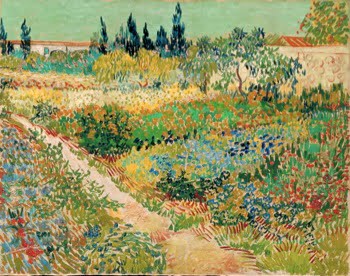
In the final room it is as though the best have been saved until last. Gustav Klimt’s Rosebushes Under Trees (1904) and Italian Garden Landscape (1913) are sumptuously rich and decorative with varied textual brushwork that illuminates the room. Vincent Van Gogh is represented by The Garden with Path (1888) and Undergrowth (1889).

The Garden with Path - Vincent Van Gogh
The first is a rich variety of jabs, zigzags and short stabbing strokes to evoke the flowers, vegetables and olive trees as they shimmer in the hot southern sun. The second was painted in the grounds of the sanatorium to which he admitted himself. The grasp of the ivy on the oak represents the grip of mental illness on his mind, but the glimpses of sunlight between the shadows suggest hopes of better health.

Naturally, there couldn’t be an exhibition of Impressionist Gardens without the inclusion of Monet’s water lily pond, and there is a shining section of wall that displays some stunning examples. Him Outdoors sighs, ‘He really was the master, wasn’t he?’

Saving the best until last - Claude Monet's The Water Lily Pond, 1904
The largest retrospective of Monet's art since 1980 opens in his home country with an exhibition in Paris this month - expected to break all gallery attendence records. With the excessive wishy-washy reproductions it is sometimes easy to overlook the man's artistic genius (a sentiment felt especially by the French who until now have regarded arguably their most famous painter as one who created daubs for American tourists); until you stand in front of one of his canvases and feel overwhelmed by light and colour.

Displays of art can often leave you satiated as you emerge from some stuffy museum, but this invigorating exhibition is like a breath of fresh air.

Sunday, 12 September 2010

The Writers' Museum

The writers’ museum on Lawnmarket houses an inspiring little exhibition focussing on Sir Walter Scott, Robert Burns and Robert Louis Stevenson. Sir Walter Scott is the author of Ivanhoe, one of only two books I have ever started and not finished – the other one was The Hobbit – but we won’t hold that against him.

I admire the small rooms with their oak and mahogany doors and panelling, red or green or purple walls (they’re colour-themed), the artefacts, portraits, oil paintings, lithographs and the authors’ desks themselves! 

Up the spiral staircase in Lady Stair’s House (the uneven steps are deliberately so to betray an intruder who might stumble on an unfamiliar pattern) is a copy of the Ballantyne press (built in 1790) – one of the presses on which Scott’s Waverley novels were printed. The boxes of wooden letters neatly filed in trays are a wonder to behold, like some highly precocious and privileged child’s educational toys.

Robert Burns (1759-1796) was born into a struggling family and was acutely aware of social distinctions. As a farmer he began writing poetry as ‘some kind of counterpoise’ to his circumstances.

He admits, ‘For my own part I never had the least thought or inclination of turning poet till I got heartily in love and then Rhyme and Song were in a manner, the spontaneous language of my heart.’

He wrote Ae Fond Kiss for Clarinda as well as many patriotic poems to Scotland, and sniffed somewhat caustically, ‘Those who think that composing a Scotch song is a trifling business, let them try.’

Robert Louis Stevenson, on the other hand, wrote that ‘to travel hopefully is a better thing than to arrive.’ He obviously had more romantic methods of voyaging than being cramped in a metal tube for 36hours. He circumnavigated the world gathering experiences for later novels.

‘I travel not to go anywhere but to go. I travel for travel’s sake. The great affair is to move: to fell the needs and hitches of our life more nearly; to come down off this featherbed of civilisation, and find the globe granite underfoot and strewn with cutting flints.’

Saturday, 11 September 2010

Fit for a Queen: The Palace of Holyrood House


The Palace of Holyrood House is the official residence in Scotland of Her Majesty the Queen. It has also been home to many famous royal residents including Mary Queen of Scots and Bonnie Prince Charlie.

An audio-guide with a beautiful voice accompanies the tour, which explains the finer points of design as you go around the building. The forecourt and quadrangle are overlooked by the Salisbury Crags and it is here that every summer the Queen is symbolically presented with the keys to the city: it soon becomes apparent that there is a lot of symbolism built into these walls.

Detail on the fountain in the forecourt of Holyrood House

Queen Elizabeth II enjoys the Ceremony of the Key at Holyrood Palace 
  
Queen Elizabeth II attends the Ceremony Of The Keys at the Palace of Holyroodhouse on July 12, 2010 in Edinburgh, Scotland. The Queen received the keys to the city and honoured Scottish recipients with 84 awards, including OBEs, MBEs and CBEs during the traditional ceremony, which marks the start of a week of royal engagements in Scotland. The monarch will entertain around 8,000 guests at a garden party in the grounds of the Holyrood Palace later in the week.
Incidentally, isn't it good that we haven't got so many martyrs in this country. All it would take is one nutter... Look how close she is to those bayonets! Not for our Queen the safety of a bullet-proof Mercedes rather than a walk-a-bout.
 
The palace is built in the classical style with each floor representing a different architectural period – Doric, Ionic, and (on the top floor where the royal apartments are) Corinthian design – which gives balance, symmetry and a sense of proportion. Charles II rebuilt the palace with a team of architects based on the design of Versailles (the residence of his cousin, Louis XIV – many things were influenced by the French in this era, despite our outward hostilities towards them).

The palace is full of tapestries, portraits and processional rooms, each more elaborate than the other as you approach the king. It all begins with the Great Stair and ends with the King’s Bedchamber where the most privileged guests were met. The effect is meant to be increasingly daunting and I’m sure it was if you were approaching with a request that might terminate in your head being removed from your body.

The Dining Room features a Jubilee gift of silver – a dinner set of 3,000 pieces laid for 20 people (the table will seat between 30 and four people, removing or adding leaves as necessary). Presiding over all is a portrait of Bonnie Prince Charlie and, on the opposite wall, one of George IV, both wearing tartan.
 
Bonnie Prince Charlie had the support of the Scottish clans but was defeated by ‘Butcher’ Cumberland at the Battle of Culloden in 1745; thereafter the use of Gallic language and the wearing of tartan were strictly forbidden. So it was highly symbolic when George IV wore tartan in his portrait of 1820 proving the unification of England and Scotland and the acceptability of wearing tartan again.


The Throne Room is decorated with portraits of the Stewarts, red carpets, coats of arms and two thrones. This was the Guard Room in the time of Charles II where access to the monarchy was strictly controlled. Now it is where the Queen and the Duke of Edinburgh hold their formal functions. Next in line is the Evening Drawing Room used by the Queen for state entertaining (this is where she met the Pope).


A portrait of the Queen Mother painted by Sir William Hutchinson has pride of place in this room. Everything else comes from the decorative pallet of Queen Victoria who first came to Scotland in 1837. She fell in love with Highlands but didn’t like the Palace so had tapestries and furnishings sent up from Windsor Castle.

The Morning Drawing Room, on the other hand, was decorated by the Comte d’Artois who hid out here after the French Revolution to escape his creditors. Being in the precinct of the abbey (with its own laws and dungeons; the oldest police force in the world, which is still on duty whenever the Queen is in residence) meant that debtors couldn’t be arrested. The new devolved Scottish executive was also appointed here, which may or may not be symbolic.


The formal attire of the Royal Company of Archers
Next, the King’s Ante Chamber was the most important waiting room in the world. It is seventeenth century in its appearance with its oak panelling and a view of the surrounding Palace Gardens and Queen’s Park (where a Royal Garden Party is held on the 1st of July for 8,000 guests, presided over by the royal company of archers – the Queen’s royal bodyguards who now perform merely ceremonial duties).

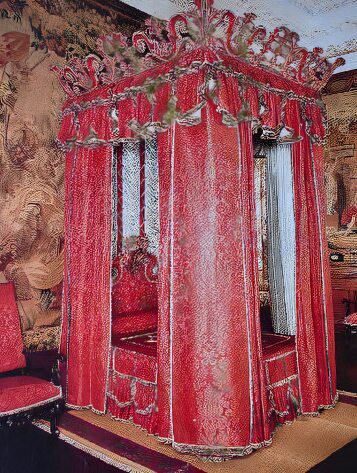
The King’s Bedchamber (with its plaster ceiling depicting images from classical mythology and four-poster bed) was only seen by the most privileged of visitors. The bed itself wasn’t used for sleeping but followed a French precedent to use it for state business – another peculiar (and indolent) French tradition. The next-door King’s closet was used as a private study and contains the most beautiful harp, piano, and green-embroidered chairs and curtains.


The Great Gallery is a long hall comprising one quarter of the building, now used for state occasions and investitures. Charles II commissioned a series of paintings of Scottish kings to assert the right of the Stewarts to rule Scotland. The portraits line the walls and they all look oddly alike, and they were hacked as revenge for Bonnie Prince Charlie trying to claim the British throne after his defeat at Falkirk in 1746. It’s always interesting to see the profound and unsettling affect that art can have.

A fantastic Bog Oak Chair is made (as you might expect) from oak submerged in a Northern Ireland bog for thousands of years. The throne-like design was first revealed at the Great Exhibition of 1851 and it features a twisted back and lion’s head arms carved from wood which is hard, brittle and difficult to work. It’s probably not all that comfortable either.

In the Queen’s Lobby you can see the green velvet robe of the Order of the Thistle – the highest order of chivalry in Scotland (established in 1687 by James VII). Its English equivalent is The Most Noble Order of the Garter. The primary emblem is the thistle, being the national flower of Scotland, but they also get to wear all sorts of paraphernalia as part of their costume: a green mantle lined with white taffeta and tied with green and gold tassels; a black velvet hat plumed with white feathers; a gold collar depicting thistles and sprigs of rue; a gold enamelled St Andrew badge. The motto of this illustrious order is ‘Nemo me impune lacessit’ translated from the Latin as ‘No one provokes me with impunity’ which you can just imagine accompanied by the swish of a glove striking the face with bristling indignation.

The tour then moves to the Queen’s Antechamber in the tower where Mary Queen of Scots was imprisoned. The Queen’s Bedchamber (previously the private rooms of Lord Darnley) maintains the low light, heavy tapestries, imposing portraits and spiral staircases with stone walls that make the place seem even gloomier.


Mary had grown up in magnificent French renaissance palaces so this was a big change. Darnley (Mary’s second husband) was jealous of Rizzio (her advisor) and thought Rizzio would interfere with his chances of becoming king, so Darnley stabbed him 15 times in the outer chamber (which sounds quite painful).
 
Darnley himself was dead (killed by the Earl of Bothwell) less than a year later. Mary then married Bothwell which was so unpopular that she was forced to abdicate in favour of her son. She fled to England where she sought help from her cousin Elizabeth I but was imprisoned for 19 years and then tried and executed for treason aged 45.

 
The room contains various artefacts such as a portrait of Mary by Francois Chie in which you can see the pale complexion for which she was famed. The Darnley jewel which he had made for his mother has complex signs and symbols which are indecipherable to us but more obvious to people back then.


There is also in a display case the Holyrood ordinal – the rules for the conduct of the abbey. The abbey itself can be seen from the window, was named after a fragment of the cross, and was the inspiration for Mendelssohn’s Scottish Symphony.


The gardens are neat and impressive with a few wild corners where you can imagine the young princes straying after kicking their football into the flowerbeds. It’s a fascinating combination of history, tradition, ceremony and domesticity.


This amazing image is by Mark Tisdale - check out more of his photography at www.marktisdalephotography.com


Sunday, 5 September 2010

World Age Group Duathlon Championships - Edinburgh 2010

The parade of nations for the World Age Group Duathlon Championship is an interesting affair. The athletes range from slightly embarrassed to pleased as punch, but all are proud to be wearing their national colours – it’s a pretty big deal to represent your country at something; especially a sport.

A female piper leads them through their paces – she is bouncy and bubbly and really rather good. There are bagpipers on every corner of Edinburgh. I don’t particularly like the infernal instrument but most of these pipers are excellent – as they should be really or they would be drummed out of town. There are the ususal Flower of Scotland and Gay Gordons and we did hear one playing Twinkle, Twinkle, Little Star which sounded rather odd. Our lead-out lady played We Will Rock You, among other things, and the athletes all lined up to listen to welcoming speeches and be inspired.

No amount of inspiration and plates of carbohydrates can make up for a stinking cold, however, and Him Outdoors suffered somewhat in the race. It was around Holyrood Park, and the Salisbury Crags, Arthur’s Seat and the Scottish Houses of Parliament made a dramatic backdrop. We all met at the transition to cheer and support him on his runs and bike ride.
 
He was obviously feeling the effects of his malady and, although he was laughing on the start line, he was visibly struggling in the first lap (out of four) and actually turned an alarming shade of grey. He then settled into something ‘a little more comfortable’ (these were his words afterwards) but it clearly wasn’t his best form. (You can check out his split times if you’re interested.)


His transition was excellent and he seemed to be happy to be on the bike. He cycled the five bike laps pretty much on his own which must have been hard. Of course there is no drafting in age group triathlon, but it still would have been good to see someone to chase down.


The final run was actually quite good – he had found his rhythm and was running confidently through the last two laps, bringing his position up to 38th (out of 74). Apparently you could request music as you ran over the finishing line; he didn’t know this but was still welcomed home by The Cure, perhaps a trifle too appropriately; ‘I’ve waited hours for this; I’ve made myself so sick, I wish I’d stayed asleep today.’ The commentators picked out his kit and he got a great mention for representing New Zealand in the ‘famous all black strip’ – he was first Kiwi home.

His overall time was 2:25:04. I know he said that he had wanted to do about 2:10 (which would have put him about 20th) but that’s simply not possible when you can hardly breathe. I know he will be the last to make excuses, and that he won’t be happy with the result but we are all very proud of Him Outdoors.