Showing posts with label Claude Monet. Show all posts

Tuesday, 17 September 2013

Sides of Bacon: 1. Streaky

Francis Bacon: Five Decades
Art Gallery of New South Wales
17 November 2012 - 24 February 2014

Crucifixion (1933)
 Artists are often lauded for capturing the zeitgeist and being representative of their time. Francis Bacon, however, was decidedly not of his time, resisting movements such as abstraction and drawing for ideas on a hodgepodge of sources from other artists (such as Velasquez, Picasso and Van Gogh), cinema, Nazi leaders, media images and religious iconography. Despite this, he managed to produce a profound impression on later artists including Brett Whiteley and Damien Hirst, and is considered by many critics to be the greatest British artist since Turner.

Contemporary thinking suggested that for art to be meaningful, it had to be abstract, but Bacon was fascinated with the human form and with flesh. His figurative compositions are still bold, confronting and intense. The exhibition of half a century’s work opens with Crucifixion (1933), a ghostly black and white depiction of a human form with an X-ray quality. Less a spiritual symbol than an emblem of human brutality and suffering, this manipulation of the human form, inspired by Picasso, is a recurrent theme throughout his art.

In the 1940s and the final years of WWII, Britain was shattered by profound violence and destruction. Bacon was excused from active military service (due to his asthma) but worked for the Civil Defence. He paints many screaming figures, gasping for air, crouched beneath umbrellas or enclosed in cage-like structures and claustrophobic boxes. Much has been written about the symbolism of the scream; is it a cry of pain, an asthmatic gasp or even a cry of orgiastic ecstasy?

He was also profoundly influenced by the silent film Battleship Potemkin, directed by Sergei Eisenstein, particularly the shot of a screaming nurse with broken glasses and bloodied face on the Odessa Steps. Furthermore, he was affected by a book on diseases of the mouth and wrote, ‘I like the glitter that comes from the mouth... I’ve always hoped to paint the mouth like Monet painted a sunset’.

The open-mouthed image frequently appeared in his artwork, including the Head series. Bacon paints heads rather than faces, rubbing and brushing the face itself until it loses form. He substitutes black shadows and voids for where the body might be. These paintings blur the line between human and animal; the fangs suggest aggression but the expression hints at deep suffering. He emphasises the emptiness above the heads, using delineated boxes to cut down the scale of the canvas and direct the eyes down to the image.
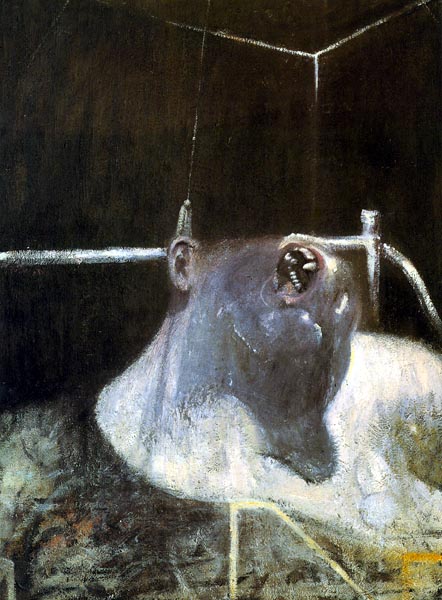

Head I
These paintings are almost sculptural in their black and white thick impasto rendering. He painted repeatedly on the back of canvases, preferring this raw, untreated surface and also the ‘frisson of difference’, working in oils and applying many coats. It took him over four months to paint the layers, which weighed down the canvas, giving it the heft and feel of a curtain. In his Study after Velasquez I, II, and III (1950) he expressed a desire to ‘paint like Velasquez but with the texture of hippopotamus skin’.

Study after Velasquez's Portrait of Pope Innocent X
Diego Velasquez’s Portrait of Pope Innocent X, painted in 1650 conveys the dignity, glory and authority of the most powerful figure in the world at that time. Bacon was obsessed by this image and painted around 45 variations on the theme. His pope seems to be in a living hell or form of perpetual torment with his golden throne morphing into an instrument of torture. And again, the scream which evokes so much conjecture.

Many of Bacon’s works of this period feature figures in awkward postures in cubes, as those displayed as exhibits of torture or go-go girls. Men in blue suits are trapped against pin-striped backgrounds like conformist attire or circus tents – cabined; cribbed, confined. Francis Bacon was homosexual in an era where it was outlawed (it was not officially decriminalised until 1957) and perhaps his figures are subject to torture that is mental, physical, and sexual.

He was inspired by photos of supposed ectoplasm and ghostly forms, echoed in his tropes of white prisms, frames, contortionism and crouching nudes: a crouch being a posture that implies oscillating energy, squeezed into a ball ready to burst outwards. His insistence on gilt frames gave the work status and suggested value, combining subversion with respectability. Bacon also liked to have his paintings shown under glass, which forces the viewer to confront his own reflection in the midst of the painting, thus negating distance and detachment.

Study from the human body (1949) displays striking tenderness alongside a gentle erotic charge, as a figure steps through a transparent curtain. The painting suggests both depth and mystery as we ponder themes of imprisonment, concealment, danger and homosexuality. Bacon’s own comments are designed to obfuscate: “I would like my pictures to look as if a human being had passed between them like a snail leaving a trail of the human presence and memory trace of past events as the snail leaves its slime.”

Study from the human body (1949)
Bacon’s paintings appear highly visceral, from the violence of technique to the frequent interaction between two men, which is neither affectionate nor relaxed but turbulent and traumatic. The wrestling men in Two Figures (1953) imply sexual violence and eroticism. Both protected and trapped within a cage-like structure, the grappling men are thrown into sharp relief by the white sheets and dark background. They are simultaneously strong and vulnerable.

Two Figures (1953)
Likewise The End of the Line (1953) embraces the ambiguity of affection and brutality in boxer’s stance – all big head and bulging arms - amidst the linear landscape of train tracks and station shed; a clandestine meeting place for coupling?
The End of the Line (1953)

Figure with Meat (1954) is a masterpiece of composition. The dry brush marks of red, orange, cream and blue that depict the carcasses flank the authoritative male figure in purple/blue. Bacon said without discernible irony, “We are meat. We are potential carcasses. If I go into a butcher’s shop I always think it’s surprising that I wasn’t there instead of the animal.”

Figure with Meat (1954)
While the figure in isolation is a familiar theme for Bacon, the background in Untitled (half-length figure in sea) 1953-54 is unusual. The figure is barely discernible, demarcated only by a vertical brushstroke against the horizontal brushstroke of sea. Both the figure and the sea are dark, mysterious and indistinct. There seems to be a dark pier or jetty in the background but before we can attach too much symbolism, Bacon explains, “I’m just trying to make images as accurately off my nervous system as I can.”

Untitled (half-length figure in sea) (1953-54)
Just as this figure seems released from the cages of his previous works, so Study for a running dog (1954) exudes energy and a feeling of liberation. The sense of movement is captured through the blurred painterly marks, achieved by dragging fabric through wet paint. A later work, Untitled Dog (1967) displays a similar canine exuberance as a few broad sweeps of paint (including pink) on a green background imbue the painting with a lithe animated quality.

Study for a running dog (1954)

Untitled Dog (1967)
A trip to Tangiers (where homosexuality was legal, incidentally) led to splashes of colour in his art. Figure in a Landscape (1956-57) incorporates patches of orange and yellow under layers of ochre and green, which reflect the intense light of the country. He also added sand to dark paint to create a heightened texture – the landscape literally making an impression on these works.

Figure in Landscape (196-57)

Wednesday, 15 September 2010

Impressionists Gardens

Impressionist Gardens
Royal Scottish Academy Building
31 July - 17 October 2010
  
The Impressionists were interested in the pleasure of the here and now, and to them gardens symbolised relaxation, recreation, innocence and light. They were inspired by Corot’s sun-dappled canvases, capturing the effect of light through the trees, the details of raindrops on roses in Simon Saint-Jean’s The Gardener Girl (1837) and Delacroix – his casually arranged arrays of dahlias and other cut blooms are the spiritual forebears of Monet’s and Gustave Caillebotte’s paintings of dahlias growing in their gardens at Argenteuil and Petit-Gennevilliers.

I love Spring (1804) by Jean-François Bony: the painting of spring flowers relegates the statue of a warrior goddess in the background to a secondary role. The focus is on the foreground lilacs, hollyhocks, roses, poppies, delphiniums, striped parrot tulips – the very flowers of my wedding bouquet.

Still life can be stylishly scruffy - Flowers in a Vase by Pierre-Auguste Renoir
Gardens and flowers were not formal constructs. Pierre Auguste Renoir’s Flowers in a Vase (1866) is a reminder of a stroll in the fields – wild flowers (corn poppies; chamomile; ragwort; cornflowers; rampion; wild parsley and Spanish broom) are stuffed into an earthenware vase. More prosaic vegetables are admired in A Flemish Kitchen Garden (1864) by Henri de Braekeleer where giant cabbages provide colour and a subtle poetry in the harvesting in the kitchen garden.

Gardens were outdoor studios; places in which to capture the effects of sun, shade and seclusion. They could be the theatre of fashion or tranquil meditation. Thomas Couturés’ The Reading (1860) depicts a lady engrossed in a book and oblivious to her surroundings. Charles-François Daubigny was commissioned by Napoleon III to paint The Cascade at Saint-Cloud (1865) which is a grand, formal work but, once again, the historic monuments are relegated to the background. Similarly, John Singer Sargent takes a thoroughly Impressionist delight in the incidents of modern life in The Luxembourg Gardens at Twilight (1879) which features children sailing their boats despite the lateness of the hour, and a well-dressed couple strolling at the centre.

Contemplative colour in Frederick Childe Hassam's Geraniums
Gardens are for sewing, playing croquet, quiet contemplation and drinking tea. And there is always room for colour. Frederick Childe Hassam painted red geraniums, watering cans and his fair wife engaged in embroidery in Geraniums (1888-9). James Tissot tinged his autumn leaves around the reflective pool with sadness in Holyday (1876). Gustave Caillebotte kept flowers in dedicated beds in his garden (unlike Monet’s mixtures) allowing him to paint studies of nasturtiums and, my favourite, Daisies (1892). Edouard Manet’s The House at Rueil (1882) is also grouped in this collection.

Napoleon III’s ambitious programme of parks and gardens was continued by the Third Republic which came to power in 1871. The new and revamped gardens provided perfect opportunities for the Impressionists to paint ‘en plein air’ but Monet and the other Impressionists preferred the city’s old, historic gardens with spreading trees and natural features. Léon Frederic’s The Fragrant Air (1894) depicts an innocent child sniffing ephemeral blooms redolent of death and mortality.

Lotus Lillies by Charles Courtenay Curran - the object of his affections
Charles Courtney Curran’s Lotus Lillies (1888) is a sublime painting of his bride, Grace Winthrop, haloed by a green parasol as she floats in a boat across Lake Erie in Ohio. She is the finest of the lotus blossoms (symbols of purity and tranquillity) and the clear object of Curran’s veneration.

Skaters in Frederiksberg Gardens - Paul Gaughin
Also included here is Paul Gauguin’s Skaters in Frederksberg Gardens (1884) – a striking action portrait in which the vivid reds and greens of the fallen leaves emphasise the coldness of the ice, in stark contrast to his more familiar sun-drenched views of Tahiti.

James Ensor’s The Garden of the Rousseau Family (1885) and Charles François Daubigny’s Orchard in Blossom (1874) highlight kitchen and vegetable gardens with no ostensible aesthetic purpose, but the abstract design of flat zones of green bisected by paths and walls offers visual impact. Arthur Melville’s A Cabbage Garden (1877) and Alfred Sisley’s The Fields (1874) share the same theme – the latter’s market gardens full of rows of vegetable crops mature with the seasons, while the old spreading tree in the corner indicates continuity.

The Artist’s Garden at Eagny (1898) by Camille Pissarro shows his wife planting seeds. The leaves and flowers shine like jewels while the house behind implies the family for whom she is preparing this food. The Portrait of Karl Nordstrein (1882) by Christian Krohg of a pointed-bearded gentleman standing at a window looking out at a market garden draws our gaze from across the room. We want to see what he’s looking at.

The Cote des Boeufs at L'Hermitage by Camille Pissarro
Is winter the hardest season to paint, with its suggestion of bleak hibernation? Alfred Sisley’s subtle harmony of restrained colouring integrates the snow into the scene as a natural part of the design in Winter at Louveciennes (1867). The scudding clouds, fresh breeze and tall poplars enhance the motionless figures of The Côte des Boeufs at L’Hermitage (1877) by Camille Pissarro.

Apparently Impressionism begins again with a completely new phase in the 1890s. Henri Martin offers Garden in the Sun (1913) in which sunlight from outside floods in like a powerful unrestrained tide of pink, yellow and cream. In The Pergola (1912-13) shows the last fruits of summer as Marie Enger adds a hint of autumn chill through grapes and red and golden gourds surrounded by withering vine leaves.

Bright colours return to the fore with Theo van Rysselberghe’s Fountain in the Park of Sans Souci near Postdam (1903). Clearly heavily influenced by Seurat’s pointillism, the technique of contrasted dots or flecks of colour display the refraction of a fountain into rainbow droplets by the afternoon sun. In The Rainbow (1896) we are invited to see a pristine garden through the eyes of his wife and son. Spring bulbs, reddish-brown flower pots, shimmering perblossom, red and blue outfits, and the red roof and blue sky combine to echo the colours of the rainbow, creating a larger harmony.

Gustav Klimt's Italian Garden Landscape illuminates the room
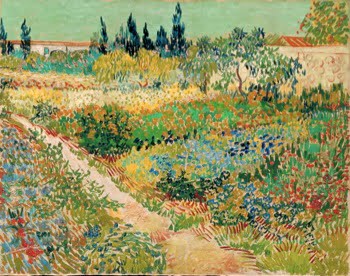
In the final room it is as though the best have been saved until last. Gustav Klimt’s Rosebushes Under Trees (1904) and Italian Garden Landscape (1913) are sumptuously rich and decorative with varied textual brushwork that illuminates the room. Vincent Van Gogh is represented by The Garden with Path (1888) and Undergrowth (1889).

The Garden with Path - Vincent Van Gogh
The first is a rich variety of jabs, zigzags and short stabbing strokes to evoke the flowers, vegetables and olive trees as they shimmer in the hot southern sun. The second was painted in the grounds of the sanatorium to which he admitted himself. The grasp of the ivy on the oak represents the grip of mental illness on his mind, but the glimpses of sunlight between the shadows suggest hopes of better health.

Naturally, there couldn’t be an exhibition of Impressionist Gardens without the inclusion of Monet’s water lily pond, and there is a shining section of wall that displays some stunning examples. Him Outdoors sighs, ‘He really was the master, wasn’t he?’

Saving the best until last - Claude Monet's The Water Lily Pond, 1904
The largest retrospective of Monet's art since 1980 opens in his home country with an exhibition in Paris this month - expected to break all gallery attendence records. With the excessive wishy-washy reproductions it is sometimes easy to overlook the man's artistic genius (a sentiment felt especially by the French who until now have regarded arguably their most famous painter as one who created daubs for American tourists); until you stand in front of one of his canvases and feel overwhelmed by light and colour.

Displays of art can often leave you satiated as you emerge from some stuffy museum, but this invigorating exhibition is like a breath of fresh air.

Tuesday, 17 February 2009

Wellington Summer Festivals - Something for Everyone

There's always something going on in Wellington, and that's why I like living here.

We've just had the Sevens and there is cricket coming up. The fact that sailboats are constantly whizzing about on the water suggests that there are regattas and whatnot occurring for the boatie folk. Events are planned or have been raced for swimming, dragon boating, running and 5-a-side football.

Circus artists are performing on the wharf and the Cuba Street Carnival is on this weekend. There are outdoor film screenings, Shakespeare productions and music festivals. Recently we have had concerts in the park form a variety of artists, the One Love concert, featuriung dub, roots and reggae, and even some decent acts - Fur Patrol and David Byrne among them. In the coming weeks saxophones and double basses will abound in the Jazz Festival.

Festival is the word of the summer with one for the Chinese New Year, a Pasifikia one, and a beer festival in Waitangi Park coming up in a couple of weeks. Touring exhibitions include one of Leonardo da Vinci's more imaginative creations, and the Boston exhibition of Monet and the Impressionists at Te Papa.

Amidst all this is the Fringe Festival. I am trying to get to some shows - so far I have seen two (both of which I have thoroughly enjoyed) with more scheduled for next week. I hope to write reviews of them, but in the meantime here's my review of The Mountain which was published on Lumiere.

Wellington is a wonderfully compact little city (little more than a town really) and it's pretty easy to get to any of these events. It markets itself as the 'culture capital' and this summer it has certainly showcased its assets. From ballet dancing to Billy Connolly, there has been something for everyone. And there's plenty more where that came from.