"The idea that women's rights and human rights are one and the same was first put into writing in the 1830s by female abolitionists. The concept has since been used by many feminist leaders, but perhaps one of the best-known uses of this particular phrase came during Hillary Rodham Clinton's speech at the United Nations Fourth World Conference on Women in 1995. This quote is still relevant today, especially when many rights, such as access to education, reproductive rights, and freedom from gender-related violence, are considered up for debate. It seems like a lot of people could still use this reminder." - Stephanie Rohr
Friday, 22 March 2024
Friday Five: Koala Tea Time
Wednesday, 20 March 2024
Trouble in Paradise: How the One-Armed Sister Sweeps Her House
The
title refers to a cautionary tale parents tell their daughters not to be willful, as the child in the narrative loses an arm due to curiosity when she enters
a tunnel despite dire warnings. The message misfires when Lala (she who is told
the tale by her grandmother, Wilma) wonders whether the girl could cope without
the limb, swapped for following passion. She is cautioned, ‘but how will she
sweep the house with only one arm’? She questions whether a woman’s worth is judged
by her housekeeping, and maybe she would rather lead an adventurous life.
Unfortunately,
her adventures do not lead to happiness. The novel is set in Barbados on a
beach straight from the brochures of paradise. White folk live in tall, gated
houses, while violence, prostitution, drug smuggling, murder and other criminal
activities exist beyond their gardens, and everyone carries a gun. The police
turn a blind eye to the abuse (particularly of women) until it enters those
houses of those who go to embassies and ruin the tourist trade.
The
community is steeped in intergenerational violence and abuse. Mothers beat
their children because they do not want them to go bad and need to whip the
devil out of them; they fear that sparing the rod is the cause of the child’s
failings. Lala marries Adan, who regularly beats and rapes her, even while she
is recovering from a traumatic birth. He commits robberies to pay for his
lifestyle, which escalate to drug smuggling and murder in a sort of subplot to
the novel. His cruelty leads to a tug of war with their newborn (known only as
Baby because they have not yet decided on a name), which results in the death
of the child as she is dropped on the floor.
Girls are routinely raped by their male relatives: Lala is the child of her mother, Esme, and her grandfather, Carter. The young women are sent away to remove the temptation, while the man is not considered to be at fault. Lala is made to sleep in the outhouse to avoid her grandfather’s attentions, or how else can he resist? Women are pursued by men. The policeman who investigates the Baby’s death pursues Sheba and refuses to accept that she doesn’t want his protection; Adan fixates on his ‘outside woman’ despite being married to Lala.
"A grown man cannot help himself, she explains, in the presence of a young Wilkinson girl. This is the way it has been for generations. It is not the man’s fault, says Wilma, there is nothing he can do about it. It was this way with her mother before her, her daughter and granddaughter after her. It was this way with her."
In some ways, the novel,
full of descriptive scenes and local patois, is reminiscent of those by Alice
Walker, Toni Morrison or Alan Duff. Characters struggle to connect with
community and lash out at those who seek to reinforce their culture without
understanding the roots of reggae or Rasta, merely turning gangsta. When Wilma
holds a funeral for Baby, Adan does not attend because he is wary of her
connection to culture, although he tells his friends that she is a bitch and
“he not going anywhere around her or her house.” He is alone and left behind in
the world where he has lost his local bonds.
Even
Lala is infused in her beliefs, although they may not support her – her grief,
trauma and post-partum depression are explained in superstition. “She is
convinced also that supernatural beings are conspiring on her daughter’s behalf
to make her understand that she will pay for her part in her death.” She fears a
“wicked duppy” is playing tricks on her, putting cans of formula in the
cupboard, although she knows she has thrown them all out, sprinkling the scent
of baby powder in the house, and “It is this duppy, or another, equally
malevolent, who infuses the peculiar sound the paper bag of flour makes when
she is making dumplings and it hits the floor with the same sound she heard
when Baby was dropped.”
Reviewers
have called the book unflinching, claustrophobic, pitiless, and relentless. Focussing
on murder, abuse, a violent marriage and the death of a baby, it is certainly
no light-hearted tale, but there is a slight glimmer of hope towards the end,
and it is ultimately compelling. It is exquisitely constructed, with flashbacks
to flesh out the characters and the pathways that have led them to this Barbadian
beach, and it is a great achievement for a debut novel.
Friday, 15 March 2024
Friday Five: Ides of March
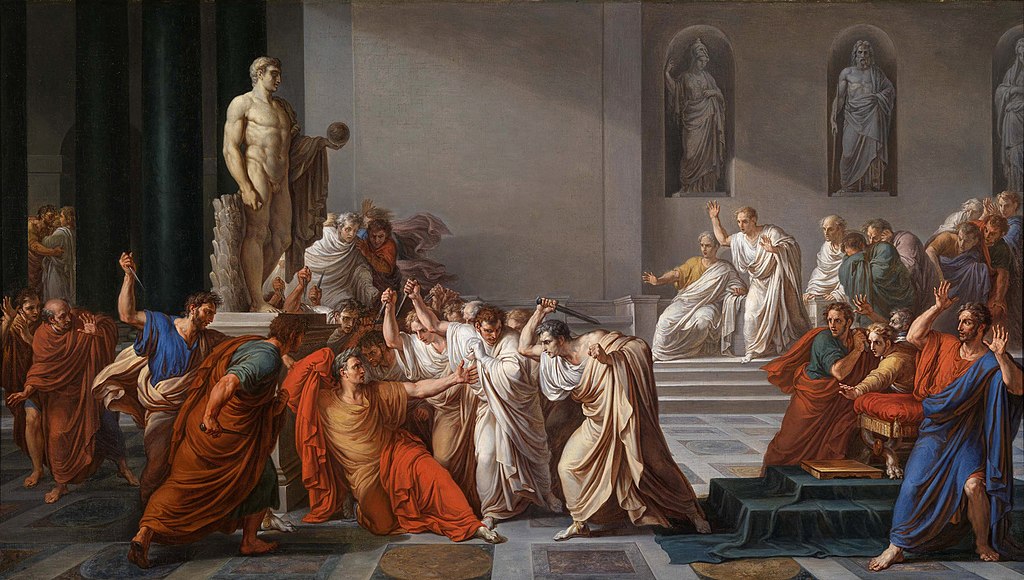
| La Morte di Cesare (1805) by Vincenzo Camuccini |
As with many people educated through the British school system in the 70s and 80s, I learned much of my history through Shakespeare plays. It was a great grounding for understanding the true definition of fake news, which allowed me to filter out a lot of the nonsense promulgated by white men talking about subjects they didn't really understand, but who had a following because they wrote a good speech, or got ghost writers to do it for them. In keeping with that theme, here are five Shakespeare quotes that relate to calendar dates.
- "Beware the Ides of March", The Tragedy of Julius Caesar, Act I, scene ii (15 March)
- ''And gentlemen in England now a-bed/ Shall think themselves accursed they were not here,/ And hold their manhoods cheap whiles any speaks/ That fought with us upon Saint Cripin's day."- Henry V, Act IV, scene iii (25 October)
- "Good morrow, friends. Saint Valentine is past: Begin these wood-birds but to couple now?" - A Midsummer Night Dream, Act IV, scene ii (14 February)
- "On Holy-rood day, the gallant Hotspur there,/ Young Harry Percy and brave Archibald,/ That ever-valiant and approved Scot,/ At Holmedon met,/ Where they did spend a sad and bloody hour." - Henry IV, Part One, Act I, scene i (14 September)
- Twelfth Night - Yep, the whole play. (5 January)
Friday, 8 March 2024
Friday, 1 March 2024
Friday Five: Books Read in February
- The Other Slavery by Andrés Reséndez (Marine Books) - If you mention slavery to most people in America, they think of the despicable African slave trade. They may even consider the ongoing trafficking among Asians, Latin Americans and Europeans. While Andrés Reséndez does not for a second diminish these atrocities and horrors, he does want to bring the homegrown slave trade of millions of Native Americans to national and international attention. The book is scholarly and academic following the history and laws (or lack thereof) that he believes are largely unknown and should receive greater recognition. He argues that slavery rather than disease and misfortune is the true reason for the decimation of the indigenous population of North America. Covering Caribbean islands, Mexico and the early territorial governors of the U.S, this powerful thesis is, in the words of a considered review published in the Los Angeles Times, "one of the most profound contributions to North American history [ever] published."
- Takes One to Know One by Susan Isaacs (Grove Press UK) - Corie has retired from her role as a counter-terrorist agent for the FBI to become a wife to federal judge, Josh, and a mother to his daughter, Eliza. Although she still does some consultation work for the FBI, she ostensibly leads the perfect suburban life complete with a dog called Lulu, a ‘cover’ job recommending Arabic literature to a publishing house, and weekly lunch meetings with fellow freelancers at a French restaurant. And she is bored senseless. So, when she suspects a member of the group of being up to no good – he always picks the same seat to watch his car, changes phones often and makes frequent interstate trips – she imagines that he must have a secret life, and she sets out to investigate. Are her instincts, honed by training at the Bureau, correct, or is she desperately trying to create some excitement, and Pete from packaging really is simply bland? I love the fact that some people made donations to Long Island charities by bidding to have a character named after them, which is a great idea. This is a very easy-to-read novel, which combines the excitement of law enforcement with the tedium of suburban domesticity. It may hurry to its conclusion, but the characters are warm and engaging, which makes them enjoyable company.
- The Midnight Library by Matt Haig (Canongate) - My sister's choice for the family book club, it has an easy-to-read style and an uplifting premise, suggesting that we can all have a second chance at life. It begins with Nora attempting to take her own life because she sees no future and is riddled with regrets, but she gets transported to a magical library where she has a chance to live out all those previous lives she wishes she could have chosen and realises that the one she has isn't so bad after all. And she gets the chance to go back to where she was and live it. It's very nice and tidy and a little bit twee, and completely unrealistic - she still has to return to the life from which there is no future, and most people who consider suicide really have no hope left. It is endorsed by the Daily Mail, which gives us an idea as to what to expect, and is clearly crying out to be made into a Netflix series.
- Shakespeare and Company: A History of the Rag and Bone Shop of the Heart edited by Krista Halverson (Shakespeare and Company, Paris) - Shakespeare and Company is an English bookshop in Paris, run by Americans - originally Sylvia Beach and then George Whitman (descended from Walt), who oversaw its move to the left bank of the Seine, in the shadow of Notre Dame, followed by his daughter, also called Sylvia. The bookshop is an icon of Paris, frequented by locals and homesick tourists alike, myself included. This glorious coffee-table book is divided into decades and contains photographs, graphic novel images, copies of newspaper articles, historical content, and the autobiographies of the Tumbleweeds. The Tumbleweeds were people who came to stay for a couple of days and helped out at the shop in return for a bed (or sofa, or place on the floor) and two meals a day; George asked them each to write an autobiography of approximately two pages, which collection he intended to publish. He was an incredible person with an eccentric nature - he 'cut' his hair by singeing it with a candle, travelled the world, and believed that books, knowledge and sharing were the staples of life.
- The Museum of Modern Love by Heather Rose (Allen & Unwin) - In 2010, an artist, Mariana Abramović, created an art installation, The Artist is Present, whereby she sat at a table in MOMA opposite visitors to the gallery, who had queued for the privilege - 1,554 people sat with her over 736 hours and more than 850,000 people observed from the sidelines. Marco Anelli photographed all the sitters and published a book, Portraits in the Presence of Mariana Abramović. Both Abramović and Anelli appear as themselves by permission in this novel. The rest is made up. It is a novel about the characters who sat or observed, and how the experience affected them, including Arky Levin, a film score composer whose wife is dying and who has legally requested he doesn't visit, although she permits her daughter to so do. Jane Miller is a recent widow who travels to New York and spends all her time at the exhibition - are all these people now connected? The novel addresses existentialist questions about human nature and art and whether either one can exist in a vacuum or whether we need to relate to common environment and shared experience. It reads like a performance itself and emphasises that its value is in the reader's reaction.
| Painting of Indian soldiers from the Coritiba Province escorting Native prisoners, by Jean-Baptiste Debret |
| George Whitman, proprietor of Shakespeare and Company |
| Mariana Abramović and exhibition goers at The Artist is Present |
Friday, 23 February 2024
Friday Five: Les Fameliars!
Tuesday, 20 February 2024
Prison Performance: Mad Blood Stirring
Simon Mayo’s first novel for adults
concerns a relatively unknown incident about a massacre at Dartmoor Prison
where American sailors were being held in 1815 after the end of the three
year-year conflict between the United States and Britain. The peace had not yet
been ratified and there were thousands of prisoners of war crammed into Dartmoor,
frustrated, angry and turning to violence. This much is true, and the novel is
packed with solid descriptions of prison life: crowded bunks; appalling food; general
boredom; thoughts of escape and political intrigues; and the constant backdrop
of fear and danger.
Inspired by true events, the detail is precise
including the initial march to the prison, the labour of snow-clearing, the smallpox
outbreak and vaccinations against it. The sailors are segregated by choice,
with the black sailors in Block Four, where they sing gospel songs and perform
plays which they take very seriously. King Dick ‘rules’ Block Four, and the Rough
Allies attempt to rule the rest, with violence and intimidation.
Sixteen-year-old
Joe takes on the role of Juliet in Romeo
and Juliet that is to be performed with great passion by the inmates of
Block Four, although they bowdlerize the text. The kiss between the lovers is fraught
with danger partly due to the homosexuality (punishable by flogging and further
brutality) and also because Joe is white, while Romeo, played by Habakkuk (Habs)
Snow is black. The title of the novel is taken from the opening scene of Act
Three of Romeo and Juliet, and here
implies but the growing unrest in the prison, and the illicit feelings that Joe
and Habs develop for each other.