Showing posts with label Henry V. Show all posts

Friday, 15 March 2024

Friday Five: Ides of March

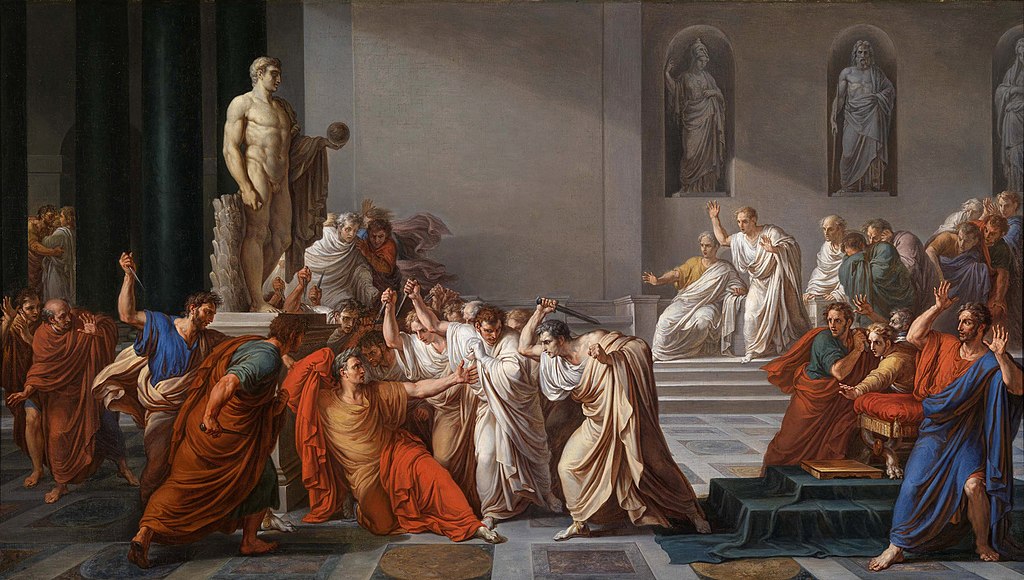
La Morte di Cesare (1805) by Vincenzo Camuccini
Well, today's the day that all self-elected senators should probably avoid temple steps, just in case all their so-called mates gang up on them and stab them in the back. Or so says Shakespeare, anyway. The soothsayer tells Julius Caesar on more than one occasion to beware the ides of March, but does he listen? No, he does not. And the rest, as they say, is history.

As with many people educated through the British school system in the 70s and 80s, I learned much of my history through Shakespeare plays. It was a great grounding for understanding the true definition of fake news, which allowed me to filter out a lot of the nonsense promulgated by white men talking about subjects they didn't really understand, but who had a following because they wrote a good speech, or got ghost writers to do it for them. In keeping with that theme, here are five Shakespeare quotes that relate to calendar dates.
  1. "Beware the Ides of March", The Tragedy of Julius Caesar, Act I, scene ii (15 March)
  2. ''And gentlemen in England now a-bed/ Shall think themselves accursed they were not here,/ And hold their manhoods cheap whiles any speaks/ That fought with us upon Saint Cripin's day."- Henry V, Act IV, scene iii (25 October)
  3. "Good morrow, friends. Saint Valentine is past: Begin these wood-birds but to couple now?" - A Midsummer Night Dream, Act IV, scene ii (14 February)
  4. "On Holy-rood day, the gallant Hotspur there,/ Young Harry Percy and brave Archibald,/ That ever-valiant and approved Scot,/ At Holmedon met,/ Where they did spend a sad and bloody hour." - Henry IV, Part One, Act I, scene i (14 September)
  5. Twelfth Night - Yep, the whole play. (5 January)

Friday, 14 December 2018

Friday Five: Top Theatre Picks of 2018

P.J. Williams as Poprishchin in Diary of a Madman
I saw 23 works of theatre this year across four cities. I saw a lot of comedy too, but I'm not including that in my reviews (apart from the one that was performed at the Comedy Festival and is, therefore, a cross-over). Obviously, we all know that a review is one person's opinion so my favourites may well be different from others' - that doesn't mean that anyone is right or wrong; just that we are different. For the record, my top five productions this year are (in alphabetical order):
  1. Diary of a Madman (produced by The Street at Street 2)With an excellent set, technical design (Imogen Keen), controlled direction (Caroline Stacey) and superb acting (P.J. Williams and Lily Constantine), this brilliant piece of theatre is both claustrophobic and expansive. The two actors occupy the entire space and their own minuscule territory, while the issues raised are both intimate and universal. Nikolai Gogol's bleak commentary on the madness within bureaucracy is sharply tuned by David Holman's stage adaptation. As an exploration of the way we mentally process mundanity and turn the monotonous into the momentous, this is scintillating drama. It deserves to be seen and discussed at length.
  2. Exclusion (produced by David Atfield at The Street Theatre)Imagine Closer meets Macbeth drenched in politics and The Pet Shop Boys, and you'll be somewhere near an appreciation of this play. It's a privilege to see new, local work of this calibre on stage. Well-written and sharply executed (David Atfield is the writer and director), it focuses on the big issues of honesty, ambition, integrity, sexuality, self-awareness and motivation; whether in the personal or public sphere, being true to oneself is often the hardest thing to face. And if these sound like weighty issues, don't worry; the cast carries them with passion and empathy. With searingly honest performances from Craig Alexander, Tracy Bourne, Ethan Gibson, Fiona Victoria Hopkins and Michael Sparks, we are in safe hands.
  3. Proof (produced by FREEFALL Productions at The Q, Queanbeyan) - Ylaria Rogers excels as Catherine, exhibiting all the vulnerability of a young woman with a brilliant mathematical mind whose father, Robert, has just died after she has cared for him in his latter years. Julia Christensen portrays the other daughter, Claire, as the one who got away, returning now to sell the family home and try and force Catherine to move on, even if she doesn't want to. Alexander Brown as one of Robert's students deftly walks the line between social awkwardness and competitive manipulation, and Gerard Carroll as Robert puts in a controlled and controlling performance. Bluntly addressing the nature of genius, academia, sexism, sibling rivalry, grief and insanity, this production manages to be amazing, moving, and overwhelming: I loved it.
  4. Shit-Faced Shakespeare: Romeo & Juliet (produced by A-List Entertainment, UK at The Street Theatre) - This was presented as part of the Canberra Comedy Festival, so it was always going to be a riot or a write-off. Fortunately, it is very much in the former camp. The troupe consists of six classically-trained actors who perform the Shakespearean play, one of whom is plied with alcohol before the show - it is a different actor each night who interrupts the performance of the others by missing lines, skipping ahead, changing the plot, tripping over and basically behaving as an inebriated person does. On stage. One cast member acts the stage manager/ MC to manage the risk, and has to ensure that the actor does no harm to himself or anyone else. It could be completely irresponsible, but it is instead clever and very funny i'faith. These guys know their shit as inspired improvisation leads to excellent entertainment. 'So raise your glass and have a drink/ Cos it's much better shitfaced, don't you think?'
  5. Wild (produced by Melbourne Theatre Company at The Southbank Theatre, Melbourne) - Described as a psychological thriller for the digital age, this is a brilliant piece of theatre. Mike Bartlett's dark and comic twist on the Edward Snowden story literally turns the world upside down. A whistle-blower, Andrew (Nicholas Denton) hides out in a hotel room, terrified of the consequences of his actions, while believing in his convictions. He is teased and taunted by a characters known only as Woman (Anna Lise Phillips) and Man (Toby Schmitz) until he is no longer sure of the truth and the nature of reality. The acting and direction (Dean Bryant) are totally solid, while the set is artfully deconstructed as the blinds are drawn and walls removed in more than just metaphorical ways. It is creatively stunning and a mind-blowing exercise in bringing the truth to light.
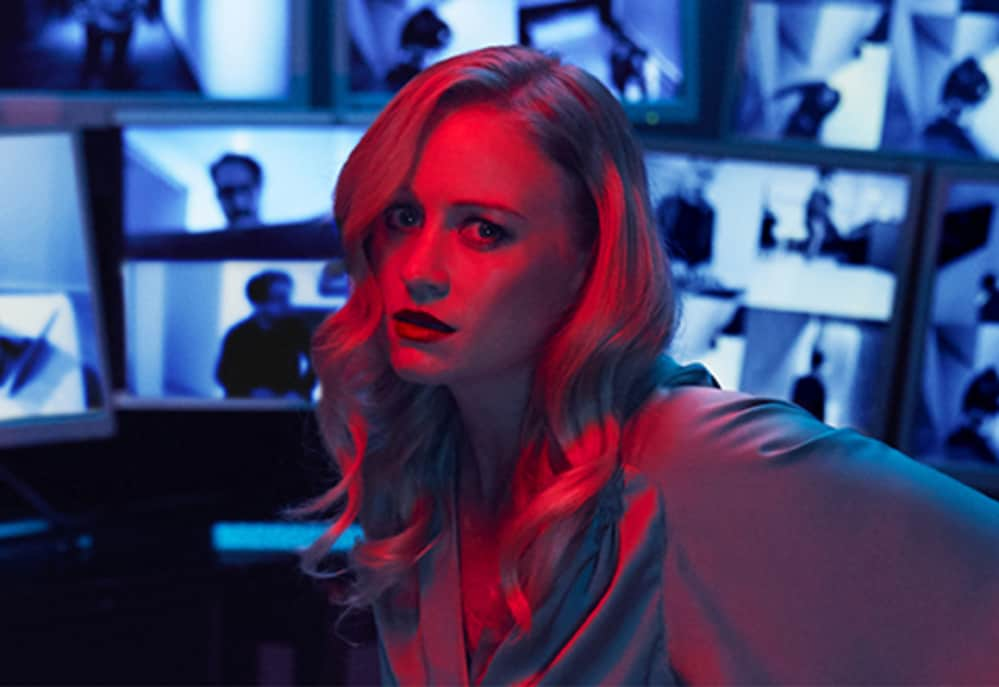
Anna Lise Phillips as Woman in Wild
Honourable mentions for:
  • The Aspirations of Daisie Morrow (produced by Brink Productions at The Playhouse, Canberra Theatre Centre) - Four actors (Paul Blackwell, Lucy Lehman, Genevieve Picot and James Smith) play a number of characters and narrate events in this adaptation of a Patrick White story. The physical shifts and slight changes of costume, props and vocals, make it beautiful, moving and touching in its simplicity. With an innovative setting, fantastic design elements, consummate acting and a gorgeous musical accompaniment, this is a spectacularly engaging production.
  • Henry V (produced by Oregon Shakespeare Festival at Thomas Theatre, Oregon, USA) - in which director Rosa Joshi incorporates innovative costume and set design to keep the pace moving briskly and precisely. The lead performance from Daniel Jose Molina is supremely confident (verging on psychotic) and the American accent and modern delivery ruins the rhythm but it sharpens the humour and militancy.
  • Venus in Fur (produced by The Street at The Street Theatre) - I've read the book; bought the single; now I've seen the play. Perhaps I should get the T-shirt: mink or sable? Faux, obviously. The post-modern play by David Ives explores the sexual politics of the original novel by Leopold von Sacher-Masoch as a director, Thomas Novachek (Craig Alexander), has adapted it to the stage. As he attempts to cast the part of Wanda von Dunajew, he auditions a young actress, Vanda (Joanna Richards), in a disturbingly contemporary power play. His dominance is questioned by the performance of Vanda who subverts his expectations by presenting a variety of versions of the play within a play within a play. It's challenging and immediate, and director Caroline Stacey is always in control of the audience and the text. 
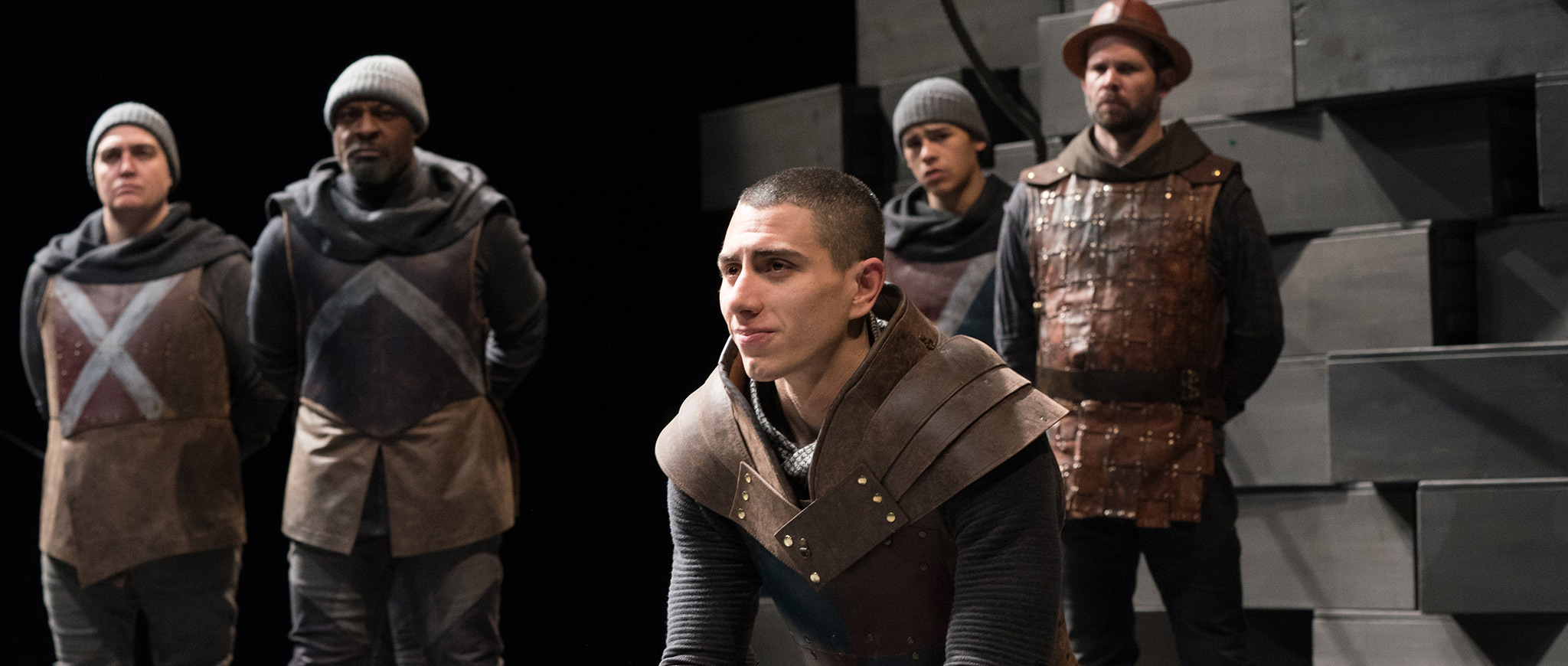
Daniel Jose Molina as the titular role in Henry V at The Oregon Shakespeare Festival

Friday, 25 September 2015

Friday Five: The Mesmeric Magic of Crowds


Following on from last week's Friday Five, I've been thinking about the mesmeric influence of dancing in a club; of the wonderful vibe experienced at a rave. A lot has been written about the brutality of the mob; about how being part of a crowd can make a person lose their individuality and behave in an ugly and anti-social manner. At this point some sort of reference is made to riots, hooliganism and/or the French Revolution. But I think that sometimes crowds can have a beatific influence, and their collective nature can be a force for good. And please stop waving your phone/tablet about and ruining it for everyone else. Aren't you capable of remembering stuff?

5 Times it's good to be part of a crowd:
  1. Music/ dancing - as discussed. Of course one can dance with oneself, but the experience is a lot different if there are 'twenty thousand people standing in a field'
  2. Theatre/film/sport - A live audience is a wonderful thing. The shared emotion makes a film even more memorable - watching Silence of the Lambs in a cinema where the code of conduct was impeccably observed and everybody jumped at the same instant was unforgettable
  3. Battle - That speech of Henry V wouldn't have been so inspiring if no band of brothers were there to listen
  4. Church/vigil - Whatever your belief or religion, if you share it publicly with others through song, prayer, or silence, the feeling of togetherness is indescribable
  5. Rally/ threat - There is power in a union: The people united will never be defeated

Wednesday, 1 July 2009

Shakespeare's Greatest Hits


All the World's a Stage
Circa Two, 29 May - 27 June

Ray Henwood’s presentation of Shakespeare’s greatest hits is a comfort for a cold evening. That there is nothing out of the ordinary is not a criticism – rather it is because, as he explains in one of his many addresses to the audience, that the bard’s conceptions have passed into common parlance.

Dressed in a morning suit against a simple curtain for a backdrop, Henwood illuminates the stage with a range of speeches, soliloquies and sonnets inspired by Sir John Gielgud’s Ages of Man. He begins with the prologue from Henry V in which the chorus begs to ‘on your imaginary forces work’. For the next 90 minutes, Henwood takes us on a veritable round-the-bard-trip as promised.

He recites some beautiful poetry with evident passion in a voice you could listen to all day. Explaining that even the non-beautiful creations get the poetry, he portrays characters as diverse as Caliban (The Tempest), Angelo (Measure for Measure), and Lorenzo (The Merchant of Venice). The Queen Mab speech from Romeo and Juliet is spirited and full of fun.

Each section is introduced with a few words or a brief discourse. In a segment on the nature of sleep, Henwood ranges from Macbeth’s – ‘that knits up the ravel’d sleeve of care’ – to Prospero’s – ‘We are such stuff as dreams are made on; and our little life is rounded with a sleep.’ The simple but effective lighting (Jennifer Lal) generally remains true to the ethics of the limited technical intervention, as actor and director (Peter Hambleton) alike choose to paint pictures with words.

As you would expect, Henwood is particularly captivating as Lear and Henry V. He includes lots of Henry V including the infamous ‘Once more into the breach’ speech and the ‘little touch of Harry in the night’. The best of these snippets is when he plays both Falstaff and Prince Hal imitating Henry IV (Henry IV: Part One).

Attempting to persuade us that there are as many strong female as male characters (which is patently untrue) Henwood gives us Lady Macbeth on receipt of the letter from her husband narrating what greatness he has been promised. He is not entirely convincing in this role, not just for the obvious reasons, nor does he seduce us as Iago (just as an aside – Peter Hambleton’s Iago is actually the best I’ve seen in New Zealand), although he draws attention to his complexity.

Shakespeare was a master at creating complexity of character – ‘what a piece of work is a man’. This always reminds me of the Blackadder episode in the second series in which Edmund has his Aunt and Uncle Whiteadder over for dinner, at the same time as hosting a drinking party. When his aunt takes him to task after someone stumbles in wearing comedy breasts, ‘Edmund! Explain yourself!’ he replies, ‘I can’t. Not just like that. I’m a complicated person, you see, Auntie.’

Shakespeare’s characters are not representative of a certain singular trait and Ray Henwood is excellent at embodying diversity. Nowhere is this more pertinent than in his Shylock, who is more than ‘just a Jew’. He gives an interesting insight into the character – there are other Jews and other money-lenders who weren’t hated as Shylock was. It was more his disposition than his religion that was despised, yet, with our (entirely understandable) fear of Nazism, we worry that this loathing is anti-Semitism.

No one else in the Shakespeare canon is a stereotype, so why do we assume he is? As Henwood points out in one of the more intriguing passages of the evening, surely this says more about the audience, with our modern sensibilities, than it does about the bard.

Other interludes are the sonnets which provide a quality counterpoint to the plays, and the morsels from other works. Having directed the opening scene of Terry Pratchett’s Wyrd Sisters, myself, I found this as recognisable as Shakespeare’s works. Less familiar, although equally enjoyable, to me was the short excerpt from Rinse the Blood off My Toga.

Mainly All the World’s a Stage was like ‘An Evening with William’, channelled towards the fans with little from the more obscure works or the comedies. Like a concert where you only really want to hear the hits and not the worthy stuff from the experimental album, this was clearly a success with the mainly elderly audience. Having said that, this would work really well in schools as an introduction to Big Bill.

Saturday, 14 March 2009

All the world's a stage

We moved into the theatre this week, two weeks ahead of the opening of Necessary Targets.

There is something so special about a theatre space. It can be an area in the round, a stage thrusting beyond a proscenium arch or simply a black box. And with each performance it can be transformed. That's the magic of theatre to me.

Just move the seats, construct a set, add some lights and you are in another world. I say 'just' but it is far from a simple achievement. The crew who build, paint and dress the set, and who design, plot and focus the lights are the craftsmen and artisans of old. Their work is incomparable.

In the short space of time that I have performed in the Gryphon it has been a 17th century New England courtroom and jail, a middle-class Suffolk drawing room, a French convent in the early 1600s, and a Bosnian refugee camp in the mid 1990s.

Each time it has been wholly believable and the actors and audience alike suspend their belief and are transported to whole new worlds. I am of course reminded of the chorus' words in Shakepeare's Henry V when he begs the audience's indulgent imaginations.

"Can this cockpit hold
The vasty fields of France? or may we cram
Within this wooden O the very casques
That did affright the air at Agincourt?

Think when we talk of horses, that you see them
Printing their proud hoofs i' the receiving earth;
For 'tis your thoughts that now must deck our kings,
Carry them here and there; jumping o'er times,
Turning the accomplishment of many years
Into an hour-glass:"

By this time, people are tired and a little grumpy - there are conflicting needs and priorities as the crew beaver away to get the production looking and sounding right while the cast are desperately trying to give them something good to work with.

But the shift into the theatre dissolves some of this tension as the lights come up and you know you're not far away now. It's exciting waiting in the darkness of the wings for your cue which will allow you to take flight to another place. And that's why we do it.

Tuesday, 24 February 2009

Henry V - Band of Brothers (and Sisters)

Henry V, Summer Shakespeare
Studio 77 Amphitheatre, February 13-28

I must admit I approached the Summer Shakespeare production of Henry V with some trepidation. It is a fantastic work focussing on grand themes such as leadership and patriotism, which are frequently mocked (particularly English patriotism) in modern society. These fears were quickly dispelled, however, as director David Lawrence remains true to the passion of the play. The serious moments are tender and touching yet also stirring and powerful. There was a lump in my throat at some of the more celebrated speeches, which was entirely due to the force of direction and acting.

Lawrence ensures that all his cast flesh out their roles and from the entrance of the Archbishop of Canterbury (David Goldthorpe) and the Bishop of Ely (played with relish by James Barber) I was enthralled. Goldthorpe’s interpretation of Salic Law (which Shakespeare’s original audience would have known) to justify Henry’s claim to the French throne is expertly handled. I’m not sure if we are enlightened by the explanation, but we are certainly entertained. The cross-clutching, bible-bashing (literally) duo does a sterling job of illuminating the hazier parts of the script.

Alex Grieg as the eponymous king is fantastic. When hesitant at asking ‘May I with right and conscience make this claim’ or anguished at his betrayal by his old friends he is convincingly human. His lament that he cannot be like other men although he is the same ‘save ceremony’ is heartfelt, his prayer before the battle of Agincourt is profoundly moving, and his wooing of Katherine is utterly delightful. His flashes of temper, remorse and insecurity make him a beloved figure.

Henry is the sort of king who demands respect, loyalty and devotion. His battle speeches are formidable and he shows his leadership in myriad ways – granting mercy where it is due – yet he is not afraid to strike through the hearts of the ‘nest of hollow bosoms’. He forgives drunkenness but not treason. Greig embodies the king versus man dichotomy brilliantly when he personally has an old drinking buddy killed for disobeying orders, and he is fierce in his protection and respect of the defeated French, ‘for when lenity and cruelty play for a kingdom, the gentler gamester is the soonest winner’.

But, men being as they are, not all support the king. When he prowls the camp in disguise the night before the battle in the ‘little touch of Harry in the night’ scene, he learns there are those who question his motives. Daniel Watterson as Michael Williams speaks his dissent with eloquence and bitterness. With his supposition that as the men are following the orders of the king so all death and blame will be on his head, the situation in Iraq doesn’t so much spring to mind as bludgeon the brain. While Henry’s reaction is fair and indicative of the equanimous king he will become, there is perhaps little else he can do in the circumstances.

Aside from the main focus on Harry, the ensemble work is also accomplished. The reprobate triumvirate of Nym (Jack O’Donnell), Bardolph (Benyamin Albert), and Pistol (Jackson Coe doing his best Orland-Bloom-as-Will-Turner impersonation) are oddly dressed but generally good value. None of them want to go to war although they do want to bask in its reflected glory, and there is a touching moment when they bid farewell to the excellent Nell Quickly (Ameila Willcox). Her newly-wed-and-nearly-widowed character is stronger and more noble than any of the men she sees off from the shores of Southampton to an unknown fate.

As Nym is slain, Bardolph steals, and Pistol ransacks the bodies on the battlefield, the horrors of war are clearly illustrated in counterpoint to those who claim the play is gloriously bellicose. Boy remarks upon this behaviour with the license of a Shakespearean fool, ‘I did never know so full a voice issue from so empty a heart’. Jessica Aaltonen looks cute in this role but her squeaking of the lines as though she has been ingesting helium makes her often incomprehensible.

On the subject of incomp- rehensible, I know Welsh accents are difficult at the best of times, but Christopher de Sousa Smith as Captain Fluellen sounds more like an Irishman being strangled underwater.


Fortunately he handles the comedy (including the ludicrous leek taunting scene) much better than the accent. The play also features a Scotsman and an Irishman, to show the cultural divisions in the ‘English’ camp, but they are absent from this rendition. Captain Gower is included but Bailey McCormack gets lost in the role beside the more expressive de Sousa Smith.

The French contingent is much better served, with the language excellently delivered. The women are wreathed in blue robes like the Beauxbatons from that other famous Harry of the Potter variety. The French lesson is outstanding as Louise Burston hams it up fabulously as Alice, the princess’ maid and tutor, and Alison Walls is much better as Katherine than the Chorus. Her rapid delivery, flirtatious simpering and jerky mannerisms suit the French princess far more than a pragmatic narrator.

The French men on the eve of battle are cocksure and confident, as they know they have greater numbers than the English forces. The banter between the fiery Dauphin (Alex Rabina) and the larger-than-life Constable (Allan Henry) underlines their arrogance. As they ride off to battle with lances protruding from the sunroof of their vehicle you just know there will be a big fall to follow this pride.

The battle scenes are expertly choreographed by Allan Henry who must have staged just about every fight scene on a Wellington stage over the past few years. There are blood-thirsty priests, savage sword fights and cowardly kickings meted out. At times the men stand around cheering and it is more WWF than Agincourt, and there are Matrix-like moments of humour amidst the gore. But when bodies bestrew the set and Henry confesses ‘I know not if the day be ours or no’, it is easy to understand his confusion.

The French herald, Mountjoy is played by Hannah McKie with an innate understanding of Shakespearean speech and a calm dignity that moved me to tears and shows that there are no real winners in war. Despite the undeniable humour of the wooing, there is a discordant note – history will prove that a defeated nation can never be united with its conqueror.

The large cast use this great little venue soundly, performing to all angles, although there is little they can do about the noise from the aeroplanes. Actors encircle the audience to demonstrate superior force; they flee across bridges to signify defeat; and they lounge on balconies to depict insouciance. The tents on the surrounding grass are probably used to store equipment but they look like an encampment. The car that delivers the French envoy is a good gag, but it would have been more powerful if it were a Peugeot, Citroën or a Renault rather than a Mazda with a battered headlight.

There are two things I would question and the first is the costuming. Red for the English and Blue for the French – fair enough (les rosbifs et les bleus) and it helps distinguish between the sides, especially when named characters (Boy and the Dauphin most notably) switch allegiance to swell the ranks. When Henry is alone in red at the French court, the surrounding sea of blue highlights his isolation and the fact that he is out of his depth.

But what’s with the glaringly American baseball caps and the Converse All-Star boots? Is there a subliminal advertising message here, or an oblique reference to the homogenisation of culture? There are also product placements of Coke (the red bottles infiltrate a blue chilly bin) and the Warehouse – which is hardly ubiquitous enough to merit such treatment if so. Why do only the trio of traitors (Cambridge, Northumberland and Masham) wear the archetypically British Doc Martens? Am I reading too much into this, and is it nothing more than an attempt at the Baz Luhrmann treatment? Either way, it doesn’t work.

The other quibble is the casting of women in traditionally male roles. This play has a huge cast and almost no women. Katherine, her maid, the Queen of France, and Nell Quickly are the only ones to be given lines. The rest of the play focuses on the relationships between the groups of men, all of which define different facets of Henry’s character. Mountjoy and Burgundy (Laura Feslier) are examples of how this can work, but none of the other female soldiers ring true.

On the whole this is an excellent production and very difficult to review, as each path leads down a cul-de-sac of revelations. It is a tight ensemble piece, given cohesion by a strong person in the title role. Kenneth Branagh and Laurence Olivier are tough acts to follow, but Alex Greig’s Henry V is equally charismatic and compelling – I feel I would be proud to be among his band of brothers (and sisters).