Friday, 12 April 2024
Friday Five: Ducking Cross-Stitch
Friday, 5 April 2024
Friday Five: Books read in March
- Iron by Rona Munro (Nick Hern Books) - This play for four actors, mainly concerns a mother daughter relationship as Josie goes to visit her mother, Fay, in prison for the first time in 15 years. Fay is imprisoned for the murder of her husband, Josie's father. Throughout the course of the play, set mainly in the visiting area, the two try to learn about each other, with Fay asking for details of Josie's life in an attempt to live vicariously through her experiences and Josie asking for annecdotes of the childhood she can't remember. Meanwhile the guards interject as all privacy is removed and people question motive and emotion. Fay tells Josie, “It’s not the zoo, you know, you can’t come in when the fancy takes you and throw me a bun!” The dialogue is grim and brittle with rapid shifts of mood and tone as the playwright questions boundaries and how we would react if we are pushed beyond them.
- Outspoken by Father Rod Brown (Ebury Press) - I have a signed copy of this book from when I saw Father Rod speak at the Canberra Readers and Writers Festival in 2019. Rector of Gosforth Parish, Father Rod is most known for putting up billboards with pithy sayings espousing love and tolerance, and denouncing bigotry and hate, 'because justice is always social'. The story begins with his autobiography, and then moves into a call for a discussion about morals and faith, and how he believes they relate to issues such as migrants, marriage equality and the review of child abuse within the church. While holding onto his values, theology, and decency, he rejects much of the Bible-thumping conservatism often equated with Christianity. He is actually the Anglican priest we should welcome into our hearts and homes for thoughtful and rational debate in a space of respect and compassion for all.
- The White Cottage Mystery by Margery Allingham (Penguin) - Margery Allingham’s first detective story, published initially as a newspaper serial,is a country house mystery of the type favoured by the Queens of Crime and follows the formula expertly. The blurb on the back summarises, “Seven people might have murdered Eric Crowther, the mysterious recluse who lived in the gaunt house whose shadow fell across the White Cottage. Seven people had good cause. It was not lack of evidence that sent Detective Chief Inspector Challenor and his son Jerry half across Europe to unravel a chaos of clues.” The clues involve people trying to cover their secrets, such as blackmail, homosexuality, adultery, class pretence, and other sins. Attitudes may have changed, but the well-plotted drama and general motivation to keep things hidden remains. As with all Golden Age detective mystery fiction, the crime is treated as something of a game. W.T. muses on the suspects, “They all behave as if they were innocent, and yet each one is hiding something. Each has a motive for killing Crowther, and admits it freely. No sane person would dare to do that unless they felt safe.” It is, of course, baffling to the duo attempting to solve it. The White Cottage Mystery is a gripping, short caper, capable of being consumed in a day, and the fine plotting ensures that everything is neatly tied up with a bow after all. This is highly recommended for fans of the genre.
- Cat vs Cat: Keeping Peace When You Have More Than One Cat by Pam Johnson-Bennett (Penguin) - This is a practical book full of information about feline dynamics and how to handle them. It covers topics from introducing a new, younger, cat to the household where there is already an established resident (and why you might choose not to do that in the first place) to calming a scared or anxious cat, and the trouble with anthropomorphosising your pet. The main piece of advice is to always give the cat a choice (including plenty of places, on a variety of levels, to hide, if that's what they want) and provide enough resources that the cats don't have to share. This includes food and water bowls, litter trays and human playtime or interaction. Cats will happily curl up to sleep and groom together, but they always need their own space and independence. I respect that.
- All That I Am by Anna Funder (Peungin) - First published in 2011, this novel about characters involved in left-wing activism in 1930s Germany received stacks of awards in Australia, including the Australian Book Industry Award Book of the Year. The author is Australian. The four main characters are forced to flee Munich and become exiles in London. Based on real people, the fictionalised version of their lives seems simultaneously sanitised and dramatised for clearer narrative. Justifiable paranoia and a sense of betrayal afflict the remaining members of the once tight-knit group who narrate their stories in alternate chapters from Sydney and New York. It's gripping with elements of secrecy and espionage with a high sense of danger. Of course I was far too contrary to read it when it was on everyone's book pile, and more than ten years on, I wonder if it still meets all the hype.
Tuesday, 2 April 2024
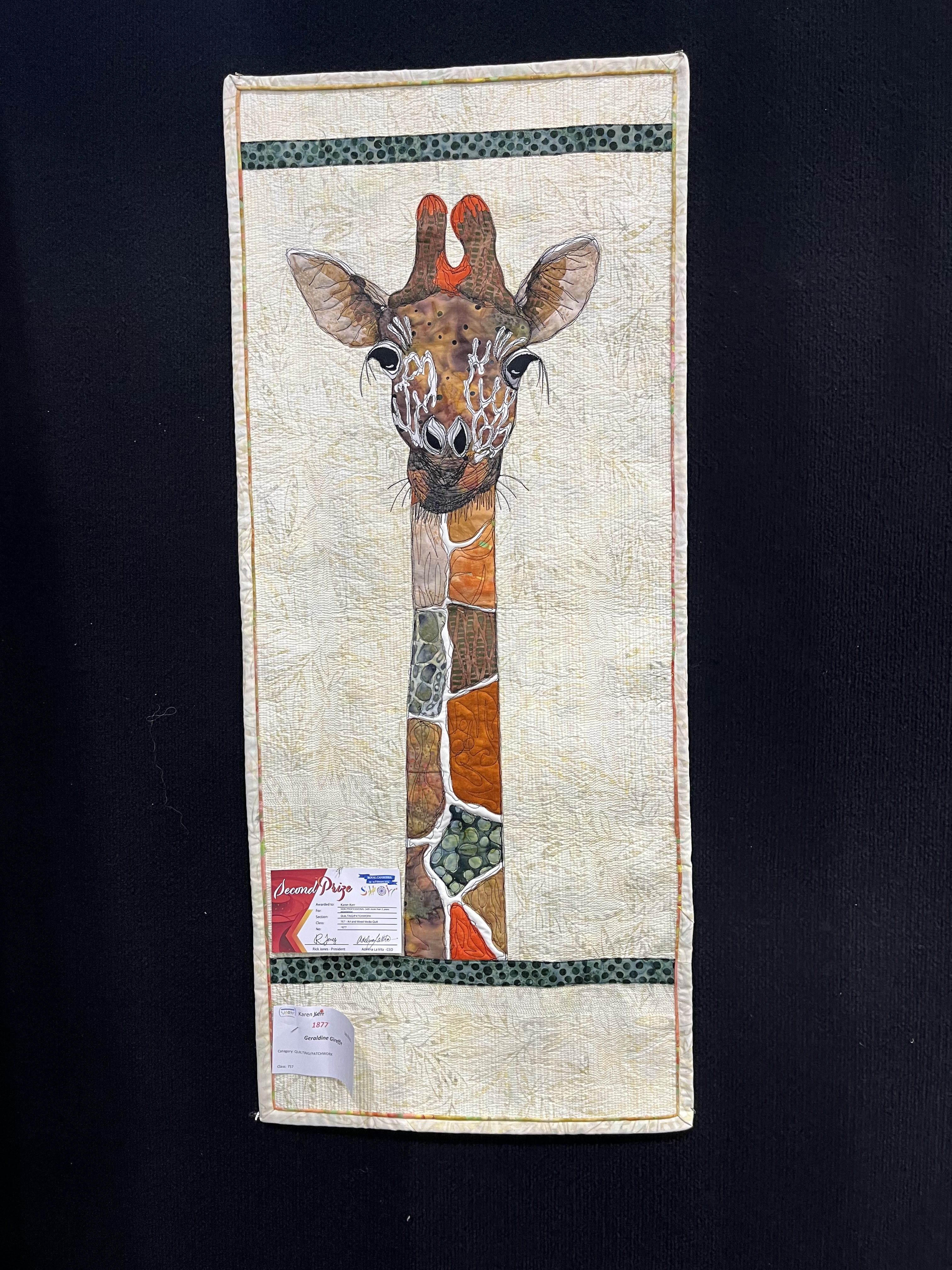
Quilts at the Canberra Show
The abstraction and the palette chosen are fascinating. Yellow seems a popular choice for happiness as in the sunflowers, but it also lends a confident golden glow in some of the bolder designs.
It's fascinating to see these quilts as a historical record, whether it be of ancient Egyptian culture or the more recent late Queen ELizabeth II.
Friday, 29 March 2024
Friday Five: Io'll Give it Foive: Rating Systems
- The Richter Scale: According to Britannica.com, the Richter Scale is a quantitative measure of an earthquake's magnitude, determined using the logarithm of the amplitude (height) of the largest seismic wave calibrated to a scale by a seismograph. Originally devised to measure the magnitude of earthquakes of moderate size (magnitude 3 to magnitude 7), theoretically, the Richter scale has no upper limit, although in practice no earthquake has ever been registered on the scale above magnitude 8.6 (the Valdivia earthquake of 1960). Each increase of one unit on the scale represents a 10-fold increase in the magnitude of an earthquake. In other words, numbers on the Richter scale are proportional to the common (base 10) logarithms of maximum wave amplitudes. Each increase of one unit also represents the release of about 31 times more energy than that represented by the previous whole number on the scale (That is, an earthquake measuring 5.0 releases 31 times more energy than an earthquake measuring 4.0). Confused? Me too - that's why I leave it to the seismologists.
- British Board of Film Classification: This one seems relatively straightforward. The focus is 'to help children and families choose well by providing them with the guidance they need to help them choose what's right for them and avoid what's not'. The classifications are - U (suitable for all or 'universal'); PG (Parental Guidance); 12A (Cinema release suitable for 12 years and over); 12 (Video release suitable for 12 years and over); 15 (suitable only for 15 years and over); 18 (suitable only for 18 years and over); R18 (Adults works for licensed premises only). The classification board states on its website that it takes into consideration 'bad language, dangerous behaviour, discrimination, drugs, horror, nudity, sex, violence and sexual violence, when making recommendations. They also consider context, tone and impact - how it makes the audience feel - and even the release format - for example, as DVDs, Blu-rays and VoD content are generally watched at home, there is a higher risk of under-age viewing'. This is not just an organisation designed to spoil your fun, but one which takes seriously its responsibility to prevent the viewing public from experiencing unnecessary trauma. The problems arise because different classification boards have different standards and measures. For example, the Motion Picture Association of film rating system has several different bands (with different age recommendations depending on state) and Americans tend to censor 'bad language' much more heavily than violence.
- Magna Carta - Clause 35: Since 1215 it has been enshrined in British law that beer is served in pints (568ml equivalent) and half pints (284ml equivalent). The actual wording is, 'There shall be standard measures of wine, ale, and corn (the London quarter), throughout the kingdom.' This makes perfect sense: you know what you're getting and can compare prices with total transparency. Unlike the system in Australia of pints (which may or may not be the same size as a UK pint), pots, midis, schooners, glasses, handles, schmiddies, butchers, ponies, bobbies and sevens. These are different names and sizes depending on which state is serving your beer. It's annoying and frustrating. Beer should not be messed about like this.
- Climbing: This is so that wispy-bearded climbers can hang out in cafes drinking mugs of tea and impressing each other with their tales of derring-do and how they plan to conquer the HVD, when it stops raining. As with many areas of specific lingo, they all know what they're talking about and form a club that deliberatly excludes those who don't. The adjective grades attempt to give a sense of the overall difficulty of the climb. This will be influenced by many aspects, including 'seriousness, sustaindness, technical difficulty, exposure, strenousness, rock quality, and any other less tangible aspects which lend difficulty to a pitch.' Apparently it is an open system, which the guidebooks smugly indicate runs from 'Easy, which is barely climbing, to E11, which has been barely climbed'. Along the way we have Moderate (M), Very Difficult (VD), Hard Very Difficult (HVD), Mild Severe (MS), Severe (S), Hard Severe (HS), Mild Very Severe (MVS), Very Severe (VS), Hard Very Severe (HVS), and Extremely Severe. The last category is further broken down into sub-grades from E1 to E11, with the numerical technical grading describing the hardest (crux) move on the climb. You're welcome.
- The Beaufort Wind Scale: The Shipping Forecast is many people's favourite part of the news, sport and weather radio bulletin. As well as providing a litany of fantastically poetic names (disappointingly many of them are just lumps of rock in the sea), it also enlists the Beaufort wind force scale to deliver weather warnings. The scale ranges from 1.Calm (wind speed <1km/h; probable wave height 0m) to 11.Hurricane (wind speed 118+ km/h; probable wave height 14+m), which is highly scientific with all wind speeds measured at 10 metres above ground using meterological instruments. What is more lyrical are the specifications, which relate descriptions of likely observations on land or at sea. For example, the specification for 5.Fresh Breeze (wind speed 29-38 km/h; probable wave height 2m) is 'Small trees in leaf begin to sway; crested wavelets form on inland waters. Moderate waves, many white horses', while a 9.Strong Gale (wind speed 75-88km/h; probable wave height 7m) is described as, 'Slight structural damage (chimney pots and slates removed). Wave crests topple over, and spray affects visibility'. In case you are wondering about that previously-mentioned hurricane, it is, quite simply, 'Devastation. Air filled with foam and spray, very poor visibility.'
Tuesday, 26 March 2024
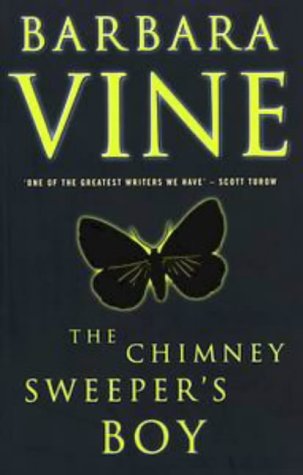
Separating Fact from Fiction: The Chimney Sweeper's Boy
As with many Barbara Vine novels, the timeframe
switches back and forth between past and present, and all the family members
are affected by the consequences of one man’s actions. Each chapter begins with
a ‘quote’ from one of Gerald Candless’ novels, allowing the author to play with
her story-within-a-story motif, as Sarah plays amateur sleuth and attempts to mine
fact from fiction. The moth on the spines of Gerald Candless’ books (and the
jacket of this novel) proves to be a ‘clue’ in the manner of an old-fashioned
detective novel, and simultaneously represents a subtle homage by Barbara Vine
to the art of cover design.
The
secrets are often to cover historic scandals, such as illegitimacy, unwed
mothers, class distinctions and homosexuality, which would not raise an eyebrow
today. She writes with sadness that such issues could lead to misunderstanding
and even murder. Another familiar trope
is the notion of blood being a metaphor for generational inheritance (both
positive and negative), while also being a vital fluid.
Friday, 22 March 2024
Friday Five: Koala Tea Time
"The idea that women's rights and human rights are one and the same was first put into writing in the 1830s by female abolitionists. The concept has since been used by many feminist leaders, but perhaps one of the best-known uses of this particular phrase came during Hillary Rodham Clinton's speech at the United Nations Fourth World Conference on Women in 1995. This quote is still relevant today, especially when many rights, such as access to education, reproductive rights, and freedom from gender-related violence, are considered up for debate. It seems like a lot of people could still use this reminder." - Stephanie Rohr
Wednesday, 20 March 2024
Trouble in Paradise: How the One-Armed Sister Sweeps Her House
The
title refers to a cautionary tale parents tell their daughters not to be willful, as the child in the narrative loses an arm due to curiosity when she enters
a tunnel despite dire warnings. The message misfires when Lala (she who is told
the tale by her grandmother, Wilma) wonders whether the girl could cope without
the limb, swapped for following passion. She is cautioned, ‘but how will she
sweep the house with only one arm’? She questions whether a woman’s worth is judged
by her housekeeping, and maybe she would rather lead an adventurous life.
Unfortunately,
her adventures do not lead to happiness. The novel is set in Barbados on a
beach straight from the brochures of paradise. White folk live in tall, gated
houses, while violence, prostitution, drug smuggling, murder and other criminal
activities exist beyond their gardens, and everyone carries a gun. The police
turn a blind eye to the abuse (particularly of women) until it enters those
houses of those who go to embassies and ruin the tourist trade.
The
community is steeped in intergenerational violence and abuse. Mothers beat
their children because they do not want them to go bad and need to whip the
devil out of them; they fear that sparing the rod is the cause of the child’s
failings. Lala marries Adan, who regularly beats and rapes her, even while she
is recovering from a traumatic birth. He commits robberies to pay for his
lifestyle, which escalate to drug smuggling and murder in a sort of subplot to
the novel. His cruelty leads to a tug of war with their newborn (known only as
Baby because they have not yet decided on a name), which results in the death
of the child as she is dropped on the floor.
Girls are routinely raped by their male relatives: Lala is the child of her mother, Esme, and her grandfather, Carter. The young women are sent away to remove the temptation, while the man is not considered to be at fault. Lala is made to sleep in the outhouse to avoid her grandfather’s attentions, or how else can he resist? Women are pursued by men. The policeman who investigates the Baby’s death pursues Sheba and refuses to accept that she doesn’t want his protection; Adan fixates on his ‘outside woman’ despite being married to Lala.
"A grown man cannot help himself, she explains, in the presence of a young Wilkinson girl. This is the way it has been for generations. It is not the man’s fault, says Wilma, there is nothing he can do about it. It was this way with her mother before her, her daughter and granddaughter after her. It was this way with her."
In some ways, the novel,
full of descriptive scenes and local patois, is reminiscent of those by Alice
Walker, Toni Morrison or Alan Duff. Characters struggle to connect with
community and lash out at those who seek to reinforce their culture without
understanding the roots of reggae or Rasta, merely turning gangsta. When Wilma
holds a funeral for Baby, Adan does not attend because he is wary of her
connection to culture, although he tells his friends that she is a bitch and
“he not going anywhere around her or her house.” He is alone and left behind in
the world where he has lost his local bonds.
Even
Lala is infused in her beliefs, although they may not support her – her grief,
trauma and post-partum depression are explained in superstition. “She is
convinced also that supernatural beings are conspiring on her daughter’s behalf
to make her understand that she will pay for her part in her death.” She fears a
“wicked duppy” is playing tricks on her, putting cans of formula in the
cupboard, although she knows she has thrown them all out, sprinkling the scent
of baby powder in the house, and “It is this duppy, or another, equally
malevolent, who infuses the peculiar sound the paper bag of flour makes when
she is making dumplings and it hits the floor with the same sound she heard
when Baby was dropped.”
Reviewers
have called the book unflinching, claustrophobic, pitiless, and relentless. Focussing
on murder, abuse, a violent marriage and the death of a baby, it is certainly
no light-hearted tale, but there is a slight glimmer of hope towards the end,
and it is ultimately compelling. It is exquisitely constructed, with flashbacks
to flesh out the characters and the pathways that have led them to this Barbadian
beach, and it is a great achievement for a debut novel.








:max_bytes(150000):strip_icc()/GettyImages-626974567-defc9220866c4e679c8d244dfbb997bb.jpg)


