Showing posts with label Chris Baldock. Show all posts

Friday, 27 March 2026

Friday Five: Theatre and Comedy

The cast in Never Closer: from left, Breanna Kelly, Natasha Lyall, Pippin Carroll, Joel Hrbek and Emily O'Mahoney
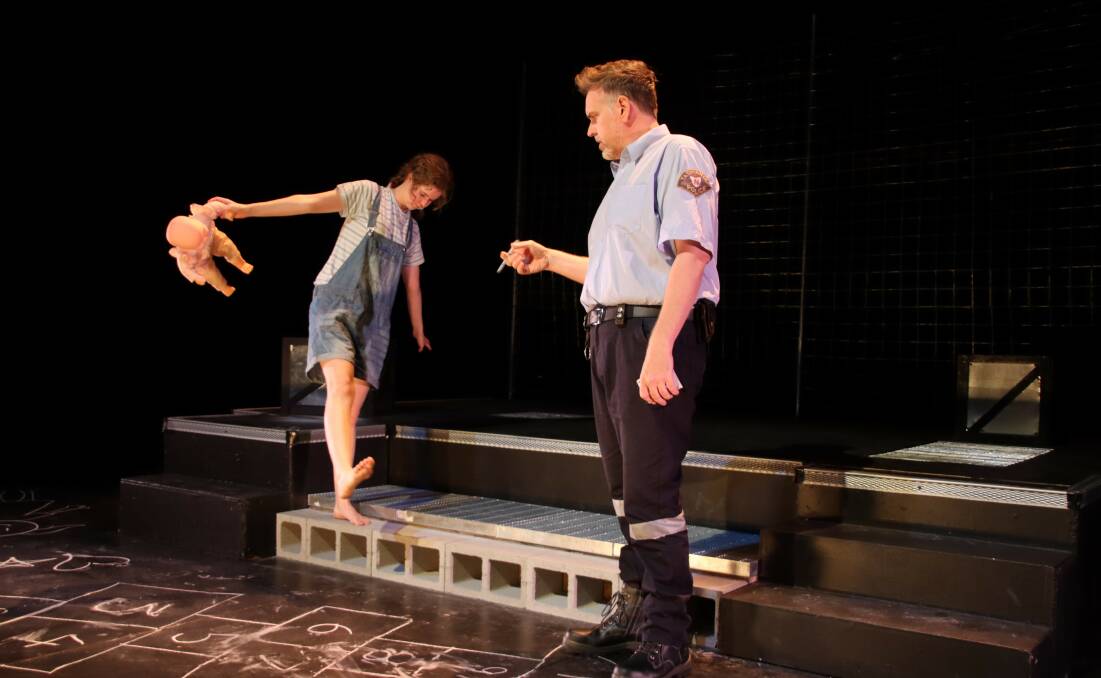
  1. Never Closer - Off the Ledge Theatre, The Courtyard Studio: This is a solid play set in Northern Ireland during the Troubles when a friendship group is on the brink of exploring a wider world, and again ten years later when they reconnect for Christmas Eve as they always used to do, except this time one of them brings along their fiancĂ©, and he's English. Director Lachlan Houen has assembled a great ensemble of actors with whom he clearly works well. He is bold in his directing choices, although this occasionally misses the mark, and there are some issues of pace where actors hit one note and stay there. Emily O'Mahoney as Deirdre is the only one with a credible Northen Ireland accent, although she wrings every ounce of bitterness out of her position as the one left behind who feels she has to martyr herself with folded arms and closed off physicality. Joel Hrbek is cute in the role of Jimmy - reassuring in his presence and warmth - whereas Nick Bisa plays the polar opposite, Conor, with monochromatic rage. Although Niamh, has arguably made the biggest change (in going to England and embracing the life and culture across the Irish Sea) she is possibly the least developed character of the play and consequently Natasha Lyall plays her with even delivery that is perhaps a little too measured. Breanna Kelly brings energy and sincerity to the role of Mary, in exactly the same way that she did to her character in You Tell My Mum I'm Dead, the previous production in which I saw her here, and I'd like to see something else. Pippin Carrol is sublime in the role of Harry, the odd one out, and for every English person who has ever been blamed for their government's choices, I feel your pain! The set design (Lachlan Houen, Sophie Hope-White, Liah Naidoo, Anna Lorenz) is appropriately busy, signifying the hoarding elements of an ancestral home without being cluttered, and while the ambient sound (Marlene Radice) enhances the production, the blast of the bomb needs to be a lot louder. Sight-lines are compromised whenever a character sits on the floor, and the costumes are not era-appropriate. The play makes me question who gets to tell whose story? This is an Australian playwright writing about an extremely sensitive Irish/ British experience produced by an Australian team in Canberra, and it just feels slightly off.
  2. The Taming of the Shrew - Lakespeare, Belconnen Arts Centre: Director Karen Vickery has created the staging for outdoor performances but I saw it indoors (because I get annoyed by distractions), and it worked very well there too with the lakeland backdrop. The world created is big, bold, comic and colourful with grand gestures and gags, while costumes (Helen Wotja) and millinery (Rachel Henson) are extravagant and coordinated to households to help identity - the hats are a particular delight. Voices are generally loud and clear without shouting or straining, and all the action is through words and deeds rather than props (with the admirable exception of hobby horses) or set. There are four entrances on the diagonal, allowing cast to appear from multiple angles, and the only concession to set is a table for height (or hiding beneath). The gender switching works well, removing the violence, misogyny and general 'ick' often found in this play, replaced with a more playful rough and tumble. Ylaria Rogers is excellent and expressive as Petruchia, and when she catches Michael Cooper's arm as he goes to hit her in his role of  Christopher/ Kit and states calmly and firmly, 'do not strike me', it feels powerful and statesman-like. Cooper, meanwhile, is sulky and petulant as Kit rather than aggressive and spiteful, and he elicits sympathy instead of censure for his behaviour. When pretending to be someone else, the characters drop nods and winks as they add a skirt or a sash, with Anneke van der Velde Trania ('disguised' as Lucentia) being particularly good at this deception, engaging with the audience where others have some fear of eye contact. Always a joy to watch, Yanina Clifton takes both fun and weariness in being Grumia, the clown, who is very much the bridge between the actors' world of wealth and privilege and us, the normal folk.
  3. Shakespeare in Love - Mockingbird Theatre, The Rehearsal Room: The play by Lee Hall is adapted from the film by Marc Norman and Tom Stoppard which we all loved thirty (yes, thirty) years ago. If you're thinking sumptuous costumes, swooning chemistry and delectable staging, think again. Director Chris Baldock has taken on an ambitious project to fit all the actors on stage - there are 23 of them in all - and the result is messy (and I've seen the dressing room, which must have been even more crowded). There is a greatly varied standard of acting from experienced senior actors to students from Mockingbird acting classes. Tom Cullen displays a range of emotion as Shakespeare and is adept at dialogue and supporting his scene partners. Unfortunately, although Asha Forno looks the part of Viola de Lesseps, she hasn't got the necessary gravitas and presence; similarly James Phillips as Christopher (Kit) Marlowe lacks the swagger and charisma demanded of the role. Liz St Clair Long revels in the regality and narcissism of Queen Elizabeth, whereas Bruce Hardie as Lord Wessex is underused and looks uncomfortable being there, as if he has tried his best but given up with some the more self-indulgent cast members. Sian Harrington stands out as the Nurse, Sachin Nayak as Lord Edmund Tilney gives a strong and grounding performance, and Rob Karlen enjoys dressing up and playing the foolish pretend nurse. Many of the witty one-liners and Shakespearean allusions are discarded without due consideration. It's hard to do comedy well, and this production merely highlights just how hard that can be. It may be a brave attempt but it falls short of the high standards set by Mockingbird and ultimately disappoints.
  4. Emma Holland: The Dog Dies at the Start - The Street Presents Canberra Comedy Festival, Street One: Don't say you weren't warned; the trigger warning is in the title. This is almost a one-act play rather than a comedy routine, and Emma Holland rearranges the sparse set to make it larger and smaller as one feels when mourning the death of a pet. Using visual aids such as a screen and a clicker, she builds a world of her domestic circumstances, frquently having a laugh at her long-suffering mother's expense. The show explores the nature of grief in both a humorous and heartfelt way. Holland has a charming rapport with the audience, and she rambles and weaves the narrative on an extremely circuitous and deceptive route before concluding with a satisfactory ending like a true shaggy dog story should.
  5. Lloyd Langford: Okay, I Believe You - Canberra Comedy Festival, The Playhouse: Lloyd's laconic style is belied by his mischievous eyes, wicked grin and the sense that he never takes himself too seriously. It may seem effortless to string a series of unrelated anecdotes and observations together, but he handles them with precision timing, apart from one instance when he is disturbed by a random snort (potentially laughter) from the audience. Some young drunken types found his accent pants-wettingly hilarious, which manifested in inane shrieks and performative outbursts at innocuous words like Hobart or dragon. Yep, he's Welsh, get over it. That aside, it's a joy to listen to a man at the top of his game riff on subjects as varied as Katy Perry, picking fights in playgrounds and cafes, and his mistrust of the cloud (he envisages it as the sickly-scented fumes left behind by an adolescent vaper, so that's unsurprising). His wife and daughter feature as topics in his show, not in any mawkish manner but in an entirely natural, they're-just-a-big-part-of-my-life sort of way. And there are lots of amusing moments in life, if we only stop to look for them. 
  6. Melanie Bracewell: Dilly Dallying - Canberra Comedy Festival, Canberra Theatre Centre: Another comedy show without a theme is almost a theme in itself, especially when it is so well orchestrated. Melanie Bracewell is not so much a raconteur as that entertaining friend down the pub who fills their stories with colourful detail. Over the course of a meandering hour or so, she tells us about her recent engagement, by way of her previous boyfriends (the Four Fuckboys of the Apocalypse) and her fight with the neighbours over who has the best bin. She lets us know that this is the first stop on the tour, and she makes no aplogies for having her notes on stage. In fact, we seem to be taken into her confidence and feel like we may play some part in shaping the show, although by the end when the threads are all as neatly tied as a pair of shoelaces (you'll have to see the performance to see why that analogy works), it is clear that she was pulling the strings all along.

Friday, 21 May 2021

Friday Five: Theatre Seen This Year

Rachel Pengilly and Craig Alexander in Echo theatre's production of Wolf Lullaby

It's been a long time, but the theatres are open again and it is a delight to be back. I am trying to see what I can, dependent on my other commitments, and I shall try to report back (in chronological order).

5 Shows Seen So Far This Year:
  1. Wolf Lullaby - Echo theatre, Queanbeyan Performing Arts Centre: Written by Hilary Bell, this is a play that asks, 'Is there intrinsic evil in the world?' When a young child is murdered in a small town, suspicion falls on nine-year-old Lizzie, played with alarming credibility by Rachel Pengilly. Her young parents (Natasha Vickery and Joel Horwood) are naturally confronted by the dawning realisation that their child may be capable of such a crime, and grapple with the fact that in some sense they created her (the father even goes so far as to ask if she is really his - tainted blood, and all that). When is one old enough to know the difference between right and wrong; storytelling and lies; boundaries and empathy? And how can one learn when presented with such conflicting role models (the arresting office, Ray is a fantastically flawed character - a dream part for an actor and one which Craig Alexander clearly relishes)? There could be an element of sensationalism with such material (and those with memories of  James Bulger in the U.K. and Derrick Robie in the U.S.A. might be tempted to avoid its visceral memories), but Jordan Best directs in the shadowy grey areas of nuance and suggestion, which is where she is at her most creative. This production is not lurid in any way, but it is deeply disturbing on many levels. 
  2. Cat on a Hot Tin Roof - Canberra Repertory Theatre, Theatre 3: In the spirit of full disclosure I must admit that I don't really like Tennessee Williams' plays - I find them mean-spirited and whiny, without any warmth or sensitivity and I dislike his vindictive portrayal of women. Having said that, this is a good production, directed with pace by Anne Somes. The lead actors play out their drama well on a set by Cate Clelland, which evokes the heat and the irritation of the situation (although the lighting design is distracting and, while though very close to Williams' initial premise, it proves that a writer doesn't always know what is best for their play). Victoria Dixon plays Maggie, the titular cat, with frustration and boredom, biding her time and knowing exactly when to unsheathe her claws; Michael Sparks is strong as an unsympathetic Big Daddy and Liz St Clair Long has fun flitting about the stage with restless insecurity. The clear standout here is Teig Sadhana who shines in the difficult role of Brick, capturing angst, depression, frustration and self-loathing, while getting steadily drunk and remaining coherent. He radiated the appropriate amount of pain and self-pity, with a convincing energy, as he portrayed a former athlete who had been broken mentally and physically. While he remained a deeply flawed and unpleasant character, he never tried to deliberately win sympathy or ‘entertain’ us, which gave the character depth and realism.
  3. Ben Elton Live 2021 - Canberra Theatre Centre: I'm including comedy in this review, because it is one of the first things to return to the stage, and also because I bought tickets for this gig about 18 months ago and am so excited it’s finally here. I first saw Ben Elton 30 years ago when I was a student in Manchester. I’ve seen him on nearly every tour since. I promise I’m not a stalker. I agree with others: he’s no longer an angry young man; rather a grumpy old git, and his material has aged with him. He is more self-aware than most of his audience (‘if you think you’re still 21 inside, ask an actual 21 year old’) and provides an informed and entertaining interpretation of the development of comedy in context. He’s still sharp and topical, and knows how to write things to make us think, and realise how little we know.
  4. The cast of Canberra Repertory's Cosi
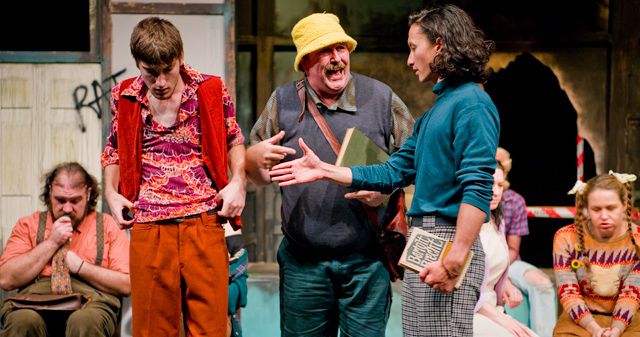
  5. Cosi - Canberra Repertory Theatre, Theatre 3: This is the first time I've ever seen Louis Nowra's Australian classic about an idealistic young man trying to put on an ambitious production of Cosi fan Tutte in a psychiatric facility with patients who can't speak Italian. Or sing. It's got a lot to recommend it, most notably the sensitive direction from Sophie Benassi combined with some great performances. Chris Baldock was entirely committed to his portrayal of Roy (and I don’t just mean in that ghastly haircut and costume). He maintained a consistency in his gestures and ticks that felt genuine and not excessive. Perhaps the true testament to his acting was that I was more interested in the person than the illness, and I feel that captures the essence of the play more than any other accolade. Max Gambale as Henry had the strength to portray a role that was largely non vocal and to make him interesting and appealing, with sensitivity when required – his outburst over the Viet Cong and his presentation of the toy soldiers towards the end of the play felt a little like set pieces, but the pay-off was well earned. All the female characters are underwritten and Ruth is one of the hardest roles to play - Alex Pelvin played her with such aching calm and continuity that she became the most realistic of the characters on stage. Her quiet questioning of every detail was clearly reflected in her dedication to the integrity of the role and her natural warmth translated into her being the one person I really wanted to watch. Meanwhile Steph Roberts was good at capturing the mood changes and personality shifts in Cherry's character, but she occasionally strayed into caricature and played lines for laughs rather than truth. There is an inherent problem with amateur productions of plays about amateur thesbians in that it can be difficult to discern the difference between the 'good' and the 'bad' acting, and this was evident on some occasions. On the whole, however, it was affirming: in a world of political divisions, individual preoccupations, performance anxiety and patriarchal expectations of 'normality', we discover that what really matters is truth, connections and love.
  6. Adam Hills: Shoes Half Full - Canberra Theatre Centre: Adam Hills is living proof that you can be a decent chap and still be bloody funny. He is inclusive and witty, highlighting his own inadequacies rather than belittling anyone else - he is happy enough to show us his prosthetic leg, to take it off, and admit that he would really have liked to have been born with two feet. His rapport with the audience is such that he even has the house lights slightly up so that he can engage more with us. He respects his fans from the deaf community and gets a laugh out of his sign language interpreter when he tells one of his more ribald or accent-related stories. I have heard some of these anecdotes before on previous televised tours or on The Last Leg but they are genuinely amusing due to the fact that he seems to get a real kick out of life (if you'll pardon the pun: I'm sure he would). Having lived in both countries and understanding the humour, highlights and cultural differences between them, he spans my UK/AUS divide perfectly (not a euphemism).

Thursday, 5 March 2020

Power to the people!

The Grapes of Wrath, Canberra Repertory Society
Theatre 3
13-29 February 2020


The Grapes of Wrath by John Steinbeck (published 1939) is one of those classic great American novels – it is taught in American high schools to the point that everybody knows it, even if they’ve only read the cheat notes or seen the 1940 film (directed by Tom Ford and starring Henry Fonda as Tom Joad) in order to pass the test. And it is a test. Full disclosure: I studied it at High School in New York (U.S.A), and I studied it for my university degree at Manchester (U.K.). It’s a tale that spans continents.

The 1988 play adapted by Frank Galati won the Tony Award for best play in 1990, and in the last thirty years has become a perennial favourite of high school productions. This is both a good and a bad thing, and a context with which to inform the Canberra Repertory production, directed by Chris Baldock.

The plot is fairly simple. During the Great Depression, the Joad family are driven off their land in Oklahoma due to a combination of drought, economic hardship, bank foreclosures and agricultural industry changes. They light out for the West (it is the American Dream, after all) in hopes of finding solid work and good fortune. It is not a spoiler to say things don’t turn out that way.

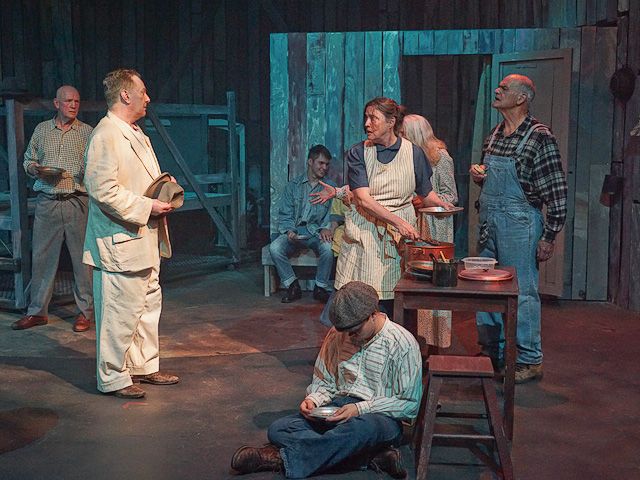
The set (designed by Chris Baldock; co-ordinated by Russell Brown) drew rounds of applause from the audience. It is a good set, made from pallets and angular constructions which variously represent houses, riverbanks and graves. The scene changes are complex and occasionally clunky, diverting attention from the dialogue or the emotion on stage to appreciation of the artifice.


The jalopy which the Joads load to travel to California is created on stage from flats and loaded up with bags and wheels, although it recalls The Wiggles more than the spirit of desperate adventure. At one point a rain curtain creates a deafening noise over which the actors cannot be heard, and soaks the stage although, strangely, not the actors. I refer to them as actors rather than characters, as this is another of those ‘stepping outside of the scene for the sake of the set’ moments.

The theme of family, friendship and community is one of the most powerful aspects of the story, and initially this is well handled as the multi-generational Joad family bustles about the stage doing chores and preparing a communal meal. It is also nicely contrasted with the isolation felt by Tom Joad (James McMahon) as he returns from a stretch in prison and encounters Jim Casey (Michael Sparks), the ex-preacher, who is struggling to come to terms with his new identity and the situation that has forced them away from all they have known.


As the family and a few extras embark on their journey this sense of community falls apart. Partly this is as members of the clan drop off by the wayside – Noah’s defection as played by John Whinfield is particularly affecting – but also because there is no sense of unity between the company. This should be an ensemble piece, but various actors proclaim and hold forth in a singular way without any perceivable warmth for their fellow cast. James McMahon and Amy Dunham (in a welcome return to the stage as Rose of Sharon) make overtures to the rest of the family, but they are almost rebuffed by a fearsome Ma (Karen Vickery), whose defensiveness is overplayed to the exclusion of the softer side of the matriarch.

Tom, Casey, and also Uncle John (played with hyper intensity by an almost unrecognisable Jerry Hearn), undergo personal, political and spiritual development with sensitivity and depth, dealing with hokey hillbilly dialogue – ‘There ain’t no sin and there ain’t no virtue. There’s just stuff people do’ – in a way that credits the acting and directing skills of all concerned. Considering this is a tale that led many to consider the implications of social economics, the differences between the socialist site and the capitalist camp are understated. Sure, the row of tents looks lovely, and the wire fence is an obvious allusion to camps closer to home, but the imminent threat is absent and the discussions about self-determination, unions, the rights of the worker, and responsibilities of the employer lack passion and are uninspiring.  


Essential qualities such as honour and resistance are given every chance to shine, and they do in solitary monologues but are lost in group moments: the dance and fight scenes are awkward, and the characters are not believable as the rough-and-ready types they represent. It is a stretch to believe in the resilience and perseverance of these average people whom circumstances have made extraordinary and it is not always clear that “We’re the people that live. They can’t wipe us out, they can’t lick us. We’ll go on forever, cos we’re the people.”

That’s not to say that there aren’t emotional scenes: the choices made in the face of starvation and the compassion shown by those suffering personal hurts are at times beautifully portrayed, not least by Dunham in the final scene. The lights fade on a touching tableau, highlighting human dignity; finally the motif of individual sacrifice to the greater good of the community is clear – and that is a wonderful way to finish. Power to the people.