I've peaked too early, with the conclusion - it's like turning to the last page before continuing with the story (people who do that blow my mind) - but for those who would like to play along with the moves of the game, they began in this post, and they follow below:
 |
| Bedside book pile July 2019 |
This is Kerry Young's second novel; the first was shortlisted for the Costa First Novel Award, and apparently many of the characters are the same - I haven't read it but it would appear to be almost the same story told from a different viewpoint. There is violence, prostitution, illegitimacy, class conflict, prejudice and redemption. I enjoyed it up to about half-way through, and then I began to get bored - it had nothing fresh or original to say and the pidgin English style became tiresome. Many others disagree, so maybe I should try another of her novels, but I'm not really in any hurry to do so.
Other books I read in July that were not on the list were The Bus on Thursday by Shirley Barrett (easy-to-read part thriller; part supernatural; part comedy novel about a primary school teacher's issues with mental illness in a rural NSW town), Ghost Milk by Iain Sinclair (a damning critique of grand projects; from urban developments and shopping malls to the structures involved in the London Olympics), and Rocky Road by Robert Wainwright (subtitled 'The Incredible True Story of the Fractured Family Behind the Darrel Lea Chocolate Empire', it covers the 'experiment' of a woman adopting children to be playmates for her 'natural' children and the consequences thereof).
Books read from pile: 17/25
 |
| Bedside book pile August 2019 |
I also read Today I Am A Book by xTx, because my peculiar reading scheme dictated that I needed to read a book by an author beginning with X. All of the short, poetic segments (it feels wrong to call them stories, and, besides, they have the tart juiciness of an orange) in this collection are introduced with the words ‘Today I am a…’ It is a great creative writing exercise, and a way to express thoughts and feelings, but a lot of them are complicated and negative.
Bonus reading (books not on the list) were the graphic novel adaptation of The Graveyard Book by Neil Gaiman (each chapter illustrated by a different illustrator gives it a sort of disjointed feel) and The Book of the Heathen by Robert Edric, which has a heart-of-darkness feel to the nineteenth century Congo explorations undertaken by a European mapmaker and anthropologist companion.
Books read from pile: 19/27
 |
| Bedside book pile September 2019 |
In my rules, it counts if you add a book to the pile and read it in the same month. Hence Someone Like Me by M.R. Carey counts. It has a good, creepy cover, and the novel has overtones of Stephen King, rooted in reality with strong doses of popular culture, and the central theme of split or multiple personalities.
I also read Boys Will Be Boys by Clementine Ford, which is excellent. While it has less of the explosive passion of Fight Like a Girl, it features more cohesive arguments and channels the rage of gender injustice in a more constructive flow.
Not on the list, but I read it anyway, was a new version of The House f Bernarda Alba by Federico Garcia Lorca, this time adapted by Rona Munro. It was suggested to me by a friend that I might like to direct it, but I am not keen, as the story still basically just features a bunch of women sitting around waiting to get married and hating each other because they are not the chosen one. The modern translation may try to bring out the injustice of the situation, but it is still a gender nightmare.
I also added An Orchestra of Minorities by Chigozie Obioma, because it was shortlisted for the 2019 Booker prize. It may be dressed up with classical mythology and Igbo traditions, but it is basically a patriarchal tale of a man behaving badly when he doesn’t get what he wants from a woman.
Not on the list, but I read it anyway, was a new version of The House f Bernarda Alba by Federico Garcia Lorca, this time adapted by Rona Munro. It was suggested to me by a friend that I might like to direct it, but I am not keen, as the story still basically just features a bunch of women sitting around waiting to get married and hating each other because they are not the chosen one. The modern translation may try to bring out the injustice of the situation, but it is still a gender nightmare.
I also added An Orchestra of Minorities by Chigozie Obioma, because it was shortlisted for the 2019 Booker prize. It may be dressed up with classical mythology and Igbo traditions, but it is basically a patriarchal tale of a man behaving badly when he doesn’t get what he wants from a woman.
Books read from pile: 21/29
 |
| Bedside book pile October 2019 |
October was a great month for reading for me, with Harvest by Jim Crace, shortlisted for the 2013 Booker Prize, being one of the highlights of the year. It is glorious, beginning in a bucolic vein (like Hardy’s pastoral interludes) but rapidly becoming much darker and more claustrophobic. Set against the movement from common land to enclosures; wheat crops and cattle to sheep it asks questions about private ownership of public land, when there are changing masters who is in charge of themselves, and how easy it is to blame women as witches to provide easy scapegoats.
Ali Smith’s seasonal quartet began with Autumn, published last year, and
continues here with Winter. The
subject is quite different but many of the themes are familiar. It is written
in a continuous fluid style, but with short sentences and without irksome
stream-of-consciousness. The novel embroiders snatches of literature and legend
into a rich tapestry: a retelling of Dickens’ A Christmas Carol for our times. This is a novel of stories and interpretations.
We are given tales of fertility; the Green Man, Sir Gawain and the Green
Knight, and defenders of past rituals and natural bounty. Smith combines the
richness of the past with the frustrations of the present and a glimmer of hope
for the future, believing that communities and compassion can overcome division
and isolation.
Mum gave me a copy of The Salt Path by Raynor Wynn, which I read and left with Scarey Sis, who I thought would enjoy it as much as I did. The author loses her home for financial reasons, and her husband is diagnosed with a terminal illness. With no ties to bind them, and very little money to support themselves, they set off to walk the South West Path. The tale is as much about the 630-mile trek as it is about homelessness, compassion and the state of the nation.
Books read from pile: 24/31
 |
| Bedside book pile November 2019 |
I practically devoured The Testaments by Margaret Atwood; a thinly-veiled polemic against totalitarianism. In her acknowledgments at the end of the 2019 Booker-Prize-winning novel, Margaret Atwood thanks “the readers of The Handmaid’s Tale; their interest and curiosity has been inspiring.” If my desire to know what happened after The Handmaid’s Tale is in any part responsible for the writing of this book, 35 years after its predecessor, you’re welcome. It’s been a long time coming, but it is certainly worth it, and after all this time, it still has a clear directive: “We must continue to remind ourselves of the wrong turnings taken in the past so we do not repeat them.”
For something completely different, I read The Cat who Sniffed Glue by Lilian Jackson Braun - it was on my bookshelf so why not? It's a light-hearted mystery featuring an eligible bachelor, and two Siamese cats. It positions itself firmly in the category of 'cosy mysteries', subsection; if you know what to expect from this genre; you won't be disappointed.
A friend recommended that I read Brothers by Yu Hua. It is a sprawling and picaresque epic focussing on step-brothers Baldly Li and Song Gang. The first half of the novel concentrates on their childhood and adolescence during the Cultural Revolution, and the second half features their adulthood, successes and otherwise during the early period of China's Opening-Up. It is wry, ribald and Rabelaisian with plenty of sex and violence delivered as farce and satire.
Books read from pile: 25/34
 |
| Bedside book pile December 2019 |
I was quite busy reading in December; one of my favourite pastimes so no complaints here! I also polished off four books that were on he list, and one that wasn't. Starting with the one that wasn't, A Universe of Sufficient Size by Mirian Sved was a recommendation from a friend. Spanning continents and three generations, this rich novel of mathematics, politics, friendship, family, sexuality and love, features numerous time and narrative shifts. And I loved it.
Girls Burn Brighter by Shobha Rao also details an incredible friendship, also across continents and decades. But the persecution in this one derives from sexism rather than fascism and the women in this novel (Savitha and Poornima) are variously raped, abused, starved and mutilated because they are female and they are poor. It becomes a touch stereotypical, which is a shame, because it could have a lot to say beneath the layers of cliche.
Girls Burn Brighter by Shobha Rao also details an incredible friendship, also across continents and decades. But the persecution in this one derives from sexism rather than fascism and the women in this novel (Savitha and Poornima) are variously raped, abused, starved and mutilated because they are female and they are poor. It becomes a touch stereotypical, which is a shame, because it could have a lot to say beneath the layers of cliche.
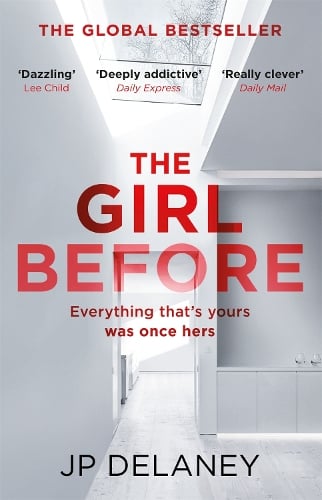
The Girl Before by JP Delaney is supposedly an erotic thriller, but it feels a little predictable and formulaic. It's not about a girl, before, after or present; it is about a house and a man’s viewpoint of manipulation and control. It is an entertaining read, but it is not earth-shattering. Shock value isn’t everything, and its veneer wears off very quickly - maybe it's time to give this style of book (girl in the title = unreliable narrator) a rest.
If it is not already apparent, let me state that I love books and books about books, so Ex Libris by Ross King, which purported to be about a whole library, should have really stocked my shelves. But it felt flat, partly due to the confusing plot, which was all over the place (and not in a good way), and partly due to an over-indulgence in historical research - I know it's set in the 1600s and the author is very knowledgeable about the period, but I didn't feel as though he needed to shoehorn those facts in at every available and inopportune gap in the narrative.
Where I was overwhelmed with insight and anecdote was Anthony Holden's biography, Olivier. He was a theatrical colossus and he made as many right as wrong choices of production and partner, but he remained dedicated to a craft that changed rapidly from stage to screen. It's also fascinating because it was written 40 years after Olivier's acting heyday and 40 years before today's judgmental generation. Holden, therefore, manages to review Olivier's towering performance of Othello without once mentioning the awkward issue of blackface. Those were different times indeed.
Books read from pile: 29/35
 |
| Bedside book pile January 2020 |
And so I begin again...