- Kehua! by Fay Weldon - "Novels can no longer sit on shelves and pretend to be reality; they are not, they are inventions, suspensions of reality, and must declare themselves as such." Fay Weldon's post-modern novel has layers of overlapping stories and lashings of authorial intrusion as she addresses the theory that we are all haunted by ancestral echoes and that we ourselves are the ghosts of the future. The eponymous kehua are Māori spirits who follow their kin across the world to bring them home where they belong. Which is why they end up in a basement in London while a great Greek tragedy plays out in Highgate. Peopled with a host of unlikeable characters and sweeping family dynamics, it's dramatic and clever and archly self-referential.
- Duende: A Journey in Search of Flamenco by Jason Webster - Flamenco is more than just a dance; it's a spirit, a passion and a way of life. Jason Webster tries to seek it out in this travel memoir through Alicante, Madrid and Granada. The blood-pumping adventures he undertakes en route teach him something about the duality of being in simultaneous ecstasy and despair, as he realises that flamenco means something different to everyone. From gun-toting gangsters, faithless lovers, sadistic guitar teachers and coked-up car thieves, he encounters many versions of the art, while trying to find his authentic self. It's certainly got flair.
- Homage to Barcelona by Colm Tóibín - A companion to George Orwell's Homage to Catalonia, Tóibín writes with insight and rich detail about the history and appeal of Barcelona. It was a pleasure to read while actually in the city and to recognise the landmarks and the peccadilloes of the people, as he darts down twisted alleyways of linguistics, art and politics, leaving the reader breathlessly struggling to keep up. Although originally published in 1990 (when he hoped the Barcelona Olympics wouldn't have a detrimental effect on the city), it maintains contemporary relevance. As a cautionary note, it must be mentioned that it borders on the academic and is a series of serious essays that should be approached as an educational study rather than as an armchair travel book.
- How to Kill Your Family by Bella Mackie - In my defence, I wasn't reading it as an instruction manual! This is fun, sharp and darkly comic, apparently inspired by the Ealing comedy Kind Hearts and Coronets, which I've never seen. The antihero seeks revenge on her family after she learns her father wanted nothing to do with her or her mother after he knew of her existence. It's written in conversational tone by a narcissistic bitchy narrator who looks down on everyone else, although she's the one in prison. It's not a mystery as such, because she tells us from the beginning how many murders she has committed, but there is still an unexpected and well-plotted ending. Great macabre fun.
- The Sisters Brothers by Patrick DeWitt - This month's family book club book chosen by My Cousin Rachael. Two brothers are hired as hit-men to bump off a goldminer who has worked out a formula for finding more of the precious metal more easily. Their travels take them across Oregon in a Wild West picaresque series of events that recall Mark Twain crossed with Cormac McCarthy. Shortlisted for the 2011 Booker Prize and made into a 2018 film (starring John C. Reilly and Joaquin Phoenix), it seems like a deceptively simple and straightforward stoic narrative but there are nuggets of profound existentialism if you dig deep enough.
Showing posts with label Jason Webster. Show all posts
Friday, 2 June 2023
Friday Five: Books Read in May
Friday, 5 May 2023
Friday Five: Books Read in April
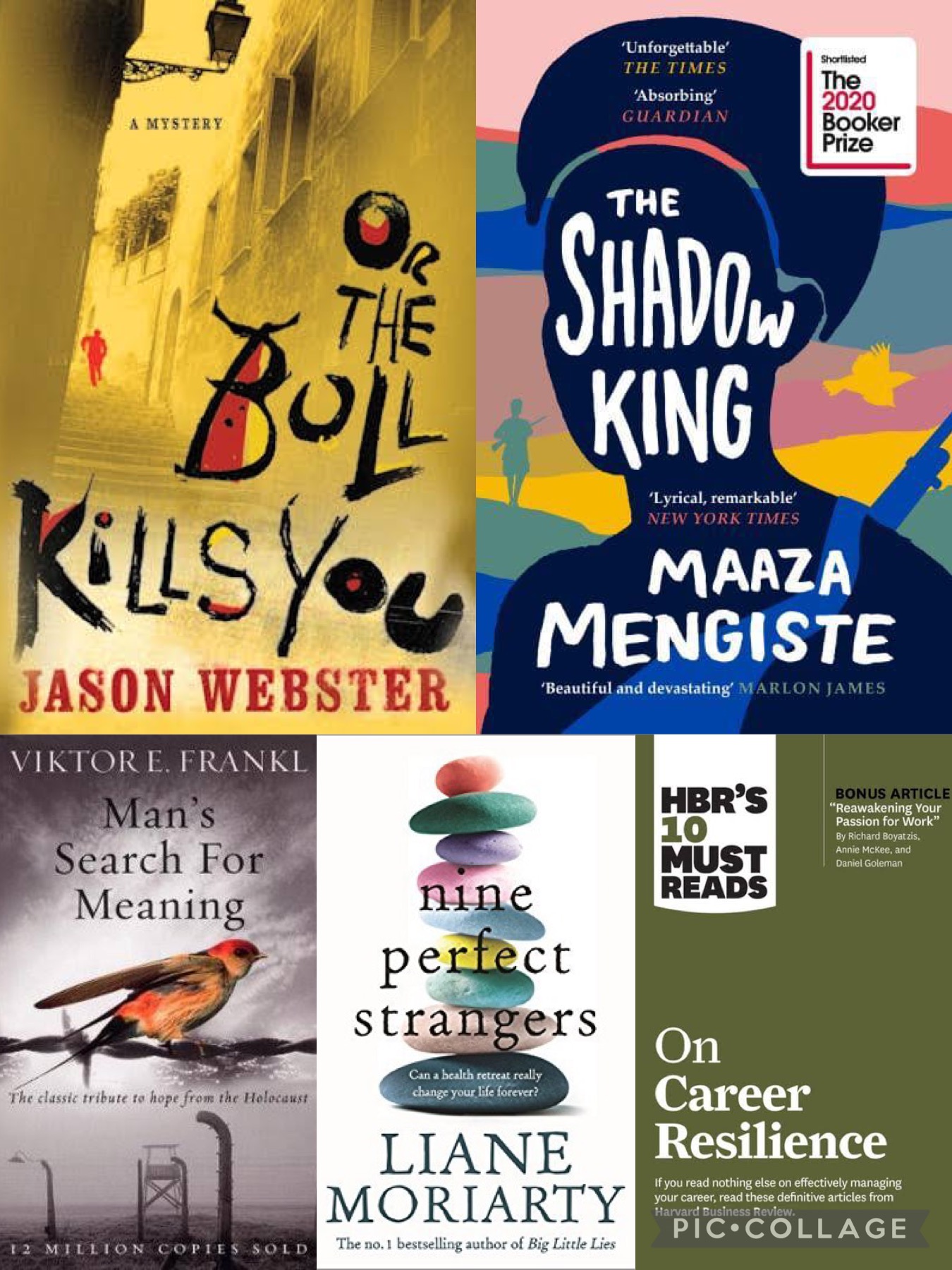
- Man's Search for Meaning by Viktor E. Frankl: Translated by Ilse Lasch, this is billed as 'the classic tribute to hope from the Holocaust'. Viktor E. Frankl was Professor of Neurology and Psychiatry at the University of Vienna Medical School. He was the founder of what has come to be called the Third Viennese School of Psychotherapy (after Freud’s psychoanalysis and Adler’s individual psychology) – the school of logotherapy. During World War II he spent three years at Auschwitz, Dachau, and other concentration camps. His outlook on the need to stay curious, the drive to understand one's experiences and the knowledge that these cannot be taken away no matter what, would be remarkable under any circumstances, least of all these. He suggests we embrace our past - our relationships and actions - connect with nature, and retain our humour while looking to the future. Logotherapy is the search for meaning (from the Greek logos, which translates as meaning), and it is up to us to find it. “There is no reason to pity old people. Instead, young people should envy them. It is true that the old have no opportunities, no possibilities in the future. But they have more than that. Instead of possibilities in the future, they have realities in the past – the potentialities they have actualised, the meanings they have fulfilled, the values they have realised – and nothing and nobody can ever remove these assets from the past.”
- Nine Perfect Strangers by Lianne Moriarty: Nine disparate people head to a wellness retreat for various reasons - the treatments are revolutionary and the clients are cautioned to accept the strangeness and trust the process. When they come to realise they are being manipulated for dubious purposes, they must work together to extricate themselves. It's fairly fast-paced, although it drags a bit towards the end, and the reader spends times getting to know stereotypes with a second (equally shallow) layer. It's exactly the sort of thing that would get picked up as a film or a TV series, and Moriarty knows it - I note that it was made into a TV series co-written by David E. Kelley and John-Henry Butterworth in 2021.
- Or the Bull Kills You by Jason Webster: Chief Inspector Max Cámara is “a dope-smoking, Fallas-hating, proverb-quoting, flamenco-loving, Valencia-based murder detective with the Policia Nacional, with a complicated, shattered love life, no social life to speak of, and a career lying in tatters.” The novel is set in Valencia with bullfighting and Fallas (the main festival in Valencia) as crucial elements of the story - the crime being investigated is the murder of a man found naked and lying in the centre of the bullring. Each chapter begins with a quote about bullfighting including traditional epithets such as ‘Either you kill the bull or the bull kills you’, which is the beginning of Chapter One. The novel explores the history and cultural relevance of bullfighting – “You can’t really understand the culture and history of this country without knowing something about bulls and bullfighting.” It is evocative in time and place as Webster writes with insight and affection about the various districts of the city; their characteristics and their food.
- The Shadow King by Maaza Mengiste: When Italy invaded Ethiopia in 1935 the Ethiopian emperor, Haile Selassie fled to England to raise support. In his absence, a man named Minim (it translates as 'nothing') was found to resemble Selassie in appearance and so was dressed in a makeshift uniform and seated on a horse at a distance to strengthen the morale of the Ethiopian soldiers. He was guarded by a fierce warrior troop made up of women and led by Aster. One of the personal guards, Hirut, had previously been a servant of Aster and her military husband Kidane, although she has been sorely mistreated by both of them. As their stories unfold they interspersed with snatches of opera and Greek chorus (to which Selassie listens to distract himself from exile) and photographs taken by a young Venetian soldier, Ettore, himself a victim of the antisemitism growing in his own country. The 2020-Booker-Prize-nominated novel is full of characters and themes and is outrageously ambitious - at times it is difficult to separate the narrative strands, but it is a glorious achievement that the story of the forgotten women in the fight is woven strongly and tightly throughout.
- HBR’s 10 Must Reads on Career Resilience by Harvard Business Review: The book contains information about how to survive in a constantly-changing business landscape. Articles cover topics such as how to create and use networks, how to bounce back from adversity, how to play to your strengths, and how to negotiate a job change. The top tips seem to be to keep learning new things, stay curious, and to always be working, constantly updating networks, seeking feedback, self-reflecting on strength and weaknesses, or volunteering in 'side gigs'. According to the opening article, by Peter F. Drucker, we are no longer predestined to fulfill a role. “Now, most of us, even those with modest endowments, will have to learn to manage ourselves. We will have to learn to develop ourselves. We will have to place ourselves where we can make the greatest contribution. And we will have to stay mentally alert and engaged during a 50-year working life, which means knowing how and when to change the work we do.” It makes resilience sound exhausting and suggests that career and [financial] achievement are the only things that matter in life. Perhaps balance is not to be expected from the Harvard Business Review, but this has made me feel less resilient and more burnt out than ever.
Subscribe to:
Posts (Atom)