Showing posts with label My Newest Favourite Thing. Show all posts

Wednesday, 7 August 2024

My Newest Favourite Thing: The Wharfies' Mural


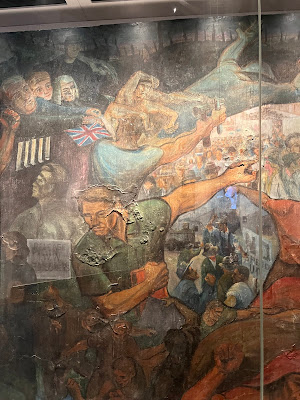
One of the most iconic treasures in the Australian National Maritime Museum is the Wharfies’ Mural. It is a window into the cultural movements that occurred among workers on the waterfront during the 20th century, and a reminder of their significant role in broader Australian politics and society.

This mural, an iconic example of Australian working-class cultural expression, originally adorned the canteen walls of the Waterside Workers' Federation building in the busy waterfront of Darling Harbour. Painted in stages mainly between 1953 and 1965, it was a collective effort by nine artists, including waterside labourers, or 'wharfies'. 


Though vital to Australia, wharf labouring was hard, dangerous, low-status work. The maritime unions had long fought for improved wages and conditions, and they took a lead role in national campaigns for social justice, minority rights and anti-war activism. This mural celebrates and memorialises that history.

The Waterside Workers' Federation encouraged the cultural and artistic development of its members. With the support of union leader Tom Nelson, artist Rod Shaw and wharfie Sonny Glynn developed a design that could intertwine maritime and labour history. For years wharfies ate their lunch as the artists worked, debating the social and political struggles as they appeared on the wall.


Reflecting the social and political ideals of those involved, the mural for the Waterside Workers' Federation (WWF) canteen was a collective effort. By the 1950s murals were important to left-wing and working-class cultural expression, particularly in communist circles. Rather than elite activities, artistic creation and appreciation were seen as accessible to everyone. Realist art and so-called 'conscious propaganda' were a focus. Producing banners and placards for May Day marches set the creative groundwork for the mural's creation. Mural artist Evelyn Healy for example, first painted banners for May Day in 1938.

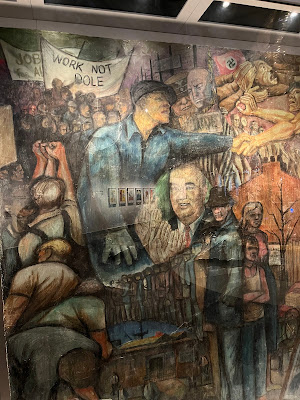
Conversations between the artists, union leaders and wharf labourers guided the struggles and victories that the mural depicted. With the help of wharfie Sonny Glynn, Rod Shaw projected the initial sketches onto the wall and then outlined them in chalk. He then painted over them in oil paint created with pigments from the printery where he worked. Shaw conceived the mural's structure as major themes painted in dark, sepia tones with spaces left for cameos, or small windows, that would be painted in full colour by different artists. He described the effect as 'like a tapestry'.


From those first lines on the wall, the mural eventually wrapped around multiple surfaces in the canteen. It was created in four phases. The first was from 1953 to around 1956 by Rod Shaw with Sonny Glynn, Evelyn Healy, Vi Collings, Harry McDonald and Pat Kelk Graham. The second phase between 1957 and 1960 was painted by Clem Millward and Harry Reade, assisted by Ralph Sawyer. The third phase in the early 1960s saw Sonny Glynn returning to work on the mural with Sawyer. During the final phase after the mural was relocated in several pieces to the new union building, Swayer filled the remaining blank cameo in 1993.
"The ideas for the mural were discussed with a lot of people. Many of us did preliminary sketches for the General Strike of 1917; that's where we started... We got a rough idea and finally Rod put some rough-outs up on the wall." - Artist Vi Collins, 1992

The harsh physical and economic realities of waterside labouring drove the creation of maritime unions in the 1800s - collective effort to ensure safer and more just working conditions. The struggles, aspirations and victories expressed in The Wharfies' Mural reveal a far-reaching trajectory with implications for workers in Australia today. What began as a localised fight on the docks in the 19th century led to ongoing organised agitation for social change. Union support for Aboriginal and Torres Strait Islander justice, women's economic equality, worker's rights, internation solidarity and global peace continues well into the 21st century.


Art and politics are often intertwined. The mural examplifies this convergence. Local artists, inspired by Socialist Realism and left-wing thought, formed groups such as the Studio of Realist Art, hoping to take art from a prerogative of a few to a concern of the many. Likewise, progressive film-making, theatre and visual arts in the 1950s sought to depict the seemingly invisible experiences of the working class and make them accessible to all. Created through communal effort and now preserved for future generations, the mural speaks to the wharfies' trials, triumphs and shared cause. 
"I believe it is... a very early example of a cooperative work of art. It involved time, a lot of thought, you know, a lot of everything - a lot of heart." - Artist, Clem Millward, 1992

Tuesday, 7 May 2024

Flyball!


I am not sure or not whether this is my newest favourite thing, but it is certainly a thing that came to my attention at the Canberra Show earlier this year. I had not heard of Flyball before. It is described in the Australian Flyball Association website as ‘a relay race between two teams of four dogs. Each dog must jump over four hurdles, retrieve a ball by triggering a flyball box pedal and then return over the hurdles to the start/ finish line’. 

Whereas the site continues to say, ‘Flyball is a canine team sport which is founded on the activities that dogs love to do - run, jump, fetch, retrieve, compete and most of all: their desire to please their owners’. But it would say that, wouldn’t it? A common internet search ‘is Flyball good for dogs’ returns the result, ‘it places greater stress on the body, increasing the risk of a potential muscular injury.’


Other questions ask which are the best breeds to participate in Flyball. The answer here is ‘There is no discrimination in Flyball. Any dog; regardless of breed, size, shape or formal training, can participate and join in on the fun’. It’s true, we saw a range of dogs competing, with the border collies and kelpies enjoying themselves and the smaller terriers and hounds executing incredible flying leaps. 

There is lots of noise and organised chaos and some beautiful dogs who missed the ball every time or collided with the hurdles, but the whole thing seems conducted with high spirits and humour. As long as they are all having fun and not feeling any pressure to perform, I think they are all good boys and girls.

Tuesday, 27 June 2023

My Newest Favourite Thing: Stirling Castle


It's not strictly true to say that Stirling Castle is a newest favourite thing because I went there about four years ago, but I liked it very much and, although I have posted about the monarchs who lived there, and the Dos and Don'ts of Kingship, I have not yet posted about the castle itself, so here we are. 

Perched atop a cliff, it is an imposing structure along the lines of Edinburgh Castle. It dominates the landscape above the river Forth at the meeting point between Lowlands and Highlands, and the tourism info claims it was the key to the kingdom of Scotland. During the Wars of Independence, which were civil wars among the Scots as well as a struggle between Scotland and England, the castle changed hands eight times in 50 years. It was the focal point for famous battles such as Stirling Bridge (featuring William Wallace) and Bannockburn (starring Robert the Bruce), in which Robert captured the castle back from the English but destroyed its defences to stop it being used by the English in future. 

Robert the Bruce is a complicated character who seems to have been on and off the English side until neither Edward I (reigning monarch in England) or the Scots really trusted him. What he really wanted was the crown of Scotland, to which his family held a claim along with several other powerful families. He stabbed the heir of one of those to death, became King of Scotland and had bloody civil wars with the family of the deceased claimant. Whatever his credentials, he is clearly admired enough to have a statue of him built just outside the castle.


There are commanding views from the battlements, as you might expect, and also some interesting archaeology. Intriguingly enough, research carried out in 2011 revealed that King Arthur's round table may well have been hidden beneath the historic King's Knot that sits below the castle. 

The King's Knot
The King's Knot, best appreciated from the Ladies' Lookout in Stirling Castle, is on the grounds of the ancient King's Park, Crown property from at least the 1100s, where Scotland's royalty partook in jousting, hawking and hunting. The earthworks known as the King's and Queen's Knots were part of the formal gardens of Stirling Castle, and were remodelled for Charles I's 'hamecoming' for his Scottish coronation, which took place in 1663.

You can also see the amazing burial grounds, such as the Old Town Cemetery which spreads over the valley between the castle and the Church of the Holy Rude. A burial ground has occupied the site west of the Holy Rude Church since 1129, when the first Dominican Chapel was built here. For most of Stirling's history, those who could afford memorials were laid to rest beneath the church floor, a practice which ceased in 1623 officially 'to avoid the great abuse and profanation of God, his house, in burying of dead corpses', but actually because the stench within the kirk had become unbearable.


Many of the graves are marked only with initials and symbols; names are rare as such identification would be a sign of sinful vanity. Who you were didn't matter, whereas what you were, did - thus stones bear the marks of a hammer, mallet and chisel (Masons and Quarriers), skulls, crossed-bones and hourglasses (Death), an Angel, Green Man or Ouroboros (Resurrection) or symbols of trade or business (Occupation).

In November 1823, 'Resurrection Men', graverobbers seeking corpses for medical study, visited the cemetery probably surmising that as it was terribly overcrowded, a few bodies wouldn't be missed. In the 1840s, the new Valley Cemetery was landscaped 'as an ornamental cemetery according to the most approved manner of a modern necropolis' by evangelist William Drummond. Its straight lines and regimented rows were inspired by scripture: 'the crooked shall be made straight, and the rough places plain.' (Isaiah 40:4).


That's quite a lot about the surrounds, now for the castle itself. After entering through the main gate, the Queen Anne Gardens are through the next archway. This peaceful and pretty garden is on the 'sunny south side' (remembering this is Scotland) of the castle, overlooked by the Queen's Lodgings and the Prince's Tower. There may have been a royal garden here since the 1400s; the flat lawn was turned into a bowling green in the 1620s, and the beech tree is over 200 years old. 

The castle has been both a great royal residence and a powerful stronghold. Following the attempted Jacobite invasion of 1807, improvements to the castle's defences were ordered as a matter of priority.  The main front wall was extended outwards to form Guardhouse Square. This had the effect of creating two defensive walls, both of which were fronted by ditches defended by covered firing galleries known as caponiers. To the rear of the walls, chambers called casemates were built to strengthen the wall and provide gun emplacements. The French Spur was modified slightly to allow more canons to be mounted. 
The main parts of the castle are arranged around the quadrangular Inner Close: the Royal Palace; the King's Old Building; the Chapel Royal; and the Great Hall. 
In times of peace, Scottish royalty came to Stirling to enjoy its comforts, the superb hunting and to hold court - the castle was often the centre of government. Royal building projects like the Great Hall, the Chapel Royal and the Palace of James V marked it out as one of the most important places in all Scotland. It was also a childhood home of some of the most famous people in Scottish and British history, such as Mary Queen of Scots and James VI and I. 
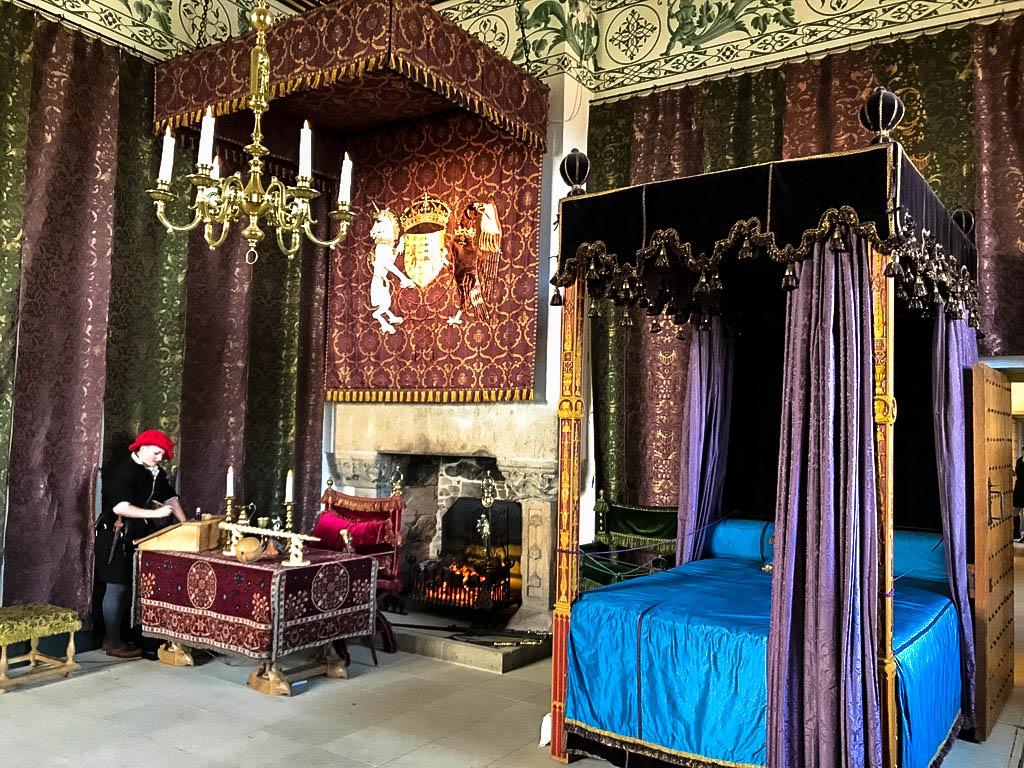
The Royal Palace is one of the best-preserved Renaissance buildings in the UK and has been refurbished to look as it might have done around the 1540s. Simply decorated and furnished, it recalls the years when it was the childhood home of Mary Queen of Scots.  The royal chambers include the magnificent rooms where nobles and courtiers met their monarch, and the bedrooms where the royals retired with their closest companions. They are also home to brightly-painted replicas of the Stirling Heads and the Hunt of the Unicorn tapestries
The architecture is French-inspired, but the decoration is German in inspiration, and sources for the statues have been found in the work of the German engraver Hans Burgkmair. The statues include a line of soldiers on the south parapet, and a series of full-size figures around the principal floor. These principal figures include a portrait of James V, the Devil, St Michael, and representations of Venus and several planetary deities. Their arrangement on the north, east and south faces of the Palace has been interpreted in relation to the quarters of the heavens. 
Internally, the Palace comprises two apartments, one each for the king and queen. Each has a hall, presence chamber, and bedchamber, with various small rooms known as closets. The Renaissance decoration continued inside, although little has survived the building's military use, excepting the carved stone fireplaces. 
In the King's Outer Chamber

The Great Hall is the largest of its kind ever built in Scotland and was used for feasts, dances and pageants. The exterior walls are a distinctive colour, rendered in Royal Gold Harling, as they would have been in the 1500s.
Completed for James IV in 1503, the Great Hall has four pairs of tall windows at the dais end, where the king and queen sat, and was heated by five large fireplaces. There are galleries for minstrels and trumpeters. In 1594 James IV held a banquet in the hall for the baptism of his son, Prince Henry. It was so lavish that the fish course was served from an enormous model wooden ship complete with firing canons and featuring live mermaids. These extravagant celebrations are thought to be the origin of the term 'pushing the boat out'.
Stained glass window in the Great Hall

The King's Old Building is the oldest part of the Inner Close. It was begun as a new residential range by James IV and originally comprised an L-shaped building. The principal rooms were on the first floor, over cellars, and included two chambers with wide open views to the west.


The Chapel Royal was built in just seven months on the orders of James VI who wanted somewhere suitable for the baptism of his son and heir Prince Henry. Dating from 1593-4, it was one of the first Protestant kirks in Scotland and also the last royal building at the castle. In 1603 the union of the crowns saw James head south to rule from England, and in 1625 he was succeeded by his surviving younger son, Charles I. The handsome frieze painted by Valentine Jenkin in 1628 was created in the expectation of a coronation visit to Scotland of the new king. 


The stunning white, blue, red and gold altar cloths were embroidered by members of the Stirling Branch of the Embroiderers Guild. Designed by textile artists Malcolm Lochhead, they take inspiration from the waves and seascapes of the chapel's upper walls. Upon completion, the cloths were dedicated to the children and teacher who lost their lives in Dunblane Primary School in 1996. Today they are used in interdenominational worship. 


Stirling Castle later became an important military base and eventually home to the Argyll and Sutherland Highlanders. Some of the vaults display barrels, which once contained gunpowder. Others showcase exhibitions from the romanticisation of Scotland (encouraged largely by Sir Walter Scott) and the identity of Highlanders, to the engineering feats of Robert Stevenson and the photography of Erskine Beveridge.


Stirling Castle is a truly fascinating place and well worth a visit. Would recommend.