Showing posts with label convicts. Show all posts

Wednesday, 22 February 2023

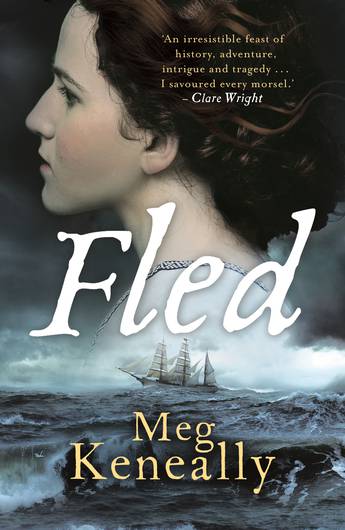
Daring Escape: Fled

Fled is based on the life of Mary (Dabby) Bryant, the woman behind one of history’s most daring escapes. Sentenced to seven years transportation to Australia, she escaped from the colony and sailed over 3,000 miles for 66 days in a stolen open boat with her husband, two children and other companions to West Timor (Coepang as it was then called). Here she was discovered, arrested and returned to Britain to be incarcerated until she was taken up as a cause célèbre by James Boswell who set her up in a house and sent her a stipend after she returned to Cornwall. In an Author’s Note, Meg Keneally stresses that this is a work of fiction, which is why she has changed some elements of the story, including names of the characters – Mary Bryant becomes Jenny Trelawny, later Gwynn after marrying Dan Gwynn.

The first part of the novel concerns Jenny’s route to crime and the highway robbery for which she was transported to the other side of the world. There is a detailed account of that trip on the Charlotte, on which she conceives and after which her daughter is named. She befriends Captain James Corbett, whose character is based on that of Watkin Tench, who tells her, “We don’t need to remake Newgate on the other side of the world. Well, I imagine there will be a guard house, or something like it. I’m sure that not everybody has left their criminal disposition back in England. But the entire place is intended as a prison. We’ll have no need of walls for the most part, it is to be hoped. We’ll have the ocean.”
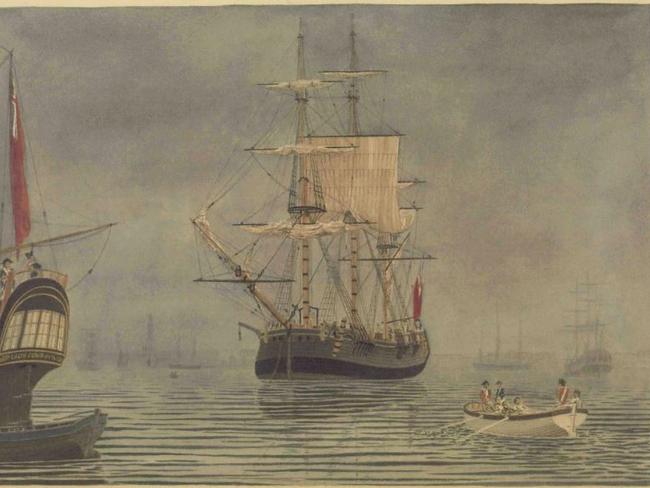
The Charlotte at Portsmouth, May 1787 from Frank Allen's The Ships of the First Fleet

Life in this colony is brutish and cruel, as it is intended to be, in a land that must seem upside-down. The triangle that is used for the floggings is “an ominous symbol, a profane and subverted trinity.” To save herself from rape and degradation by the male convicts and soldiers, she marries Dan and has another child, Emmanuel (these were the real names of Mary Bryant’s children). Married couples are given separate quarters but others, jealous of what they perceive to be her advantages, strive to bring her low. When their actions result in Jenny being expelled to the women’s camp, she reflects, “While space was the only blessing this colony provided in abundance, it was one of the many denied to the hut convicts. Jenny now lived in a place of wails and screams and sobs and fights, of stench upon stench, of dangers buried in innocent conversation.”

From the moment she lands in Botany Bay, Jenny knows she wants to leave, and it soon becomes apparent that their best chance of survival is escape. Food is scarce, supply ships are absent, farming is in its infancy, and provisions are rapidly dwindling; making theft of food a hanging offence and starving to death a distinct possibility. Perhaps if the settlers had collaborated with the local people they might have had better chances of survival, but there is limited interaction between the white settlers and the Indigenous tribes. Jenny encounters an Aboriginal woman who shows her what leaves to chew or to brew to avoid scurvy. Although these are plentiful, Jenny guards this knowledge as currency, as she does when the Indigenous people take her fishing and share their methods with her.

Questions have been asked as to why Mary Bryant would risk a journey for herself and her children on the ocean and potential drowning. As well as starvation, the new colony is rife with disease (particularly smallpox) and the dangers to the women convicts are manifold. “Emmanuel’s death at sea is a possibility. His death here is nigh on certain.”

1930s era illustration of the convict escape
Much of the action of the novel takes place on the water, either in the Charlotte, or the cutter in which Jenny and her companions make their escape. These seafaring experiences are described in some length, which is both terrifying and tedious as indeed it must have been in reality. When they land, Dan’s bragging of his expertise at sailing the boat back to Coepang, leads to them being discovered and their subsequent arrest. The governor who had supported them and admired their skill and courage when he thought they were shipwrecked, turns against them when he learns they are escaped convicts, because he is angry that he has been cheated and make to look a fool; he fears for his reputation and “Laughter, laughter on the seas as the story spreads about the dupe of a governor.” Jenny is frequently at the mercy of men and their egos.

Eventually she returns to her family in Cornwall. She had been afraid of their reaction, but they are thrilled to see her and welcome her back, so the story has come full circle. This is one of the bits that the author has invented, but it makes for a satisfying conclusion. Mary Bryant’s adventure is a fascinating story and, although she has changed the names to compensate for lack of certain facts, Meg Keneally has told it with drama and compassion.

Wednesday, 12 September 2018

The Human Face of History


Crime, Punishment and Redemption: A Convict’s Story by June Slee 
(NLA Publishing), Pp. 194

The diary of John Ward is one of the few existing records of life from the perspective of a convict. He was sentenced to ten years transportation to Australia in 1838, before which he spent 19 months on the prison hulk York, moored at Gosport. He was then transported on board The Mangles (1839-1840) but by the time he arrived in NSW, they were no longer receiving convicts, so he was sent instead to Norfolk Island. During 1840-1844 he came under the more humane system of Captain Alexander Maconochie and his marks system, before being sent to Van Diemen’s Land to serve out the final four years of his sentence.

June Slee is delighted with this diary of 155 pages, which provides valuable information about the period. In this book she has copied excerpts from the dairy, adding analysis and background. It is lavishly illustrated with photos, paintings and images of artefacts, collected by the National Library of Australia. Interpretative sections on a variety of topics add colour and include smuggling; eating out; fox hunting; county courts and the justice system; hulks; homosexuality (punishable by death – between 1801 and 1835 more than 50 men were hanged in England for sodomy); convict ships (often shoddy and barely sea-worthy); surgeons-superintendent (the highest ranking man on the ship; he had power over all the convicts; a decent one made a huge difference); convict class and society; and evangelicalism (men could be saved through religious conversion).

In some ways it is reminiscent of Moll Flanders, dwelling on the sordid and squalid aspects which sell, and then the religious conversion and desire to do good seem narratively disappointing. His religious conversion is probably a result of the evangelical tracts which were in vogue at the time. He sees life through the eyes of the evangelists and shuns relatively innocent pleasures such as the line-crossing ceremony held as the Mangles crossed the equator, describing it as “very improper”. The diary in effect becomes an extended confession in which he interprets his previous lifestyle with new-found disapproval.

As a surviving record of transportation, John Ward’s diary adds a human element to the statistics. “Transportation to Australia began with the arrival of the First Fleet at Botany Bay in 1788 and ended when the Hougoumont landed 279 convicts in Western Australia in 1868. Over that 80-year period, an estimated total of 163,000 convicts was sent to Australian penal colonies from Britain.”

Sections on Captain Alexander Maconochie are fascinating from a philosophical perspective as to the future of the nation. He believed that punishment alone would not result in peopling the colony with desirable citizens, and that it was important to recognise that those who were convicts would become settlers.

In writing his diary, John Ward hoped that it “may prove of service to those that may come after me”. Clearly he was intending to convert potential sinners to his brand-new evangelism, but it has proved invaluable to those studying this fascinating period “as a rare, if not unique, eyewitness account of the final decades of British transportation to the Australian penal colonies.”