Showing posts with label glass. Show all posts

Tuesday, 25 May 2021

My Newest Favourite Thing: Ken & Julia Yontenani

Five years ago I went to an exhibition at NGA Contemporary. The gallery closed the next day. It's not my fault, honest - the gallery on the Lake Burley Griffin waterfront was only open for 18 months with articles at the time citing 'the federal government's continued efficiency dividend imposed on several cultural institutions' or 'relentless government cutbacks' as the reason for the closure. Anyway, I was clearing some photos from my phone because it's full (hard to believe, I know, being as it's still got photos from five years ago on it...), and I came across these from the exhibition so I thought I would share.

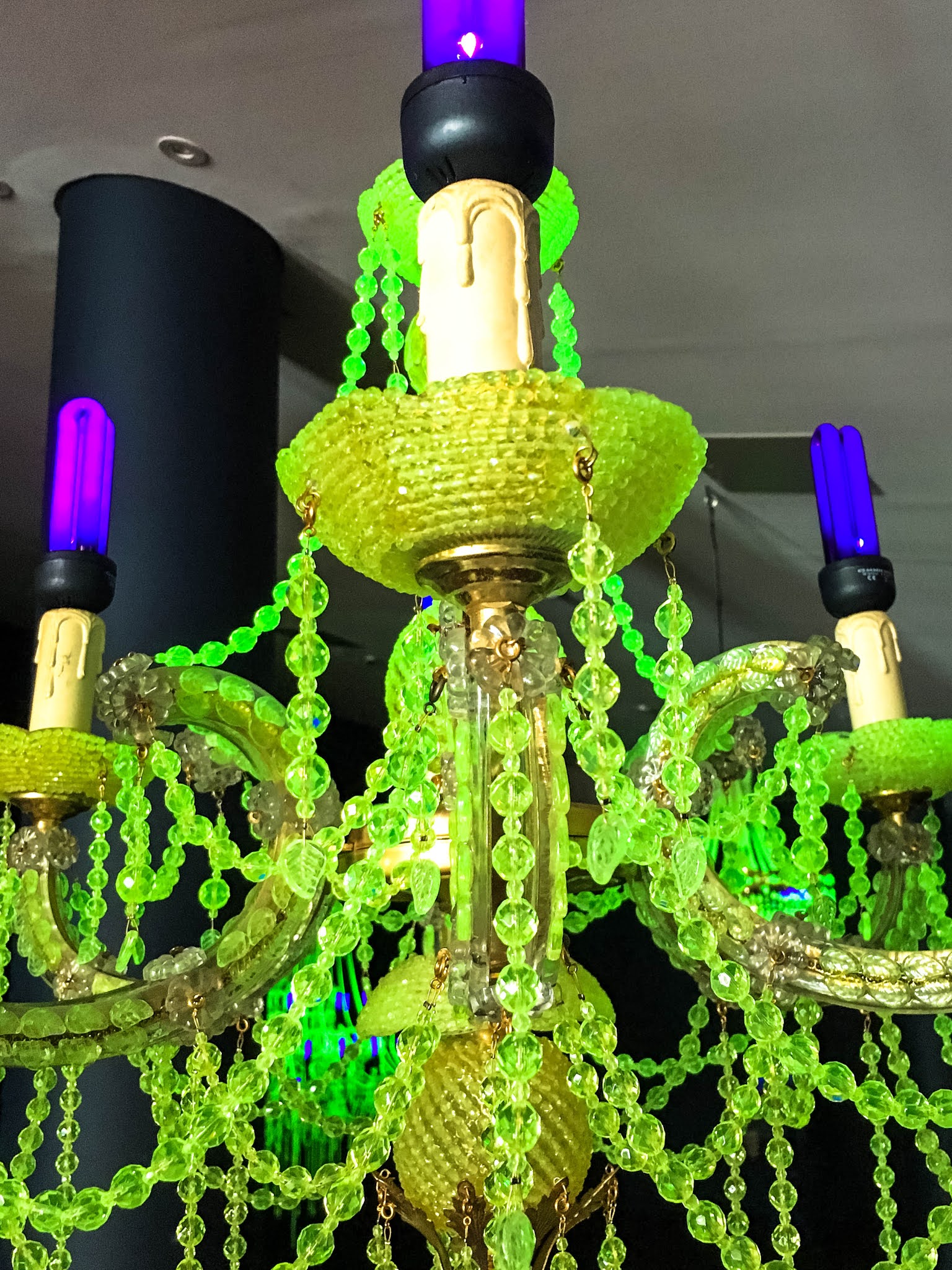
In two major installations, artists Ken and Julia Yonetani explore the notion that although the world appears rich in natural resources, the well-being of the planet is held in precarious balance. The first exhibition, Crystal Palace: The Great Exhibition of the Works of Industry of all Nuclear Nations is a provocative response to the Fukushima Daiichi nuclear power plant disaster in Japan in 2011. In an installation of chandeliers reconfigured to emanate UV light, and decorated with specially sourced uranium glass, each chandelier represents a country that operates nuclear power stations and is of a scale relative to that country's nuclear output. 

The idea of using the chandelier was sparked when the Yonetanis were entranced by the displays in the shop windows while on a bus ride in London. Tempted by the opulent beauty of antique chandeliers and their history in the evolution of electric light, they envisioned a contemporary take on The Great Exhibition of 1851 in the Crystal Palace, which aimed to showcase the world's latest technologies (those of the Industrial Revolution). This set the stage for the artists' idea of nuclear nations of the world.

Faced with the challenge of how to represent radiation, they hit upon using uranium glass beads and ultraviolet light bulbs that make the green of the beads fluoresce in the dark. The work is aesthetically astounding, accessible and engaging. Uranium glass contains very small traces of uranium within the glass, is legal and poses no health risks. While their chandeliers are entirely safe, the idea of recycling a uranium by-product that glows in the dark appealed to the artists. 

‘You can’t see, smell or perceive radiation with your senses, but it becomes visible in our works when illuminated with ultraviolet lights,’ say the artists. ‘Presented in darkness, the glass chandeliers and tubes glow with an eerie bright green light indicating the presence of radiation. We hope to prompt viewers to react in their own way to this radioactive presence.’

The blurb says that there are many cross-cultural layers of meaning and paradoxes in this installation that combines significant environmental issues within a floating glowing dream-world. I think it's pretty. 

Alongside these opulent chandeliers sits The last supper, a nine-metre table made of over one tonne of groundwater salt sourced from the Murray-Darling Basin featuring a variety of foodstuffs in the form of an exquisite banquet. Drawing its title from Leonardo's great Renaissance mural of the same name, this work plays with the idea of the final meal - the endgame of how we utilise our natural resources. 


The artists' use of salt came out of a residency working with scientists at the Murray-Darling Freshwater Research Centre, where their research was focused on the question of how to deal with rising salt levels in the water irrigating crops in a region regarded as a food bowl. Their initial concerns broadened, however, to include the impact of salinity in a a global sense, noting the subject of salt has been fraught since the beginning of human existence. ‘Here salt is a metaphor for the death of the land, sacrificed in the production and consumption of what has become The last supper,’ explain the artists.


On a practical level, the medium of salt posed great difficulties for the artists due to its solubility. After experimenting with smaller works, the creation of a nine-metre salt banquet table replete with an array of foodstuffs and objects was a labour of love and a great challenge. It connects with a tradition of still-life and banqueting subjects in the history of art as well as with different religious and cross-cultural traditions.As the artists have said,
"Although the work isn't necessarily a religious comment, The Last Supper is obviously connected to biblical stories, and salt is very much connected to not only the bible but a lot of religions, including in Japan - it's seen as a very sacred material."

The incongruity of the salt creations of edible treats is most market on the supposedly sweet things, and it also carries over into a work which combines the two installations, in a piece that meets the viewer as they enter the gallery. Grape Chandelier (2011) is made of salt and metal, although it looks like an exotic style of beaded curtain one might find in the tropics. 

"Historically in Europe the chandelier was often considered as reminiscent of the shape of grapes. In this chandelier, we have cast more than 5,000 grapes with salt. The grapes were sourced in the Mildura region, known for its wine production. The issues of irrigation, wine production and salinity all go hand in hand in this region. Hence we put them all together in this work, which is actually our first chandelier-inspired work, made before the Crystal Palace series. We began drawing on the idea of the chandelier as a symbol of luxury from the Renaissance era with this work." - Ken and Julia Yonetani

Friday, 30 October 2015

Friday Five: Artistic Expression

I stumbled across an exhibition at Belconnen Arts Centre called Landscapes of Decay. It features work by artists from a collective called Random9. Working in a range of mediums, they use this exhibition to explore the influence of disintegration. The exhibition is curated by Liz Taggart-Speers, and the following statement is quoted in the catalogue:
"Disintegration is a subtle whispering, a barely realised theme of everything in life. It is as finely woven into the textures of humanity as birth, creation, war, sex and love." 
As our world continually decays, erodes and transforms, we have an artistic desire to capture the ephemeral nature of our existence. Despite the expression 'as old as the hills', landscapes are impermanent. Their living nature makes them vibrant and precious, and the ability to transform with time inspires these artists to attempt to capture their essence.

From the trees branching out of seats of learning in Dianne Libke's sculpture (the dictionary supporting the found wood are enclosed within a bell jar, preventing them from access to oxygen and carbon dioxide), to Camallie Guest's black and gold pigment wash and charcoal image of a peacock with feathers named for disasters caused by human intervention, the implications of the artwork are there for the viewer to interpret. I imagine that the latter with its colour scheme of the images painted for posterity onto Greek vases and the like juxtaposed with the stereotype of shrieking vanity suggests we should be ashamed of having caused such destruction to humanity and the environment.

Melinda Brouwer's ceramic boulders remind me of the peculiar rock formations in Tidbinbilla, or the Snowy Mountains. Her work investigates the changes caused in the environment by weather, seasons and the passage of time. Similarly, Naomi Somerville's cold-worked cast glass hints at melting polar ice and all the consequences that entails.

Meanwhile, although the word 'decay' has such negative connotations, Maria Klingner sees a more positive message in transformation and ageing, representing the ups and downs in the rhythms of a baby's heartbeat, captured in a piece of jewellery. She says she likes to examine 'the dynamic connection between adornment, creative expression, daily rituals and embedded memory'.

Five Pieces of Artwork from the Exhibition, Landscapes of Decay:

Memento Senescere... To Grow Old (2015) by Dianne Libke
Promenade of Failed Ideologies (2015) by Camallie Guest
Untitled (2015) by Naomi Somerville
In Utereo (2015) by Maria Klingner

Boulders (2015) by Melinda Brouwer

Friday, 29 January 2010

My newest favourite thing: artists on the green


It was a scorching hot day as I walked down to Arrowtown Village Green for a spot of art and craft. The shady positions were highly sought after as the artists and artisans sold their wares.

I love Leslie Duggan’s artwork and we have several of her colourful and vibrant fabric creations adorning our walls. One (of red hot chillies and ice cool martinis) was given to us as a wedding present. The quirky cats and jaunty pukekos are also favourites. I see she also does triptychs of more subtle korus and kiwis in muted tones which would make great wall hangings too – check them out at her garden shed gallery.

I met the charming Rex Charlesworth with his fabulous display of handcrafted glass beads and jewellery. He is inspired by dragonflies; their iridescent colours, fragile wings and superlative aerodynamics. Some of the beads featured in pendants and earrings are fashioned to represent their startling eyes.

We discussed photography and patience – he clearly has lots of it as he used to spend hours photographing dragons and damsels in minute detail and extreme close-up. You can follow a link from his
Queenstown Hotglass website to see some of these wonderful images.

I was also pleased to meet the artist Christina Roach who, despite being inundated with golfing fans for the Michael Hill NZ Open, was still smiling as she painted her Central Otago landscapes. This is the scenery with which she chooses to surround herself and you can tell her connection to it with each loving brush stroke of the oil on the canvas or the dots of colour that represent glorious autumnal leaves on Tobin's Track.

Christina had almost sold out of her paintings and so was completing some more to add to her stock. Today she was painting from a photograph – a panorama of images taped together, which she kept in the front pocket of her apron. I suggested that it might be difficult to imagine the landscape while she looked out at the Arrowtown street bustling with summer visitors, but as she mixed more pockets of paint, she said she knows these hills like the back of her hand.