Showing posts with label government. Show all posts

Tuesday, 10 May 2022

Eora by Jake Nash

Eora by Jake Nash

This amazing artwork is Eora by Jake Nash, which is immediately outside the National Office of The Smith Family in Sydney (on the corner of Kent Street and Market Street). 

The Eora are an Aboriginal Australian people of New South Wales. Eora is the name given by the earliest European settlers to a group of Aboriginal people belonging to the clans along the coastal area of what is now known as the Sydney basin in New South Wales, Australia. The Eora share a language with the Darung people, whose traditional lands lie further inland, to the west of the Eora.

2 Market Street

Jake writes:

"My mother’s Country is Daly River, west of Darwin, and while I am not from Sydney and it is not my ancestral land, for the last twenty years I have lived, worked and created here and it has now become my home and my family’s home.

"Eora sits at the crossroads of the city, a point of intersection between the past, present and future, and is surrounded by institutions that have shaped and governed our land: the Law Courts, the Church, as well as the Hyde Park Barracks. These buildings, both now and in the past, symbolise white governance in this city and represent the very beginnings and formalisation of colonisation.

St James Church from Hyde Park Barracks

"These historical and site-driven factors are what underpin Eora, as the artwork makes a statement about resilience, cultural strength and the everlasting relationship between people and place and reminds us all that the land on which this artwork and these buildings stand, always was and always will be Aboriginal land.

"Eora is a contemporary, timeless symbol and can be passed down through the generations into the future. It is a message stick, within a city which has many cultural narratives running across its surfaces, that describe who we are as a contemporary, multi-cultural people with a shared history and shared future.”

I think it is an outstanding artwork that welcomes interaction and reflection from the design incorporated into the sandstone wall, which we are encouraged to observe, to the outline reflected in the ground on which we walk. I love that this is outside the head office of the place where I work.

Thursday, 19 March 2020

COVID-19 - What a Wonderful World!

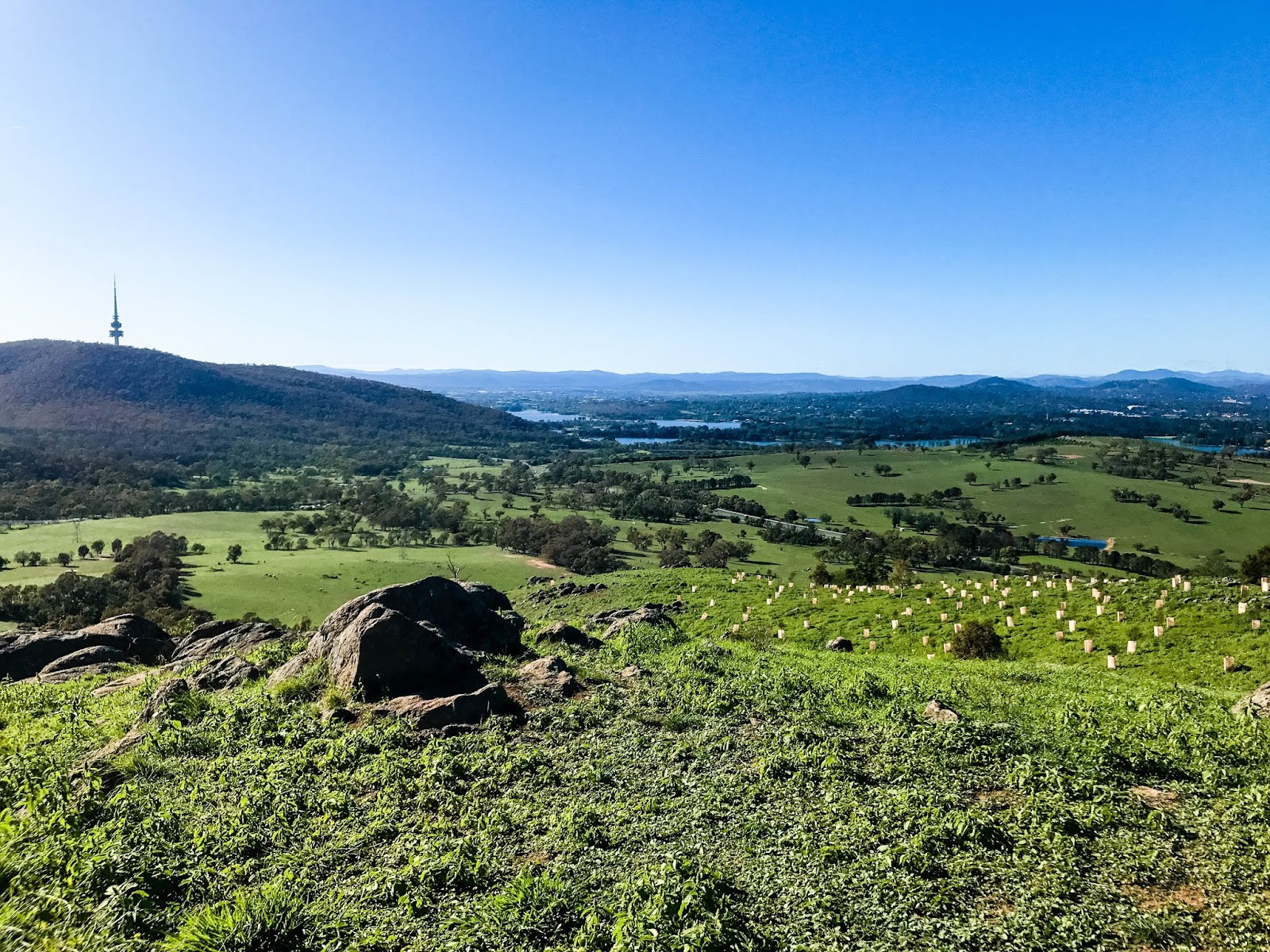
The view from Mt Painter
It's hard to make sense of things right now. A week ago we were joking about toilet paper, dried pasta, and how incredible it was that grown adults needed instruction on how to wash their hands. Now, the world has changed. 

I am working from home. My job, which involves putting educational programs into schools and communities to ensure that all children have equal opportunities to aid their learning development and engagement, is in limbo. Schools are still open, but they are not allowing any incursions or excursions; hence all our programs are suspended until further notice. 

I have read a lot of information. I have answered a lot of emails. I have cleaned up my digital files. I don't know if my job will continue to exist. This is a time of great uncertainty. We need to support ourselves and the vulnerable members of our community. But how? The Australian government seems to be doing very little compared with other governments - this is a global crisis and, as a citizen of three countries with family in all of them, I am watching things closely.  Our family is connecting and checking on each other regularly. 

I am avoiding gatherings where I might spread any infection to others - I don't think I've contracted it, but how would I know? I think the best thing to do is to avoid others. I don't know. Governments in different countries are telling people to do different things: stay in; go out; get exercise; abandon sport; support local business; avoid cafes and pubs 'like the plague' (even the cliches are relevant). 

I'm jotting my thoughts down here like some kind of diary - I don't know what's going to happen; no one does. But I need to record things because it's all so weird. In every version of apocalyptic scenarios I've seen, the world does not look like this. After months of not being able to go outside, due to fires, smoke and hazardous air quality, the sun is shining, the sky is blue, the fields are green and the roses are blooming. It is a world full of wonder; if not a wonderful world. 

A rose in our garden

Tuesday, 10 September 2013

More from Old Parliament House

I wandered through the (very narrow) corridors, poking in rooms, past clocks, telephones and typewriters – so much ritual belonging to a bygone era. All the volumes of Parliamentary debates from the House of Representatives and Senate are collected – hmm, I’ll bet they make for fascinating reading...

The speechwriters' office
The Country Party Rooms have an exhibition about various members including Tim Fischer, from Barra Creek, who joined the Narrandera branch of the Young Country Party. The Country Party became the National Country Party which morphed into the National Party and is now simply the Nationals. Apparently, ‘The Country Party was formed to represent the interests of people living on the land and in country towns’, which explains a lot.

Fischer was deputy PM to John Howard – he held the party together during the 1990s with the threat from One Nation dividing the rural support base, and was pivotal to the success of the anti-gun legislation of 1996. There are cabinets full of gifts from firms and communities acknowledging his support (as trade minister) for the growth of Australia’s export markets.

The place is like a labyrinth with rooms opening off corridors. One holds an architectural model of Parliament House in 1927 and 1988. Another is dedicated to the Queen’s royal tour of 1954 when she opened the Federal and State Parliaments and wore a golden ball gown with sprays of wattle (this symbolism began her Coronation dress, which was the first time her white dress had been embroidered with colour; decorative flower emblems represented every country in the Commonwealth).

 
Many of the doors have frosted glass with the names etched upon them. The government whip and opposition whip’s offices back onto each other across the Speaker’s Walk at the back of the Chamber of the House of Representatives. The rooms were divided to create more space, for receiving members like naughty schoolchildren making excuses for not doing their homework. Politicians gave the whip some imaginative reasons for missing a Division, which was very serious: legislation can be defeated or motions lost for the lack of a single vote.

 
The Senate Opposition Party Room operated as a sort of gentleman’s club from 1927-37. There was (was??!) little entertainment in Canberra, so here the senators, regardless of which party they were in, talked, read, wrote letters, drank wine, and enjoyed film nights together. It had amenities such as mail boxes and sound-proof telephone booths for senators who didn’t have offices.

The building has little kitchens and bathrooms which are very 70s but were probably considered flash at the time: brown wood and tiles, square furniture and straight lines date the place. Furthermore, the narrow corridors and low ceilings give it the feel of a bunker, trapped and sealed in time.

Susan Ryan, who was a Cabinet Minister in the Hawke Government wrote, “At the beginning of our administration, the standard snacks consisted of white bread sandwiches and lamingtons, the latter very popular with our team, especially the leader. Sometimes during extended meetings party pies and sausage rolls appeared. When we met at weekends the attendants did not come in, and we were left to our own devices.

"Distracted from affairs of state by hunger pangs, one Sunday evening we tried to rustle up a meal. Nothing doing: no local eateries were inclined to provide take-away to the Cabinet of Australia. In the end one of our Comcar drivers, typically down to earth, located a few pizzas and brought them in to us. As we ripped the messy strips of fat and carbohydrate off the cardboard to which they had congealed, we agreed that it was pretty flash being in Cabinet.”

John Smith Murdoch, the building’s architect, also designed much of the furniture, of which there is an exhibition in Suites Seats and Suits. The functional furniture is of the Stripped Classical style – simple lines with limited decorative features – and constructed of Australian timbers, such as Queensland maple or Tasmanian oak and Australian Blackwood.

I like the Blackwood reading slopes for reading papers and the octagonal tables (a departure from the usual strict discipline of right angles and circles) for displaying periodicals – cut off from the outside world in Canberra, this was the only way many politicians could keep in touch with their constituents. There’s also a room of signs – strictly members only etc. – which echoes the bold design and geometric precision, even reflected in the coat and hat stand, and the solid, square bins.

 
The Senate Government Party Room (with record player and Mozart records) features a hexagonal table representing the original six senators from each of the six states. The brushed aluminium light fittings in this room replaced the original glass fittings in the 1940s.

A couple of politicians are highlighted in displays. Dorothy Tangney became the first female senator in 1943 and served for 25 years, concentrating on social issues and Labour principles such as the needs of returned servicemen, war widows and war brides. Meanwhile, Neville Bonner was the first Aboriginal senator in 1971. He strongly believed that Aboriginal people should work within the parliamentary system to achieve their rights.

The members’ dining room was closed as it was being prepared for a function, but the nearby courtyards are a nice touch, affording glimpses of trees, grass, light and air. Along the carpeted hallways (a natty blue design) are cabinets containing special crockery with a parliamentary crest and a tea service including a set of tongs resembling emu feet. 

The Illuminations by Wendy Fairclough
The halls are lined with information and quotes – this one is telling:
“Throughout Provisional Parliament House there is a very interesting incongruity between the glamour of the seat of power and a concern to be seen as not wasting money on luxuries for members. Despite the refurbishment of the Members Bar in 1974, a member in 1978 described it as looking like a ‘second rate hotel’. There are very few photographs of the Members Bar and even fewer of members patronising it – apparently members did not wish to publicise this image of themselves.”

Tuesday, 21 May 2013

Get Carta: Magna Carta Place


The Magna Carta monument in Canberra was unveiled in 2001. It celebrates both the Centenary of Federation and Australia's special relationship with Great Britain. The funds for the project were raised by the Magna Carta Committee, a part of the Australia-Britain Society. It is heartening to see the countries supporting and respecting each other in relation to such an important issue as government and democracy.

The materials used apparently convey a sense of timelessness - bronze, bluestone, granite and ironbark. The design by architect Alastair Falconer was inspired by history, myth and geology. It consists of a three-tiered pavilion with a hill at the back referencing ancient burial mounds. It is designed as though the hill is slashed open and the pavilion is revealed at the heart.


The mound is shored up with a wall along which runs a time line through a series of murals (by Silvia Velez and Chris Meadham) tracing the events that led to the emergence of the Magna Carta in England and its relevance to Australian law and civil rights.

The time line then spirals through the centre of the monument with tenets of the Magna Carta imprinted on it, such as Justice; Equality; Freedom; Rule of Law and Trial by Jury - all noble sentiments and fundamental to the British (and, hence, Australian) justice and legal system.

A time capsule is buried in the middle to be opened in 2101. Meanwhile, back in the present (and past), the pavilion is crowned with a golden ring incised with the Latin wording of Chapter 29 of the Magna Carta (one of the four remaining copies of the 1297 issue of the Magna Carta is displayed at Parliament House). The English translation is found on a rubbing plaque in the pavilion:


"No Freeman shall be taken or imprisoned, or disseised of his Freehold, or Liberties or free Customs, or be outlawed, or exiled, or any other wise destroyed; nor will We not pass upon him, nor condemnation, but by lawful judgement of his Peers, or by the Law of the Land. We will sell to no man, we will not deny or defer to any man either Justice or Right"


These legal terms are stirring and impressive, and make me feel proud to be a British (and New Zealand) citizen.