Showing posts with label supermarket. Show all posts

Saturday, 13 February 2010

Supermarket creep


I hate supermarkets; they sap my soul.

There is so much stuff – so many varieties of things we don’t need in packages that we will just take home and throw away. We are faced with a plethora of options but no real choice. How many cereals can one person handle? I find myself standing in front of them staring at the multiple versions of maize and my eyes glaze over.

It starts with the vegetables. There are simply too many and they are all evenly spaced and displayed in colourful regimented mounds that seem plastic in their uniformity. And it’s so cold that I lose the circulation in my hands, while my mind loses the will to live.
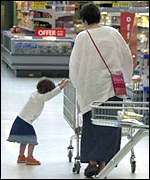
The music is vile, and the forced jollity of the announcements telling me what’s on special in aisle four makes me want to cry at the thought that the real world is out there somewhere, but it’s not in here. What’s in here is bored-out-of-their mind women pushing trolleys and pandering to their brattish offspring.

It’s one of the domestic chores I like least, right up there with cleaning the toilet. And yet, I love a farmer’s market.

Here there is something seductive about the produce on offer. Even the names are alluring; the pale and fragrant lemon cheese; the still-warm vine-ripened tomatoes; the personally-pressed virgin oil; earthy new potatoes; regal purple aubergines; spiky but soft artichoke hearts. Some people believe that any list can be poetry if the right words are used, but that’s another matter.

I’m currently reading the brilliant Eating for England by Nigel Slater. He writes of the farmer’s market; “I shop there because I want to meet the people who grow what I eat, to experience the joy of seasonal shopping, to be as close as I can to where my food originates without actually getting my hands in the soil. And I suspect that, as I trundle up the hill with my recycled bag of cheap corn on the cob still in its fresh green husks and a swaying bunch of three-foot-high sunflowers, it probably allows me to feel just a wee bit smug about those shoppers with their supermarket packet of identically sized, overpriced, cellophane-wrapped green beans from Mozambique.”

When I was a student, I used to go to different shops to collect my groceries. There was a herbalist, a greengrocer, a fishmonger, a delicatessen (I couldn’t afford anything from there), a butcher, a baker and yes, even a candlestick maker (and I was going through that late teen/early twenties obsession with smelly incense and cinnamon and spiced pumpkin candles).
Things were cheaper, and I could talk to the people who sold them. Sure, it took all day to collect my bits and pieces wrapped in waxed paper but that was okay, because I had all day – I was inevitably procrastinating about writing an essay on eighteenth century English drama.

Now it’s far more convenient to drive to one soulless sterile building with blinding bright lights and no heart. (To be fair, when Big Fresh in Christchurch introduced singing vegetables to the greengrocery section it was truly terrifying).

And yet, some people like it. As I returned a trolley to its berth (is that what they call them? They should) a bloke smiled happily, “I love the supermarket; it’s full of hot women. I’m going to come here every day.” And there you have it; it may not be a bustling bazaar or a social souk, but it can be considered a meat market.

Tuesday, 15 December 2009

Food waste

When I was a child, I was subjected to school dinners. Actually, they weren’t that bad – I heard horror stories of far worse meals than the ones we were served in our canteen (liver with tubes is often mentioned by Him Outdoors in tones of horror and revulsion). But we were made to eat semolina.

It’s still one of the few foods that I don’t like (melon and tripe are the others, in case you’re interested), although I’ve tried. Back then I simply couldn’t see the point of it, once you’d swirled the blob of raspberry jam into it and made it go pink. The dinner ladies were aghast and told me that ‘starving children in Africa would be grateful for that’.

I wished no harm on the starving children in Africa and thought I was doing them a favour by transferring the congealed goo into an envelope and addressing it to them. Apparently not. I got into quite substantial trouble for that, and I have been concerned about food waste ever since.

8.3 million tonnes of food is thrown away by households in the UK every year. That’s a lot of food. The ‘
Love food hate waste’ website states that if we all stop wasting food that could have been eaten, the CO2 impact would be the equivalent of taking 1 in 4 cars off the road. That’s a lot of cars. A recent study conducted by the University of Arizona (UA) in Tucson, reveals that almost half of the food in America goes to waste. That’s outrageous.

I blame the supermarkets and the advertising – they tell us that we need to eat this or that in bright shiny packaging to be better people. There are mounds of tempting fresh fruit that we just have to have – we take it home to rot in its bowl. We are bombarded with advertising for ready meals and additive enhanced snacks that will supposedly fill the emptiness in our souls. Anita Desai’s 1999 novel Fasting, Feasting explores this concept horrifyingly well.

We need to buy it all at once because we don’t want to make excessive trips and burn extra fuel. We can’t take a trip down to the local high-street greengrocer, butcher or baker because they no longer exist – the corporate supermarket in the shopping mall squeezed them out of existence.

And the effort of getting there and parking and walking around the impersonal, clinical cavern with the soporific music, and then waiting in the line with tantrum-throwing toddlers and loading it all onto the conveyor belt and taking it all off and getting it all into the car and returning the trolley and driving home and unpacking it all and putting it all in the fridge and the pantry is such that you don’t want to do it any more than you have to – so you buy as much as possible in one go, and are rewarded with coupons if you spend over a certain monetary value.

It’s an easy trap to fall into, but I am crawling out of the pit and have discovered my own form of resistance. It’s called planning. I plan my week’s evening meals. I buy magazines (Dish is a current favourite) and I try out new recipes from them and old cookbooks. I write out a list of the ingredients that I need to make these meals and that’s all I buy, plus some fresh fruit and salad stuff for snacking on, and (of course) cat food for Chester.

I write the meals up on a blackboard and I know that either Him Outdoors or I can make anything on that board because we have a recipe and the ingredients. I don’t have snacks in the house because I will eat fruit if I need a quick fix.

If I do ever have leftovers I have a pantry full of herbs and spices, dried pasta and tins of beans – a mixture of some of these staples can make something healthy and tasty (and if we have a civil emergency I’m sorted for a good few weeks).

It’s not a massive step (I need to start a compost heap to make use of the scraps) but it’s a little thing that makes me feel better about the starving children in Africa. I may not be able to do much to help them individually, but I can at least not waste the resources that I have.

I’m also adopting this procedure for Christmas presents this year – make a list and stick to it. Impulse buys are rarely a good idea in the long run. 'Waste not; want not' as the old folk used to say. They probably still do, but now I agree with them – help; I’m becoming an old folk!