Friday, 8 February 2013

Friday Five: More Monopoly

Following on from my previous post, I may have indicated before that I love Monopoly. Indeed, my friend Our Gracious Hostess can attest to the fact that we spent (wasted?) hours of childhood poured over the board plotting minor intricacies in games that went on for weeks. So what's so great about it?


5 Things I Love about Monopoly:
  1. The basic concept: it's really very simple. Sure, it teaches the harsh world of capitalist policies, but can also teach co-operation and partnerships - when the family played we used to 'gang up' on our father and let each other off paying rents. Fair? Probably not. Fun? Hell yes!
  2. Own rules:  so many people do that putting fines into the middle and then collecting it if you land on free parking thing, that I used to think it was an actual rule. It isn't.
  3. Different versions: we had the American version and my American friend had the British version. I also have got a French and New Zealand edition. You learn a lot about what areas were valued in the year the games were made. I believe there are also boards based on fictional worlds, such as The Muppets, Coronation Street and Batman, rather than actual cities. I'm not entirely sure how I feel about those, but they are probably fun for children and geeks.
  4. Cheating: come on, everyone does it - Scary Sis was particularly adept at it. Whoever heard of an honest banker?
  5. Endurance: yes, it goes on for hours (or possibly weeks) but you can take up where you left off, so long as you have got a room where you can shut it away from the cat.

Thursday, 7 February 2013

Monopoly Shock!

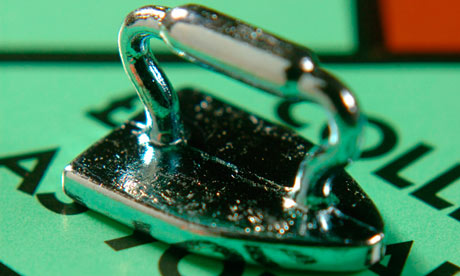
According to a recent press release from Hasbro, the game of Monopoly has got a new player. The iron counter has been replaced with a cat, after a Facebook voting poll.

Now, anyone who shares their life with a cat will not be surprised by this news. After-all, whenever they try to play Monopoly, there has always been a cat on the board. Ba boom tish!

Wednesday, 6 February 2013

Art Gallery of South Australia: Part One


The Art Gallery of South Australia in Adelaide contains the largest collection of Australian art in the world, so of course I went to look at it. Photography is allowed without flash, so I recorded the panel explanations of favourite artworks, to study them later. Here are some of them.

Portrait of Captain Matthew Flinders, RN 1774-1814 (1807) by Toussaint Antoine de Chazal de Chamarel
This portrait painted by the French amateur painter de Chazal is the only known life-size oil portrait of Captain Matthew Flinders.

Matthew Flinders made a voyage to Australia in 1801-03 as captain of the Investigator. It was on this expedition that the South Australian coastline was charted for the first time by a European explorer. Returning to Britain in 1803, Flinders was detained, for almost seven years on the French colony of Mauritius on charges of being a British spy. It was during his detention that this portrait was painted.

I've become fascinated with explorers' exploits and I particularly like Flinders because of his affection for his ship's cat, Trim, about whom he wrote a book (as did Bryce Courtenay several years later). I think this portrait, hinting at sensitivity and secrecy, makes him look like the type of chap who could love a cat.

Self Portrait (1815) - Colonel William Light
Colonel William Light arrived in South Australia in 1836 to survey the colony. As well as a meticulous draughtsman, he was regarded as an excellent watercolourist. The first European artist in South Australia, he made numerous drawings and watercolours that recorded the first landing and the first settlement. He designed Adelaide, the colony's capital, and surveyed more than 600,000 hectares of surrounding land.

I like how he has portrayed himself nonchalantly leaning against a rock with suitably craggy and romantic scenery in the background and a folded-up telescope in his hand. Apparently this style is representative of the Regency fashion - studied or calculated informality designed to make "young upwardly mobile dandies look dashing or at least interesting in a Byronic way.'

Captain Cook on the coast of New South Wales (1860) by Joseph Blacker
Joseph Backler was a talented forger in London before he was caught making false money orders in 1832 and transported to New South Wales for life. Once in Sydney his talent for drawing marked him out as a special convict and he was assigned to the Surveyor general's department as a draughtsman. After he was pardoned in 1847 he made his income as a landscape and portrait painter.

This portrait of Captain James Cook was made from copies as Cook died in 1779. He is depicted standing on a rocky legde with cliffs in the distance, suggesting the East coast ocean cliffs near the Heads of Sydney Harbour, resting his hand on a globe of the world, on the northern hemisphere, likely to be England.

Fish Catch and Dawes Point, Sydney Harbour (1813) by John William Lewin
This is the earliest known oil painting to have been painted in Australia. John Lewin, Australia’s first professional artist, arrived in Sydney in 1800 after training as a natural history painter in London. The arranged fish catch from the harbour waters is positioned on the shore at Kirribilli Point. The view looks south across Sydney Harbour to Dawes Point, from which the Harbour Bridge spans today. This painting is an oddity being neither a straight forward natural history painting, nor simply a decorative still-life, nor a sporting painting of a proud fisherman’s catch – all popular subjects in Britain in the early nineteenth-century. Rather, it is a combination of all of the above.

A View of the artist's house and garden, in Mill's Plains, Van Diemen's Land (1835) by John Glover
This painting of Glover’s Patterdale farm at Deddington in Northern Tasmania depicts the artist’s new shingle-roofed stone house and wooden studio-gallery surrounded by his flourishing garden in bright sunlight in the summer of 1934-35. Glover has delighted in depicting each of the English annuals in the new squared garden of his farmhouse, and he has also taken pains to depict accurately the distinct qualities of the native Australian trees beyond.

Group of natives of Tasmania (1860) by Robert Dowling
Robert Dowling was Australia’s first locally trained professional artist. He arrived in Tasmania with his parents in 1834 at the age of seven, and later settled in Launceston. In the 1840s he studied in Tasmania, under several artists including Thomas Bock. Dowling relied heavily on Bock’s 1830s watercolour portraits of Aboriginal Tasmanians to create this group composition when most of the sitters had passed away.

The painting depicts notable Aboriginal Tasmanians who, due to their connection to G.A. Robinson’s Friendly Mission, were the repeated subject of major Tasmanian artists.

In the Sassafras Valley, Victoria (1875) - Isaac Whitehead
Isaac Whitehead’s detailed paintings provide some of the most evocative depictions of natural forest stands in Australian art. In this painting ancient eucalypts create a towering, protective canopy through which dappled sunlight filters onto the fronds of tree-ferns and the creek beneath. The giant scale of the trees is emphasised by the inclusion of bushwalkers and figures seated around a campfire, dwarfed by their surroundings.

Whitehead worked as a framemaker in Dublin before arriving in Victoria in the late 1950s where he established himself as Melbourne’s leading framemaker. He made frames for the leading Melbourne painters Nicholas Chevalier, Thomas Clark, Louis Buvelot and Eugene von GuĂ©rard. This painting is framed by an example of his 1868 international prize-winning frame.

Evening Shadows, backwater of the Murray, South Australia (1880) by H.J. Johnstone
This painting was the first work of art acquired by the Art Gallery of South Australia. Since it was first displayed at the Gallery’s opening in June 1881, it has been one of the most reproduced and copied paintings in the collection.

H.J. Johnstone arrived in Victoria in 1853. After an unsuccessful attempt at prospection on the Victorian gold fields, he established himself in Melbourne as a photographer and then as a landscape painter of scenes of Victoria and South Australia. Johnstone left Australia in late 1876 but continued to paint Australian landscapes, often from his photographs, in the United States, London and Paris for the Australian market. Evening Shadows, painted in either London or Paris, is typical of Johnstone’s landscapes, all of which are characterised by an uncanny photographic stillness.

Friday, 1 February 2013

Friday Five: Adelaide

Local Adeladian resident
We have recently returned from a week in Adelaide. Slowly we are exploring the Australian cities and towns. This week I read that Sydney and Melbourne are both in the top five most expensive cities in the world according to the cost of living index, so although they are still worth a visit, they are not on my viable places to live list. Adelaide, however, has much to recommend it.

5 Things I Like about Adelaide:
  1. The hills: farmers markets; vineyards; orchards; cute little towns; winding roads; wildlife and trees - cooler than the town and packed with personality
  2. The sea: from timeballs, lighthouses and micro-breweries in former wharf buildings to hippy artwork and squeaky white sandy beaches; it's got all facets of the ocean covered
  3. The cycling: The Tour Down Under was made for Adelaide but even when it's not on, the roads are heaven for pedalling perfection
  4. The festivals: Adelaide used to be known as the city of churches; now it's called the festival city - theatre; film; music; sport; food; wine - everything has a festival and they're pretty much all fabulous
  5. The wineries: Barossa; Eden Valley; McLaren Vale; Adelaide Hills; Clare Valley; Kangaroo Island and many many more, all there just waiting to be drunk!

Wednesday, 30 January 2013

Quote for Today: Christmas Culture

"I loved our first Christmas in Australia - it's completely different to being here and it only seems to last a day, if that. I've warned Shane that ours lasts a good 10 days - most of which is spent lying on the sofa eating Quality Streets." - Liz Hurley comes to terms with the 'finer points' of relationship differences with Shane Warne. (Plus she's lying: look at her - there's no way she scoffs boxes of chocolates.)

Friday, 25 January 2013

Friday Five: The First Time

Parents record their children’s achievements all the time. Their first smile; their first steps; their first words… it goes on and lovingly on. And then it stops. At some point they stop remarking on their offspring’s milestones, possibly because they don’t know what they are or when they happened.

No one’s suggesting that you sit down at the kitchen table and discuss the loss of your virginity with mum and dad, but there are some wonderful memorable experiences that deserve wider recognition. The first time you drink champagne deserves an honourable mention. I’m talking about the proper stuff. Bubbles are all very well, but champagne is bliss. There’s no comparison. But it doesn’t make the top five, which are...
5 First Time Experiences:
  1. The first time you ‘get’ Shakespeare – chances are it won’t be at school. You’re just aware of him as some bloke that other people appreciate for whatever reason and suddenly it hits you – that poetry; that characterisation; that insight; that freedom with language and plot. For me it was the Triumph Theatre production of Richard II at the Phoenix Theatre in 1988 with Derek Jacobi in the title role. I thought, ‘I want to do that; I want to move people as I have been moved’.
  2. The first time you go home after having been away for a long time. Flying back to Heathrow makes me blub like a baby. I haven’t lived in England now for over 16 years, but it’s home. There are so many people and places there that give me a sense of security and comfort while conversely filling me with excitement and anticipation. It just feels like home, and nothing makes you appreciate home more than leaving it.
  3. The first time you drive your own car. Whether it’s second-hand or brand new (I assume, having never owned a brand-new vehicle), it gives you a sense of independence and liberty and responsibility all in one. You can go anywhere there is a road and enough petrol. That’s power.
  4. The first time you vote. Going into the little booth and marking your voting paper and then posting it in the box – it’s all so civilised and you are part of a democracy that people have fought and died for. It makes me feel proud every time I do it.
  5. The first time someone other than your family says ‘I love you.’ Don’t get me wrong, it’s wonderful to hear your family say it, and to say it to them, but if you’re lucky you’ve grown up with that unconditional affection and you probably can’t clearly remember the first time it was said or you said it back. When someone unrelated says it to you and you say it back and you know you both mean it, there may not be a better feeling in the whole world.

Wednesday, 23 January 2013

Quote for Today: It's not meant to be real!

"He's making entertainment. Hopefully, it makes you go ask questions and you Google it. If you want to learn something from a movie, watch a documentary." - Samuel L. Jackson when asked about the portrayal of slavery in Quentin Tarantion's latest film, Django Unchained