Showing posts with label Captain Cook. Show all posts

Wednesday, 6 February 2013

Art Gallery of South Australia: Part One


The Art Gallery of South Australia in Adelaide contains the largest collection of Australian art in the world, so of course I went to look at it. Photography is allowed without flash, so I recorded the panel explanations of favourite artworks, to study them later. Here are some of them.

Portrait of Captain Matthew Flinders, RN 1774-1814 (1807) by Toussaint Antoine de Chazal de Chamarel
This portrait painted by the French amateur painter de Chazal is the only known life-size oil portrait of Captain Matthew Flinders.

Matthew Flinders made a voyage to Australia in 1801-03 as captain of the Investigator. It was on this expedition that the South Australian coastline was charted for the first time by a European explorer. Returning to Britain in 1803, Flinders was detained, for almost seven years on the French colony of Mauritius on charges of being a British spy. It was during his detention that this portrait was painted.

I've become fascinated with explorers' exploits and I particularly like Flinders because of his affection for his ship's cat, Trim, about whom he wrote a book (as did Bryce Courtenay several years later). I think this portrait, hinting at sensitivity and secrecy, makes him look like the type of chap who could love a cat.

Self Portrait (1815) - Colonel William Light
Colonel William Light arrived in South Australia in 1836 to survey the colony. As well as a meticulous draughtsman, he was regarded as an excellent watercolourist. The first European artist in South Australia, he made numerous drawings and watercolours that recorded the first landing and the first settlement. He designed Adelaide, the colony's capital, and surveyed more than 600,000 hectares of surrounding land.

I like how he has portrayed himself nonchalantly leaning against a rock with suitably craggy and romantic scenery in the background and a folded-up telescope in his hand. Apparently this style is representative of the Regency fashion - studied or calculated informality designed to make "young upwardly mobile dandies look dashing or at least interesting in a Byronic way.'

Captain Cook on the coast of New South Wales (1860) by Joseph Blacker
Joseph Backler was a talented forger in London before he was caught making false money orders in 1832 and transported to New South Wales for life. Once in Sydney his talent for drawing marked him out as a special convict and he was assigned to the Surveyor general's department as a draughtsman. After he was pardoned in 1847 he made his income as a landscape and portrait painter.

This portrait of Captain James Cook was made from copies as Cook died in 1779. He is depicted standing on a rocky legde with cliffs in the distance, suggesting the East coast ocean cliffs near the Heads of Sydney Harbour, resting his hand on a globe of the world, on the northern hemisphere, likely to be England.

Fish Catch and Dawes Point, Sydney Harbour (1813) by John William Lewin
This is the earliest known oil painting to have been painted in Australia. John Lewin, Australia’s first professional artist, arrived in Sydney in 1800 after training as a natural history painter in London. The arranged fish catch from the harbour waters is positioned on the shore at Kirribilli Point. The view looks south across Sydney Harbour to Dawes Point, from which the Harbour Bridge spans today. This painting is an oddity being neither a straight forward natural history painting, nor simply a decorative still-life, nor a sporting painting of a proud fisherman’s catch – all popular subjects in Britain in the early nineteenth-century. Rather, it is a combination of all of the above.

A View of the artist's house and garden, in Mill's Plains, Van Diemen's Land (1835) by John Glover
This painting of Glover’s Patterdale farm at Deddington in Northern Tasmania depicts the artist’s new shingle-roofed stone house and wooden studio-gallery surrounded by his flourishing garden in bright sunlight in the summer of 1934-35. Glover has delighted in depicting each of the English annuals in the new squared garden of his farmhouse, and he has also taken pains to depict accurately the distinct qualities of the native Australian trees beyond.

Group of natives of Tasmania (1860) by Robert Dowling
Robert Dowling was Australia’s first locally trained professional artist. He arrived in Tasmania with his parents in 1834 at the age of seven, and later settled in Launceston. In the 1840s he studied in Tasmania, under several artists including Thomas Bock. Dowling relied heavily on Bock’s 1830s watercolour portraits of Aboriginal Tasmanians to create this group composition when most of the sitters had passed away.

The painting depicts notable Aboriginal Tasmanians who, due to their connection to G.A. Robinson’s Friendly Mission, were the repeated subject of major Tasmanian artists.

In the Sassafras Valley, Victoria (1875) - Isaac Whitehead
Isaac Whitehead’s detailed paintings provide some of the most evocative depictions of natural forest stands in Australian art. In this painting ancient eucalypts create a towering, protective canopy through which dappled sunlight filters onto the fronds of tree-ferns and the creek beneath. The giant scale of the trees is emphasised by the inclusion of bushwalkers and figures seated around a campfire, dwarfed by their surroundings.

Whitehead worked as a framemaker in Dublin before arriving in Victoria in the late 1950s where he established himself as Melbourne’s leading framemaker. He made frames for the leading Melbourne painters Nicholas Chevalier, Thomas Clark, Louis Buvelot and Eugene von Guérard. This painting is framed by an example of his 1868 international prize-winning frame.

Evening Shadows, backwater of the Murray, South Australia (1880) by H.J. Johnstone
This painting was the first work of art acquired by the Art Gallery of South Australia. Since it was first displayed at the Gallery’s opening in June 1881, it has been one of the most reproduced and copied paintings in the collection.

H.J. Johnstone arrived in Victoria in 1853. After an unsuccessful attempt at prospection on the Victorian gold fields, he established himself in Melbourne as a photographer and then as a landscape painter of scenes of Victoria and South Australia. Johnstone left Australia in late 1876 but continued to paint Australian landscapes, often from his photographs, in the United States, London and Paris for the Australian market. Evening Shadows, painted in either London or Paris, is typical of Johnstone’s landscapes, all of which are characterised by an uncanny photographic stillness.

Monday, 2 July 2012

Portrait Gallery - Part One

When I go to a new country, one of the things I love to do is go to their national portrait gallery. I think you can learn a lot from these places, such as who is important to the nation and why.

The National Portrait Gallery, Canberra, contains a visual snapshot of Australians. The portraits are predominantly of politicians, athletes, generals and soldiers, activists and Indigenous rights' campaigners, chefs and restauranteurs, newsreaders, fashionistas, artists, authors and musicians, architects, doctors and scientists.

Some are against blank backgrounds; others have elaborate settings, which can be as significant as the subject themself and can help you guess their occupation.

Dr John Yu by Ah Xian
A glazed ceramic head of Dr John Yu by Ah Xian was my starting point. Dr John Yu was Australian of the Year in 1996; as a paediatrician and administrator, and noted for his collection of Chinese ceramics and love of art and music, this torso with little child figures crawling over it makes perfect sense, and it is the first 21st century porcelain bust in the National Gallery's collection.

HRH the Crown Princess of Denmark by  Jiawei Shen
I love this portrait of Mary. She stands in a stunning blue gown with a sash, accessorised with a Danish elephant, looking frankly at the viewer. On one side is a Danish column, and on the other is an open widow, through which can be glimpsed the Opera House which, as it was designed by Dane Jørn Utzon, cleverly combines her background with her future representing the two countries.

George Tjungurrayi by Matthÿs Gerber
George Tjungurrayi was an artist, of the Pintupi/ Luritja/ Ngaatjatjarra language group from Kintore, NT. He has become one of the masters of Pintupi art, and his huge dazzling paintings of the Tingari Cycle are represented in the National Gallery of Victoria and the Art Gallery of New South Wales, as well as European collections. Matthÿs Gerber has painted his image as a series of coloured planes, contour-mapping the artist's face as a cartographer might, to evoke Tjungurrayi's colourful depictions of the country.

Nick Cave by Howard Arkley
Howard Arkley's synthetic polymer on canvas portrait of Nick Cave (1999) is one of my favourites. It combines bright colours and bold sweeps of spray paint with the singer's uncompromising glare. The two knew each other vaguely in Melbourne in the late 1970s. Arkley came to see no sense in the Australian preoccupation with paintings of the bush, when such a small percentage of the population engages with the bush itself.

Instead, over twenty years of experimentation, he developed a distinctly psychadelic and incandescent airbrush style, which he employed in immaculately finished depictions of suburbia. After representing Australia with such works at the 48th Venice Biennale in June 1999, he travelled to London to plan an album cover for Cave, and then to Los Angeles for a sell-out show of his paintings. He died a few days after his return to Melbourne, and this was one of his last completed works.

Christos Tsiolkas by John Tsiavis
When you look ast the photograph of author Christos Tsiolkas by John Tsiavis, the first thing you see is your own reflection against the black background covered in glass, and then you notice his judgmental look as he seems to lurk in sepia in the top corner. Unnerving.
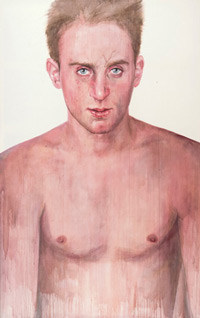
Simon Tedeschi unplugged by Cherry Hood
The giant canvas of Simon Tedeschi Unplugged (by Cherry Hood) in watercolours that run down his bare torso makes him look more like a swimmer than the pianist he apparently is, so you can't guess them all!
Geoffrey Gurrumul Yunupingu by Guy Maestri
Geoffrey Gurrumul Yunupingu's portrait (by Guy Maestri) is another huge and powerful work. He was born blind, learned guitar, keyboard, drums and didgeridoo to play in The Saltwater Band. His debut album in 2008 (entitled Gurrumul) won four ARIA awards. The portrait seems to reflect depth and harmony.

While I was roaming aimlessly between galleries, the chap I had previously left my stuff with in the cloakroom approached me. He was finishing his shift and said he wanted to show me some of his favourite works in the gallery. I'm pretty sure that wasn't a euphemism, because the first thing he showed me was Ned Kelly's death mask!

Captain James Cook by John Webber
Next he showed me a fabulous portrait of Captain James Cook by John Webber. It used to hang on the wall of Alan Bond's office until he was declared bankrupt and it was given to his liquidator. The National Portrait Gallery bought the painting for $5.13 million - it is the most expensive art-work in their collection.

Deborah Mailman by Evert Ploeg
The guide also showed me the People's Choice Award, which is a portrait of Deborah Mailman by Evert Ploeg (1999). She is an actor of Maori and Aboriginal parents, and the rendering of oil on jute makes for an interesting background.

Nora Heysen self-portrait
His own favourite is a self-portrait of Nora Heysen which he points out (correctly) has a 3-D-like effect, and wherever you stand in the room it appears as though she is watching you, and her image stands out from the canvas.

Still of Cate Blanchett from a video by David Rosetzky
Finding out what I liked, he took me to a video by David Rosetzky of Cate Blanchett explaining her acting process, and he left me to watch the ten-minute documentary. She explains that acting is a "constant pull between wanting to be seen and not wanting to be seen." To assume a character you've got to get to a place of neutrality; to see the horizons of a character and know you won't fall off the edge. Characters are there to do something, like figures in a dream. They are real, but when you wake up... they're shadowy. "Who I am is constantly changing." She stands, sits and dances in an empty warehouse, and it is entirely compelling.

Friday, 18 May 2012

Friday Five: Canberra Insights

Since arriving in Canberra, I've spent a lot of time reading leaflets and being a tourist. Among my ramblings I have visited the Botanic Gardens, the National Library of Australia, the Embassy District and the National Portrait Gallery. No doubt over the coming weeks I'll post more information about the above, but in the meantime here are some highlights:

5 Things I've Learned Since Coming to Canberra:
  1. Canberra comes from the Aboriginal word 'Kamberra' meaning meeting place
  2. Canberra has the lowest unemployment rate and highest average wage in Australia
  3. Patrick White is the only Australian to be awarded the Nobel Prize in Literature (in 1973)
  4. After the mutiny on the Bounty when Captain Bligh was cast adrift near Tonga with 18 crew members, they travelled 6,000km to Timor - only one man died on the voyage, killed by islanders on Tofoa when they landed looking for water
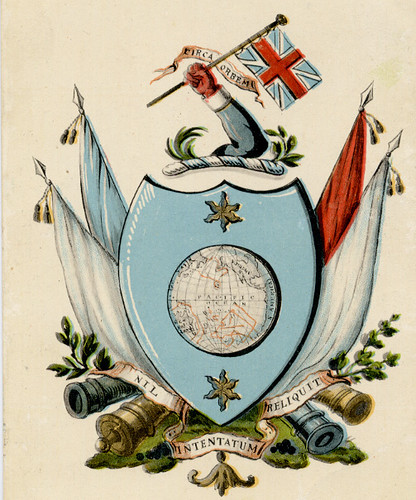
  5. King George III posthumously granted Captain James Cook a coat of arms featuring a globe (the only one to do so) and the motto 'nil intentatum reliquit'; he left nothing unattempted.

Thursday, 18 September 2008

Capturing Captain Cook

It wasn't exactly a pilgrimmage, but when I was in Gisborne, I found myself drawn to the Captain Cook monuments. The landing monument is quite understated and in the midst of the industrial docks. It seems oddly fitting.

I felt quite melancholy as I went for a drive and came across a second Cook monument on top of Kaiti Hill with the harbour laid out behind him.

Dusk was falling so the light was interesting and I played with the camera settings to get some spooky photographs.


The one on the right is my version of 'The World
Turned Upside Down'


The next day I went for a run along the beach and saw the statue in honour of Young Nick who first spotted land from Cook's ship. His hand is outstretched in a yearning manner and the sun lit him up as he reached out to land.

It began to rain but it was warm and still, and there was a rainbow. I saw the prism of filtered rays ignite Young Nick's Head and I felt a long way from Dover. A small fish was glistening above high tide, so I shunted him back to the sea and watched him shimmy away in the waves.

Captain Cook is again standing sentinel on the waterfront, again looking inland while Young Nick looks out to sea. This seems the wrong way round to me.


I took the photo on the left with the shadow of a telegraph pole because I thought it resembled a cross or a ship's mast and I liked the composition as it nestled between the statue and the tree.

I know that some people consider him persona non grata and blame him for all the evils of colonialism, but his navigational feats are indubitably magnificent and I do think he is a hero, albeit from a bygone era.