Showing posts with label Deborah Mailman. Show all posts

Friday, 26 October 2012

Friday Five: Gems from The Sapphires

The Sapphires (2012)

Dir: Wayne Blair


This is what every review will say about this film: ‘feel-good Australian version of Dreamgirls, loosely based on a true story’. That’s because it’s actually quite accurate. Four girls (three sisters and their cousin) sing cute harmonies in 1958 at a concert in the Cummeragunja Mission, a remote outback station. Cut to 1968 (via images of the times – protest marches; JFK; Muhammad Ali) and they are a poor aboriginal family living in a shack, but clean and loved, and singing around the house.

They want to go to the local town to sing in a talent quest, although Julie (Jessica Mauboy) isn’t allowed to go because she’s too young, although she’s the best singer. The other sisters try to hitch a lift but end up walking. “It’s because we’re black” says the oldest, Gail (Deborah Mailman) matter-of-factly. “No, it’s because you’re ugly” replies Cynthia (Miranda Tapsell), setting the tone. There is no self-pity, but there is plenty of attitude.
 
The talent quest is a joke, compèred by the fabulous Chris O’Dowd as drunken Irish soul devotee, Dave Lovelace. Julie joins the girls on stage as they are about to sing and they perform a Merle Haggard song – beautifully. But half of the audience leave. Overt racism ensures the winner is a woman with a woeful rendition of a Carpenters number. Lovelace knows this is a travesty – “Country music is not my thing, but those girls can sing!” He’s sacked for his dissent and drunkenness; he needs a job; they need a manager; it’s a match made in Cummeragunja.

The Cummeragunja Songbirds
The girls see an advert for singers wanted to perform for the forces in Vietnam and they want to audition but they need their cousin Kay (Shari Sebbens) to complete them, so they go to the city to recruit her. She is at a Tupperware party with her white friends who shut the door in Aboriginal faces, but she breaks away from them to rejoin her old group. They begin to practice, and it’s all about the singing.

Chris O’Dowd steals the show as he has great delivery and he gets all the best lines. He persuades the girls they need him – “Without me, there’s no you” – and he gets them the gig through an unscrupulous promoter, Myron (Don Battee). He teaches the girls about soul, and if it seems odd that a white Irish man is preaching soul music to black women who aren’t even included in their national census, the irony is entirely intentional.
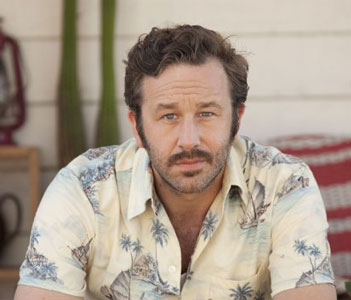
Chris O'Dowd as Dave Lovelace - he's a soul man!
They get the gig; they change their name to The Sapphires (from the Cummeragunja Songbirds); they go to Vietnam; they sing. The music is good and the playlist includes fantastic numbers such as Hold On, I’m Coming, Who’s Loving You?, I Heard it Through the Grapevine, I’ll Take You There, and What a Man. The comic contrast between their natural accents and the poignant numbers they belt out is reminiscent of the regional dissonance in The Commitments.
 
One, Two, Three, Four!
Dave wants them to ‘entertain’ the troops: the costumes must be “classy with cleavage”. Sexy Cynthia takes the diversion a little too far, a charming but clumsy Marine falls (literally) for Kay, and Julie just soaks up all the experience and reflects it in her amazing voice. The attitude is sensuous and compassionate (skinniness is dull and distant) and when Martin Luther King is shot, the girls perform their most soulful show ever after Dave tells them, “Tell me how a black marine feels tonight. I know you’re hurting but I need you to sing.”

 
Relationships are formed and broken, but this is the weaker part of the film. Kay and Gail fight, and we learn the source of their difference when Gail accuses her pale-skinned cousin of only being black now there’s money in it. We realise how unfair this is when a flashback to 1958 shows the government cars pulling up at that original concert. Kay is taken as part of the Stolen Generation because she can “pass as white”.
 
Gail failed in her duty to look after her and suffers regret and bitterness, accusing Kay of turning from them, although she was raised independently and only allowed to see them at her mother’s funeral. When the military escort pulls out of Vietnam abandoning the girls to the violence, Gail again feels the burden of being in charge.
 
 
What is really unbelievable is the relationship between Gail and Dave. They spar verbally from the start, but no sparks fly. He describes her as a “mouth on legs – a defensive, argumentative old witch”, but this is understandable because she’s a “momma bear looking after baby cubs”. Yes, it’s understandable, but it doesn’t make her loveable and the improbable romance is unconvincing, appearing tacked on to the end for a cheesy finish.

 
Indeed, the entire ending is cheesy, as the girls return to perform in their home town and we see the four stars of the Southern Cross in the sky above. The four stars turn into the ‘original’ Sapphires (in case we missed the point): sisters Laurel Robinson and Lois Peeler, and their cousins Beverley Briggs and Naomi Mayers. The film is a lighthearted fluff piece with a few deeper issues and a great soundtrack which probably worked better in its original theatre form. As all the other reviews have already said.
 
5 Great Lines from Dave Lovelace:
  1. "Do you sing anything other than that country and western shite?"
  2. "This may have escaped your notice, but you’re black, and you’re singing country and western. It’s just wrong."
  3. “90% of recorded music is shite. The rest is soul.”
  4. “When I met you, you were doing that country and western thing, and that’s fine; we all make mistakes.”
  5. “Country and Western is about loss. So is Soul. But In Country and Western you’ve lost, given up, and are sitting at home whining about it. Soul is about struggling with everything you’ve got to get it back.”

Monday, 2 July 2012

Portrait Gallery - Part One

When I go to a new country, one of the things I love to do is go to their national portrait gallery. I think you can learn a lot from these places, such as who is important to the nation and why.

The National Portrait Gallery, Canberra, contains a visual snapshot of Australians. The portraits are predominantly of politicians, athletes, generals and soldiers, activists and Indigenous rights' campaigners, chefs and restauranteurs, newsreaders, fashionistas, artists, authors and musicians, architects, doctors and scientists.

Some are against blank backgrounds; others have elaborate settings, which can be as significant as the subject themself and can help you guess their occupation.

Dr John Yu by Ah Xian
A glazed ceramic head of Dr John Yu by Ah Xian was my starting point. Dr John Yu was Australian of the Year in 1996; as a paediatrician and administrator, and noted for his collection of Chinese ceramics and love of art and music, this torso with little child figures crawling over it makes perfect sense, and it is the first 21st century porcelain bust in the National Gallery's collection.

HRH the Crown Princess of Denmark by  Jiawei Shen
I love this portrait of Mary. She stands in a stunning blue gown with a sash, accessorised with a Danish elephant, looking frankly at the viewer. On one side is a Danish column, and on the other is an open widow, through which can be glimpsed the Opera House which, as it was designed by Dane Jørn Utzon, cleverly combines her background with her future representing the two countries.

George Tjungurrayi by Matthÿs Gerber
George Tjungurrayi was an artist, of the Pintupi/ Luritja/ Ngaatjatjarra language group from Kintore, NT. He has become one of the masters of Pintupi art, and his huge dazzling paintings of the Tingari Cycle are represented in the National Gallery of Victoria and the Art Gallery of New South Wales, as well as European collections. Matthÿs Gerber has painted his image as a series of coloured planes, contour-mapping the artist's face as a cartographer might, to evoke Tjungurrayi's colourful depictions of the country.

Nick Cave by Howard Arkley
Howard Arkley's synthetic polymer on canvas portrait of Nick Cave (1999) is one of my favourites. It combines bright colours and bold sweeps of spray paint with the singer's uncompromising glare. The two knew each other vaguely in Melbourne in the late 1970s. Arkley came to see no sense in the Australian preoccupation with paintings of the bush, when such a small percentage of the population engages with the bush itself.

Instead, over twenty years of experimentation, he developed a distinctly psychadelic and incandescent airbrush style, which he employed in immaculately finished depictions of suburbia. After representing Australia with such works at the 48th Venice Biennale in June 1999, he travelled to London to plan an album cover for Cave, and then to Los Angeles for a sell-out show of his paintings. He died a few days after his return to Melbourne, and this was one of his last completed works.

Christos Tsiolkas by John Tsiavis
When you look ast the photograph of author Christos Tsiolkas by John Tsiavis, the first thing you see is your own reflection against the black background covered in glass, and then you notice his judgmental look as he seems to lurk in sepia in the top corner. Unnerving.
Simon Tedeschi unplugged by Cherry Hood
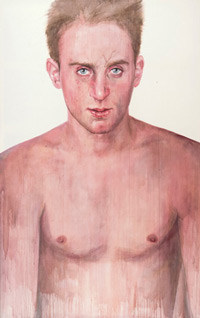
The giant canvas of Simon Tedeschi Unplugged (by Cherry Hood) in watercolours that run down his bare torso makes him look more like a swimmer than the pianist he apparently is, so you can't guess them all!
Geoffrey Gurrumul Yunupingu by Guy Maestri
Geoffrey Gurrumul Yunupingu's portrait (by Guy Maestri) is another huge and powerful work. He was born blind, learned guitar, keyboard, drums and didgeridoo to play in The Saltwater Band. His debut album in 2008 (entitled Gurrumul) won four ARIA awards. The portrait seems to reflect depth and harmony.

While I was roaming aimlessly between galleries, the chap I had previously left my stuff with in the cloakroom approached me. He was finishing his shift and said he wanted to show me some of his favourite works in the gallery. I'm pretty sure that wasn't a euphemism, because the first thing he showed me was Ned Kelly's death mask!

Captain James Cook by John Webber
Next he showed me a fabulous portrait of Captain James Cook by John Webber. It used to hang on the wall of Alan Bond's office until he was declared bankrupt and it was given to his liquidator. The National Portrait Gallery bought the painting for $5.13 million - it is the most expensive art-work in their collection.

Deborah Mailman by Evert Ploeg
The guide also showed me the People's Choice Award, which is a portrait of Deborah Mailman by Evert Ploeg (1999). She is an actor of Maori and Aboriginal parents, and the rendering of oil on jute makes for an interesting background.

Nora Heysen self-portrait
His own favourite is a self-portrait of Nora Heysen which he points out (correctly) has a 3-D-like effect, and wherever you stand in the room it appears as though she is watching you, and her image stands out from the canvas.

Still of Cate Blanchett from a video by David Rosetzky
Finding out what I liked, he took me to a video by David Rosetzky of Cate Blanchett explaining her acting process, and he left me to watch the ten-minute documentary. She explains that acting is a "constant pull between wanting to be seen and not wanting to be seen." To assume a character you've got to get to a place of neutrality; to see the horizons of a character and know you won't fall off the edge. Characters are there to do something, like figures in a dream. They are real, but when you wake up... they're shadowy. "Who I am is constantly changing." She stands, sits and dances in an empty warehouse, and it is entirely compelling.