Friday, 30 September 2022

Friday Five: Cross Stitch Crew

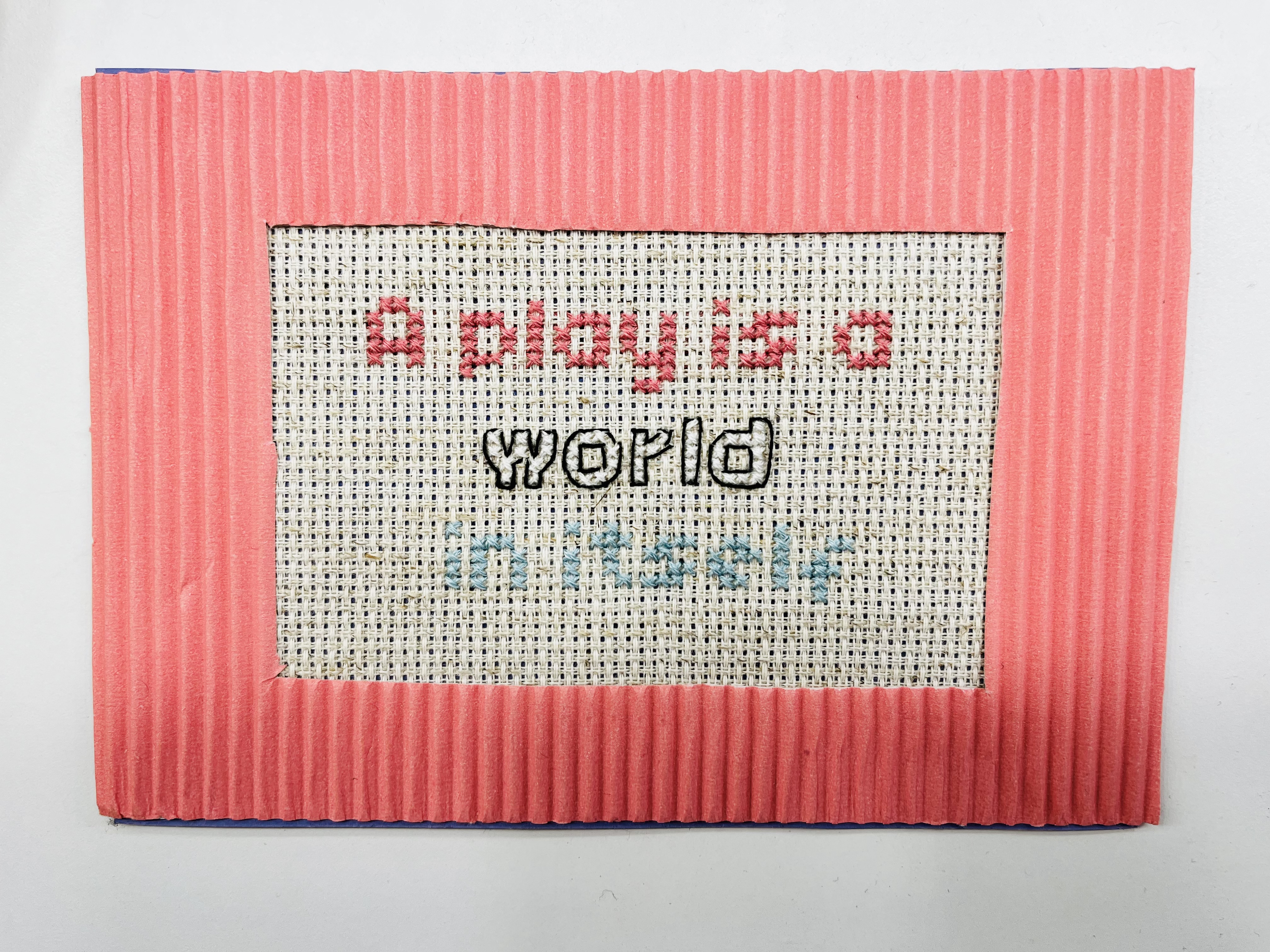
And now for the final quintet from Our Country's Good, here are the cross stitches that I made for certain members of the crew. These are all lines spoken by the character I played, Mary (Dabby) Bryant. Based on a real woman from history, this character dreamed of returning to her native Devon, and in fact she did (although not in the play itself). Despite being unable to read, she conducts conversations about the nature of theatre and the meaning of plays, which add the meta-theatrical level to the production.

For one of the cross stitches I maintained the avian theme from previous works (the crimson rosella, because it is one of my favourites), but for the others I chose either the colours of the Aboriginal flag as a representative of this land, or those that remind me of Devon. At one point Dabby says, "I want to see a wall of stone. I want to hear the Atlantic breaking into the estuary", and she also exclaims, "Oh, give me some English rain. I could recognise English rain anywhere. And Devon rain... is the softest in England".

I gave this one to The Luminosity who was the Assistant Director and also ran several line-learning sessions
For the German Rep who made my basket of chicken props (pine cones with feathers). The character follows this up with, 'This is a very stupid line and I'm not saying it'.
Said at the end of the play as Dabby dreams of 'my future success'
For our Stage Manager, who did indeed see the whole play, several times
The conclusion of the above line, for our kind and generous prompt

Friday, 23 September 2022

Friday Five: Our Cross-Stitch’s Good

Further to the previous post about cross-stitch quotes from Our Country's Good by Timberlake Wertenbaker, here are some more words of the text picked out in the colours of the local birdlife.

Said by Watkin Tench (played by Gaurav Pant) in the colours of a crimson rosella (Platycercus elegans)
Spoken by John Arscott (played by Paul Sweeney) in the colours of the Eastern ground parrot (Pezoporus wallicus)

Said by Ketch Freeman (Played by Maurice Downing) in the colours of a Gang-gang cockatoo (Callocephalon fimbriatum)

Said by 2nd Lt Ralph Clark (played by Callum Wilson) in the colours of an Eastern rosella (Platycercus eximius

Said originally by George Farquhar in The Recruiting Officer, and frequently by director Karen Vickery in rehearsals, in the colours of a King parrot (Alisterus scapularis)

Wednesday, 14 September 2022

Ordering Chaos: The Mercies


The Mercies by Kiran Millwood Hargrave
Picador
Pp. 336

With echoes of The Crucible, The Handmaid’s Tale and My Antonia, this is a fascinating tale of how the women in a remote society cope after a natural disaster wipes out most of the male population. The novel begins with the (real life) sudden storm on December 24, 1617 just off the coast of the island of Vardø, Norway’s north-easternmost point, which caused forty fishermen to drown in minutes. The women are left to mourn and bury their dead, and to try to work together to survive, until ‘a stranger comes to town’ and changes everything, resulting in accusations of witchcraft and a (again, real life) ‘trial’ held on 29 March 1620.

At the outset, there are stories of the women working together at domestic chores, after their men have been lost at sea; they undertake soothing rituals of the home (bread making and sewing), but they must also put to sea to fish, and butcher the meat – things the menfolk did but they are no longer here. The action of rowing becomes a metaphor for cooperation which, despite personal differences, is essential for survival. “They pull together as men rowing a boat. It is a closeness born of necessity: they need each other more than ever, especially as food begins to scarcen.” Maren observes that there is a rhythm and a natural order to their society, which we know will be overturned, because that is the chaos that makes drama.

Women are expected to fit a mould, and they cause discomfort to others when they break out of it. Men from the mainland come to bury the bodies when the earth has thawed enough to dig. They wish to wish to control women; they dislike seeing women doing manual labour such as fishing and butchering, and they disapprove of them wearing practical clothing (trousers) to do so.

Absalom Cornet is appointed by Lensmann Cunningham to visit the island, with his new wife, Ursa, and hunt out any instances of witchcraft. The sense of unease throughout the novel is palpable, and the reader may be horrified at the ending but not surprised. Hargrave is portentous in her foreshadowing from Maren’s dreams of dead whales to more explicit warnings that the arrival of men, and Absalom Cornet in particular, will have dire consequences. “They imagine he will be like their minister, have as little impact as snow falling into the sea. They imagine that their lives will go on, and that the worst is behind them. They imagine all sorts of silly, inconsequential things, and every bit of it is wrong.”

Some of the women have relied upon ritual to deal with grief and help them to feel safe; in some cases using runes and leaving food out for trolls. Maren is comforted by the Sámi ceremonies of Diina, her sister-in-law. “She had believed it, because in those months she was grasping for something, anything, to order the chaos that the storm had set among them.” Many of the women submit to soothing domestic routines, rather than praying in the church to a stern deity. Ursa has been brought up with housekeepers and no idea how to provide for herself; when Maren teaches her how to bake bread, the description is sacramental.

The men also need to find order in the chaos, so they choose to blame witchcraft. The clear rift between the meeting house and the kirke women is embodied between Kirsten and Toril. Kirsten is stronger, but Toril speaks the right words to the church men and there is nothing anyone can do against the charge of witchcraft. The things by which they accuse the women of witchcraft are very mundane. “It reads like a list of women’s gossip, from arguments over fish-drying racks to saying the Lord’s Prayer backwards.” The women collude with the practice and find that once accusations of witchcraft begin, they are as impossible to stop as the weather. “Oh, God have mercy on us. We have begun it, and cannot end it.”

The arrival of the witch finder destroys everything the women have built, but his wife also leads to conflict from the moment she alights from the boat in her vibrant yellow dress so dramatically different from the drab outfits of the island women. Ursa and Maren seek physical comfort in each other’s arms, but not until their emotions have threatened to overrun them and left them dumb. Kiran Millwood Hargrave has taken the bare facts of witchcraft trials in a Norwegian island, and woven them into a most intriguing tale full of contemporary themes. The lessons of how an isolated community is broken by those wanting power are ringing loud and clear. 
Steilneset Memorial in Vardo, Norway, commemorating the trial and execution in 1621 of 91 people (77 women and 14 men) for witchcraft

Friday, 9 September 2022

Friday Five: Cross-stitch quotes from Our Country's Good

Tonight is opening night of Our Country's Good by Timberlake Wertenbaker at Canberra Repertory Theatre. As I am in it, I have listened to the wonderful words night after night in rehearsal and, as is my wont, in my down time I have created cross-stitch patterns based on the text to make into cards for the cast. 

The colours I have used are based on the plumage of Australian birds (mainly parrots). I remember when I first moved here myself, how taken I was with the avian vibrancy, and so the line, "You have been made Governor-in-Chief of a paradise of birds" (spoken to Captain Arthur Phillip by Captain David Collins) resonates particularly strongly. 

Said by Arthur Philip (played by Amy Crawford) in the colours of a Bald-eyed corella (Cacatua sanguinea)
Said by 'Shitty' Meg Long (played by Meaghan Stewart) in the colours of a Rainbow lorikeet (Trichoglossus moluccanus
Said by Robert Sideway (played by Isabelle Gurney) in the colours of a Sulphur-crested cockatoo (Cacatua galerita)
Said by Liz Morden (played by Alexandra Pelvin) in the colours of a Yellow-tailed black cockatoo (Zanda funerea)
Said by Mary Brenham (played by Rosy Fasano) in the colours of a Galah (Eolophus roseicapilla)

Wednesday, 7 September 2022

Paddock to Plate: Orange Regional Museum

On a trip to Orange, when Him Outdoors was busy competing in a cycling race, I went to the regional art gallery and museum. Their exhibition was Paddock to Plate: a history of food and wine in Orange and the district.


While it did pretty much what you would expect - using historic objects and photographs to illustrate how growing, processing, distribution and consumption of food has changed over time - it was curated in an interesting and interactive fashion, encouraging visitors to learn more about the stories of the people of the region. The exhibition starts with the mountain, an ancient volcano, which created the soils and climate that attracted indigenous people, then others from across the world. 

Stories about producing, processing and forces of change run around the perimeter walls, giving space for large farming objects and showcases containing smaller artefacts. A range of farming tools is mounted on simple white backing boards, so the timelessly beautiful shapes of these objects can be clearly seen. 


Curator Sandra McEwan and the museum team assembled an impressive trove of over 200 historic from around the Orange region with enormous variety of size and scale. Ploughs, refrigerators and a rare wheat flail join whisks, butter pats and dainty mementos of dining in a bygone era. 


Central to the exhibition was the concept of food in the home, and this was represented through a stylised 'kitchen' displaying utensils in a pigeonhole format that echoes kitchen cupboards. Some of these cupboards are see-through, and others have solid doors. Each door has a single word printed on the face giving a clue to the use of the object inside, such as grind, whip, cut, beat, squeeze, shape, lift, protect and hold, which sounds either like cookery, cosmetic surgery or a particularly violent poker game.  


A dining table is covered in a series of projections showing changing styles and tastes of home eating from the 1800s to today. One table features a display of seeds and legumes as in a curiosity cabinet, including wheat, wattle, apple, pumpkin, hazelnut, cucumber, kurrajong and kangaroo grass. 


Paddock to Plate tells the story of food and wine production in this beautiful district through the stories of people, place and a passion for produce. Lists of words always inspire poetry in me, so naturally I took myself to the café where I had coffee and cake and thought of my domestic culinary memories.
Pitter patter of kitchen helper;
patty cake with butter pat,
licking clean the whisk and spoon
with mother in the warmest room:
better batter on baking day.

Friday, 2 September 2022

Friday Five: Books Read in August

Once again it turns out that I have (conveniently for blog purposes) read five books in a month. These are they.

5 Books Read in August:
  1. Chatter: The Voice in Our Head and How to Harness It by Ethan Kross (Vermilion) - We all have voices in our head; some supportive and encouraging; others belittling and disruptive. Kross provides pop-scientific reasons for why and which ones count. Talking to ourselves and others can be beneficial to help us distance ourselves from traumatic experience, but it can also lead us into a vicious cycle of repetition, particularly in the echo chambers of social media. This book presents ways to normalise and contextualise confronting events and suggests methods that enable us to take back 'control'. Easy to read and with a practical 'toolkit' of strategies, this is recommended for anyone struggling with daily overwhelm. 
  2. Cow by Susan Hawthorne (Spinifex) - A sublime book of poetry inspired by the humble (or scared in some societies) bovine beast. From ancient aurochs to nursery rhyme moon jumpers; cattle chattel of Lakshmi, the Hindu goddess of wealth and good fortune to the shape-shifting Io of Greek myth who became a white heifer due to Zeus' lust and Hera's rage, there are cows, "at the edges of every known world/ like it or not we are everywhere."
  3. The Club: Johnson, Boswell and the Friends Who Shaped an Age by Leo Damrosch (Yale University Press) - Named one of the ten best books of 2019 by the New York Times Book Review, this is the story of the phenomenal London club, established in 1764, and the men (and it was only men) who comprised it. It was established in a tavern and was the meeting place of writers, thinkers, economists, philosophers, artists, actors, playwrights, politicians, historians, lawyers, doctors, musicologists, poets, clergymen, botanists, chemists, scholars and statesmen - a who's who of the mid-late eighteenth century. Told mainly through the eyes of James Boswell (he wrote a lot), it captures the characters and the events of the times, such as the cultural climate and political happenings, but, "Above all the Club existed for conversation: not just small talk, but wide-ranging discussion on topics of all kinds."
  4. Fled by Meg Keneally (Echo Publishing) - This novel tells the story of Mary (Dabby) Bryant, who was transported to the fledgling colony of New South Wales for highway robbery. Once there, she manipulated the system as much as possible until she escaped to make her way back to  England, where she thought she had a better chance of survival for herself and her children. She is renamed Jenny Trelawney for the purposes of fiction, and while the 'real' Mary Bryant was illiterate and never wrote down any thoughts or feelings, many of the facts are true and make for an incredible historical adventure. In the Mobius strip-like way that art can unfold, Meg Keneally's father, Thomas wrote a book, The Playmaker, based on the story of the first play ever performed in Australia, with Dabby Bryant being one of the actors - this book was the basis for a play by Timberlake Wertenbaker, Our Country's Good, in which I am currently performing (as Dabby Bryant) at Canberra Repertory.
  5. The Secrets of Strangers by Charity Norman (Allen & Unwin) - When a bloke marches into a café in London and shoots the proprietor, several of the patrons get caught up in the cross-fire and the ensuing hostage situation. We learn about them all individually in a highly stylised manner that makes the novel seem more like a stage play or a series of TV episodes. Among those captive in the café are a grandmother looking after her grandson, a lawyer who is meant to be defending her client in court, a former teacher who is now homeless due in part to a gambling addiction, and a waitress who is hiding in the cleaning cupboard, her presence unknown to the gunman. Their stories all wrap up neatly - everyone has to have a backstory to provide context for their actions, many of which are glossed over or shoehorned into the story as the cause du jour (coercive control; refugee experience; infertility obsession) - and the reader has very few gaps to fill, removing any tension necessary for a thriller. We also hear from Eliza, the police negotiator who is talking to the gunman and trying to secure the release of the hostages - hers is the most interesting and realistic voice in the novel. While the pace is fast enough that one does want to keep turning the pages, there are no surprises and the need to keep everything tidy and completed is distancing and unsatisfying to the point of triteness. 

Tuesday, 30 August 2022

Crime of its Time: Vintage Murder


Vintage Murder by Ngaio Marsh
Fontana
Pp.223

Inspector Roderick Alleyn is on holiday in New Zealand when he gets caught up with a theatre group and a murder, involving a mistimed opening of a jeroboam of champagne. This combines Ngaio Marsh’s interests perfectly, allowing her to give her chapters such titles as Prologue in a Train, Intermezzo, Duologue, and Business with Props. Written in 1937, it is dated in language and attitude, although it was doubtless considered progressive at the time.

Detectives, witnesses and suspects have a lot in common with actors as they rehearse stories, play parts and deliver lines, whereas Alleyn is straightforward and direct with a self-deprecating sense of humour. When he lists the suspects, their possible motives and alibis, he draws up a chart which is included in the chapter Entr’acte to assist the reader as much as himself – naturally, everybody has one.

There is snobbery towards people’s age, size, class and accent, although most prejudice, however, occurs towards the Maori people, as exemplified through the character of Dr Rangi Te Pokiha. A considerably hateful comedian describes Te Pokiha as “the black quack” and “the light-brown medico”, and when Te Pokiha retaliates (he has also been called silly, obviously wrong, and a liar), we are told, “The whites of his eyes seemed to become more noticeable and his heavy brows came together… [His] warm voice thickened. His lips coarsened into a sort of snarl. He showed his teeth like a dog… the odd twenty per cent of pure savage.” One suspect asserts, “There is no colour bar in this country,” but people still use the expression ‘a white man’ to denote a person of good character. Alleyn describes the country and the people with an anthropological aspect that is offensive to modern readers.

The plot is well-crafted, some of the characterisation and theatrical tropes are fun, and the Kiwi setting is original, but the inherent racism, sexism and body-shaming are problematic. Crime novels may remain popular, but fortunately times have changed.