Showing posts with label history. Show all posts

Thursday, 13 October 2022

The Campbell Epergne

When I visited the Orange Regional Museum a couple of years ago, I was struck by this decorative table piece (not literally - it was displayed behind glass). I read that the national Cultural Heritage Account had assisted the museum with the purchase of this item to the tune of $90,000. I thought that was a fair whack for a candlestick, so I read all the information about it - turns out it is quite the icon, so here are the facts, as presented by the museum.

"This sterling silver epergne was presented to David and Amelia Campbell of Goimbla, Eugowra in 1864 by residents of the district to mark their respect and admiration for her role in defending her family's property. The gift was in recognition of the heroism shown by Mrs Campbell and her husband in resisting an attack on their property Goimbla by Ben Hall, Johnny Gilbert, and John O'Meally. The bushrangers attacked the property and set the Campbell's barn and stables on fire. O'Meally was killed in the attack.

The epergne is a decorative table centrepiece which stands 72cm high and was made in London in 1862 by Thomas Smily. The epergne was purchased from Hardy Brothers Sydney for £150 with funds raised by community subscriptions. Modelled in a rococo revival style, the epergne has a tri-form base with leaf feet, scrolls and beading, rising to a naturalistic trunk with six scrolling arms, three with candle fittings and three supporting loop-handled baskets with a centre basket. The entire epergne is ornately decorated with vines and grapes.

Although the inscription is to both David and Amelia Campbell, contemporary accounts of the presentation event describe Mr Campbell being given a gold watch, now in the State Library of NSW, while the epergne was a gift to Mrs Campbell along with a silver-plated coffee urn inscribed by the ladies of Upper and Middle Adelong, and a printed silk address signed by 92 male residents of Forbes and District. The presentation of these lavish gifts was made at Goimbla in October 1864.

David and Amelia Campbell (taken from a lantern slide: National Museum of Australia)

Approximately 16 gold and silver bushranger medals were presented to police and members of the public to mark their heroism during encounters with bushrangers. This is the only presentation-epergne associated with bushranger attacks and the only presentation made to a woman. Its delicacy of design and execution has a particularly feminine character. 

Amelia Campbell was lauded as a 'daughter of Australia - a lady brought up and educated in Sydney who did not flinch under gunfire.'

Her heroism is emblematic of the often-overlooked dangers of many women living on lonely farms in regional Australia. Sadly, other women who stood their ground and fended off attacks by bushrangers received little public recognition. This epergne represents an important aspect of Australian colonial history and is one of the most notable and significant items of nineteenth-century Australian women's history."


From the 1840s attacks by bushrangers and acts of resistance prompted public recognition in the form of testimonial gifts. In addition to cash gifts as compensation for property losses, presentation items included watches, gold medals, firearms, and written testimonials. 

The attack on Goimbla and Mrs Campbell's courage in particular marked a turning point in public sentiment towards the Ben Hall gang, who had until then received covert support from some settlers through the exchange of horses and food. The bushrangers' decision to shoot at Amelia Campbell was likely a major factor in undermining whatever trust or passive support existed for the gang. 

In 1865 the Felons Apprehension Act effectively declared bushrangers outlaws and shortly afterwards Ben Hall was shot dead. 

Ben Hall 
As for Amelia Campbell, she died in childbirth at the age of 34 along with one of the twins she had given birth to. The notes in the museum record that 'The other twin lived only for a few months. This followed her losing a son at ten years of age. This was a very sad end for a very heroic woman.'

I feel this is the purpose of museums: to tell stories through objects and relate the history of past events to the current perception of the society.

Friday, 2 September 2022

Friday Five: Books Read in August

Once again it turns out that I have (conveniently for blog purposes) read five books in a month. These are they.

5 Books Read in August:
  1. Chatter: The Voice in Our Head and How to Harness It by Ethan Kross (Vermilion) - We all have voices in our head; some supportive and encouraging; others belittling and disruptive. Kross provides pop-scientific reasons for why and which ones count. Talking to ourselves and others can be beneficial to help us distance ourselves from traumatic experience, but it can also lead us into a vicious cycle of repetition, particularly in the echo chambers of social media. This book presents ways to normalise and contextualise confronting events and suggests methods that enable us to take back 'control'. Easy to read and with a practical 'toolkit' of strategies, this is recommended for anyone struggling with daily overwhelm. 
  2. Cow by Susan Hawthorne (Spinifex) - A sublime book of poetry inspired by the humble (or scared in some societies) bovine beast. From ancient aurochs to nursery rhyme moon jumpers; cattle chattel of Lakshmi, the Hindu goddess of wealth and good fortune to the shape-shifting Io of Greek myth who became a white heifer due to Zeus' lust and Hera's rage, there are cows, "at the edges of every known world/ like it or not we are everywhere."
  3. The Club: Johnson, Boswell and the Friends Who Shaped an Age by Leo Damrosch (Yale University Press) - Named one of the ten best books of 2019 by the New York Times Book Review, this is the story of the phenomenal London club, established in 1764, and the men (and it was only men) who comprised it. It was established in a tavern and was the meeting place of writers, thinkers, economists, philosophers, artists, actors, playwrights, politicians, historians, lawyers, doctors, musicologists, poets, clergymen, botanists, chemists, scholars and statesmen - a who's who of the mid-late eighteenth century. Told mainly through the eyes of James Boswell (he wrote a lot), it captures the characters and the events of the times, such as the cultural climate and political happenings, but, "Above all the Club existed for conversation: not just small talk, but wide-ranging discussion on topics of all kinds."
  4. Fled by Meg Keneally (Echo Publishing) - This novel tells the story of Mary (Dabby) Bryant, who was transported to the fledgling colony of New South Wales for highway robbery. Once there, she manipulated the system as much as possible until she escaped to make her way back to  England, where she thought she had a better chance of survival for herself and her children. She is renamed Jenny Trelawney for the purposes of fiction, and while the 'real' Mary Bryant was illiterate and never wrote down any thoughts or feelings, many of the facts are true and make for an incredible historical adventure. In the Mobius strip-like way that art can unfold, Meg Keneally's father, Thomas wrote a book, The Playmaker, based on the story of the first play ever performed in Australia, with Dabby Bryant being one of the actors - this book was the basis for a play by Timberlake Wertenbaker, Our Country's Good, in which I am currently performing (as Dabby Bryant) at Canberra Repertory.
  5. The Secrets of Strangers by Charity Norman (Allen & Unwin) - When a bloke marches into a café in London and shoots the proprietor, several of the patrons get caught up in the cross-fire and the ensuing hostage situation. We learn about them all individually in a highly stylised manner that makes the novel seem more like a stage play or a series of TV episodes. Among those captive in the café are a grandmother looking after her grandson, a lawyer who is meant to be defending her client in court, a former teacher who is now homeless due in part to a gambling addiction, and a waitress who is hiding in the cleaning cupboard, her presence unknown to the gunman. Their stories all wrap up neatly - everyone has to have a backstory to provide context for their actions, many of which are glossed over or shoehorned into the story as the cause du jour (coercive control; refugee experience; infertility obsession) - and the reader has very few gaps to fill, removing any tension necessary for a thriller. We also hear from Eliza, the police negotiator who is talking to the gunman and trying to secure the release of the hostages - hers is the most interesting and realistic voice in the novel. While the pace is fast enough that one does want to keep turning the pages, there are no surprises and the need to keep everything tidy and completed is distancing and unsatisfying to the point of triteness. 

Thursday, 10 June 2021

Life's Nourishment: Milk by Dylan Van Den Berg

Dylan Van Den Berg, Katie Beckett and Roxanne McDonald in Milk

Milk by Dylan Van Den Berg

Directed by Ginny Savage
The Street Theatre
3 -12 June, 2021

The theatre is a forum for sharing stories; exploring the past; questioning the present; and preparing for the future. ‘Milk’ does all of the above with superb staging and atmospheric sound and lighting featuring pivotal moments in liminal spaces, directed with depth and nuance by Ginny Savage.

We are taken to a metaphysical Flinders Island off the coast of Tasmania, which is created instantly through imagery and sound (Peter Bailey) – the wind is a constant presence. The design of the rock-strewn stage (Imogen Keen) is evocative and versatile; piles of stones can be interpreted as cairns and path-markers, burial sites and weapons. Ranging in size they indicate the passage of time through erosion, and they can be put in a pocket and transplanted to another time and place.

Spanning two centuries the play tracks the conversation between three Aboriginal ancestors coming together on the verge of life-changing moments. The characters are nameless – known only as Character A, B, and C – which suggests a blending of personalities and continuation of stories. Playwright and Character C, Dylan Van Den Berg has just become a father, which has made him introspective. He wants to know where he came from and what he might be passing on to a future generation.

Character A (Roxanne McDonald) and Character C (Dylan Van Den Berg) 

He and the other characters, A (Roxanne McDonald) and B (Katie Beckett), attempt to reconcile what came before invasion and colonisation of Tasmania with what is yet to come. Roxanne McDonald (portraying an old woman from the 1840s) tells her story with honesty and heartbreaking integrity. While the horror and violence of the past is not dwelt upon, there are certainly uncomfortable scenes and a few tears were shed in the audience. A note in the programme reminds us that “a group of Palawa people, mostly women, were removed from their country and taken to the Bass Strait Islands in the early-to-mid 1800s. They were sold, bartered, and gifted as ‘wives’ to the white sealers who lived there.”

Katie Beckett plays Character C’s grandmother, although the actors are similar in age, which leads to an intimacy and shared understanding of identity. The difference is that “You’re lucky with that milky skin. You get no trouble. You get to carry it all on the inside – all the knowledge. Some of us gotta carry it on the outside for everyone to see.” Character B is a middle-aged woman from the 1960s who is attempting to find fun and explore the world through various encounters and relationships, while refusing to be confined by convention. 

Katie Beckett as Character B

Through outstanding physicality, the actors all embody greatly varying experiences and shifts of mood that are entirely convincing and utterly compelling. The costumes, also by Imogen Keen, are designed to accentuate the details of their circumstances, from the rough-looking, sturdy coverings, fashioned like a blanket, of Character A, to the impractical and uncomfortable shiny fabric worn by Character B as she prepares to go on a date and sell herself as something she is not – “I’m a natural blonde, baby… this is just a dye-job.”

They progress and move past grief, shame and self-loathing by literally picking themselves up and carrying on. Lighting by Gerry Corcoran illuminates, defines and conceals spaces in intriguing ways that create conversation. We all have blind spots in our family history, but learning about the past can inform our present and teach us to be more compassionate towards the people around us.

It is apt that Milk opened in a world premiere during Reconciliation Week. It may be a personal story about loss and survival, but it asks us all to question our heritage and to consider our relationship to the land we live on. Again, the programme notes that, “For many years it was said that the Palawa people were ‘extinct’. White history has swallowed our stories. This is just one of many.” A lot of stories and knowledge have been lost through lack of sharing, but in the words of character C, “It’s all out there. Even the stuff we think is gone. We just – have to listen. We just – have to dance.”

This play is stunning and heartfelt. It is personal and it is broader than one man’s story. It affects all of us, as it should. See it; feel it; share it. That is all.

Thursday, 26 March 2020

Walking in Circles: London Overground


London Overground by Iain Sinclair
Hamish Hamilton
Pp. 258

In 2012 Iain Sinclair and his walking companion, Andre Kötting (British artist, writer and film-maker b.1959) spent a day tramping around the London Overground circuit, and Sinclair recounts the journey by weaving in references to others who have come before. Processions and pilgrimages are evoked from Chaucer’s Canterbury Tales to Bunyan’s Pilgrims Progress, as the duo walk just for the sake of walking. He is at his best when describing the physical mechanics of motion. “Refuelling was a requirement, but sitting down would carry the risk of our not being able to rise again. Pints were delivered, swilled back, replenished, before a bowl of steaming fish pie made it from microwave to table.”

He likes to walk. He has walked around Hackney, the M25, and areas that have been cleared for the Olympics before, and written books about all of them.  Understanding the needs for a hook with which to draw in the reader, he chooses routes that are frequently travelled, but by different forms of transportation. Above all, he fears bland homogenisation and he despises shopping centres, such as Clapham Junction, in a sentiment familiar from Ghost Milk.

Sinclair writes with a sense of nostalgia, and is proud of his grumpy old man status: “This old-man sourness is addictive. Period pains from the inability to accommodate change. When nature pricks and the heart engages, people go on long pilgrimages”. Resistance to progress tends towards snobbish bigotry. He dislikes popular culture; he dislikes cyclists, mothers with pushchairs, and people on mobile phones; anyone, in fact, who enters ‘his’ space.

His references are deliberately esoteric but they are overwhelmingly white, middle-class, and decidedly male. The number of name drops becomes exhausting – there are 387 in 258 pages (I counted and catalogued them all, with their Wikipedia entries as interpretation). Of these 387 authors, artists, poets, politicians, film-makers, architects, actors, explorers, scientists and activists who people this particular landscape, only 43 are female: that’s fewer than 12%. Women may be mentioned as eye witnesses to events, nameless passers-by to whom he talks, or memories of previous lovers (again nameless), but they make no significant impression on this history of London.

Sinclair writes in truncated sentences, which can be punchy but soon grow tiresome: “He put his money where his mouth was. And his tongue was blistered with diamonds.” It can be difficult to tell whether the prose is clever or just obtuse: are these profound analogies or empty aphorisms?

One of Sinclair’s bugbears is the commercialisation of the environment. He notes the areas of desirable real estate: “Even a minor physical elevation comes with entitlement to upward social mobility.” He admits, “We would all live on the river if we could, waiting for the rains of Schadenfreude to wash us away. Climate is another word for conscience.” He shuns the wealthy and the nouveau riche. “Fundamentalism of every stamp, including the fundamental decencies of the old Surrey stockbroker belt (now given over to Russian oligarchs and Premier League footballers), is suspect. Bourgeois marriage is a lie. Property is debt.”

While mourning the past, he invokes the present in poetic language, “The Thames riverbank would, in a few years, become a circus with a Ferris wheel, chair-lift rides, millennial (discon)tent on the East Greenwich swamps, and a shockheaded mayor as a public clown, swinging from wires or falling off a trick bicycle.” His associations with the city are intense, and he refutes any that don’t align with his emotions. “Maybe that’s it: the memory-place should remain fixed. The attitude to the great sprawl of the metropolis is verging on Oedipal.” London changes constantly, and while everyone is defensive of their own version, they should probably be more tolerant of the fact that there is room for many more.

Monday, 9 December 2019

History Never Repeats: The Testaments


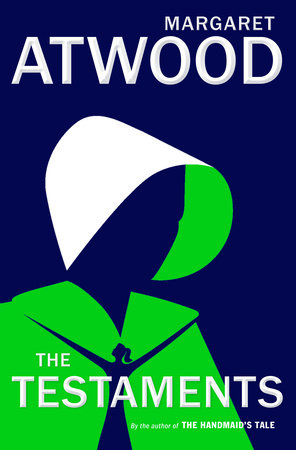
The Testaments by Margaret Atwood
Chatto & Windus
Pp. 415

In her acknowledgements, at the end of The Testaments, Margaret Atwood thanks “the readers of The Handmaid’s Tale; their interest and curiosity has been inspiring.” If my desire to know what happened after The Handmaid’s Tale is in any part responsible for the writing of this book, 35 years after its predecessor, you’re welcome. It’s been a long time coming, but it is certainly worth it, and after all this time, it still has a clear directive: “We must continue to remind ourselves of the wrong turnings taken in the past so we do not repeat them.”

Much of the novel is a thinly-veiled polemic against totalitarianism. One of the narrators is Aunt Lydia, who warns against assuming all that is new is good, and ignoring past wisdom, especially that derived from women. “The corrupt and blood-smeared fingerprints of the past must be wiped away to create a clean space for the morally pure generation that is surely about to arrive. Such is the theory.” She keeps a secret diary, which is part confession, within the hollowed-out pages of a book, incorporating sarcasm about women’s perceived roles with asides about the veracity of history and the stories we are conditioned to believe.

Her wit and humour are displayed throughout her manuscript, and she rambles with her folksy sayings and pragmatic methods. There is a dark side to the humour, however. Some of the young girls threaten to will kill themselves if they are forced into marriage, afraid of male sexuality. “No one wants to die. But some people don’t want to live in any of the ways that are allowed.” It is horrifically symptomatic of totalitarian regimes: women and children suffer as men rape and take what they want.

Before Gilead, Lydia was a judge, and the new (male) rulers did not want her around. “Any forced change of leadership is always followed by a move to crush the opposition. The opposition is led by the educated, so the educated are the first to be eliminated.” Persecution was fairly indiscriminate: “All that was necessary was a law degree and a uterus: a lethal combination.” Now she is a cornerstone of the Gilead government, but she knows power can be overthrown and statues easily toppled.

Whereas The Handmaid’s Tale was focused primarily on June and the other handmaids and was claustrophobic in tone; this novel is narrated through three different voices: Aunt Lydia, Agnes, and Daisy. As the title suggests, they are putting their name to a document they have sworn to be true, and the novel opens up into a wider world. Where there are women; there is communication. “The Aunts, the Marthas, the Wives: despite the fact that they were frequently envious and resentful, and might even hate one another, news flowed among them as if along invisible spiderweb threads.”

Treatment of women by men, who seek to dominate and oppress them, is an over-arching motif. Women must be pure: those who enjoy sex and physical relationships are sluts. Women should be nurturers and carers. Women are blamed for their indiscretions; men are not held accountable for their deeds: men must act on their urges; women must not encourage them. Women exist to reproduce; their bodies are baby-making factories and do not belong to them individually. “Every woman wanted a baby, said Aunt Estée. Every woman who wasn’t an Aunt or a Martha. Because if you weren’t an Aunt or a Martha, said Aunt Vidala, what earthly use were you if you didn’t have a baby?” It’s all depressingly familiar.

Aunt Lydia keeps secrets so she can blackmail people later when it is useful to do so. “All that festers is not gold, but it can be made profitable in non-monetary ways: knowledge is power, especially discreditable knowledge. I am not the first person to have recognised this, or to have capitalized on it when possible: every intelligence agency in the world has always known it.” Fake news and students on strike are recognisable tropes. The combination of adulterated Shakespeare and pertinence to contemporary affairs is deliberately unsettling. Atwood uses the language of fairy tales, but the chilling ones like Sleeping Beauty and later comparisons with Bluebeard.

Atwood notches up the tension as a couple of young protagonists escape Gilead by boat in a thrilling adventure, as the reader experiences the fear of young women who have never left their established order. Just as in The Handmaid’s Tale, there were cassette tapes that carried the messages of those trapped within a system; here there is another way of disseminating information and spreading the truth. Aunt Lydia thinks, “Fly well, my messengers, my silver doves, my destroying angels. Land safely.” Further parallels between the books exist in the closing of them both with a Symposium. Here the thirteenth Symposium cleverly ties it together and prevents alternative endings, while still leaving sufficient scope to flesh out. “As they say, history does not repeat itself, but it rhymes.”


Monday, 23 May 2016

Rise Up.


Now is the Time by Melvyn Bragg
(Sceptre)

Melvyn Bragg’s novel may ostensibly be about The Peasants’ Revolt (a dramatic six weeks in summer 1381), but it clearly has parallels to today’s socio-political situation where the rich tax the poor beyond reason and endurance.  

In the author’s note, Bragg writes that he studied history at university but that the Peasants’ Revolt – the greatest popular uprising in English history – was overlooked. He suggests that this may be because “it was too dangerous for establishment historians to dwell on, too radical, altogether un-English... Perhaps for some it was too disturbing. Perhaps it always will be.” He sets out to right this wrong with a work that took him 15 years to write.

The historical fiction focuses on the factual characters of preacher John Ball, activists Jack Straw and Walter (Wat) Tyler, his wife (Margaret), daughter (Joan), and follower and sometime-lover Johanna Ferres, the boy-king Richard II, his mother Joan, Princess of Wales and Maid of Kent, and his several advisers and councillors.

Money is the root of all this evil, particularly the unjust raising of taxes. Under the leadership of Wat Tyler, the people join forces and march on London to meet their King and to present their demands. These demands are not excessive, and the people who call themselves The True Commons, remain loyal to the King. Their issue is with his advisers and the wealthy merchants and priests who hoard their wealth to the detriment of the people. 

Inequality is rife as John Ball sees by the vast warehouses of the wool trade nestling beside great poverty, “like an illustration of the World As It Was and the World As It Could Be. Ball saw, yet again, here as all over England, the rich seeming to need to confine and cramp the poor. And the poor had agreed to endure it until now.”

Many use the anarchy on the streets to settle old scores; the prisons are opened and people ‘join’ for the mayhem, not the cause. “London feels as if a barrel of gunpowder has been thrown into the middle of it. Many people think they will never get out alive.” People adopt the cover of rebellion to settle old scores and redress grievances of envy, and there is soon indiscriminate bloodletting.

The novel begins with a quote from The Mirror of Man, a 1378 poem by John Gower in which he claims that there are three things capable of producing “merciless destruction when they get the upper hand”; water, fire, and “the common multitude”. The last words of the book, in the author’s note remind us that, “The poll tax was not imposed again for six hundred years. In the 1980s, Margaret Thatcher reintroduced it. It provoked violent riots and was quickly withdrawn.” 

This is almost a polemic; a call to arms. It is certainly a stark warning about what can happen to a society that allows the rift between rich and poor to plumb to such astronomic depths. The clue is the title.