Showing posts with label London. Show all posts

Tuesday, 25 July 2023

You Keep It All In: A Clear Conscience


A Clear Conscience by Frances Fyfield
Corgi
Pp. 284

Helen West is a prosecutor in domestic violence cases, and this is her fifth outing in novels by Frances Fyfield, although that is not obviously apparent from this edition. The fast-paced and bleak thriller is set in the world of back-street boozers, wife abusers, ex-boxers, and knock-off perfume. The crime is both petty and serious, as passion erupts into fights over office romance and much darker offences. The characters are criminals, cleaners, bar staff, ex-army personnel, lawyers, policemen and caseworkers.

The writing style is almost breathless, and grammar seems optional as the prose gathers pace along with the narrative. The author constantly switches point of view so it appears to be third-person omniscient but we are always in the mind of the subject, blurring the lines between reality and perception. Helen’s friend Emily employs Cath as a cleaner; Cath’s brother Damien is the murder victim of a case investigated by Bailey, Helen’s partner; Damien was killed after a night at the pub where Joe, Cath’s abusive husband works. There are no easy answers or definitive source of truth; law and justice are explicitly not the same thing.

Everyone lies to a certain extent, and no one tells the whole truth to anyone, even themselves. “We are all at cross purposes, he thought, every one of us a little mad, each of us with a piece of puzzle in our hands, while the truth floats up there like that big, black raincloud.” In an attempt to feel better about one’s self-image, characters believe their own narrative and don’t examine their motives too closely. Helen is obsessed with home decorating, Cath smells of bleach, Emily dismisses Cath for suspected theft of perfume – the interior renovation metaphor alludes to the patina of gloss that covers cracks but doesn’t mend them. Perfume serves a similar masking purpose. “What a terrible gift was perfume, always given by a man to make you wear it and please him, while you stank of blackmail.”

Written in 1994, the novel has an end-of-the-century feminism feel as the author questions women’s roles and their need to validate themselves in society. Helen claims to be determinedly independent and happily childfree. “I’d hate to be a megalomaniac wife and mother. Mothers run a closed book. They shut the world out, close off anything inconvenient, as if being mum in charge of a family is so self-satisfying, so sanctifying, they never need have a conscience about anything else.” And yet, she is yearning for something intangible. “It was useless pretending she was not influenced by what she saw and read; she was not immune to the contagion of the romantic or the desire for security purveyed by mothers and magazines…but she did not quite know how to not want it either, or how to close her ears to the blandishments of marriage propaganda.”

Although short and sharp, this is an oppressive novel in which women are struggling to stand alone without being defined by men – partners; bosses; social constructs. There is a menacing tone and a fear that they will never be enough – but by whose standards? It reminds me of that playground 'joke', Q: Why do women wear make-up and perfume? A: Because they're ugly and they smell. They are not and they do not, but our patriarchal capitalist society has a vested interest in making them think thus.

Wednesday, 12 April 2023

Unconvincing Café Crime: The Secrets of Strangers


The Secrets of Strangers by Charity Norman
Allen & Unwin
Pp. 334

Published in 2020, this fast-paced action novel about five strangers held captive by a gunman in a London café instantly recalls the Lindt Café siege in December 2014, when a lone gunman held hostage ten customers and eight employees of a chocolate café in Martin Place, Sydney, Australia. There have doubtless been many events such as this in London, but the novel doesn’t feel as though it is set in that city at all – there are no landmarks or sense of place, the people are caricatures rather than characters, and there is a reference to playing soccer, betraying the fact that the author has lived in New Zealand for the past twenty years.

The novel is written in the present tense and structured in short chapters with different third-person-omniscient perspectives to make it feel immediate and resemble a TV drama or a play. Neil is an erstwhile teacher, now homeless due to a gambling addiction, Abi is a defence lawyer, Mutesi is a Carer at an aged care facility, Sam is the gunman who has shot Robert, the café owner, and Eliza is the police negotiator.

The most interesting and believable of these characters is Eliza, who is co-ordinating between the gunman on the phone and those directing the police operation on the ground. Tension abounds when they want to enter the building although she cautions against it. Her communication with Sam must be rational and calm as she tries to establish a rapport and get to the crux of the matter.

Everyone has the capacity for both good and evil and Sam is plagued by memories of a two-faced puppet, an obvious metaphor for his relationship with his manipulative step-father. The owner of the café, Robert, whom everyone thought was a good guy, is actually a snake and uses coercive control on his partners. He’s a narcissist and a sociopath, and few people can see through him as he gaslights women (including Sam’s mother) and convinces them they have gaping holes in their memory and forget whole conversations.

In a very conventional outlook, we are guided to believe that children are the future and the reason for living. Mutesi is only afraid for her grandson; Abi is undergoing IVF in a desperate attempt to conceive which has taken over her life and that of her partner, as if she is nothing without offspring.

The situation is extremely unrealistic, with sympathetic cups of tea; coherent stories told and a neat tying-up of ends. In a cosy conclusion it provides a satisfying story (no innocent bystanders are shot) and we are almost directed (the words is used advisedly) to feel sympathy for Sam because of the incidents in his past. Although it is dangerous to assign labels if one is not a clinical psychiatrist, it may be that Sam is on the spectrum and possibly lives with ADHD. He has suicidal thoughts and ideation, and is taking Ritalin to help focus his attention. And yet he shot someone, held up others at gunpoint, and clearly has terrifying anger issues. 

We are told, “People survive. Human beings go on. They have a capacity for love and a capacity for evil, but they go on.” It doesn’t ring true that contemporary Londoners would be that equable or forgiving, and the novel can’t decide between being a gritty police procedural and a charming endorsement of humanity.

Tuesday, 21 June 2022

My Newest Favourite Thing: Diagonal Lifts


When I was a child and I tried to envisage the future, my mind was full of social and technical achievements. I saw driverless cars; phones on which you could see the person as well as talk to them; and lifts that went in all directions rather than strictly up and down. I also dreamed of equal rights and pay for women in a world where women's sport was taken as seriously as the men's equivalent; where women had the right to drive cars and not be accused of witchcraft and beaten to death; where a woman had the right to decide what she did and did not want to do with her body and was valued for more than her ability to reproduce. Clearly that last one is a bit too far-fetched. 

But the new incline lifts on London's Elizabeth Line run proudly parallel to the escalators, rather than vertically. Apparently this is a cost-effective exercise with additional ecological benefits. The diagonal design is cheaper to build as it 'negates the need for the costly excavation of a lift shaft and will reduce power consumption by nearly 50 per cent'.

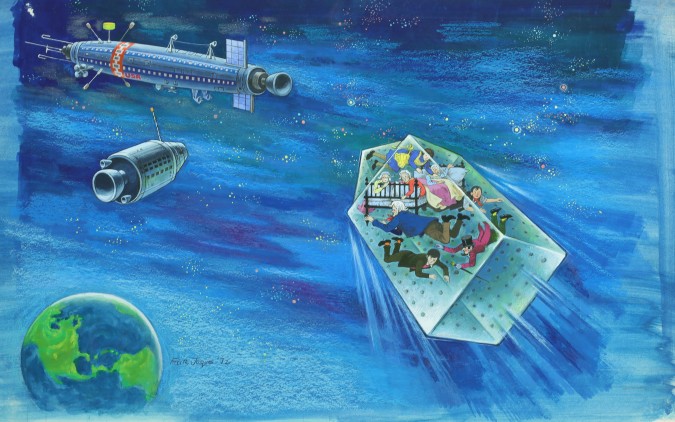
I'm sure that some nerdy lift electrician (now, where can I find me one of them?) could explain all the practicalities to me if I really cared, but I just think they look cool and can't wait for them to do loop the loops and fly off into space. That's totally possible, right? 

Original artwork for Charlie and the Great Glass Elevator
Incidentally, the new Elizabeth Line will slightly redress the gender imbalance of nomenclature. There are currently only three stations named after women: Seven Sisters; Victoria and Lancaster Gate - this latter being so-called in honour of Queen Victoria in her guise as the Duke of Lancaster, as the monarch is styled, regardless of gender.

Aware of this injustice, Londoners Reni Endo-Lodge and Emma Watson created a City of Women tube map for International Women's Day this year. The map is available to buy and there's also an interactive version on-line where you can look up more details about the women featured.
"The usual names of London's 272 Underground stations are switched out for pioneering female figures across every genre - the arts, sport, politics, activism... the list goes on. Among them are household names like Audrey Hepburn, Adele, Mary Seacole, Madhur Jaffrey, Michaela Coel, Boudica and the Ford sewing machinists, as featured in the film Made in Dagenham. Even Holloway - the erstwhile women's prison - gets a namecheck."


As for my childhood vision of the future? Well, I guess three out of four ain't bad.

Friday, 21 January 2022

Friday Five: Keep on Puzzling

And now we bring you the latest from the puzzling files, beginning with a picture of the church at Port Arthur lent to us by The Luminosity. The trees were the hardest bit. And there was a piece missing, which we only found later after we had boxed it back up.


 Next we have this rather beautiful colour wheel made from sharpened pencils...


...and a cat, lent to me by Design Diva (the puzzle; not Melantho).


Third on the list is this depiction of Jane Austen's world, lent to me by The Purple Lady. I don't love Austen as I do Shakespeare, so this wasn't quite as much fun as the previous one I did from this company, but it was still quirky enough to be enjoyable. 


I did really enjoy piecing together this image of London landmarks, which I did with my Dad while I was visiting my parents at home.


And finally (for now), I completed this picture entitled Frosty Friends at my sister's house while Scary Sis went out to work. Clearly it's been a tough holiday.

Wednesday, 6 October 2021

My Newest Favourite Thing: Pieces of Shakespeare

Shakespeare's London
I have been posting updates on my blog about the puzzles I have been doing, but I feel that this one deserves a post of its own. This beautiful and rich image is by Adam Simpson; the puzzle is by Laurence King Publishing; and it was lent to me by Purple Lady.

There is an accompanying sheet (text by Neil Carter) that tells us all about the picture - it's superbly educational for younger folk interested in the bard, or those of any age starting out on their knowledge gathering, or those with experience who just want a bit of fun recognition. It states, "Shakespeare's London is alive with activity. The River Thames winds past the Globe Theatre on the South Bank, under London Bridge, and by the Tower of London in the east. Houses are tightly packed together in the city centre, but the outskirts quickly give way to open spaces and woodland nearby."

Naturally, when piecing the puzzle together, I did the river first, partly because the colour stood out, and partly because it is my river. I then did The Globe, because, well, it's the Globe.
 
The Globe
Henry V
The bear pit
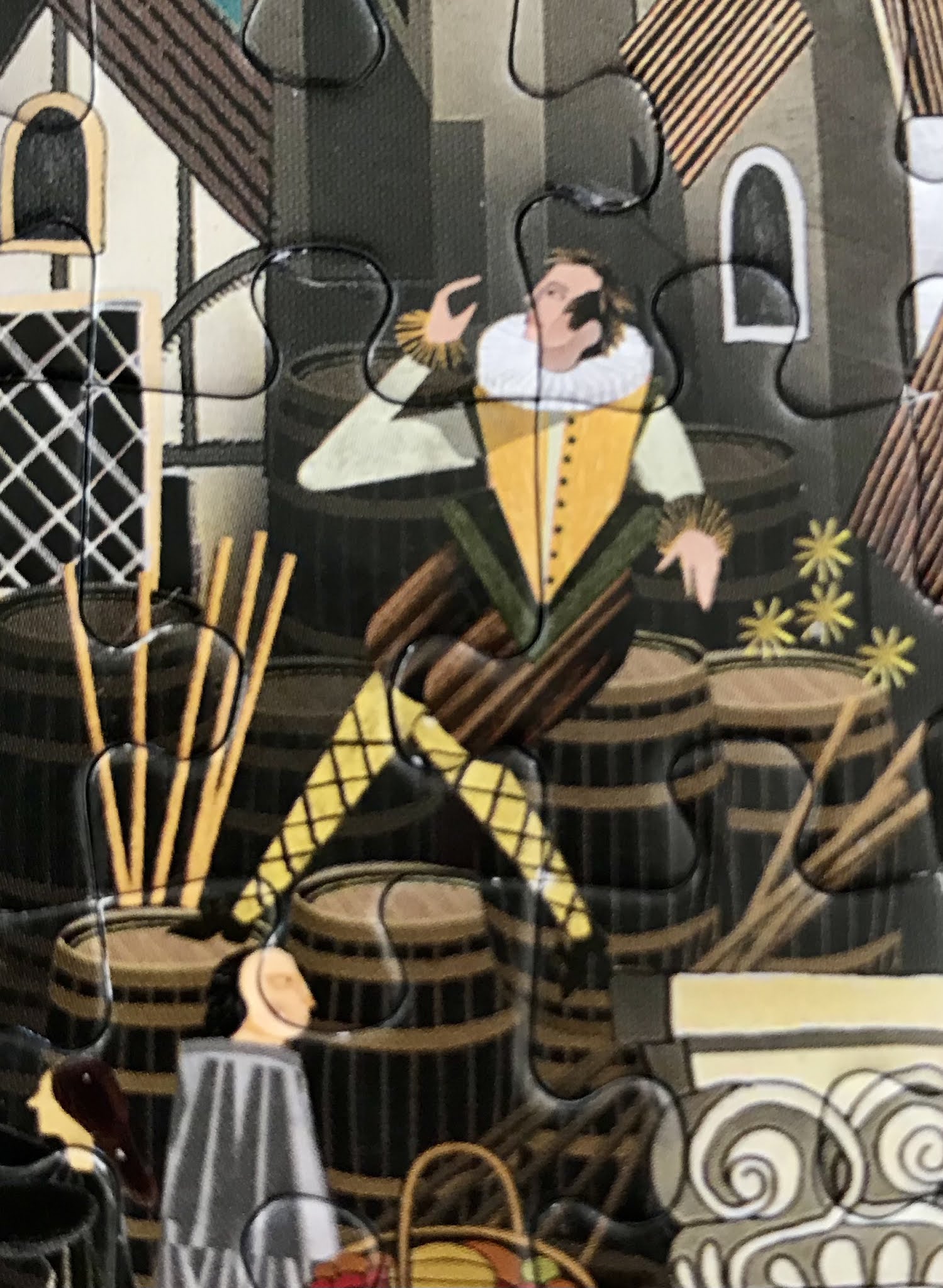
Inside the Globe, there is a rehearsal for A Midsummer Night's Dream featuring the characters of Bottom, Titania and Oberon with an entourage of fairies and (my favourite thing) William Shakespeare with script and quill in hand overseeing the rehearsal. Outside "a man stands on a box addressing the crowd, wearing a crown and armed with sword and shield: this is Henry V delivering his rousing 'Once more into the breach, dear friends' speech." Nearby is the bear pit in which a bear has escaped its chains and is chasing its keeper, with a nod to the famous stage direction, ‘exit pursued by a bear’ from The Winter's Tale.

Macbeth
A Midsummer Night's Dream
Gravediggers on the edge
Next, I did the Macbeth scene, where the three witches are "engaging in nefarious practices", as Macbeth and Banquo ride up on their horses. At the edge of this scene are the pairings from A Midsummer Night's Dream (Demetrius; Lysander; Helena; Hermia) watched by Puck from the tree marvelling at 'what fools these mortals be'. In another section of the puzzle, the gravediggers from Macbeth lean on their spades for a break in their work. 

Hamlet
Romeo and Juliet
King Lear
Julius Caesar
Scenes from all the greatest hits are scattered throughout the picture. Let's start with the tragedies... Hamlet offers Yorick's skull to Ophelia in front of Gertrude and Claudius, while the ghost of Hamlet's father hovers above the scene. Romeo climbs up some steps to get to Juliet, who is hanging out of a tower, while Tybalt and Mercutio fight a deadly duel below. King Lear is flanked by his daughters Goneril and Regan, "desperately haranguing him on each side, while a third quieter and more beautiful daughter (Cordelia) watches from the sidelines." He is also accompanied by his fool and a mad beggar (Edgar).  

The Julius Caesar scene is interesting because, as a way of getting around the fact that it is totally anachronistic (even more so than the play itself), this is described as, "in a field a group of children playing dress-up in Roman costume are having a mock battle in the vein of Julius Caesar". Lurking on the edge of this vignette is an alchemist, trying to turn base metals into gold, "watched from the shadows by Ben Jonson frantically scribbling notes for his next play." This is not the only time Simpson places one of Shakespeare's contemporaries in the periphery.

A tavern featuring a scene from Othello in the foreground and Falstaff on the roof
Andrew Aguecheek and Sir Toby Belch from Twelfth Night
Malovolio from Twelfth Night
Outside one of the taverns, “Othello and Iago are watching another man, Cassio, talk to Desdemona. Iago is whispering poisonous lies into Othello’s ear.” I love the fact this occurs underneath a pub sign of Shakespeare. Behind this tavern, "some are settling debts with a moneylender (perhaps even Shylock from The Merchant of Venice).”

On the roof, “Falstaff is in full drunken flow, holding court and being extremely obnoxious, with his flagons of ale held aloft. The tavern is lively. Andrew Aguecheek and Sir Toby Belch (both of whom hail from Twelfth Night) debate loudly as they eat and drink their fill.” Meanwhile, “Malvolio sits forlornly at the side of the bridge in his cross-garnered yellow stockings, wondering where it all went wrong.”

Prospero and Miranda from The Tempest
Caliban from The Tempest
Dogberry and Verges from Much Ado About Nothing in the centre of the scene
The Tempest is alluded to by Prospero in the brow of a boat “with his staff in the air attempting to conjure up a storm while his daughter, Miranda, waits at his feet, slightly annoyed.” Looking back at the pair from on land, Caliban “can also be found lurking on the riverbank.” Okay, he looks more like the Jolly Green Giant than 'abhorred slave', 'hag-seed', 'monster of the isle', 'a most perfidious and drunken monster', 'moon-calf', 'a born devil on whose nature/ Nurture can never stick', and an 'abominable monster', but at least he gets in the picture. 

Between Caliban and the King Lear grouping on the path, we see that, “Two bumbling night watch constables totter along the riverbank (Dogberry and Verges from Much Ado About Nothing). They are being pursued by rats, which populate many areas of the city and cause recurring plague epidemics.”

The Tower of London
Richard III
The Comedy of Errors
The Tower of London is another fantastic setting which includes a number of references to Shakespeare's plays and contemporaries. As well as the previously mentioned Hamlet consortium, we have a scene in which, “Two young boys - could they be the Princes in the Tower? - are playing watched on by someone who looks suspiciously like Richard III.” Meanwhile, “in the tower’s inner courtyard two masters are discussing comically confusing orders for twin servants (referencing The Comedy of Errors).” 'Comically confusing' is an interesting description of that play, and I'm not sure all would agree. Incidentally, the figure leaning out of the window of the Tower above them is Walter Raleigh who "is being held prisoner: he gazes out on to the water longingly.”

Benedick and Beatrice from Much Ado About Nothing
QEI
Sir Francis Drake on the Golden Hind
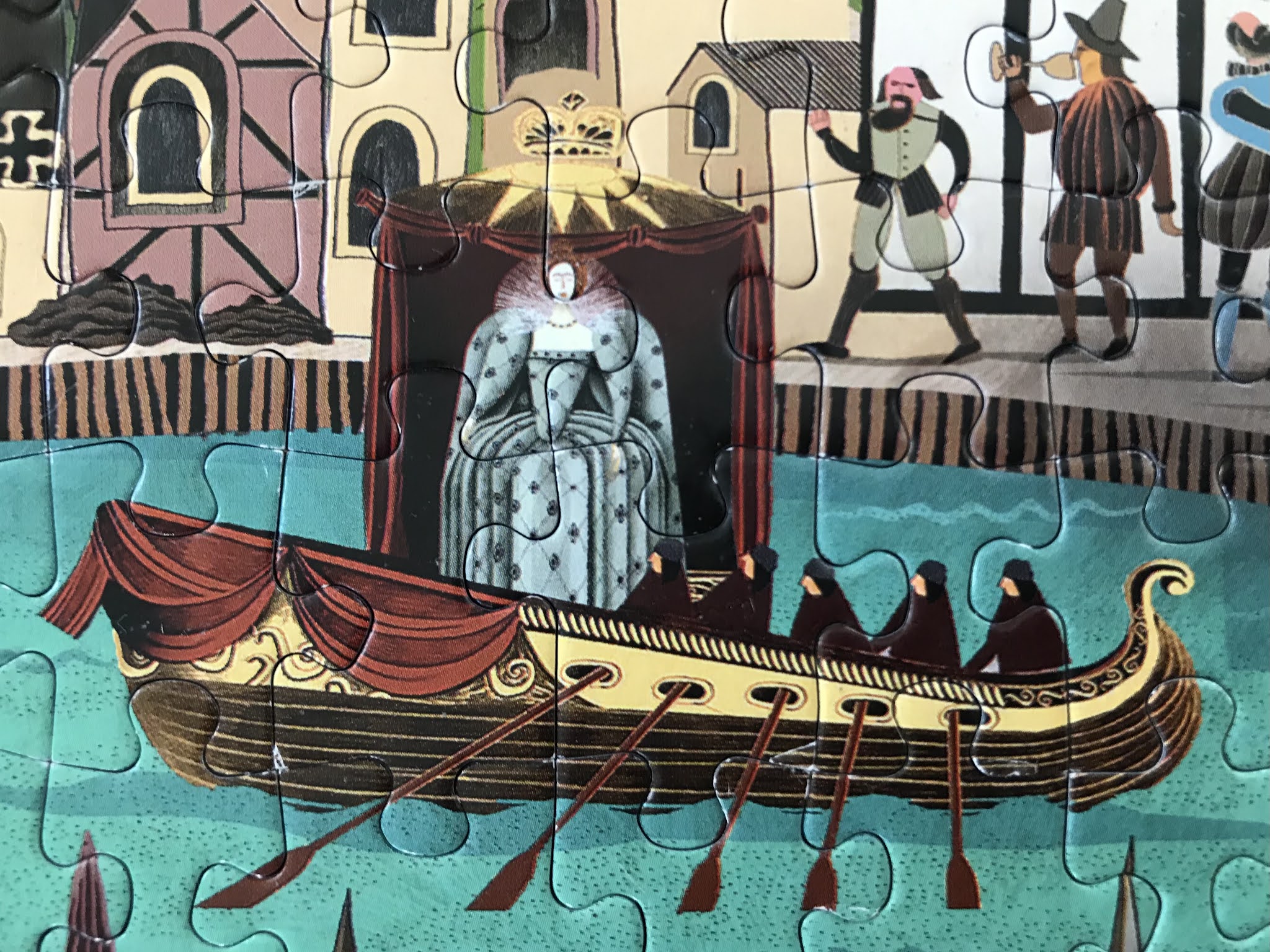
I wouldn't have guessed these characters, but apparently “Two small boats are quite close to each other and Benedick and Beatrice are quarrelling across the water.” There are other great figures upon the water too: at one side of the picture is Gloriana, Queen Elizabeth I herself, “on the deck of her royal barge, attended by various lords, making her way to the theatre” and at the other side, downriver, Sir Francis Drake buckles his swash on the deck of his famous ship, the Golden Hind.

Christopher Marlowe
John Donne
Christopher Marlowe is featured being stabbed, recalling the rumours of his death in a fight over a bill. It is described thus: “In a back alley behind the theatre a drunken brawl is taking place, and Christopher Marlowe is fighting a loosing battle with an assailant.” Another contemporary at the edge of the puzzle is John Donne. “In a room in the city’s northeastern outskirts John Donne is reluctantly waking up, light streaming through the window, which annoys him (referencing  his famous poem ‘The Sun Rising’).” Interestingly, the annoyance felt in this poem is because the poet would rather linger in bed with his lover, although in this sanitised version, he is alone. The makers would like this puzzle to be pieced together by children, and clearly violence and death is a lot more acceptable to show them than sex and healthy physical relationships. This bothers me on many levels, but this is not the place...

London Bridge
Heads on spikes
Speaking of the violence, there are heads on spikes at the end of London Bridge. The Old Medieval Bridge (1209-1830) was lined with buildings, shops, houses and churches. For over 600 years this bridge was the key crossing point of the Thames in London, ferrying people, goods and livestock across the river. It was an iconic feature of the City of London, not least due to those heads. (Digression alert.)

In a very informative blog, Paul Asling tells us all about it. The severed heads served as a warning to anyone thinking of challenging the Crown. The first head to be placed there is thought to be that of William Wallace in 1305 after the Scot was found guilty of leading a campaign against Edward I. Other celebrity dead heads included Jack Cade (who led a rebel army to overthrow the government), Thomas Moore (who refused to accept Henry VIII as the supreme head of the Church of England), Guy Fawkes (part of the Gunpowder Plot of 1605), and some of those who had signed the death warrant of Charles I (in 1660 when the monarchy was restored with Charles II). They ended the practice in 1678 when the heads of the most important traitors were displayed at Temple Bar instead.

The silent heads became a tourist attraction, drawing visitors from far and wide. To ensure longevity, the heads were parboiled and coated in pitch. Once put on the spike on one of the gates at the end of London Bridge, they were left to the elements to rot and eventually fell into the Thames; when the original bridge was pulled down, workers found skulls in the mud. The Keeper of the Heads had full managerial control over this section of the Bridge. I wonder if the power went to his head... (Digression over.)

May Day fete
I love the charmingly skewiff perspective. I love the little drawings of dogs and musicians popping up all over the place. And I love the inclusion of entertainments such as jugglers outside the Globe, and the merriment of the May Day fete. “The land between the South Bank and the city’s eastern edge (towards Bermondsey) is host to a May Day fete, with food and drink flowing freely, and displays of maypole dancing and archery.” 

This is an utterly charming puzzle and I am very grateful to Purple Lady for letting me borrow it. I shall now look out for others in their range, which include The World of Charles Dickens; The World of Jane Austen; The World of Frida Kahlo; Pop Art Puzzle; The Story of the History of Impressionism; The Dream of Surrealism (in 1,000 jigsaw pieces); The World of Sherlock Holmes; The Wonderful World of Oz; Inside the Chocolate Factory and The Mythical World, among others. 

Tuesday, 6 July 2021

Ham and Pea Soup: A Rare Interest in Corpses


A Rare Interest in Corpses by Ann Granger
Headline
Pp. 410

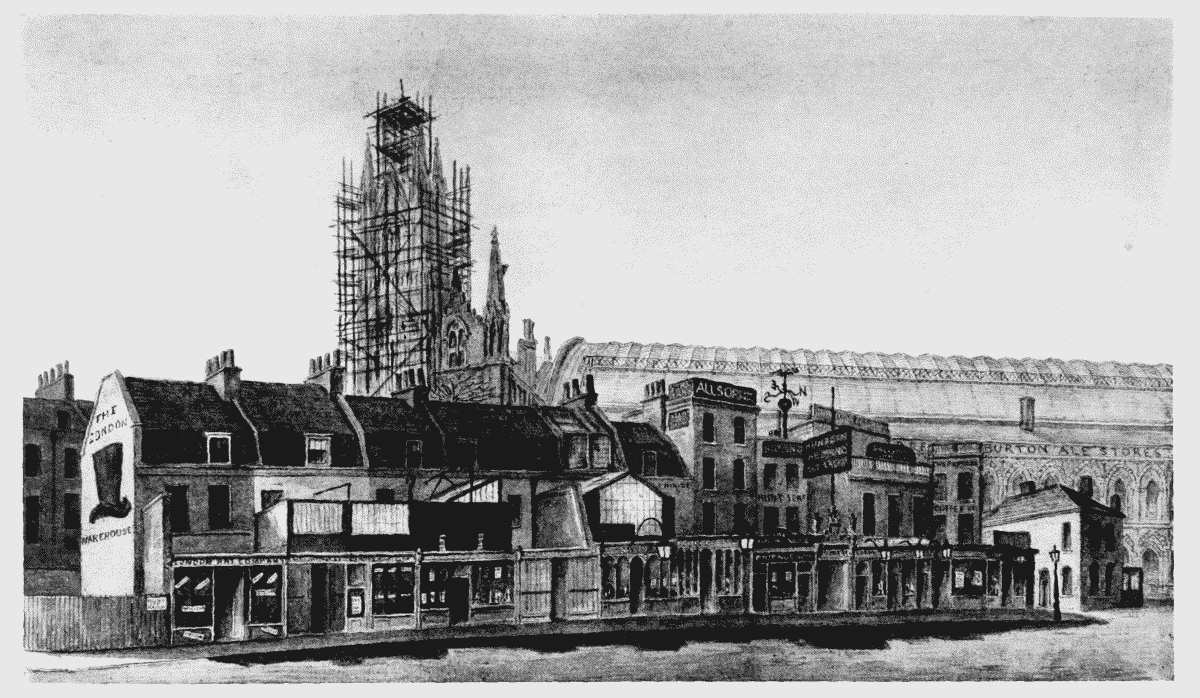
Marketed in some territories as The Companion, this is the first novel in what becomes a historical crime series set in Victorian London. After her father’s death in 1864, the penniless Elizabeth (Lizzie) Martin takes up a position as companion to Mrs Parry, her god-father’s wealthy widow, only to find that her predecessor, Madeleine Hexham, who had supposedly run off with an unknown man, is dead (and pregnant). Madeleine’s body is discovered in the recently-demolished slums around the prestigious new railway station at St Pancras, and Inspector Benjamin Ross is in charge of the investigation. Lizzie realises that she knows Ross from her childhood (her father sponsored his education) and that ‘Aunt’ Parry, as she is encouraged to call her, was a landlord for the housing development, causing several elements to build up into a classic detective mystery.

Through the use of alternating chapters between Lizzie and Ross, we are drip-fed information about the developments and social mores of the times, ranging from scientific progress to insights into the working of and attitudes to the police force, and personal relationships.

London is changing and the era is one of rapid development: the capitalist society dictates the rich will get richer while the poor are further oppressed. Mr Fletcher runs the construction company which is building the station on the grounds of the housing Mrs Parry sold to the railway for development. He doesn’t want the police involved on his worksite, because people are fascinated when a body is found. Mrs Parry is equally uncomfortable. “No one wants to be known as a slum landlord and after Madeleine’s body was found there, she liked even less the idea that people would associate her with the place.”

St Pancras Station in the course of building (1871)

Morals and attitudes to women are also questioned. The supposedly religious and upstanding Dr Tibbett expresses his conservative reactionary views to Lizzie in a manner that demonstrates the constraints within which she must work. “I am sorry to say I find increasingly that there is a type of modern young woman who fancies she may speak as freely as a man. I am an old-fashioned fellow who believes that woman is the greatest ornament to her sex when she realises the boundaries Nature has set for her.” He, and others, blame female victims when they are exploited and abused. “We did not know the circumstances of Madeleine’s death. Whatever Tibbett had to say it would amount to declaring that it was all her own fault.”

This is a world in which class distinctions are rife and supremely hierarchical. Inspector Ross comes from mining stock and has risen through the ranks; his superiors dislike him because he is working class. He notes that the social strata extends to the upstairs/ downstairs milieu of the masters and servants. “I reflected that below stairs there existed a world which, in true Darwinian fashion, had evolved quite differently to society above. Had the great naturalist set himself to study it, he might have found as much of interest there as he had in Terra del Fuego.” Although this is the first in the series about Benjamin Ross and Elizabeth Martin, it is evident that there will be more, and that Lizzie and Ben will end up together; they are both honest and self-aware with a strong moral backbone.

The novel is full of the classic features of the Victorian detective drama. The dim-witted Dunn (Ross’s superior officer) struggles to solve the mystery, announcing, “This is turning into a dashed complicated business, regular cat’s-cradle of possible motives.” There is a dressing table with a hidden drawer in which Lizzie conveniently finds a diary written by the dead woman. Thick Victorian fogs made of coal fire smoke and freezing atmospheric conditions add to the ambience and there is even a standard chase through the pea-souper. It is satisfying without being too demanding and a thoroughly enjoyable addition to the genre.
George du Maurier cartoon in Punch, 1889

Thursday, 26 March 2020

Walking in Circles: London Overground


London Overground by Iain Sinclair
Hamish Hamilton
Pp. 258

In 2012 Iain Sinclair and his walking companion, Andre Kötting (British artist, writer and film-maker b.1959) spent a day tramping around the London Overground circuit, and Sinclair recounts the journey by weaving in references to others who have come before. Processions and pilgrimages are evoked from Chaucer’s Canterbury Tales to Bunyan’s Pilgrims Progress, as the duo walk just for the sake of walking. He is at his best when describing the physical mechanics of motion. “Refuelling was a requirement, but sitting down would carry the risk of our not being able to rise again. Pints were delivered, swilled back, replenished, before a bowl of steaming fish pie made it from microwave to table.”

He likes to walk. He has walked around Hackney, the M25, and areas that have been cleared for the Olympics before, and written books about all of them.  Understanding the needs for a hook with which to draw in the reader, he chooses routes that are frequently travelled, but by different forms of transportation. Above all, he fears bland homogenisation and he despises shopping centres, such as Clapham Junction, in a sentiment familiar from Ghost Milk.

Sinclair writes with a sense of nostalgia, and is proud of his grumpy old man status: “This old-man sourness is addictive. Period pains from the inability to accommodate change. When nature pricks and the heart engages, people go on long pilgrimages”. Resistance to progress tends towards snobbish bigotry. He dislikes popular culture; he dislikes cyclists, mothers with pushchairs, and people on mobile phones; anyone, in fact, who enters ‘his’ space.

His references are deliberately esoteric but they are overwhelmingly white, middle-class, and decidedly male. The number of name drops becomes exhausting – there are 387 in 258 pages (I counted and catalogued them all, with their Wikipedia entries as interpretation). Of these 387 authors, artists, poets, politicians, film-makers, architects, actors, explorers, scientists and activists who people this particular landscape, only 43 are female: that’s fewer than 12%. Women may be mentioned as eye witnesses to events, nameless passers-by to whom he talks, or memories of previous lovers (again nameless), but they make no significant impression on this history of London.

Sinclair writes in truncated sentences, which can be punchy but soon grow tiresome: “He put his money where his mouth was. And his tongue was blistered with diamonds.” It can be difficult to tell whether the prose is clever or just obtuse: are these profound analogies or empty aphorisms?

One of Sinclair’s bugbears is the commercialisation of the environment. He notes the areas of desirable real estate: “Even a minor physical elevation comes with entitlement to upward social mobility.” He admits, “We would all live on the river if we could, waiting for the rains of Schadenfreude to wash us away. Climate is another word for conscience.” He shuns the wealthy and the nouveau riche. “Fundamentalism of every stamp, including the fundamental decencies of the old Surrey stockbroker belt (now given over to Russian oligarchs and Premier League footballers), is suspect. Bourgeois marriage is a lie. Property is debt.”

While mourning the past, he invokes the present in poetic language, “The Thames riverbank would, in a few years, become a circus with a Ferris wheel, chair-lift rides, millennial (discon)tent on the East Greenwich swamps, and a shockheaded mayor as a public clown, swinging from wires or falling off a trick bicycle.” His associations with the city are intense, and he refutes any that don’t align with his emotions. “Maybe that’s it: the memory-place should remain fixed. The attitude to the great sprawl of the metropolis is verging on Oedipal.” London changes constantly, and while everyone is defensive of their own version, they should probably be more tolerant of the fact that there is room for many more.

Saturday, 12 January 2019

A tour de force of story-telling


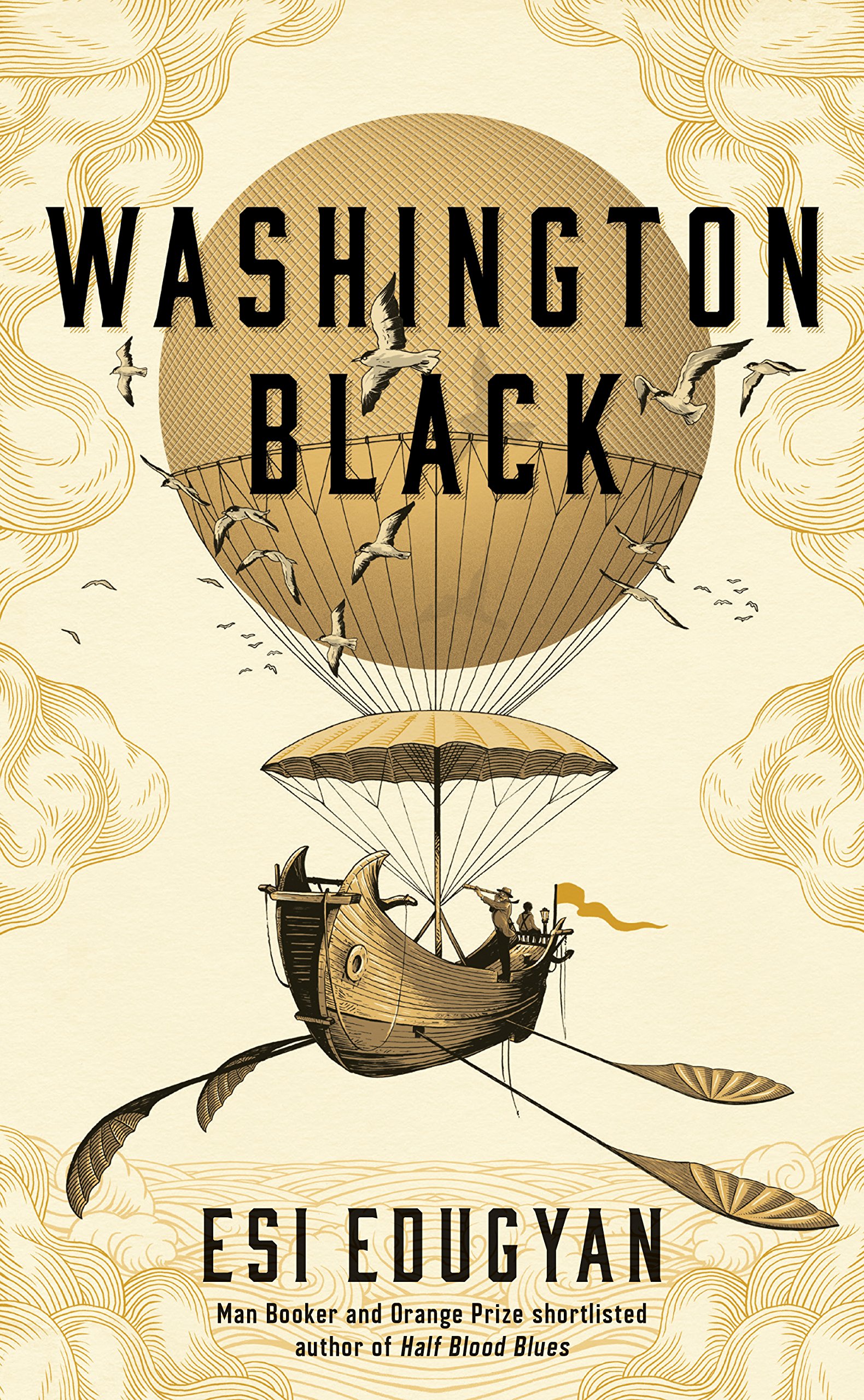
Washington Black by Esi Edugyan
(Serpent's Tail)
Pp. 417

This is a picaresque novel full of adventures and multiple locations: from the slave plantation in Barbados to the frozen wastelands of the Canadian Arctic; from the structured canals of Amsterdam to the wild coasts of Nova Scotia; from the scientific calm of the London Aquarium to the wind-swept deserts of Morocco. It is peopled by explorers, adventurers, scientists and exploiters. Everyone is seeking something: discovery; freedom; equality or survival, and it can all be realised as Washington Black says to his mentor who warns him something is impossible, “Nothing is possible, sir, until it is made so.”

Washington Black is rescued from his brother’s slave plantation by adventurer and inventor Christopher ‘Titch’ Wilde, who says he wants a young boy to help him carry his instruments and take scientific measurements. Titch is trying to sail in a cloud cutter – a craft propelled by both a hot air balloon and more prosaic oars. He encourages Washington’s prodigious gift of drawing and removes him from the daily cruelty of life he has previously experienced. Is he really benevolent, however, or simply using him for his own means?

After an incredibly unfortunate incident, Titch knows that he and Washington must flee and so they affect a wonderfully improbable escape to the Canadian Arctic. Here Washington is introduced to a new world, culture and relationships. When Titch disappears from Washington’s life, he is presumed dead, and Washington must attempt to forge his own way in the world that has hitherto denied him freedom.

Edugyan never flinches from the violence and barbarism of slavery and its consequences, but nor does she dwell upon it. Washington knows his mother was abused and raped, and he writes baldly of the horrors of the slave ships: “The stench of the holds, all of them rolling naked and ill in the dark stomach of the barquentine. The urine and excrement and vomit, men clawing their own throats open with ragged fingernails, bloodied women leaping the deck rails into waters sharp with the fins of sharks. I saw the dozens who had died on the way to Barbados, and I saw those who died once ashore.”

In striving for his freedom, Washington severs his ties with his previous existence and the people he once knew and cared for – it seems that he can only care for himself in order to survive. The novel questions the meaning of belonging. We understand that we do not belong to a person, but can we belong to a place, and how important are family connections? When Washington suspects that Titch may be alive, he begins to search for him, but why? Was he abandoned?

As well as being a sweeping saga of derring-do and outrageous plots, this novel also examines the conundrum of colonialism, survivor’s guilt, and the impossibility of altruism in a pointed and poignant manner. The language is clear and precise as Washington attempts to describe unimagined circumstances, and the fantasy and realism elements blend well in a tour-de-force of storytelling.

Monday, 23 May 2016

Rise Up.


Now is the Time by Melvyn Bragg
(Sceptre)

Melvyn Bragg’s novel may ostensibly be about The Peasants’ Revolt (a dramatic six weeks in summer 1381), but it clearly has parallels to today’s socio-political situation where the rich tax the poor beyond reason and endurance.  

In the author’s note, Bragg writes that he studied history at university but that the Peasants’ Revolt – the greatest popular uprising in English history – was overlooked. He suggests that this may be because “it was too dangerous for establishment historians to dwell on, too radical, altogether un-English... Perhaps for some it was too disturbing. Perhaps it always will be.” He sets out to right this wrong with a work that took him 15 years to write.

The historical fiction focuses on the factual characters of preacher John Ball, activists Jack Straw and Walter (Wat) Tyler, his wife (Margaret), daughter (Joan), and follower and sometime-lover Johanna Ferres, the boy-king Richard II, his mother Joan, Princess of Wales and Maid of Kent, and his several advisers and councillors.

Money is the root of all this evil, particularly the unjust raising of taxes. Under the leadership of Wat Tyler, the people join forces and march on London to meet their King and to present their demands. These demands are not excessive, and the people who call themselves The True Commons, remain loyal to the King. Their issue is with his advisers and the wealthy merchants and priests who hoard their wealth to the detriment of the people. 

Inequality is rife as John Ball sees by the vast warehouses of the wool trade nestling beside great poverty, “like an illustration of the World As It Was and the World As It Could Be. Ball saw, yet again, here as all over England, the rich seeming to need to confine and cramp the poor. And the poor had agreed to endure it until now.”

Many use the anarchy on the streets to settle old scores; the prisons are opened and people ‘join’ for the mayhem, not the cause. “London feels as if a barrel of gunpowder has been thrown into the middle of it. Many people think they will never get out alive.” People adopt the cover of rebellion to settle old scores and redress grievances of envy, and there is soon indiscriminate bloodletting.

The novel begins with a quote from The Mirror of Man, a 1378 poem by John Gower in which he claims that there are three things capable of producing “merciless destruction when they get the upper hand”; water, fire, and “the common multitude”. The last words of the book, in the author’s note remind us that, “The poll tax was not imposed again for six hundred years. In the 1980s, Margaret Thatcher reintroduced it. It provoked violent riots and was quickly withdrawn.” 

This is almost a polemic; a call to arms. It is certainly a stark warning about what can happen to a society that allows the rift between rich and poor to plumb to such astronomic depths. The clue is the title.

Friday, 11 July 2014

Friday Five: Le Tour en Angleterre


Philip Davies (MP for Shipley) has called for the CEO of Welcome to Yorkshire (Gary Verity) to be recognised in the next honours list. It's not that far-fetched; 2.5 million people watched Le Tour in Yorkshire, with the scenery and residents displayed to their best advantage. 

Despite some utter selfie-taking morons thinking they were more important than the race and causing crashes and potential harm to the athletes who have trained for years for the opportunity to participate, the British leg of arguably the world's greatest cycle race has been a resounding success.


5 Great Things about Le Tour in Britain:
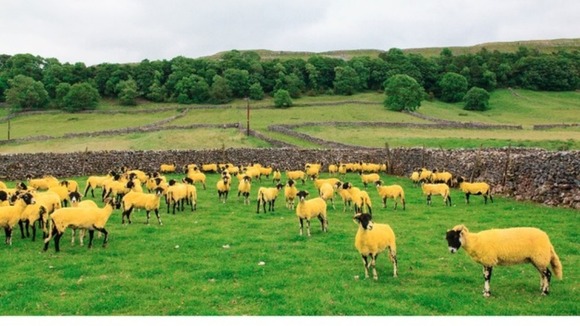
  1. Yorkshire: dry stone walls; green rolling hills; acres of moors; spectacular villages... and coloured sheep
  2. The history: just as the helicopter flies above the beautiful chateaux of France; so we got brilliant aerial shots of castles, colleges, stately homes and abbeys - stunning
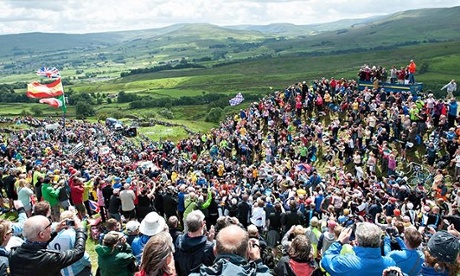
  3. The crowds - the number of people who turned up to shout and support and add colour and enthusiasm was fantastic to see. And the road closures and the publicity and the all-round welcoming spirit can only bode well for the future of cycling in the country.
  4. London - the capital looks great with cyclists streaming through it, past the sights of Big Ben, Tower Bridge, the Tower of London and so many more
  5. The Red Arrows flypast at the beginning, with Ian Stannard in the back seat.