![]() |
| Apparently that's Tenerife |
Friday, 26 April 2024
Friday Five: Sangria etc.
Tuesday, 23 April 2024
Bedtime stories: Witches Abroad
It transpires that
Granny Weatherwax has a sister, Lily – now calling herself Lilith – who wants
to force people into enacting the stereotypes of the fairytales, living in a
land where everyone must be happy whether they like it or not. Lily lets
several stories happen simultaneously; like the evil queen who appears in the
mirror, she uses mirror magic as a form of control. She has her own form of
power (is she the good or the bad witch, and which one does that make Granny
Weatherwax?). “She had buried three husbands, and at least two of them had been
already dead.” Pratchett touches upon myths and legends as well as fairytales, so
Circe, Bluebeard, Casanova, vampires and the Wizard of Oz intermingle with Cinderella,
Rumpelstiltskin, the Three Little Pigs, Little Red Riding Hood, the Three Bears,
Snow White and Sleeping Beauty – “There’ll be a spinning wheel at the bottom of
all this, you mark my words.”
As the witches set
off to right the wrongs of the world, they learn about the structure of stories:
“Three was an important number for stories. Three wishes, three princes, three
billy goats, three guesses… three witches. The maiden, the mother and the…
other one. That was one of the oldest stories of all.” Naturally, not all
these conventions are true, for example, “The natural size of a coven is one.
Witches only get together when they can’t avoid it.” Meanwhile, Nanny Ogg sends
postcards home to our Jason, about what it’s like to be abroad or in foreign parts
(where they do odd things like ‘drink fizzy wine out of ladies’ boots’) and
obviously the structure and convention of writing postcards is its own artform –
sadly, practically lost in 2023.
Friday, 19 April 2024
Friday Five: Theatre in 2024 So Far...
![]() |
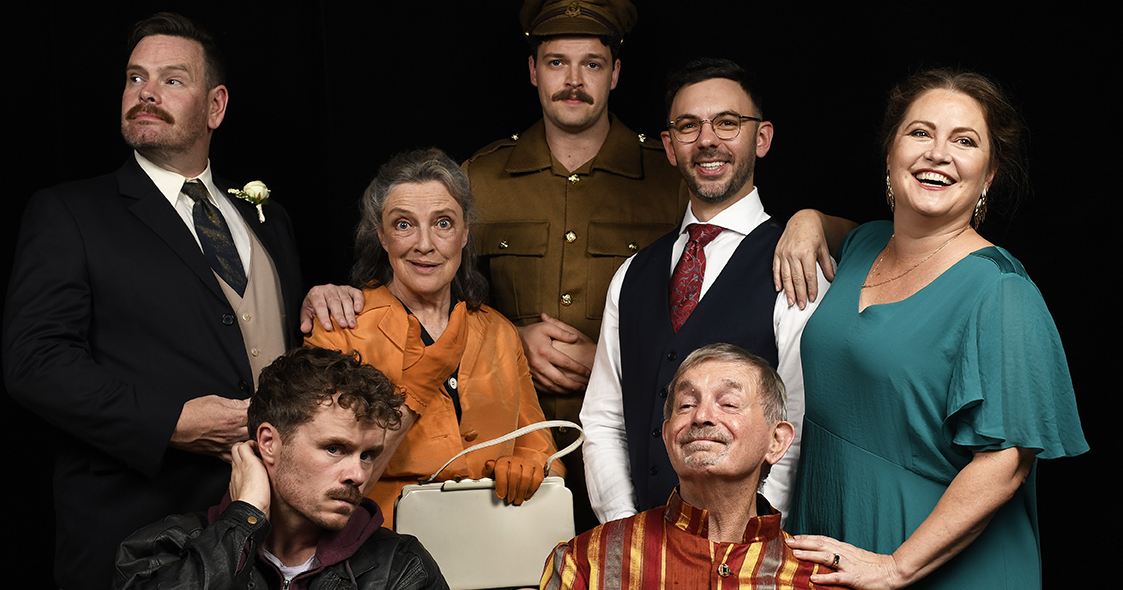
| The cast of Queers at ACT Hub |
- Queers - Everyman Theatre, ACT Hub: A evening of well-performed entertainment that sits more under cabaret than theatre. It is a series of eight monologues performed by indiviual actors with no interaction between them. The direction (Jarrad West and Steph Roberts) is solid as each seperate monolgue takes us through various decades and gives some insight into the main concerns of the gay 'scene', which (according to the publisher of the works curated by Mark Gatiss) 'celebrate a century of evolving social attitudes and political milestones in British gay history. Here, the pub setting and musical interludes provided extra interest and atmosphere, with a special mention for Steph Roberts who played the bartender interracting with actors and adience alike.
- Last of the Red Hot Lovers - Canberra Repertory Society, Theatre 3: A fine production of a not-particularly outstanding play. Barney Cashman (David Cannell) decides he wants to have lots of sex with different women so he invites three of them individually to his appartment and fails to get intimate with any of them, possibly due to a disturbing and extremely unpleasant habit of constantly sniffing his fingers. As usual with a Neil Simon play, the self-indulgent, over-entitled, middle-aged, middle-class, mediocre white man is centre stage while the women are left to act in supporting roles. Victoria Tyrrell Dixon played the wisecracking Elaine Navazio with the perfect blend of cool confidence and comic timing, Stephanie Bailey as Bobbi Michelle played a demanding role with a lightness of touch, gradually and sensitively revealing the truth of her fantasist behaviour, and Janie Lawson as Jeanette Fisher handled existentialist dread well, although was a little stilted and uncertain of her cues.
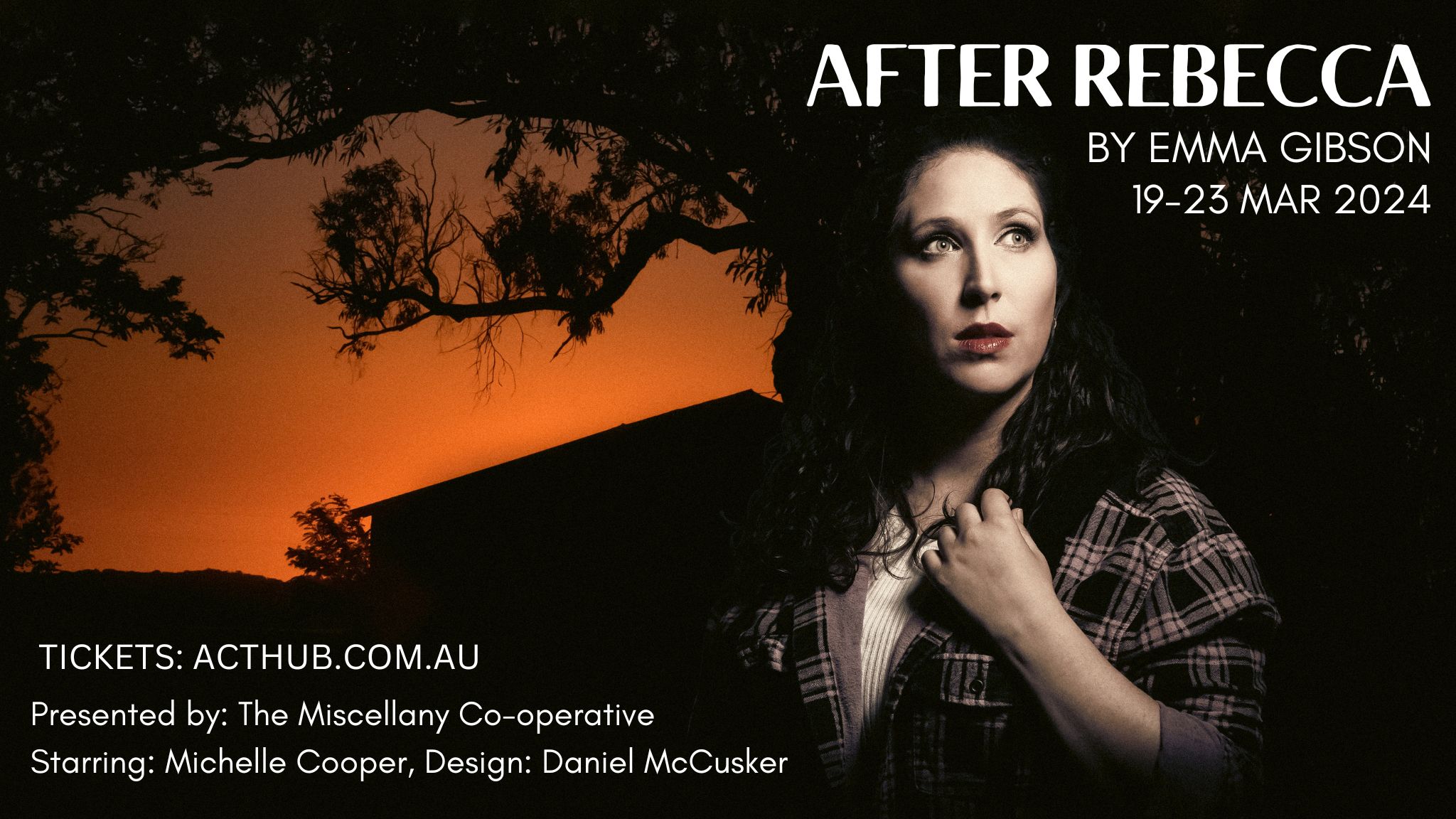
- After Rebecca - The Miscellany Co-operative, ACT Hub: Michelle Cooper is a tour de force in action as she delivers this one-person, seventy-five-minute mologue, which tackles themes of abuse and co-ercive control. She also co-directs with Emma Fibson, who wrote the work which transposes the story Daphne du Maurier's Rebecca to a remote outback farm. The idea of a young impressionable woman being swept off her feet by the star of a reality show only to discover when she is alone and isolated that he is more than the handsome heart-throb portrayed on television and that she is expected to be much less than the talented production assistant he met and seduced, is horrendously relevant and contemporary. It starts with a confidence which seems attractive. He takes charge, he promises adventure, he removes you from your support network, he shapes you to fit his mould, he snaps in anger, he denies everything, he will never ever stop. And you say sorry. Sixteen women have been killed in Australia this year due to ‘gender-based violence’. That’s more than one a week. It's only March. You need to see this.
- Sh*t-Faced Shakespeare, Macbeth - Canberra Comedy Festival, The Playhouse, Canberra Theatre Centre: Six years ago I saw Shit-Faced Shakespeare do their version of Romeo and Juliet at the Canberra Comedy Festival and I loved it. This interpretation of Macbeth is just as fun, sharp and witty, and as there is a different inebriated actor/ character each night, it has a wide range of appeal and bears repeat viewing. I also think the more you know the play; the funnier it is, and I have seen and performed in this play more times than any other of Shakespeare's canon. It's very well-crafted entertainment.
- RBG: Of Many, One - Canberra Theatre and Sydney Theatre Company, The Playhouse, Canberra Theatre Centre: FOr anyone who saw and loved Julia and Prima Facie, this new work by Suzie Miller will be a welcome delight. Heather Mitchell portrays the titular character, Ruth Bader Ginsberg from her budding legal awakening through her appointment as a Supreme Court Justice of the USA, and her cult status that saw her labelled as Notorious RBG. I have been interested in her career so I couldn't say if prior knowledge is necessary to the enjoyment of the play, but what I can say is that Mitchell is quite brilliant in embodying the woman as she ages and develops, learning and encountering all the highs and lows of her experience. The script is spectacular as Miller blends primary source material with directorial imagination, and the performance, directed by Priscilla Jackman, is nothing short of remarkable. Theatre that tells us stories of outstanding people and their effect on their surroundings is theatre worth watching.
Wednesday, 17 April 2024
An Obsession with Birds: A Bird in the Hand
A
birdwatcher is found dead on a marsh with his head bashed in and his binoculars
still around his neck. This is a great surprise to everyone in the small
community because everyone loved him. Or did they? Of course, they didn’t, as
this is an old-style mystery and secrets soon come to light complete with
multiple suspects, red herrings, precise timings of the murder, poison pen
letters, and suspicious alibis. At one point when discussing how the “smooth
and cylindrical” murder object might be a telescope, they admit, “It had become
something of a game.” After noting the sincere concern of a potential victim,
however, George realises it is not so cosy. “Her fear had been wild and
irrational. So was murder. He would not find his answers through reason and
intellect. This was no crossword to be solved by a gentleman in an armchair.
Murder was mad and unreasonable, and gentlemen had no part in it.”
The
novel contains lots of interesting birdwatching information – who knew
twitchers were such addicts or that they had great rivalries with ringers? Twitching
is a way of life, which affects people in dramatic ways when a ‘rarity’ is discovered,
and news of which sighting is shared among the community. The impulse nature
and attraction of twitching is highlighted, and George considers how far one
might take this addiction. “He had always considered his obsession for birds to
be relatively harmless, but now his own experience showed that it could alter
mood, sense, even personality, like a drug. Did it also have the power to make a
person mad enough to commit murder? Twitching was a desire for possession and
that was always dangerous.”
The
novel offers an interesting approach to retirement, as Molly admits to an unexpected
bereavement at giving up her job. “She had thought that she would enjoy a time
of quiet, enjoy having the time to do things well. But she had missed work
desperately. It was not just that she missed feeling useful, although that was
important. It was that she missed meeting people who were different, unusual,
unconventional.” Although she has no real interest in the birds, she studies
the passions of the people that chase around the country from the Scilly Isles
to Scotland.
Friday, 12 April 2024
Friday Five: Ducking Cross-Stitch
Friday, 5 April 2024
Friday Five: Books read in March
- Iron by Rona Munro (Nick Hern Books) - This play for four actors, mainly concerns a mother daughter relationship as Josie goes to visit her mother, Fay, in prison for the first time in 15 years. Fay is imprisoned for the murder of her husband, Josie's father. Throughout the course of the play, set mainly in the visiting area, the two try to learn about each other, with Fay asking for details of Josie's life in an attempt to live vicariously through her experiences and Josie asking for annecdotes of the childhood she can't remember. Meanwhile the guards interject as all privacy is removed and people question motive and emotion. Fay tells Josie, “It’s not the zoo, you know, you can’t come in when the fancy takes you and throw me a bun!” The dialogue is grim and brittle with rapid shifts of mood and tone as the playwright questions boundaries and how we would react if we are pushed beyond them.
- Outspoken by Father Rod Brown (Ebury Press) - I have a signed copy of this book from when I saw Father Rod speak at the Canberra Readers and Writers Festival in 2019. Rector of Gosforth Parish, Father Rod is most known for putting up billboards with pithy sayings espousing love and tolerance, and denouncing bigotry and hate, 'because justice is always social'. The story begins with his autobiography, and then moves into a call for a discussion about morals and faith, and how he believes they relate to issues such as migrants, marriage equality and the review of child abuse within the church. While holding onto his values, theology, and decency, he rejects much of the Bible-thumping conservatism often equated with Christianity. He is actually the Anglican priest we should welcome into our hearts and homes for thoughtful and rational debate in a space of respect and compassion for all.
- The White Cottage Mystery by Margery Allingham (Penguin) - Margery Allingham’s first detective story, published initially as a newspaper serial,is a country house mystery of the type favoured by the Queens of Crime and follows the formula expertly. The blurb on the back summarises, “Seven people might have murdered Eric Crowther, the mysterious recluse who lived in the gaunt house whose shadow fell across the White Cottage. Seven people had good cause. It was not lack of evidence that sent Detective Chief Inspector Challenor and his son Jerry half across Europe to unravel a chaos of clues.” The clues involve people trying to cover their secrets, such as blackmail, homosexuality, adultery, class pretence, and other sins. Attitudes may have changed, but the well-plotted drama and general motivation to keep things hidden remains. As with all Golden Age detective mystery fiction, the crime is treated as something of a game. W.T. muses on the suspects, “They all behave as if they were innocent, and yet each one is hiding something. Each has a motive for killing Crowther, and admits it freely. No sane person would dare to do that unless they felt safe.” It is, of course, baffling to the duo attempting to solve it. The White Cottage Mystery is a gripping, short caper, capable of being consumed in a day, and the fine plotting ensures that everything is neatly tied up with a bow after all. This is highly recommended for fans of the genre.
- Cat vs Cat: Keeping Peace When You Have More Than One Cat by Pam Johnson-Bennett (Penguin) - This is a practical book full of information about feline dynamics and how to handle them. It covers topics from introducing a new, younger, cat to the household where there is already an established resident (and why you might choose not to do that in the first place) to calming a scared or anxious cat, and the trouble with anthropomorphosising your pet. The main piece of advice is to always give the cat a choice (including plenty of places, on a variety of levels, to hide, if that's what they want) and provide enough resources that the cats don't have to share. This includes food and water bowls, litter trays and human playtime or interaction. Cats will happily curl up to sleep and groom together, but they always need their own space and independence. I respect that.
- All That I Am by Anna Funder (Peungin) - First published in 2011, this novel about characters involved in left-wing activism in 1930s Germany received stacks of awards in Australia, including the Australian Book Industry Award Book of the Year. The author is Australian. The four main characters are forced to flee Munich and become exiles in London. Based on real people, the fictionalised version of their lives seems simultaneously sanitised and dramatised for clearer narrative. Justifiable paranoia and a sense of betrayal afflict the remaining members of the once tight-knit group who narrate their stories in alternate chapters from Sydney and New York. It's gripping with elements of secrecy and espionage with a high sense of danger. Of course I was far too contrary to read it when it was on everyone's book pile, and more than ten years on, I wonder if it still meets all the hype.
Tuesday, 2 April 2024
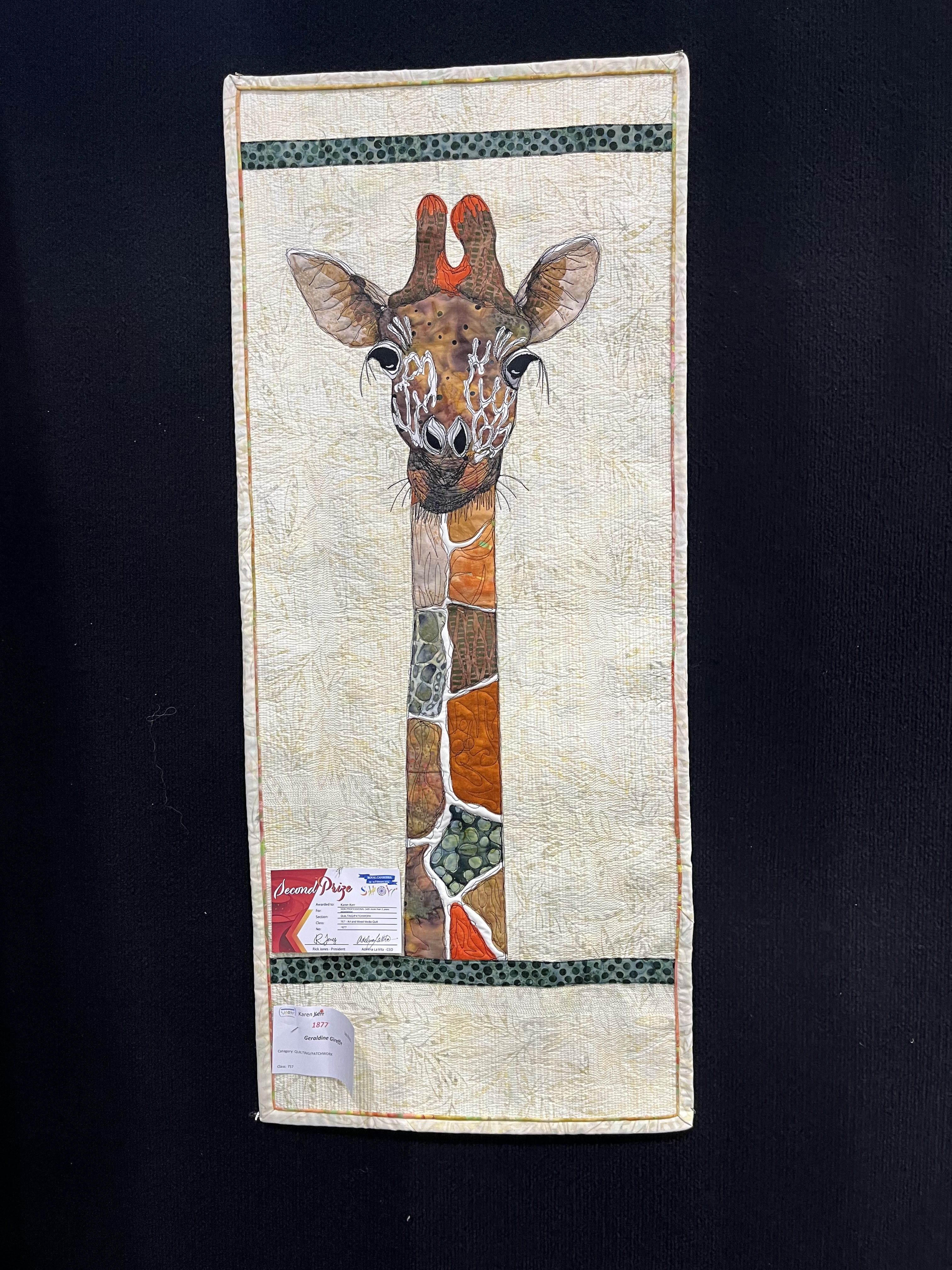
Quilts at the Canberra Show
The abstraction and the palette chosen are fascinating. Yellow seems a popular choice for happiness as in the sunflowers, but it also lends a confident golden glow in some of the bolder designs.
It's fascinating to see these quilts as a historical record, whether it be of ancient Egyptian culture or the more recent late Queen ELizabeth II.