Showing posts with label Canberra Times. Show all posts

Friday, 24 January 2020

Friday Five: Old News

Yesterday's news
While unpacking boxes (yes, still), I found a pile of newspapers that I had put aside, obviously because I thought there might be some articles that I would like to read 'later'. The thing is with news; it very quickly goes stale. Back in the days when people would get fined for trading on bank holidays in the U.K., there was an argument that newsagents could open because they sold 'perishable goods'; not packets of prawn cocktail crisps and cans of Tizer, but newspapers. The expression, quoted in Elvis Costello's 1981 tune, Fish and Chip Paper, suggests that 'Yesterday's news is tomorrow's fish and chip paper', and we all know how quick we are to move on from the headlines. 

But what about the 'supplementary news': the stories in the magazine-type section of the paper? They might be reviews for films and books, thought-pieces about cultural events, or interviews with iconic personalities. These are often interesting many years later, as this sample from Panorama (the supplement to The Canberra Times) of 20 July 2013 indicates. 

5 Old (News) Stories from the Paper:
  1. Taking Charge: Hollywood has developed an appetite for science-fiction tales starring young women in empowered roles by Nicole Sperling (including stories from The Hunger Games, Divergent, Mortal Instuments and Ender's Game, in which she finds it encouraging that 'young women have more role models on the page and on screen - heroes as physically adept as their male counterparts but admired more for their internal strength than their fighting skills').
  2. Playing the name game: As J.K. Rowling has found, a nom de plume can be a writer's best friend by Anna Maxted (in which she examines the reasons writers hide behind pseudonyms from the Bronte sisters to the famous Harry Potter author).
  3. From Bond girl to bar brawler: Rosamund Pike may have broken onto the big screen with 007 but she has still had to fight for her career by Benjamin Secher
  4. Movie posters a design of the times: Vintage film imagery can stand the artistic test of time by Charlotte Cripps
  5. Great Pie Drive: our adventurer journeys from Canberra to coast to sauce the best of our baker's products by Tim the Yowie Man (for the record he listed the East Lynne Store as the premium pie purveyor).

Friday, 2 March 2018

Friday Five: Different (Re)viewpoints


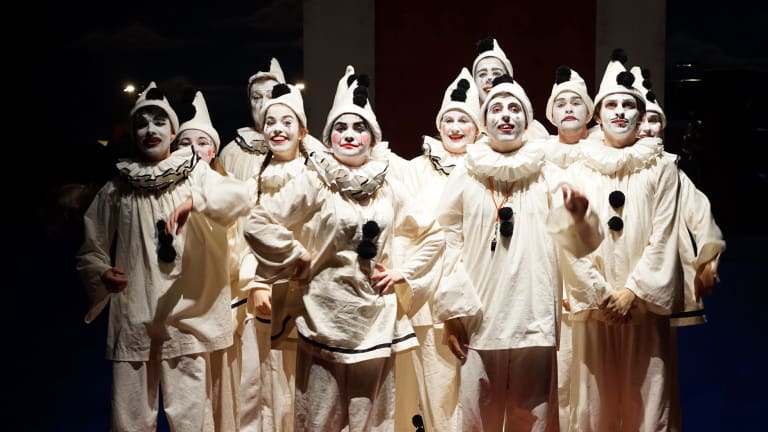
I am currently performing in the Canberra Repertory Production of Oh, What a Lovely War! I am not one of those people who don't read reviews (or claim not to) of the shows in which they are performing. I do read them but, as I have been a professional reviewer myself and have studied the art of reviewing under several different people, all of whom I respect (including Jeffrey Wainwright; Dave Olive; Laurence Coupe; Jeffrey Walsh; Kathryn Ryan; Peter Rose; Marion Halligan), I am aware that they are to be taken with a grain of salt. 

One of the first things I learned is that a review is only one person's opinion; not everyone will like what you do and that's just fine. A good reviewer should never divulge the plot or criticise without good reasoned argument; neither should they refer to themselves unless they believe the reader is more interested in them than the product they are reviewing, such as Jeremy Clarkson's car 'reviews' or Martin Scorsese's film choices.

The purpose of a review should be to give the potential consumer an idea of whether they will like the thing being reviewed or not, by placing it in context and mentioning the ways in which it is similar to or different from other comparable works. It should review the object that is there; not what the reviewer would have liked it to be. In that light, some of these are better than others - not because of what they say, but because of how they say it.


5 Reviews of Oh, What a Lovely War!
  1. Reviewed by Joe Woodward in The City News - "The production is a triumph for what theatre can achieve in a cultural and social connection with the political agendas of our time."
  2. Reviewed by Len Power for The Canberra Critics Circle - "This production is a puzzling disappointment...This was an important play in its day but with this uninvolving production it’s hard to see why."
  3. Reviewed by Peter Wilkins for The Canberra Times - "A precisely marshalled demonstration of outstanding ensemble work by the company, inspired by Baldock's directorial inventiveness, Ewan's excellent musical direction and Ylaria Rogers' lively and appropriate choreography."
  4. Reviewed by Cathy Bannister for Stage Whispers - "A fresh and vibrant interpretation... handled with alternating humour and foreboding, formality and relief."
  5. Reviewed by John Lombard for The Canberra Critics Circle - "While there were a lot of good physical ideas, they did not always tell the story effectively. Between thick accents and some poor articulation, it was hard to follow the extremely dense narrative."

Thursday, 14 March 2013

The Whole Damn Thing


A couple of weeks ago I read an article in The Canberra Times by Chris Wallace. She was writing of the furore created by knee-jerk journalistic reaction to Hilary Mantel's mis-quoted comments about Kate Middleton. Wallace still called her that, although she must be Kate Windsor or some such now, mustn't she? Or did she keep her name? That would be quite radical, but is entirely beside the point.

The point is not even Mantel's speech in question, given as the first of the London Review of Books' Winter Lectures at the British Museum and reprinted in full. The point is the haste of pundits and plonkers to comment on stuff about which they know nothing. The internet exacerbates this with abundant examples of trolling and ignorance.

It seems to happen a lot with literature, however. Governments and various authoritative bodies have often banned books because they don't like their substance or content. Usually they haven't read them. The people who pronounced the fatwa against Salman Rushdie claimed it was due to the blasphemy inherent in The Satanic Verses, which of course they had not read. 

Folk frequently dismiss artforms such as opera or ballet, without ever having seen one. Similarly some claim to despise football without ever having been to game. Pundits are falling over themselves to mock the new Pope, yet most of them know nothing at all about Catholicism and have certainly never read the Bible. Some people vote for political parties without the faintest clue of their policies.

The internet spawns opinions - everyone seems to have one on just about everything. And yet many of them can't have a coherent conversation about the thing they claim to hate. And it is always hate. Softer sentiments don't stand out from the crowd. Sure, it can be fun to make sweeping statements (and of course I've done it), but I think perhaps we should be more conscientious about trying to uncover the whole story before spitting forth spiteful comments.
"Readers have responsibilities, not just writers. Paying proper attention and reading the whole damn thing before rushing to condemn is the least courtesy writers are owed." - Chris Wallace

Monday, 10 September 2012

Quote for Today: Twitter Trolls

"Perhaps the 140 character limit on our thoughts has made it far easier to abuse and insult the individual rather than construct a good argument. People jump to unintelligent, incoherent and annonymous abuse online because they don't have an intelligent argument to put their name and face to." - Rachel Olding, The Canberra Times