Showing posts with label George W Lambert. Show all posts

Thursday, 10 October 2013

Australian Galleries 3


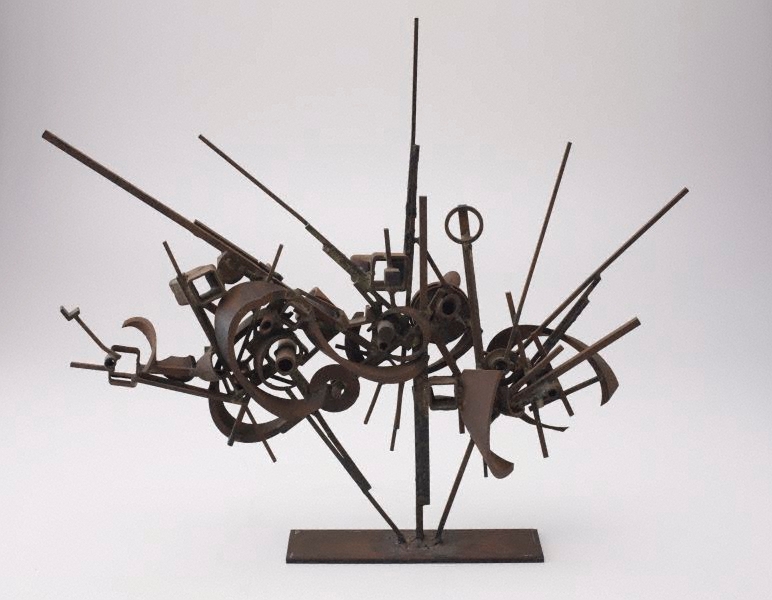
Metal Construction 123 - Robert Klippel
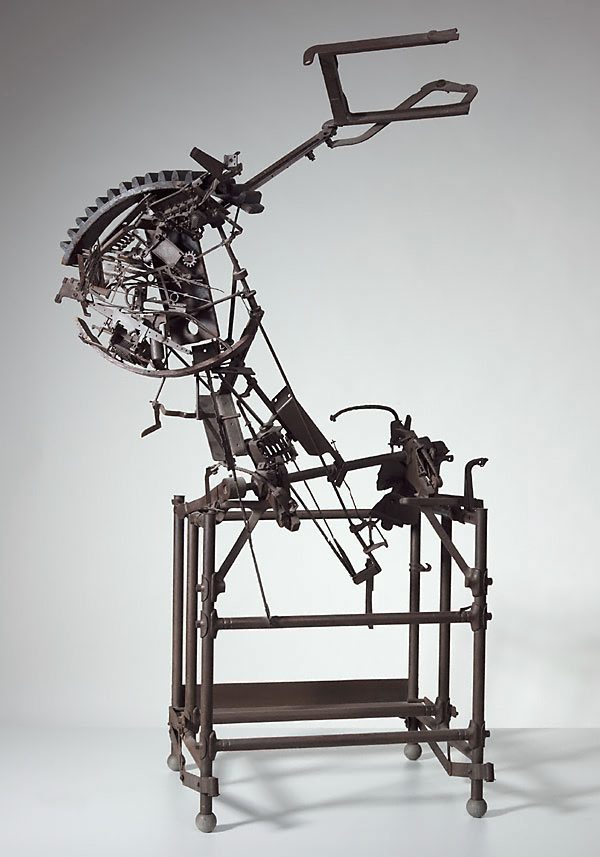
With a career spanning six decades, Robert Klippel was one of Australia's leading sculptors. His work investigates the realtionship between the organic and the mechanical; a duality that he saw as central to life and culture in the twentieth century. He took night-courses in arc-welding, silver soldering and panel-beating to acquire new skills.

In 1957 he moved to New York where he explored the unlimited 'vocabulary of shapes' available in junk metals. Using detritus - the chance fragments of modern disposable society - he created complex configurations with new life and meaning. By the late 1960s he had begun to shift his emphasis from using primarily machine parts to steel sections. Klippel aimed to synthesise sculpture and landscape and bring nature and technology together.

Metal Construction 202 (1966) - Robert Klippel
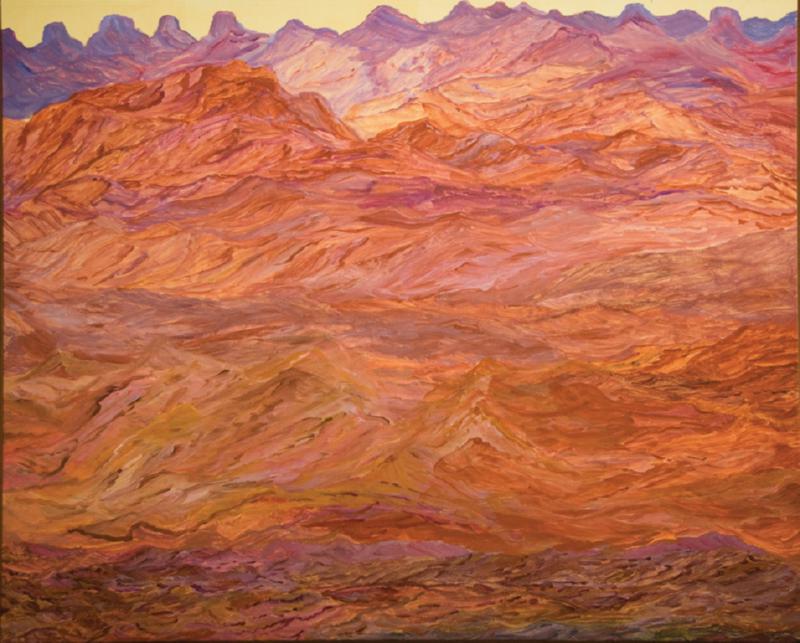
Angelina George paints the most amazing expansive canvases of her home land where she grew up and remembers when she used to walk about with her brothers and sisters or her mother. In the series of Dry Season paintings, she says she has worked from memories and imagination so it is 'not exactly what it looks like. You know. Traditional way and law.'

The sharp cliffs and rugged rocks hide billabongs and creeks where they find fish and birds. She says, 'we had to find our own tucker and we knew where to go hunting.' The spectacular landscape formations and shadows in these paintings are barren, bleak and beautiful with the sky forming only a tiny fraction of the canvas - the remainder is comprised of reds, oragnse, purples and distant greens. There is clearly life, if you know where to look.

Untitled (2008) - Angelina George
 When Ben Quilty first asked legendary painter Margaret Olley to sit for him, she said no. 'Her lack of ego is so appealing. Margaret didn't understand why anyone would want to see a portrait of her.' Fortunately, she relented and this amazing portrait in which paint sticks out in great blobs and swathes to create a fantastically piercing expression, won the Archibald Prize in 2011.

Margaret Olley (2011) - Ben Quilty
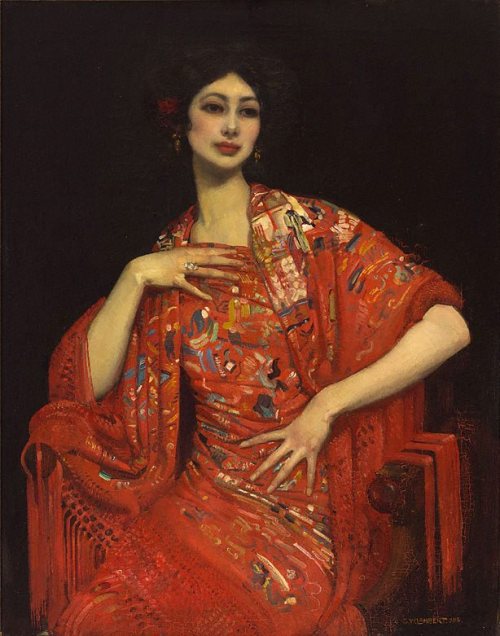
George Lambert's work is also a study in texture. In The Red Shawl, the material in its form and colour seem to be more important than the sitter. Another subject is caught in the act of removing her glove in Miss Helen Beauclerk and again, the detail paid to the fabric and the stitching of the material suggests the work of a fashion designer as much as a portrait painter.

The Red Shawl (1913) - George W. Lambert

Miss Helen Beauclerk (1914) - George W. Lambert
A third 'portrait' that caught my eye was Important People. Lambert suggested an allegory in his grouping of a flower-seller, a clerk and a boxer. He felt it should not only be the wealthy who get their portraits painted and that his work represented motherhood, the future generations, the fighting forces of the world and administrative qualities, without which the world (symbolised by the red cart wheel) would not turn smoothly.

Important People (1914-21) - George W Lambert
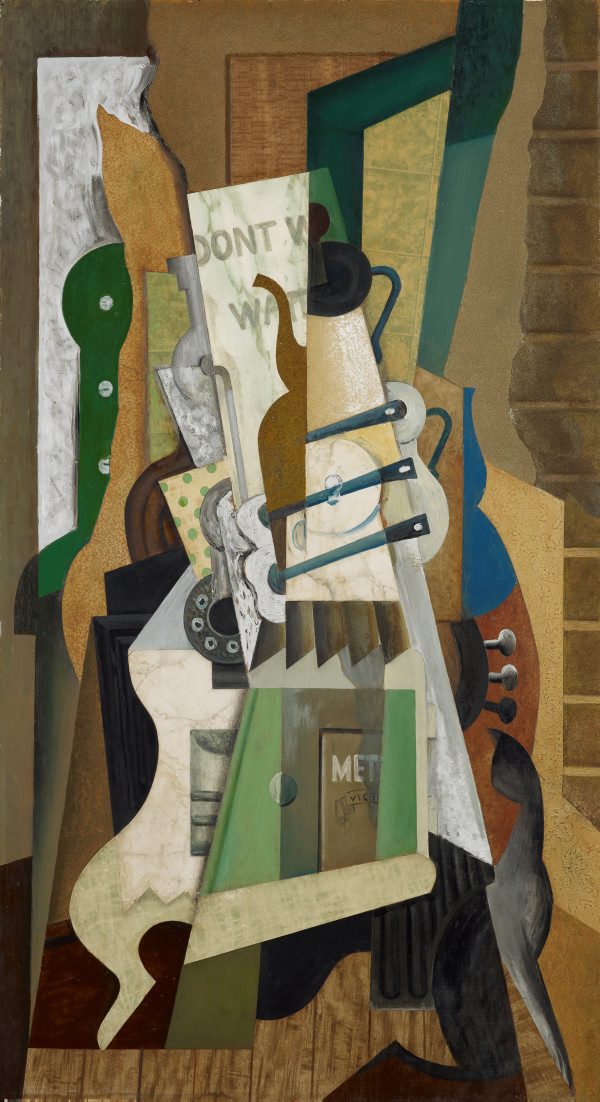
Eric Wilson studied abstract design and cubist philosophy on his travels to London and Paris. In Abstract- the kitchen stove he uses a domestic object to explore formal elements such as colour, shape, surfacing pattern and texture. The painting is structured around a triangular composition and demonstrates his attempt to create an 'orchestration of the formal elements into a symphonic whole'. The image also recalls domestic harmony in a musical instrument such as a lute or a cello.

Abstract- the kitchen stove (1943) - Eric Wilson
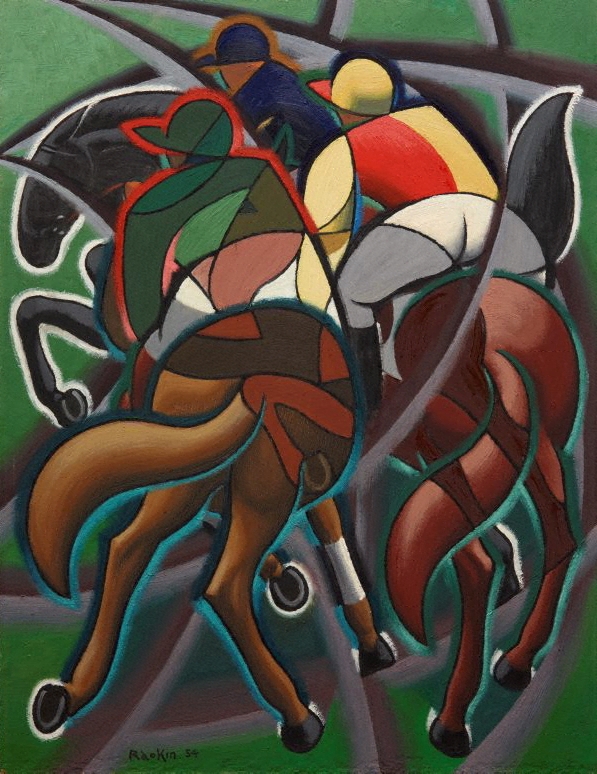
The cubist forms of the racehorse and riders in Weaver Hawkins' Going Round, create an almost stained-glass window effect. Hawkins was a founding member of the Contemporary Art Society and, in the early 1960s, a founding member of the Sydney printmakers' group.

Going round (1954) - Weaver Hawkins
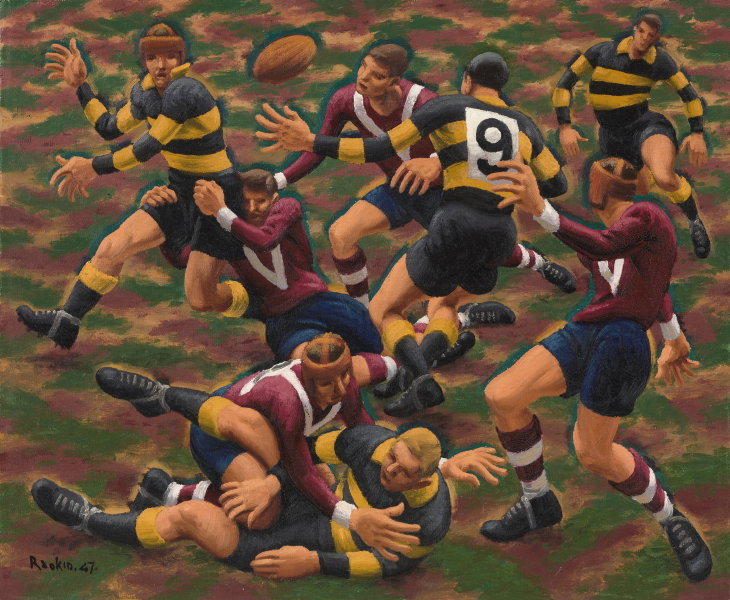
Hawkins' sporting works full of energy and movement assume another dimension when you realise that he was wounded in the Battle of the Somme and subsequently lost the use of his right hand and arm. He retrained himself to draw and paint using his left arm, which was never at full strength. From 1927 he began to use the alias 'Raokin' to avoid unwanted public and media perceptions about being an artist living with severe injuries after WWI. Almost as an antidote, the appreciation of the male form in all its rugged masculinity is on display in Dance of the Football Field, which depicts a rugby league match between Balmain and Manly.

Dance of the football field (1947) - Weaver Hawkins


Tuesday, 30 October 2012

Australian Portraits 1880-1960 (Part One)

Australian Portraits 1880-1960
Canberra Museum and Gally, Canberra, ACT
17 August - 21 October

This exhibition promised to contain "a compelling and diverse representation of Australians" including 54 portraits and self-portraits by 34 leading Australian painters. I don't know much at all about Australian art so I am beginning to familiarise myself with it. The exhibition is divided into chronological sections, so I just strolled around, taking notes on the pictures I liked.

Montgomery, Esquire (1885) by Bernard Hall is part of a series of his 'late night images' of his friends. I like the way he sits casually with his leg crossed over, smoking a cigarette, with a drink balanced behind him. His look, however, is anything but casual and is, in fact, almost disturbingly frank - the way things can get late at night...


Seated outdoors, perhaps in a walled garden, the model for Robert Dowling's Miss Robertson of Colac (Dolly) (1885-86) presents quite a different prospect. Although in a relaxed setting, she appears stiff and focused on something beyond the canvas, almost as though she were eavesdropping on a private conversation and completely ignoring the stylised accessories of the Japanese tea service and the spaniel. These may have been added later as her posture and mien suggest absolutely no interaction with them.

I love Tom Roberts' An Australian Native (1888) and can well believe this is a classic of Australian art. In her pink dress/ coat with a bustle and feathered hat, clasping her umbrella before her with both hands, the subject is clearly meant to be a 'type': a young, healthy, vigorous Australian-born woman of Anglo-Celtic descent.
She, in turn, is in contrast to Miss Myra Kemble (1888) by Girolamo Nerli, who is painted with swathes of theatricality. She was, according to the catalogue notes, 'one of Australia's best-loved stage actresses.' Teasing her audience from behind her ostrich fan, we glimpse her coy expression, direct eye and amused mouth. The artist has painted her as if spot-lit on a darkened stage, focusing our attention on her playful character, flair and beauty. His attentive eye has picked out her plush red cloak with intricate detail on the lining, and her ruched water-silk gown with high neck and button and dart detail.

And so we move on to the next section - The Edwardians 1900 - 1920. Apparently many Australian artists of this era spent a substantial amount of their time living and working abroad. Many subjects appear dressed up or acting out roles, as many families commissioned portraits in historical style to give themselves credibility.

I love the Study of Lena Brasch (1893) by Tom Roberts. The artist has used rapid brush-strokes and bold colour, capturing the subject galncing down in her hat trimmed with tartan ribbon or perhaps even shiny bon bon wrappers. The charming combination of auburn hair, pale pink lips and the delicate blush on her cheek make this painting seem alive, although it is incomplete. One almost expects the subject to turn, to look up and burst out laughing any minute.

George W Lambert's Chesham Street (1910) is altogether more serious. This is a dramatic self-portrait in which the subject lifts his shirt to reveal a fairly skinny torso, presumably to a doctor. The blinding white flesh lightens the canvas, although judging from the serious expressions contained in the portrait, it is unlikely to have lightened the mood.

Many artists painted self-portraits because they saved money by not hiring models. This proceedure also allowed them a degree of critical self-analysis and introspection.

In Hugh Ramsay's Self Portrait Bust Showing Hands (1901), his hands are jointed like the wooden mannequins often seen in artists studios. With the long face and aquiline nose, this may equally be a study in antaomy or the effects of light and dark, as his half-smile is emphasised by the shadow cast on his lopsided lips.

Charles Wheeler can also afford to be less than flattering in Apres le bal (1910) in which he paints his self-portrait in a turban; his facial features contorted in an exaggerated yawn.

The full-length portrait of The Boy with the Palette (1911) by Violet Teague is of Theo Scharf, who at this time was a child prodigy. He betrays a nonchalant stance in his dark polo neck, long shorts, and knee-high socks. With his supercilious expression, his eyes really do follow you about the room, while never looking directly at you. He appears to be looking down on you with a sneer.

The artist has totally captured his assertive gaze and conveyed his confidence in himself and his artistic talents.

Bright colours against a studio background capture the attention in Max Meldrum's Poland (Madame de Tarczynska) (1917). The subject is dressed in traditional costume which seems more important than her strong but ill-defined features.

Meldrum was an adherent of the tonalist theory which maintained that the contrasting light and dark was the most important component of a painting.

E Phillips Fox takes a more impressionist approach with The Green Parasol (1912). Luminous colour abounds in this portrait of a seated woman in a green dress and parasol with a small black dog on her lap. Her auburn hair and the flowerful garden enhance the sensuous and stylish work celebrating light and colour. The warmth of the dappled, diffused afternoon fairly spills out of the canvas.

George W Lambert's Weighing the Fleece (1921) is another classic to behold. It is painted as a tableau with focus on the structure and pattern. The men are engaged in business  (with a record-priced fleece being weighed) while a woman sits casually on a woolsack. One sheep is shorn while the other stands by beneath a heavy fleece hinting at further riches. The painter has captured minute details such as the brand on the wool bale and the swallow droppings on the beams, while the overall projection is one of wealth, success and good fortune.