Showing posts with label Japan. Show all posts

Wednesday, 29 April 2026

Horror in Another Dimension: Strange Houses


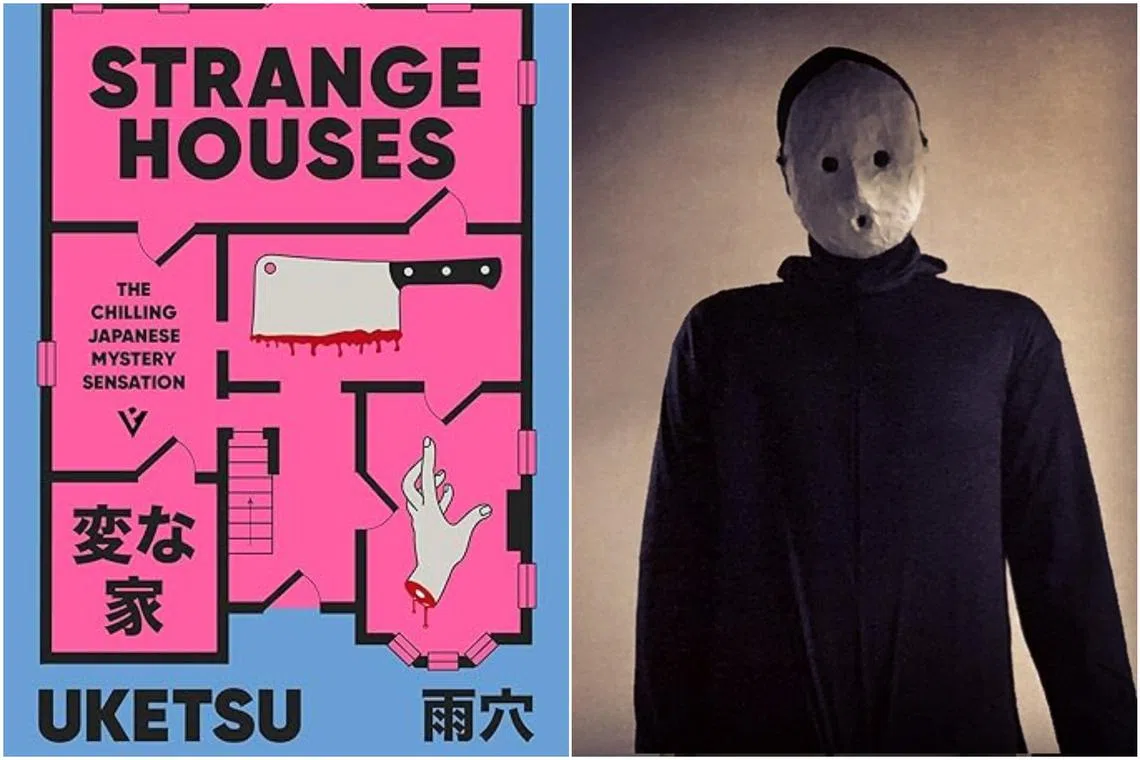
Strange Houses by Uketsu
Pushkin Vertigo
Pp.197
 

This is the first of three (so far) short novels by Uketsu, translated to English from the original Japanese by Jim Rion. According to the publisher’s blurb, the author, Uketsu, is “an enigmatic YouTuber and author, specializing in horror and mystery, who has exploded onto the literary scene in Japan, where his books have sold millions of copies. He only ever appears online, wearing a mask and speaking through a voice changer. His true identity is unknown.” A sort of viral Banksy if you will.


The story begins with the narrator explaining, “I’m a freelance writer, my speciality being stories of the macabre. Given this line of work, lots of people approach me with their personal experiences of the eerie and the unpleasant.” He goes on to tell a story with a blanket level of detail, in which floor plans and family trees take up half the book – refreshingly, there is no need to flick back to the beginning pictures to follow along. The floor plans reveal hidden passages and secret rooms for nefarious business. Most of the text is written as play dialogue, which contains all the exposition so there is very little description. There is an element of Edgar Allen Poe’s short stories; thrilling creepy tales that can be read in a day or two.


In keeping with detective fiction rules that all clues must be mentioned, there are plenty of apparent irrelevancies, but also deliberate omissions. Despite exhuming some standard tropes, the Japanese horror story is certainly different. Sub-headings within chapters are almost like a child’s first reader: A Message from a Friend; An Unexpected Email; The Mysterious Space; Daydream; Two Bathrooms; The Article; A Grisly Discovery; Differences; The Letter; The Hidden Room; The Sign. The tale deals with dismembered bodies, curses, murderous children, blackmail, and the importance of succession and illegitimacy. One character fairly remarks, “I can see how it all fits together, but… isn’t it all a little far-fetched? It’s so convoluted.” Japanese horror is built on this sort of thing, and there is already a film - released in Japan in 2024.


The murders themselves seem quite matter of fact. “The Katabuchi family has been murdering people for generations. I don’t know why, but it has become a tradition.” When a character suspects her father is involved, the narrator notes, “It was not the kind of truth that most people could have accepted so calmly, but she seemed surprisingly untroubled.” He, himself, hardly seems more disturbed, as he ponders where a child was killed, but not why they were killed at all. He casually discusses horrific customs, such as, “Mabiki. ‘Thinning the garden’. In Japan, there was once a tradition of aborting babies or even killing children to keep down the number of mouths to feed. The practice lasted into the late nineteenth or even early twentieth century in some communities.” When the ending appears to be inconclusive, and his colleague “flashed a broad grin”, he allows himself to feel “a twinge of irritation at his total lack of concern.”


Training children in macabre cults and brainwashing them into murder adds a particularly chilling element. “He had an unhealthy pallor, and his expression was as blank as if it had never known emotion… He never took any action of his own volition and never expressed any of his own feelings or desires.” The whole scenario is highly implausible, but this is the breeding ground for horror. “It sounds wild, but we already know the Katabuchi family is not a normal one.” Investigating murder by looking into floor plans brings a new angle – in many dimensions – to a standard genre. They may be compact crimes, but they are far from cosy.

Friday, 4 October 2024

Friday Five: Books Read in September


There are only four for this month so the Friday Five is missing one, but I'm sure it all evens out in the end.
  1. Bel Canto by Ann Patchett (Harper Collins) - Set in an unnamed South American country, Bel Canto is inspired by the Japanese embassy hostage crisis of 1996-1997 in Lima, Peru. It begins at a birthday party thrown at the country's vice-presidential home in honour of visiting Japanese dignitary and opera enthusiast, Katsumi Hosokawa. In attempt to secure funding from the guest, the famous American soprano, Roxanne Cross is scheduled to perform as the highlight of the party. Near the end of the evening, a group of terrorists break in, hoping to take the president hostage, but when they realise he is not in attendance, they take the entire party hostage, only to subsequently release all except those for whom they think they might get a higher ransom. The isolation-aspect of the novel is fascinating as the characters develop in relation to each other, and alliances, friendships, and even romances form. As one might expect from a novel that won the Orange Prize and the PEN/ Faulkner Award for Fiction, it is beautifully written, following the score of an opera with great highs and lows and an explosive ending. Part love story; part hostage thriller; part musical appreciation, it contains many unrealistic and implausible plot developments, but leaves a lasting impression on the senses.
  2. Colorless Tsukuru Tazaki and His Years of Pilgrimage by Haruki Murakami (Vintage Books) - "From July of his sophomore year in college until the following January, all Tsukuru Tazaki could think about was dying." This is the opening line of the novel and if it has similarities with the beginnign of A Man Colled Ove, there are also strong echoes of Frank Kafka. Tsukuru is 36 and reflecting on his past, particularly why his friends suddenly stopped speaking to him and expected him to know why. Encouraged by a new lover, he sets out to discover the truth, meeting each of his former friends to question them individually, and also to understand himself better - why did he simply accept this fact? His old friendship group was a solid unit of two girls and three boys, whose names and nicknames all relate to colours (for example, Kei Akamatsu/ Aka; 'red pine'), except him; "“Tsukuru Tazaki was the only one in the group without anything special about him... Everything about him was middling, pallid, lacking in colour.” His sole interest is in train stations, and he is the only one who leaves the home town of Nagoya and goes to university in Tokyo to study engineering. He is practical and orderly, featuring in logically progressing sentences with limited adjectives - “He took a shower every morning, shampooed his hair well, and did the laundry twice a week.” Despite the clarity of language, the narrative is complex, containing stories within stories, exploring theories of freedom of thought, death and music, and causing Tsukuru and the reader to question, “People do change. And no matter how close we once were, and how much we opened up to each other, maybe neither of us knew anything substantial about the other.”
  3. Unfinished Portrait by Mary Westmacott (Ulverscroft Limited) - When Agatha Christie writes as Mary Westmacott, she enjoys the psychology of her characters rather than the mystery of the plot. In this story within a story, the framework is set by the narrator, Larraby, meeting a young woman, Celia, whom she thinks is going to end her life because she has had enough. Sitting on a seat overlooking the sea, the narrator draws her into conversation and Celia tells the story of her life, which Larraby notes down and sends to 'My Dear Mary'. Because she is concerned with the effects of the events, she pays less attention to the specifics; “I’m not going into details – this isn’t a chronicle of such things. There’s no need to describe the quaint little Spanish town, or the meal we had together at her hotel." Celia was an imaginative child who became a sensitive woman, learning to live more frugally once her family's fortune and social standing mysteriously diminished on her father's death. The summary of the ‘coming out’ period of introductions to the marriage market is amusing, terrifying and deeply instructional, as men flock around the young innocent woman who knows no better and might provide them with an heir and domesticity. The ideas of marriage and maternity are both historic and current, highlighting the trauma and depression felt by women who didn't want these circumstances but were not encouraged in any other aspirations.
  4. Master of Shadows by Neil Oliver (Orion Books) - having written half a dozen non-fiction, history and geography books, this is Neil Oliver's first work of fiction. Its backdrop is the fall of Constantinople, the skirmishes in Scotland, and another historical figure, Joan of Arc, thrown in for good measure. This makes for an interesting scope of different generations, geographical locations and time periods, but it also makes the narrative a little confusing. Central characters, John Grant and Badr, are mercenaries so have no affiliation with Christians, Turks, Ottomans or Muslims, and there are many violent and creatively cruel deptictions of fighting and torture. The structure is of a bird who soars above the city, diving in and drawing back, giving us a bird's eye view of specifics, and also allowing for generalisations, similar to the Greek gods looking down from Mt Olympus on the humans and using them as playthings - “High above, impassive and imperious, a lammergeier flew, riding columns of warm air and surveyed the movements of the tiny figures trapped upon the world below.” There are some nice turns of phrase - John Grant is a thin child who appears to his mother like a will-o'-the-wisp: “If he had been a pot of soup, she would have stirred in flour, to thicken him" - but there are also plenty of clichés. When John grant learns that the woman who raised him is not his biological mother, it sets up may alternate possiblities and complicated relationships. The novel seems incomplete, as though there are more planned to follow.

Tuesday, 23 May 2023

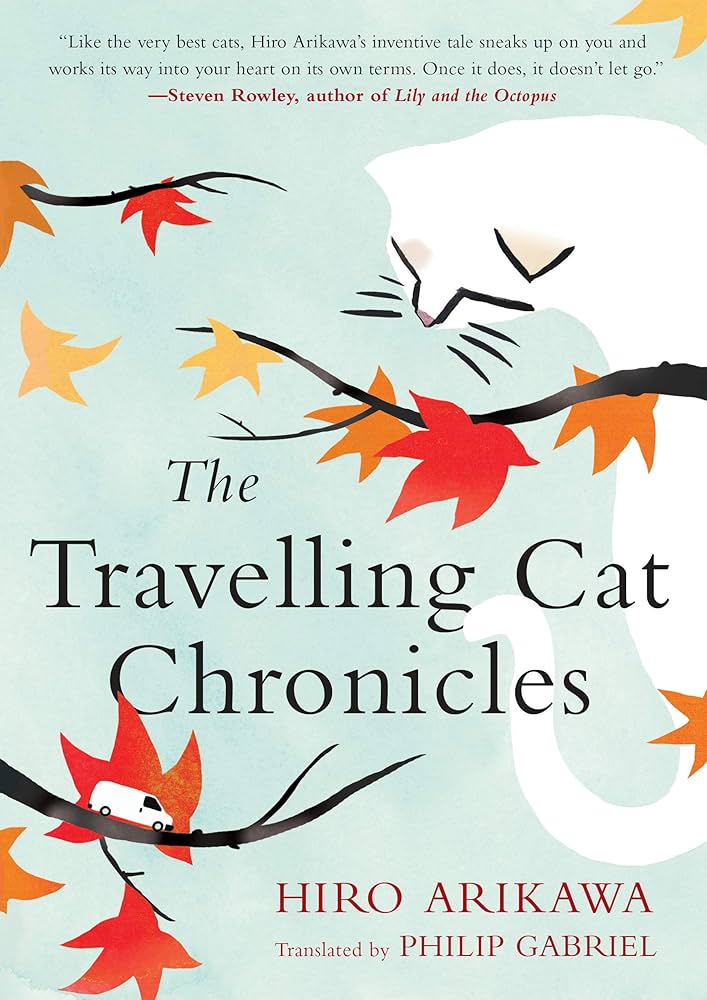
Deceptively simple or just a little bit naff? The Travelling Cat Chronicles


The Travelling Cat Chronicles by Hiro Arikawa
Thorndike Press
Pp. 327

Translated from the Japanese by Philip Gabriel, this novel (first published in 2015) had reviewers gushing that it was gentle, wise, witty, beguiling and full of simple but deceptive prose. I didn’t realise I was quite so cynical, but I have to wonder, is it deceptive or just simple and is it really profoundly charming or just a little bit naff?

The novel is mainly narrated by Nana, a cat named after the Japanese word for seven, which is considered to be lucky and the shape of the cat’s tail. Nana was a stray cat who was nursed by Satoru after being hit by a car. In return, Nana lives with Satoru and gives him affection. When Satoru knows he is dying, he wants to make sure Nana has a happy home so he sets off on a road trip to visit possible adoptive homes and friends.

These travels give Satoru an opportunity to spark memories and reconnect with old friends. He and Nana meet Yoshimine, the brusque and unsentimental farmer who thinks cats are just for catching rats, Sugi and Chikako, the warm-hearted couple who run a pet-friendly B&B, and Kosuke, the mournful husband whose cat-loving wife has just left him. In the pages concerning Kosuke, the point of view switches to the third person omniscient narrator who tells us about the boys’ friendship and how they bonded with a cat called Hachi (which means eight) when they were both in elementary school.

When we see Nana’s perspective he instructs us on cat behaviour, such as why they like cardboard boxes rather than special beds and toys. Nana doesn’t understand certain human idiosyncrasies including their fondness for the sea, and he also questions their need to concern themselves about burials and cemeteries. “When an animal’s life is over, it rests where it falls, and it often seems to me that humans are such worriers, to think of preparing a place for people to sleep when they are dead. If you have to consider what’s going to happen after you die, life becomes doubly troublesome.”

As well as teaching kittens to stand up for themselves and explaining feline ways, Nana also cares for his adopted human. He’s a proud cat, but he’s loyal, loving and perceptive. The Travelling Cat Chronicles is a novel about the bond between humans and their animals, but it also about the power of friendship from childhood to adults. Without the support of those he visits, Satoru would not have grown into the kind and gentle man he has become – the kind of man who would scour the country to find the perfect home for his cat.

Friday, 22 January 2010

My newest favourite thing: cherries


Cherries are the heralds of summer. They are the rubies in the centre of the golden stone fruit bowl.

When children, and some adults, swing the ripe red pendulums from their ears and pretend to be wearing sumptuous earrings, you know the season has arrived.

Obviously, when they arrive depends on where you live. Here they arrive just in time for Christmas, but in the Northern Hemisphere I associate them with my sister’s birthday. The Weevil was born in July and we were often abroad in European orienteering countries for the event.

I have a childhood memory (of course, they are notoriously unreliable) of the Weevil skipping joyously along carrying a Black Forest gateaux (I suspect we may even have been in the Black Forest itself) and tripping; sending cream, cherries and chocolate shavings in all directions. The tears had nothing to do with the skimmed knees.

A stall in Arrowtown tempts you with luscious delights; the sellers have come from That Dam Fruit Stall in Cromwell. You can try varieties and pick a favourite punnet, if you are decisive.

Otherwise you struggle with your choice; red, white, pink or purple? Sweet or tart; ‘subacid’ or ‘bland’ – those last descriptions are not mine but come from the Horticultural Society. They probably provided the more prosaic number and letter naming system, while someone with a little more imagination came up with ‘Liberty Bell’, ‘Stardust’, ‘Columbia’ and ‘Staccato’.

Not only do they taste delicious, but apparently they are good for you. Cherries contain high quantities of the antioxidant anthocyanin, (also found in grapes and berries) so you can claim you are being healthy as you puff out your cheeks with the pips.

We would count them as children to see who we were going to marry; tinker, tailor, soldier, sailor, rich-man, poor-man, beggar-man, thief. There was never any mention of electrical engineers so I can only assume their powers of prediction are equally as good as any other form of divination.

If you’re not counting the pips, you can always spit them out. My mother will be pleased to know that I haven’t entered (or even witnessed) the cherry pip spitting championships, but there is a hotly contested regional round of the competition in Cromwell at the start of the season. They make their own entertainment in this area, you know.

And when the cherries have all gone, it's not too long to wait for the blushing blossoms to appear. Symbolising the ephemeral nature of life, they are bashed and buffeted by the winds but some survive.

They are revered in Japan and in 1912 the Japanese gave a gift of some 3000 trees to America to symbolise their blossoming friendship between nations. Is it even more symbolic that these ornamental trees bear no fruit? Whatever, they look simply beautiful.