
- The Dear Departed: Live Radio Play - Lexi Sekuless Productions and ArtSound, The Mill Theatre: A fun hour or so spent in the presence of some fine actors going through their paces and clearly enjoying themselves. The play itself is a fairly innocuous drama from 1908 by Stanley Houghton which Bart Meehan has adapted into something more immediately palatable. A couple of sisters, Amelia and Elizabeth (Andrea Close and Helen McFarlane) and their extended family of husbands and child (Richard Manning, Sarah Hartley and Timmy Sekuless), squabble over the last will and testament of their dear deaprted father, until they realise that he (Graeme Rhodes) is not dead a at all. Although they do their own foley and commit to the characterisation, I question whether performing a rehearsed reading is a little self-indulgent. Don't get me wrong, all these people are charming actors and delightful company, but I can't help questioning whether it is more entertaining for the actors than the audience.
- No Exit - Mockingbird Too, The Studio, Belconnen Arts Centre: The famous quote, "Hell is other people" is the premise of this play, except it was written by Jean-Paul Sartre, so it is actually, "L'enfer, c'est les autres". The originial title is Huis clos, which is the French equivalent of the legal term, in camera, itself Latin for 'in a chamber' or a private discussion behind closed doors. These levels of translation and interpretation are relevant to this existentialist drama first produced in 1944, in which three people, Garcin (Eli Narev), Inez (Victoria Tyrell Dixon) and Estelle (Phoebe Chua) are trapped together in the afterlife. They imagine they will face torture or flames of damnation but the Valet (played with goblin-like glee by Peter Fock) who guides them to their room, assures them that while there is none of that, they can never close their eyes. While physically this does indeed sound like torment, metaphorically they are forced to see everything, including themselves through others' eyes and without filters. Initially they attempt not to speak to each other, but they then decide to explain why and how they died, before falling back upon the realisation that they don't like each other and perhaps silence might be the best policy. Being as we know that hell is eternal, there is no dramtic intrigue in the expectation of a denoument which compromises the pacing of the play. The actors try their best to enliven the situation and Victoria Tyrell Dixon in particular displays her range, from anger to seduction and back through desparation and ennui, as well as she can. The other two are less successful and once the premise is set, the action doesn't really take us anywhere - perhaps that is the true meaning of hell.
- Thom Pain (based on nothing) by Will Eno - Lexi Sekuless Production and Joey Minogue, The Mill Theatre: Do you like those stream of consciousness comedians (usually American - usually New York) who seem to fall apart in front of your eyes when performing in a club? Or do they make you cringe as you have no option but to sit and endure their manic inner monologue, wondering if there are actually any jokes in this set at all? If the former, this is the play for you, as Joey Minogue as Thom Pain performs an hour of deep introspection, musing on seemingly random subjects including the death of his childhood dog, which informs his adolescent trauma, while being constantly distracted by his environment. It's a rambling monolgue delivered as therapy, without inviting the audience to do anything but witness a private meditation. The performace is solid, but the show is unengaging.
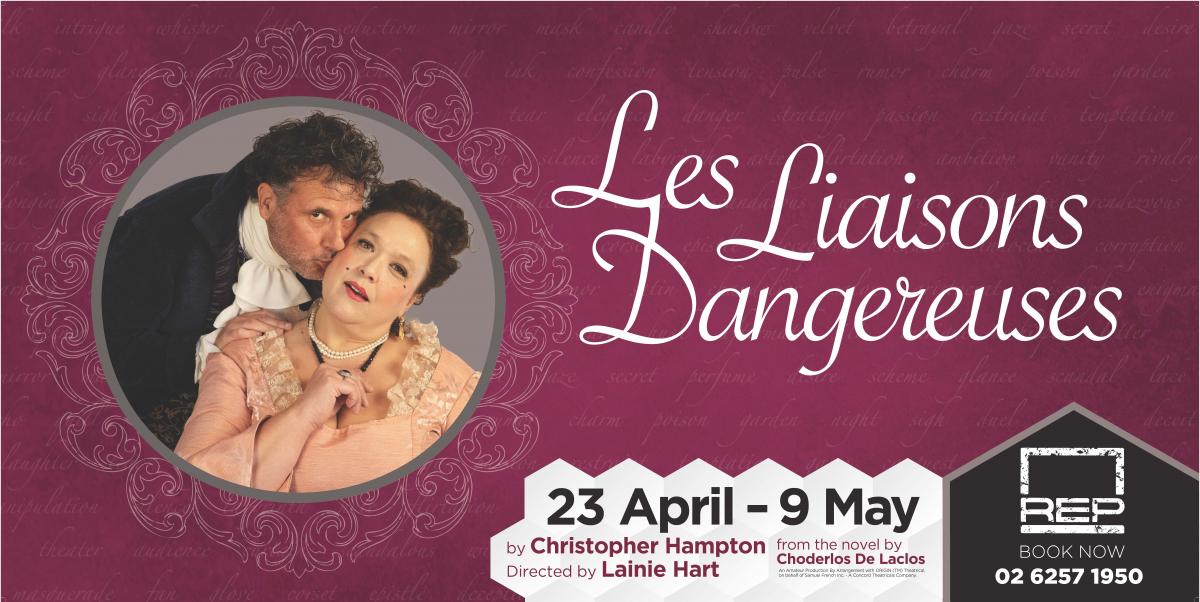
- Les Liaisons Dangereuses - Canberra Repertory, Theatre 3: This is a strong production of a highly-regarded play. Excellent performances from the three leads carry the drama and wit well; the casting of married leads (Jordan Best as Merteuil and Jim Adamik as Valmont) allows the sexual flirtation to flourish, and Yanina Clifton as Tourvel displays a haughty demeanour which is broken as she abandons herself to a torturous love. Director Lainie Hart keeps the action tight, with staging in quadrants and sharp character-driven scene changes, the fight scene is well executed, and the understanding of the game-turned-bad nature comes across well through card games and levels of both actors and set. The innovative approach to multiple scenes and locations keeps the pace from dragging too much, as the scene changes are fluid and morph into each other, although a touch more of the letters on which the play/novel is based would have been welcome. The set, sound and costume and are all cohesive; the scarlet woman taffeta of Merteuil and matching waistcoat of Valmont are suitably sumptous, and all the bodices, bustles, ruffles and cuffs look absolutely comme il faut. A commendation must go the intimacy consultant (Jill Young) as this play contains a rape scene which is vey sensitively handled.
- Vanya and Sonia and Masha and Spike - Mockingbird, The Studio, Belco Arts Centre: Brother and sister (by adoption; not birth, which accounts for some almost incestous contemplations), Vanya (Chris Bladock) and Sonia (Tracey Noble) live alone together in a Pennsylvanian farmhouse contemplating the blue heron in the garden and their daily grind. Their lives stretch before them in an endless future of ennui, until the third sibling, Masha (Helen McFarlane) returns from her rapidly-drying-up screen career with a toyboy lover, Spike (Darcy Worthy), in tow and news that she is going to sell the family home (which she owns and allows her siblings to live in rent-free). There is also a fancy-dress party next door to which she has invited them, bringing costumes that show her in a good light. A young woman, Nina (Lily Welling), suggests a threat to Masha's hold over Spike while providing a catalyst for Vanya to stage his play based on the avant-garde work of Konstantin in The Seagull. And hovering on the edges is Cassandra, the housekeeper who spits out random portentious warnings and dabbles in a little voodoo on the side. Mockingbird Theatre often mixes veteran actors with newcomers, and the effect can make for an uneven production. Chris Baldock is commanding as Vanya, particularly shining in his closing tirade lamenting the decline of manners in the modern world, Tracey Noble fully embodies the petulance of a woman afraid she has missed out on life and trying to blame someone else for her failings, and Helen McFarlane is utterly beliveable as the one trying to cling to her outward presentation to the world, secretly knowing that it isn't their true self. Darcy Worthy keeps taking his clothes off as the script demands and he is certainly nice to look at, although his acting is laboured and gestures repetitive, Lily Welling's freshness and innocence are delightful but the pitch is a little too high, and India Kazakoff feels too young and inexperienced to carry the weight of the Cassandra character (described as '30-60' in the script). Steph Evans directs with a relatively light touch - the best moments are the natural sibling bickerings - in this consummate satire of Chekovian drama in which nothing appears to happen, but everything actually does.
 God of Carnage
Circa Theatre, 4 April – 2 May
Ferdinand (son of Annette and Alain Reille) has broken Bruno’s (son of Veronique and Michel Vallon) teeth with a stick. The middle-class, middle-aged parents gather to discuss the consequences like the polite and reasonable adults they are. Instead their civil conversation degenerates into adults behaving badly as they become as infantile as the children they are discussing. The question is asked, ‘Are we ever interested in anything but ourselves?’ and the answer is that I am certainly not interested in anything on this stage.
Veronique Vallon (Carmel McGlone) is a writer with expressive hand gestures who cares deeply about things, particularly at present the history of Darfur. Her husband, Michel (Andrew Foster) is a hardware salesman who appears to be acting in homage to John Cleese as Basil Fawlty. His impressions of a paralysed hamster liberated on the pavement and his mother hobbling along on crutches are hyperactive and amusing at least. Veronique has no sense of humour which is in itself quite funny despite the hints at alcoholism and deep depression.
 Their world is highly structured with neat piles of art books, starkly positioned furniture (if this is meant to be a natural front room the setting of the sofa alone negates it) and arrangements of tulips. Living against a backdrop of red corrugated iron walls, it is clear that this couple are minimalists who don’t like mess. It is equally predictable that chaos (represented in this case by drunkenness and vomit) is exactly what will be introduced. This is because the god of carnage has ruled since the dawn of time, apparently.
Apart from people discussing their diets (thanks to my sister for pointing that out), the most boring topic of conversation on this earth is parents discussing their children. We are ‘treated’ to 90 minutes of debating different child-rearing techniques. Alain (Jeffrey Thomas) concedes that his son really is a savage, but despite the best efforts to interest children in reading and art, all boys really want to do is belong to gangs and pretend they are John Wayne or Spartacus.
Alain and Michel agree that perhaps the lads should just have it out ‘man to man’ until it is pointed out that they are only 11. Alain gets some of the best lines, such as ‘Children are the worst thing you can inflict on anyone’; ‘Children fracture and consume our lives’; ‘I’m not a pushchair father – it’s deathly all that’. Veronique questions, ‘Why have children in the first place?’ Why, indeed? There is no satisfactory answer to this question.
Alliances shift throughout the play between couples who fall in and out of agreement quicker than they down their rum. Initially the couples hold hands with an intimacy that will clearly be broken. When the Vallons bicker and Annette (Carol Smith) begins to argue with Alain, he cautions her, ‘Just because their marriage is fucked up, we don’t have to compete.’ Things reach such a state of suburban cliché, I am almost surprised that they don’t indulge in a spot of wife-swapping
In a rare moment of accord, the women agree that men are a dead weight when it comes to parenting and that they are instead wedded to their gadgets. Annette is irritated when Alain, a lawyer embroiled in a pharmaceutical debacle, takes increasingly frequent business calls. Having had a husband who is permanently on call and will answer his mobile in the middle of a conversation, I have to disagree with the reviewer who found this ‘compromised credibility’.
Evidently this is a play about words, which are emotive and have connotations. For example, was Ferdinand ‘armed’ or ‘furnished’ with a stick? The Reilles ‘don’t care for the word disfigured’ to describe Bruno’s toothless appearance. The courtroom parlance is introduced to the courtly parlour, as the couples find the art of co-existence goes deeper than the veneer of politeness.
It takes half an hour before they call each other by their first names; to ‘tutoyer’ someone is a big deal in France and this scene could echo the introduction of Gwendoline Fairfax to Cecily Cardew in The Importance of Being Earnest, except it lacks the comic and social commentary. It might be possible that the fault lies in the translation, but Chistopher Hampton (who wrote Les Liaisons Dangereuses) is not entirely to blame.
The acting is uniformly good, and each character gets their moment to shine with acerbic barbs and witty ripostes. All production values are more than adequately met, which indicates that the fact this falls flat is in the writing. Although I have never seen Art or any other works by Yasmin Reza, I had great expectations of this play based upon her reputation.
One of the characters says, ‘We are a lump of potter’s clay – it is up to us to shape something out of it’. The God of Carnage proves that sometimes idols really do have feet of clay.


