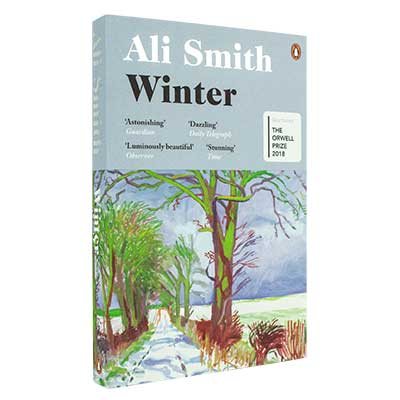
Winter by Ali Smith
Penguin
Pp. 322
Ali Smith’s seasonal quartet began with Autumn, published last year, and continues here with Winter. The subject is quite different but many of the themes are familiar. It is written in a continuous fluid style, but with short sentences and without irksome stream-of-consciousness. The novel embroiders snatches of literature and legend into a rich tapestry: a retelling of Dickens’ A Christmas Carol for our times. Dickens opened his festive novel with the words, “Marley was dead, to begin with. There is no doubt whatever about that.” Smith riffs on this idea. “God was dead: to begin with. And romance was dead. Chivalry was dead. Poetry, the novel, painting, they were all dead, and art was dead. Theatre and cinema were both dead. Literature was dead. The book was dead.”
So, what’s left? An ageing woman
called Sophia imagines a child’s floating head to keep her company. She is
visited by her son, Arthur (Art for short), who writes a blog called Art in Nature, which his ex-girlfriend,
Charlotte, hates because it isn’t political. He explains, “What I do is, by its
nature, not political. Politics is transitory. I watch the progress of the year
in the fields, I look closely at the structures of hedgerows. Hedgerows are,
well, they’re hedgerows. They just aren’t political.” Not wanting to admit he
is alone, Art pays Lux, a girl he spotted in a bus-stop, to accompany him and
pretend to be his girlfriend. When Sophia appears to be very ill, Lux contacts
her estranged sister, Iris, to whom she no longer speaks. Iris turns up on the
doorstep and recriminations and family resentments rise to the surface. The names
with their connotations of sleeping heroes, guiding light and Greek gods are
all pertinent.
The treatment of nature is centre stage – if Autumn was about Brexit; then Winter is about the environment, and the disasters destroying the planet and humanity. Iris is politically motivated, and the sisters dredge up memories of the Greenham Common protests, about which Smith seems almost nostalgic. She suggests that individuals can still make a different if they work together, as topics range from the Grenfell Tower to the insistence on stopping migrants; the political becomes personal and vice versa. The novel contains CND songs, and 1960-style rhymes about poisonous gasses and noxious chemicals. Horrifyingly, people are crowdfunding to raise money to stop rescue boats from helping refugees.
Having been impressed by Cymbeline, Lux originally came to England because it is the land of Shakespeare. In an obvious political metaphor, she says, “If this writer from this place can make this mad and bitter mess into this graceful thing it is at the end, where the balance comes back and all the lies are revealed and all the losses are compensated… then that’s the place I’m going. I’ll go there, I’ll live there.”
The treatment of nature is centre stage – if Autumn was about Brexit; then Winter is about the environment, and the disasters destroying the planet and humanity. Iris is politically motivated, and the sisters dredge up memories of the Greenham Common protests, about which Smith seems almost nostalgic. She suggests that individuals can still make a different if they work together, as topics range from the Grenfell Tower to the insistence on stopping migrants; the political becomes personal and vice versa. The novel contains CND songs, and 1960-style rhymes about poisonous gasses and noxious chemicals. Horrifyingly, people are crowdfunding to raise money to stop rescue boats from helping refugees.
Having been impressed by Cymbeline, Lux originally came to England because it is the land of Shakespeare. In an obvious political metaphor, she says, “If this writer from this place can make this mad and bitter mess into this graceful thing it is at the end, where the balance comes back and all the lies are revealed and all the losses are compensated… then that’s the place I’m going. I’ll go there, I’ll live there.”
Language and
communication are themselves under threat in this modern world. To glean
information, people no longer talk to each other; they google things and the
results are listed. Just as there is a disembodied floating head in Sophia’s imagination,
words are split in half to create new meanings: get ahead; get a head; “I’m
nobody’s child. I’m no body’s child.” Art examines the concept of snow and the
connotations of the word ‘snowflake’. In one section, Art asks Lux a series of
questions, and then we see her side of the dialogue separately as she answers
them. Further indications that cohesive dialogue is breaking down is seen in
parliament when a man barks like a dog at a woman who is trying to make a
speech.
This
is a novel of stories and interpretations. We are given tales of fertility; the
Green Man, Sir Gawain and the Green Knight, and defenders of past rituals and
natural bounty. Smith combines the richness of the past with the frustrations
of the present and a glimmer of hope for the future, believing that communities
and compassion can overcome division and isolation. Winter is an incredible achievement – it was written to reflect the
immediacy of the time (even the text is not justified, implying a sense of urgency),
yet it feels fresh rather than hurried. It ends with another echo from A Christmas Carol: “In the middle of
summer it’s winter. White Christmas. God help us, every one. Art in nature.” It’s
enough to make the reader want to take to the streets.
