The novella immediately announces
itself as a surreal work of post-modernism, deconstructing itself as even being
a book. It is not really about trout fishing, but it hangs loosely together around
that conceit as it spawns ideas and floats off down streams and meandering tributaries.
The chapters are very short – a page or
two at most – and the first one explains the purpose of its own cover. The
language is hallucinogenic and often touchingly whimsical as the book defies
all conventions in an extremely self-aware manner.
First published in 1967, the novella has a
strong element of The Machine in the Garden about it, as Brautigan seems
to reflect on nature and the destruction of the environment. A child thinks he
sees a waterfall, but really it is “just a flight of white wooden stairs
leading up to a house in the trees.” The author remembers how he once mistook
an old woman for a trout stream in Vermont. “‘Excuse me,’ I said, ‘I thought
you were a trout stream.’ ‘I’m not,’ she said.” In another chapter, an
abandoned shack has a notice nailed to the front door. “NO TRESPASSING 4/17 OF
A HAIKU”
It
is nostalgic in the way that it captures a moment in time, but then suspends it.
The contemporary context may be a poor pretext for the sexism that was
prevalent in the era, but it can’t excuse the fact that some passages are misogynist
and highly distasteful. Brautigan was a contemporary of Kerouac, Burroughs,
Kesey and other (always male) beat writers. He usually refers to “the woman I
was travelling with” and women are peripheral, mentioned only in relation to
their use to men. “The only woman he could find up there was a
three-hundred-pound Indian squaw. She had twin fifteen-year-old daughters and
he wanted to get into them. But the squaw worked it so that he only got into
her. She was clever that way.”
Trout
Fishing in America writes letters; it is a slogan written on the backs of first
graders in chalk by a gang of sixth graders; it is a pen nib, “with a stroke of
cool green trees along the river’s shore, wild flowers and dark fins pressed
against the paper”; it moves to Alaska to escape the heat of New York, leaving
a forwarding address; it has Maria Callas for a girlfriend; it is its own
autopsy as if “it had been Lord Byron and had died in Missolonghi, Greece, and
afterward never saw the shores of Idaho again”; it is an item for sale at The
Cleveland Wrecking Yard where it is sold by the foot length, “You can buy as
little as you want or you can buy all we’ve got left… We’re selling the waterfalls
separately of course, and the trees and birds, flowers, grass and ferns we’re
also selling extra. The insects we’re giving away free with a minimum purchase
of ten feet of stream.”
There
are oddly specific similes, many of which are fancifully extended. Dead fish “had
been turned white by death, like frost on iron doors. Their eyes were large and
stiff.” Some descriptions are gloriously visual. “The streets were white and
dry like a collision at a high rate between a cemetery and a truck loaded with
sacks of flour.” Others are nonsensical and absurdist for their own sake, such
as when mentioning small wooden markers in a graveyard for the poor.
“Eventually the seasons would take care of their wooden names like a sleepy
short-order cook cracking eggs over a grill next to a railroad station.”
Sometimes
Brautigan falls into a simpler writing that comes close to being a studied
imitation of Hemingway’s plain style or even a parody of it. When travelling,
the narrator gets picked up by a farmer in a truck. “The farmer did not ruin
his audition for the Metropolitan Opera by making a sound. He just nodded his
head again. The truck started up. He was the original silent old farmer.” He
can deflate situations before they even begin. “The garbage was a problem for a
little while and then we discovered a way to get rid of it.” And he can include
universal transcendent hallucinogenic passages: “You made love standing,
sitting, lying on the dirt floor with pigs and chickens around you. The walls,
the floor and even the roof of the hut were covered with your sperm and her
come.”
The book resembles an LSD trip, as if Lewis
Carroll were writing it on acid. There’s clearly a time and place for this sort of this –
I’m just not sure it’s here and now.
On a recent trip to Sydney, we went to the World Press Photo Exhibition 2023 at the State Library of New South Wales. The annual exhibition presents the results of the 2023 World Press Photo Contest - the best and most important photojournalism and documentary photography of the last year. The winners were chosen by an independent jury that reviewed more than 60,448 photographs entered by 3,752 photographers.
We all know that bad news sells - few people want to read good news stories - and so it is with the photos in this exhibition. There are harrowing images of war, floods, drought, poverty, incarceration, and ecological disasters, leading to a warning such as the one above, and the one below: the photo of the year.
Mariupol Maternity Hospital Airstrike by Evgeniy Malolekta
Iryna Kalinina (32), an injured pregnant woman, is carried from a maternity hospital that was damaged during a Russian airstrike in Mariupol, Ukraine, on 9 March 2022. Her baby, named Miron (after the word for 'peace') was stillborn, and half an hour later Iryna died as well. An OSCE report concluded the hospital was deliberately targeted by Russia, resulting in three deaths and some 17 injuries. The jury felt the photo depicted an attack on the future of Ukraine. Evgeniy Maloletka photographed the image on assignment for Associated Press.
The port of Mariupol on the Sea of Azov was the first city struck when Russia launched its full-scale invasion of Ukraine on 24 February 2022. Civilians were hit hard.
The strategically important port is one of the largest Russian-0speaking cities in Ukraine, a major industrial hub, and vital for the country's steel exports. The territory was also of symbolic value to invading forces as it represented a large step towards building a land bridge between the self-proclaimed Donetsk People's Republic (DNR) and Crimea, which Russia had illegally annexed in 2014.
Images from The Siege of Mariupol by Evgeniy Maloletka
Top: 06 March 2022 - Zhanna Goma (right) and her neighbours settle in a bomb shelter in Mariupol, Ukraine.
Middle left: 11 March 2022 - Serhiy Kralya, a civilian injured during shelling by Russian forces, rests after surgery at a hospital in Mariupol, Ukraine.
Middle right: 11 March 2022 - Russian army tanks move through a street on the outskirts of Mariupol. The Z marking is one of several symbols painted on Russian military vehicles in the early stages of the invasion.
Bottom left: 04 March 2022 - Marina Yatsko and her boyfriend Olesksandr Kulahin bring her 18-moth son Kirill, fatally wounded during shelling, to a hospital in Mariupol, Ukraine.
Bottom right: 09 March 2022 - People place dead bodies in a mass grave in an old cemetery in Mariupol. According to the BBC, on some days during periods of heavy Russian shelling, up to 150 people a day were buried in mass graves.
By early March, Russian forces had completely surrounded the city, restricting water, power and food supplies. Some 200,000 citizens were trapped in Mariupol, as attempts to evacuate them failed. Russian bombardment devastated the city, and included civilian targets such as a maternity hospital and a theatre where people were sheltering. Evgeniy Maloletka, who is Ukrainian, was one of very few photographers documenting events in Mariupol at that time.
Image from The Siege of Mariupol by Evgeniy Malolekta
On 21 April, President Vladimir Putin announced that Russian forces had taken Mariupol, but the city council said that 1,000 civilians alongside thousands of Ukrainian soldiers were holding out in the giant Azovstal steelworks. By 20 May, the soldiers defending the steelworks had surrendered, and the UN and Red Cross were able to evacuate the citizens. The UN Human Rights Office confirmed 1,348 civilian deaths during the siege of Mariupol, stating that the actual death toll was likely thousands higher: Ukraine says that figure is more than 25,000.
At the time of this exhibition in April 2023, Mariupol remained under Russian occupation. Russia has begun rebuilding the city and scrubbing it of its Ukrainian identity by renaming streets and changing school curriculums.
The exhibition includes a short history of World Press Photo: since 1955, World Press Photo has connected the world to the stories that matter. The non-profit organisation remains committed to press freedom and the power of visual journalism by providing platforms that present accurate, diverse, and trustworthy images.
1955 - A group of Dutch photographers organizes the first World Press Photo contest to introduce their work to a global audience
1967 -Although black-and-white pictures still dominate the submissions, and chromogenic printing remains expensive, the jury awards World Press Photo of the Year to a colour photograph for the first time
1972 - The annual exhibition featuring current winners of the World Press Photo contest begins to tour outside the Netherlands. Since then, the exhibition has travelled to 129 countries
1977 - Francoise Demulder becomes the first woman whose work is awarded World Press Photo of the Year
1990 Charlie Cole's photograph of a demonstrator in front of tanks in Tiananmen Square becomes a symbol of peaceful resistance. To this day, this picture remains banned in China
Tank Man, Tiananmen Square by Charlie Cole
2002 - Fourteen years after creation of the JPEG, digital entries surpass analogue entries for the first time in the history of the contest
2019 - John Moore's photograph of a child from Honduras at the US border, which wins World Press Photo of the Year, leads to the repeal of the 'Zero Tolerance' policy that permitted separating immigrant parents from their children when apprehended
2021- To better represent a plurality of perspectives and global voices, World Press Photo introduces a new regional strategy, changing the set-up of the annual contest, the categories, and the judging
2022 World Press Photo of the Year by Amber Bracken
2022 - With her photograph of a roadside memorial commemorating the deaths of indigenous children who attended the Kamloops Indian Residential School in Canada, Amber Bracken becomes the first person to win World Press Photo of the Year without depicting a human figure
Woman, Life, Freedom
This photo-based video project narrates one chaotic night in the life of an Iranian nurse as she saves the life of a young protestor called Reza. The footage offers a rare glimpse into the dangers faced by protestors on the streets of Iran today, situated in the context of an inciting incident: on 16 September 2022, Mahsa 'Jina' Amini, a 22-year-old Kurdish woman, died after she was arrested by the Islamic Republic's morality police for allegedly violation the country's strict rules restricting the dress and conduct of women. The ensuing protests quickly intensified, spreading across the country. The Islamic Republic responded by disrupting internet access and violently repressing uprisings. Because hospitals are controlled by the regime, anyone injured in the protests risks arrest and further abuse upon seeking medical attention.
Iranian photographer Hossein Fatemi encountered the nurse in the video while providing support to local Iranian photographers covering the protests. Images and video for this project were captured by local photojournalists, the nurse herself, and a photographer on assignment to cover her story. Journalists and photographers attempting to report on the protests face reprisals from the Iranian regime, ranging from intimidation to arrest and violent abuse. Due to these efforts, it is difficult to know what is really happening inside the country. Many of the photographers who captured the images seen here will remain anonymous for security reasons.
Images from The Price of Peace in Afghanistan by Mads Nissen
These two images are from a collection that won World Press Photo Story of the Year, which captures the daily life of people living across Afghanistan in 2022. The top image shows Khalil Ahmad (15), whose parents, unable to afford food for the family, decided to sell his kidney for US$3,500. After the operation, Khalil suffers chronic pain and no longer has the strength for football and cricket. The lack of jobs and the threat of starvation has led to a dramatic increase in the illegal organ trade.
The bottom image shows women and children begging for bread outside a bakery in central Kabul, Afghanistan. Bread is a staple in Afghanistan, but soaring prices have forced more and more people to rely entirely on the compassion of others.
In August 2021, the withdrawal of US and allied forces from Afghanistan marked the end of a 20-year long attempt at nation-building. Taliban forces, having sustained an insurgency across the country, returned to power shortly after the collapse of the Afghan state. Consequently, all international aid, which in 2019 accounted for an estimated 80 percent of the country's expenditures, was halted, and 7 to 9 billion dollars of assets belonging to the Afghan state were frozen. Without these two sources of government income, the already fragile Afghan economy effectively collapsed.
National gross domestic product of Afghanistan dropped to around 25 percent of its peak in early 2021. Estimates for 2022 suggest that 97 percent of the population lives below the poverty line and 95 percent of people do not have enough to eat. Nine million people are at risk of famine and, according to the UN, over a million children are severely malnourished. COVID-19, intense droughts, and the inability of aid organisations to bring relief to those in need have all exacerbated the crisis, which is only expected to worsen in 2023.
The Nomad's Final Journey by Jonathan Fontaine
This highly-commended image shows Samira (16) looking out onto Qolodo camp near Gode in the Somali Region, Ethiopia, on 16 May 2022. Her family owned 45 goats and 10 camels, all of which died during recent droughts.
Nomadic peoples of Ethiopia and Somalia depend on their livestock, migrating across their territory to pasture their animals. In recent years water scarcity has threatened these livestock. Exacerbated by the climate crisis, droughts have devastated the region which, according to the World Food Program, now endanger the food security of over 26 million people. With many families forced to seek aid in climate refugee camps, social structures are weakening, precipitating violence against women and a host of mental health crises.
As droughts persist annually, women, who are often responsible for finding water, bear an enormous share of the physical and mental toll exacted by the ongoing crisis.
The text in the image above reads: This map, generated by RSF (Reporters Sans Frontiers) represents the current state of press freedom in 180 countries and territories. To arrive at the results compiled and visualised here RSF conducted extensive research during the past calendar year. In addition to distributing questionnaires among journalists, RSF also employed a panel of experts who ranked press freedom around the world according to five equally-weighted criteria: political context, legal framework, economic context, sociocultural context and safety. Their rankings are coded by colour, with the highest level of press freedom classified as 'good situation'. As you can see, that's pretty much Scandinavia. And that's it.
Part of Me by Nadia Shira Cohen
Surrogate mothers Vin Win (right) and Ry Ly (left) were arrested during a raid to fight trafficking in 2018. They live near one another and their children from surrogacy, Korng (3, left) and Phavit (4, right) often play together. Vin Win is separated from her husband who resents the situation.
This series portrays Cambodian surrogate mothers who have been required to raise their surrogate children as their own ever since Cambodia began prosecuting surrogacy in 2016.
Surrogacy - the act of carrying and birthing a baby for another person or couple - was accepted in practice in Cambodia until 2016, when the government started prosecuting surrogate mothers under already existing human trafficking laws. In 2018, a raid on a house in Phnom Penh led to the arrest and imprisonment of 32 women who were acting as surrogates to predominantly Chinese parents. Nearly all gave birth in confinement and, after sentencing by the Cambodian Supreme Court, all were obliged to raise the babies themselves or face prison terms.
Many of the women sought surrogacy arrangements with Chinese family planning agencies in order to help their families escape impoverishment and, in some instances, indebtedness from microfinance loans. In recent years, Cambodian households have become some of the most indebted on Earth and a major contributing factor has been the poorly regulated microfinancing sector. The rising burden of financial debt has resulted in an increase in child labour and families forced to sell their homes and land. For many of the women portrayed in this series, surrogacy represented a way out of debt, but now with the court ruling against them, their lives have become more difficult. Despite financial, social, and personal challenges, many of the would-be surrogate mothers have formed a deep bond with their children even as they express sadness that their children will not be able to benefit from the economic advantages that their biological parents could provide.
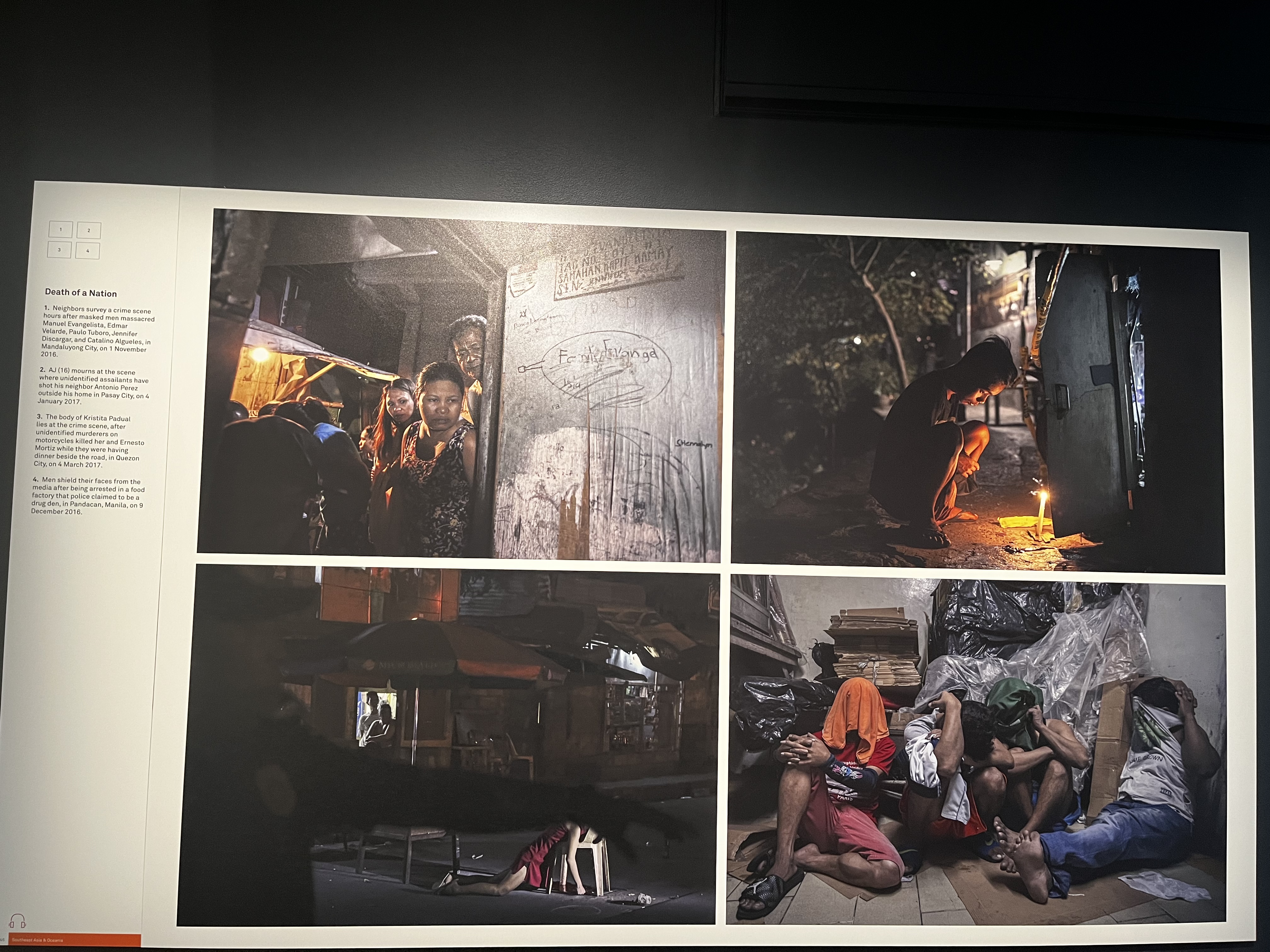
Death of a Nation by Kimberly dela Cruz
Winner of the long-term projects in the Southeast Asia and Oceania category, this project documents the Philippines' drugs offensive from its outset, capturing its broadening focus and the continued impact on families involved. The above photograph shows Jazmine Durana (15) cradling her month-old daughter Hazel on 2 February 2017, at the wake of her partner John 'Toto' Dela Cruz (16), who was shot by men wearing black masks a few days earlier.
Soon after taking office in June 2016, Philippine president Rodrigo Duterte began a concerted 'war on drugs', repeatedly ordering attacks against suspects. A surge of extrajudicial killings followed, perpetrated not only by police but also by masked vigilantes and other civilians. Amnesty International reports that executions mostly target low-income communities. The Philippine National Police admits to more than 6,000 such deaths to date; local human rights organisations put the figure at 30,000. The police appear to act with impunity, with only a handful of these killings being seriously investigated and almost no prosecutions.
Images from Death of a Nation
Top left: November 01, 2016 - Neighbours survey the crime scene hours after masked men massacred Manuel Evangelista, Admar Velarde, Paulo Tuboro, Jennifer Discargar, and Catalino Algueles, in Mandaluyong, the Philippines.
Top Right: 04 January 2017 - AJ (16) mourns at the scene where unidentified assailants have shot his neighbour Antonio Perez outside his home in Pasay City, the Philippines.
Bottom left: March 04, 2017 - the body of Kristita Padual lies at the crime scene, after unidentified murderers killed her and Ernesto Moritz while they were having dinner beside the road, in Quezon City, the Philippines.
Bottom right: December 09, 2016 - Men shield their faces from the media after being arrested in a food factory that the police claimed to be a drug den, in Pandacan, Manila, the Philippines.
According to the United Nations Office on Drugs and Crime, the Philippines has a low prevalence of drug use compared to the global average. Human rights organisations such as the World Organisation Against Torture (OMCT) and Amnesty International say killings often target political opponents, activists or marginalised groups. A Human Rights Watch report found that many of the killings that police attributed to drug gangs to be a veneer to shield themselves from culpability for executions carried out without legal process - an accusation the police refute, claiming self-defense.
Images from Death of a Nation
Top left: 08 September 2019 - Nestor and Alma watch the evening news, in Quezon City, the Philippines. Exactly three years earlier, their son Richard was killed during a police operation - an event that was reported on the news at the time.
Top right: 21 February 2022 - The family of Rovelyn and Richard Cham receive the urns containing their ashes in Tayuman, Manila, the Philippines. Unknown gunmen killed the couple at home in 2016.
Bottom left: 22 November 2019 - Mothers and widows of war-on-drugs victims rehearse for a theatre performance in Tondo, Manilla, the Philippines. Sarah Celiz (centre) lost two of her sons in 2016 and 2017 and was left to care for her 12 grandchildren. The performance was organised by Paghilom (Healing), a program started in 2016 by former drug user Father Flaviano Villanueva for the families of victims of the war on drugs, providing them with support and counseling.
Bottom right: 14 February 2022 - Mary Anne Domingo stands outside a courthouse after giving testimony, in Caloocan, the Philippines. She brought a case against the police after her husband and son were killed in a raid in 2016. The trial commenced in 2021.
In 2020, Fatou Bensouda, then the prosecutor of the International Criminal Court, said there was a 'reasonable basis to believe' that crimes against humanity had been committed in the Philippines in connection with President Duterte's drugs offensive. In July 2022, Duterte's successor President Ferdinand Marcos Jr. announced a refocus of the anti-drug offensive onto rehabilitation, however, killings continue and reforms have not yet been made to rehabilitation programs, according to Human Rights Watch.
The photographer has been documenting the war on drugs since its outset, and the jury commended her ability to capture the continued impact on families involved.
The Dying River by Jonas Kako (winner of the North and Central America, Singles category)
Alfredo, Ubaldo, and Jose tend beehives near Wenden in the Arizona desert, United States. A substantial decrease in rainfall in the area means that the men must now provide water for the bees in troughs. Heat and drought weakens bees, making them more susceptible to pathogens and parasites, and impacts the pants from which they feed. Between 2019 and 2020, colonies of managed honey-bees declined by 43.7% across the US. Bees are vital for pollinating many crops, and so play an important role in food security for humans.
This image is part of a broader project on how the climate crisis and increasing water demand are affecting the Colorado River, which flows nearby. Annual flow in the Colorado River has shrunk 20 percent in the past 30 years, according to a river program manager. The Colorado relies on snow melt from the Rocky Mountains and precipitation in upstream forests that collects in lakes and natural reservoirs. Drought and global heating have accelerated evaporation from reservoirs, and melted snowpack faster, so that rivers run dry earlier in the season. Hot, dry conditions have also parched the soil, which soaks up precipitation before it even reaches the river.
Water diverted for agriculture accounts for up to 80 percent of consumption in the Colorado River Basin, and a series of dams along the course of the river - providing drinking water to more than 40 million people and hydroelectric power to meet the needs of some seven million - further shrinks the flow.
In late 2022, the US government implemented severe restrictions on river-water use in states along the course of the Colorado River, cutting Arizona's annual allocation by 21 percent.
Jury comment: This portrait of beekeepers is visually clean and sparks interest and curiosity to understand the issue at hand. The image is subtle and understated, and the jury was impressed by the composition of bees across all thirds. While the topic resonates at ag global level, the image itself encourages us to sit with these particular people and consider how they might be impacted by the ongoing environmental crisis.
Oil Spill in Lima by Musuk Nolte
On 15 January, nearly 12,000 barrels of crude oil spilled into the sea while a tanker was unloading at Repsol's La Pampilla refinery. Repsol, the Peruvian government, and the Italian tanker company each disputed the cause of the spillage, trading accusations of negligence, inadequacy of equipment, and mismanagement.
The spill extended over 7.13 square kilometres, polluting beaches, killing wildlife, and impacting livelihoods in what the Peruvian government termed the country's worst ecological disaster in recent memory.
The oil reached three marine protected areas: Lomas de Ancon, the Pescadores Islets, and Punta Salina. The plankton-rich Peruvian Pacific waters sustain a chain of marine life, from anchovies to dolphins and seabirds. Marine mammals and birds are especially vulnerable, as the oil affects their eyes, nasal tissue and their insulating capacity, potentially leading to suffocation and hypothermia. Commercial fisheries, people relying on tourism, and local communities dependent on seafood for their diets also suffered. UN experts believe the effects of the spill will last up to ten years.
Alpaqueros by Alessandro Cinque
Vital to the livelihoods of many people in the Peruvian Andes, alpacas face new challenges due to the climate crisis. Part of the camelid family, alpacas can endure the high altitudes of the Andes and are a critical source of income for farmers in an environment where few or no crops can be cultivated. They are primarily bred for their fine fibre (wool) which is highly prized for knitwear and woven cloth. Tens of thousands of Andean families depend on raising alpacas or dealing in their fibre for subsistence. Among local Indigenous communities such as the Quechia, alpacas are also embedded in cultural and ritual life.
The climate crisis is putting alpacas and the communities they sustain at risk. Shorter rainy seasons and more intense, longer periods of drought are shrinking natural pastures and reducing the quality of the grass on which alpacas feed. In addition, meltwater from Peru's glaciers, which supports high meadows during the long dry season, is declining rapidly. Peruvian glaciers retreated by 53 percent between 1962 and 2016.
These challenges threaten not only the alpacas, but the loss of high-Andean cultural identity, as alpaquero (alpaca-farmer) communities are forced to move to even greater altitudes, or to abandon their lifestyles entirely and seek work in low-lying cities. Scientists hope to help address the problem using biotechnology to create alpaca breeds more resistant to extremes in temperature. This would help the animals to survive harsh nights at higher altitudes, as well as thrive at lower elevations, since alpacas also suffer in warmer temperatures, from illnesses not present in highland areas.
It's fair to say that the images and the situations depicted are extremely grim. A brief summary of the Year in Review attempts to explain 'What Happened in 2022?' "Photojournalists working in 2022 brought stories of the war in Ukraine and life under Taliban rule in Afghanistan, of use and abuse of river water in Central Asia and the United States, flooding in Australia, oil spillage in Peru, and people with dementia in Ghana. But a tough judging process and the limitations of how to visualise certain stories means that some major stories discussed by the jury did not make it through to the final selection:
Anti-LGBTQI+ Violence - April 2022, Kenya - Sheila Adhiambo Lumumba, a non-binary lesbian, is found raped murdered in Karatina, Kenya. Human rights organisations call attention to institutionalised homophobia in Kenya and other nations across the continent including Ghana, Nigeria and Uganda.
Uvalde School Shooting - May 2022, Uvalde, Texas, United States - On 24 May and 18-year-old gunman kills 19 children and two teachers at Robb Elementary School in Uvalde, in the deadliest school shooting in the US in a decade.
Abortion Law Overturned - June 2022, United States - The US Supreme Court overturns Roc v Wade, the legislation that made access to an abortion a federal right in the United States. The move leads to nationwide protests.
Sri Lankan President Resigns - July 2022, Sri Lanka - President Gotabaya Rajapaksa flees the country and resigns, after months of protest against the country's economic crisis had culminated in popular occupation of the presidential palace.
Death of Mahsa Amini - September 2022, Iran - The death of Mahsa Amini after being arrested by Iran's 'morality police' for allegedly not wearing the hijab in accordance with regulations sparked some of the largest demonstrations in Iran in years.
Kanjuruhan Stadium Disaster - October 2022, Jawa Timur, Indonesia - More than 130 football fans die in a crush apparently sparked by police firing tear gas as a crowd-control measure, while leaving the Kanjuruhan Stadium after a match, in one of the world's worst stadium disasters.
'Lula' Wins Brazilian Presidential Elections - October/ November 2022, Brazil - Luiz Lula da Silva wins a majority in the Brazilian presidential elections. Former president Jair Bolsonaro does not initially concede defeat, but President Lula da Silva is inaugurates in January 2023.
Ethiopia and TPLF Declare Truce - November 2022, Ethiopia - Ethiopia's federal government and the Tigray People's Liberation Front (TPLF), which controlled much of Tigray province, agree to stop fighting after a two-year conflict that has caused a dire humanitarian crisis.
White Paper Protests - November/ December 2022, China - Protests spread through cities across China, as demonstrators held up blank sheets of paper to oppose on-going government COVID-19 restrictions. In January 2023 China revoked its Zero-COVID policy.
An image from Net-Zero Transition by Simone Tramonte
In the above image (13 July 2021), people swim at Amager Strand, Denmark, near a wind farm which is co-owned by 8,552 electricity consumers, and serves more than 40,000 Copenhagen households. Upwards of 15,000 Danish families are members of similar wind turbine co-operatives.
Winner of the Europe, Long-term projects category, this sequence is a rare positive view of the world around us, which is why I felt the need to include it in this post. The project documents different technologies that offer possible routes of transition to a net-zero economy. The photographer visited innovative facilities across Europe, from Iceland to Italy, from 2020 to 2022.
Human-induced climate change is the largest, most pervasive threat to the natural environment and society that the world has ever experienced, according to the UN Human Rights Office, OHCHR. This prompted the European Union to establish targets to cut greenhouse emissions by at least 55 percent by 2030. European companies seeking ways to achieve these goals are exploring renewable energies, new technologies for food production, and the circular economy as potential ways forward.
Image from the series World Champions by Tomàs Francisco Cuesta
I wanted to finish this on a positive note, which is why I have placed this image last. It is a scene of jubilation as Argentinians revel in their country's return to World Cup dominance, Buenos Aires, Argentina, 18 December 2022. An estimated five million people took to the streets to participate in the parade and join the national team members in one of the greatest public demonstrations in Argentina's history. For striker and star player Lionel Messi the win cements his legacy as one of the greatest footballers of all time. Argentinian photographer Tomàs Francisco Cuesta said about taking these photographs,
"You really just feel good looking at those images, and those are ones that may resonate. It's just the beauty of sports. And it's the beauty of imagery, the beauty of pictures. Soccer in Argentina is so much more than a sport. It's more important than Christmas, more important than the New Years. For many people, it's more important than their jobs. That's why you saw five million people crowding the streets of Buenos Aires. It was the first time that I saw such a union in the streets without any discrimination. People were really united to celebrate and to let the players know that they were supporting them."
I have seen the works of Fiona Hall before. I think she is innovative and creative with an ability to execute her ideas in an engaging manner. In 2015 her exhibition Wrong Way Time attracted global attention at the Venice Biennale, and the following year I was lucky enough to see it at the National Gallery of Australia, complemented by a collection of Hall's works mainly from the NGA collection.
In Wrong Way Time, Fiona Hall brings together hundreds of elements, each embedded with layers of meaning. Together, the works focus powerfully on the intersecting themes of global conflict, world finances and the environment, which Hall perceives as a "minefield of madness, badness and sadness in equal measure."
Sasha Grishin wrote in The Canberra Times, "The exhibition's 800 items are presented within a darkened space, with walls painted black, as part of a deeply immersive installation. It is a troubling, dark, gothic experience, where the artist appears as a shaman who, through alchemy, transforms the materials drawn from a commonly experienced reality into mystical and wondrous creations. Wall-pieces create an outer boundary and vitrines, which are set up as wunderkammer-like cases or cabinets of curiosities, frame the central space that is occupied by the installation All the King's men."
This installation includes twenty sculptures, knitted out of shredded camouflage fabric from military uniforms of various countries. Ghostly vestigial bodies hang from oversized disfigured heads, forming a disturbing group that represents the foot-soldiers who are casualties of conflict regardless of nationality. Teeth, bones, horns and found objects adorn the mask-like heads and their spectral skeletal bodies.
According to curator of the NGA, Leigh Robb, "It is an exemplary manifestation of Hall's maverick powers of material transformation and is the culmination of decades of conceptual and material investigation... These hollow people of war and conflict represent the many who have fallen and those who are yet to fall in the name of nationhood. Fiona Hall has shaped the course of Australian art history. Her enduring vision will help us to understand ourselves, each other and these uncertain times."
Sasha Grishin continues, "A major artistic strategy in Hall's repertoire is that of 'bricolage', where the artist improvises with the materials at hand. It is a sort of DIY approach to art making, where the artist will take aluminium sardine and fish tins, US dollar bills, as well as other foreign banknotes, old clocks, model aeroplanes and ships, damaged books, a carburettor, car light and radiator hose, light switches, driftwood, pool balls, mobile phones, camouflage military garments, deer teeth, a zebra hoof, credit cards, bones and horns, together with coal, bread, perfume bottles and living spiders and employs these to create alternative realities. The French term 'bricolgae' comes from the verb 'bricoler' (to tinker) and in some ways this characterises this artist's method of work."
In Tender she slices up US dollar bills to become the threads out of which to build beautifully designed and realised bird's nests. The banknotes are woven into an 86-piece installation accurately replicating the nests of extinct birds from areas logged by American interests. The nests are now bird-less, silent and deserted. The title itself plays with an array of associations from 'legal tender' to emotional tenderness.
To make Tender, Hall paid face value for thousands of US dollars and sliced them up to weave the nests. As the US dollar is the most valued currency in Third World countries, this work suggests people hunting for the dollar like a bird scavenging for materials to build its nest. The artists is also commenting on one of the prices paid for capitalism - the destruction of the environment.
Speaking about Tender in 2006, Fiona Hall said, "I knew that shredding the American dollar was for me conceptually an act of revenge for the sorry state our world is in. I don't mean to direct my wrath towards that to the United States alone, but it's the inevitability of the globalised world that we live in that the environment is under enormous pressure. Socially and globally suddenly we are aware of that in a way that we weren't five years ago when I was still making that work.
"It's amazing how quickly the tide has changed. The power of the greenback has really faded in the last few years. Now the greenback suddenly has perhaps come to represent a world and a system that is foundering; a system that used to be watertight and isn't any longer. Now with the financial downturn globally and with all the other political events of the last few years that have changed the idea of America as being a figurehead nation for the rest of the world to aspire to - all of that has changed in the minds of so many of us and I think that our regard of the American dollar in that context is different now."
The work explores the complex relationship between the natural world and human systems of value, trade and exchange. Hall combines the empirical knowledge of a scientist working in the natural sciences, the creative associative imagination of the artist, together with an obsessive and manual dexterity and technical precision.
Another example of her work combining the natural world with capitalism is Leaf Litter (1999-2003) in which paper money or bank notes are used as canvases for delicate x-ray-like paintings of leaves. While money is the bottom line in our contemporary economy and overrides crucial environmental concerns, plants are often the raw material for generating income (and money, made from paper, is also produced from plants). Fiona Hall's witty and elegant work captures this perfectly.
Also adding to the Venice exhibition is the earlier work, Paradisus terrestris (1989-90), made from sardine tins and aluminium cans over a fifteen year period. These otherwise discarded materials have been transformed into beautiful objects as each sardine tin has been wound down to reveal within an embossed depiction of the human form. At the top of the tin grows botanically correct representations of flora; the plant and the body interconnected in form. The connection we as humans have with our natural world is emphasised through ideas of fertility and reproduction, growth and natural cycles.
Holdfast (Macrosystis angustifolia; giant kelp)
As seen in Holdfast (Macrosystis angustifolia; giant kelp), part of the object emulates the natural and jagged textures of foliage, seen branching outwards, growing from the unraveling tin can. The text imprinted on the tin is a jarring reminder of the artificiality of the sculpture.
In a similar vein, endangered marine species have been hand-carved out of single sardine tins and each painted with maritime signal flags to comprise the work, Fleet.
Fleet
Vaporised
I loved the way many of the exhibitions were displayed as items in curiosity cabinets. These cabinets of curiosities (wunderkammer) originated in Renaissance Europe as a way of cataloguing the world (or communicating one version of it). Glass cabinets also recall coffins and embalmed corpses; captured forms that we have killed so we can study. It creates a sombre atmosphere, in keeping with the subject matter. In one case (Vaporised) sits a collection of small glass perfume bottles on which are painted skulls to represent disappeared Tamils in Sri Lanka. Fiona Hall writes,
"The world is a very curious place. It's an amazing place and it's filled with curious things in the best sense of the word. And that seems to be accentuated by the way that objects have been displayed in cabinets; an innocent idea that you could actually put all these things in a museum display and you could comprehend the world. In a sense the museum cabinet makes the world somehow more incomprehensible rather than more comprehensible because you've just taken little fragments of it and conveniently left aside the context. And I find that curious as well; the implications of what's not in the cabinet; that are pointed out because of their absence; because of what has been put in the cabinet."
I also really enjoyed the section of the exhibition, Crust, in which a series of small sculptures carved from baked bread installed on an open atlas represent various tragedies - environmental, cultural and militaristic - that occurred in the region on which it sits. One bread carving is of intricate barbed wire; another, an exploded village on a map of Syria, with tiny bricks of bread strewn across it. Dr Deborah Hart, senior curator at the National Gallery describes the sculpture as, "one of the great miracles of the show that made it through customs. Even Fiona was quite amazed that these had arrived in tact."
The exhibition investigates global politics, world finances and the environment. Other areas of interest for Hall include post-colonial issues, the relationship between culture and nature and the human condition. Hart describes Wrong Way Time as a "very dense exhibition" as it involves works made from an assortment of media including bread, banknotes, cork, aluminium and cuckoo clocks. These curious configurations speak deeply of Hall's practice, which continues to transcend fluidly without restriction.
The artist's choice of materials is never arbitrary, nor are the newly created forms. The large, dramatic wall-piece, Manuhiri (Travellers), looks from a distance like a collection of bones in the form of a strange organic installation. On closer inspection it turns out to be made from driftwood, arranged in a loose mandorla-like pattern.
The artist explains that she collected the driftwood from a beach at Awanui on New Zealand's East Cape, where the Waiapu River flows into the sea. Over-farming has led to wide-spread erosion and the trees have fallen and been swept out to sea, while the waves and tide have returned them to the shore in the form of driftwood. Manuhiri is like a shrine or graveyard of the forest, or in the artist's words, these bits of driftwood appear like "travellers from a former forest life reshaped by the ocean currents and now journeying to another life back in the world of the living."
Manuhiri (Travellers)
One of the strongest parts of the show is Kuka irititja (Animals from another time), where Hall collaborated with 12 women artists from the Tjanpi Desert Weavers of the Central and Western Desert region of Australia: Roma Butler, Stacia Lewis, Rene Nelson, Takiriya Tjawina Roberts, Angkaliya Nelson, Sandra Peterman, Yangi Yangi Fox, Molly Miller, Nyanu Watson, Rene Kulitja, Niningka Lewis and Mary Pan. These women have long history of making animals woven from the local grasses and other materials from their country, and Fiona suggested they work together to weave a 40-piece installation representing a group of native animals, most of which are extinct in the wild.
The work was created in June 2014 at an artist camp at a place near Pilakatilyuru (in the tri-state border region of Western Australia where it meets South Australia and the Northern Territory). The Tjanpi artists have a deep and intricate understanding of their country and were able to incorporate this knowledge into the woven pieces. They drew upon the interrelatedness of people, place and ancestral stories they call Tjukurpa (Dreaming), and from their intimate knowledge of hunting, tracks, and animal behaviour - including that of the predatory feral cat, the top killer of native Australian animals. Fiona as a non-Indigenous Australian brought her own thoughts about the impacts of colonisation on our environment and the animals that inhabit it.
Both the Tjanpi weavers and Fiona Hall share a mastery of weaving with various materials and this shared skill helped to inform the collaboration. The Tjanpi weavers harvested tjanpi (grass) and Fiona supplied Australian and British military printed camouflage fabric to incorporate into the works registering the damaging effects of British colonialisation including atomic testing in the 1950s and 60s on the fragile desert ecosystem and the lives of the Aboriginal people. The artists used each other’s fibres and also added in other found materials to create the final group of work. They are strange, whimsical creations that serve as a commentary on loss and absence.
A woven helicopter seems incongruous until we read that Hall uses this to refer to the nuclear tests that were carried out at Maralinga by the British Government, with the agreement and support of the Australian Government, between 1952 and 1963. The toxic fallout is believed to be responsible for widespread illnesses across desert communities, the deaths of the weavers' parents and relatives, and the extinction of animal species.
The exhibition also features several recent works on loan from the artist that were shown in dOCUMENTA 13 (2012). Kassle, Germany. These relate to endangered birds and animals from around the world. Hall reflects on the troubled times we are facing and this concern is ingrained in many of the pieces. The works from Fall Prey incorporate military camouflage material from the country in which the species is found on the International Union for Conservation of Nature (IUCN) List of Threatened Species, and found objects to create curious hunting trophies; a macabre menagerie of near extinction promoting environmental vigilance.
Cervus elaphus/ red deer, Europe, North America (2012) IUCN threat status: least concern
Another few works that stand out to me are the coal and aluminium sculpture, Untitled, with its implications of seaweed, branches, and lungs breathing pollutants that have come from natural sources, and the potato print and watercolour on khadi paper, MobRot, which speaks for itself in a fundamental earthy commentary on corruption and exploitation.
Untitled (2015)
Mob Rot (2015)
Another exhibit which was not part of the Vienna Biennale, but which I enjoyed all the same, was Morality Dolls - the seven deadly sins (1984). This series of marionette dolls, based on the theme of the seven deadly sins are grotesque yet captivating, assembled from a variety of photocopied anatomical diagrams. Each figure anthropomorphises a vice, with body parts acting as metaphors for each sin. Hall's use of antique medical imagery alludes to the historic nature of these sins. The fanciful forms satirise basic human characteristics which continue to be relevant in a contemporary context. There is a sense of inexorability as these beasts are controlled by someone else pulling the strings.
It's hard to explain the visceral hold this art has on me, as it appeals to and repels me at the same time. I will leave the last words to a local art reviewer, Sasha Grishin in the Canberra Times.
"Throughout the exhibition there is a combination of immediate high visual impact followed by a slow release of associative meanings that each individual viewer brings to the experience. Although it has become fashionable to speak of 'slow art' , where beyond the immediate 'wow factor' there lies a rich, slowly developing cultural response, Hall's art creeps along at a subversive pace. The high-[pitched dramatic, emotional and intuitive level in her art is to some extent supplemented by its cerebral and philosophical content. It is art that is simultaneously visually exciting and at times intellectually profound."
There is one more major part of Wrong Way Time, which is Wrong Way Clocks, a body of work that I feel deserves its own post. So I'll get on to that next.


/cloudfront-us-east-1.images.arcpublishing.com/tgam/2BYB7TMOVJOQHEYNRQ6NE3JSGY.JPG)