The stars are out to play. Mbappe and Haaland may be taking over from Messi and Rondaldo as the newer generation of super strikers. Goals galore are also expected from the likes of Kai Havertz and Vinicius Junior, while I am quietly keeping an eye on Harry Kane and Jude Bellingham. it was also noted that Mo Salah scored his first World Cup goal helping Egypt to win their first World Cup match (3-1 v NZ). How have they not done this before now? They are now in the round of 32: let's hope their successful run continues.
Meanwhile, other so-called celebrities are less illuminating. Those from the realm of music and film are recognisable: Mick Jagger; Matt Damon; Penelope Cruz; Javier Bardem; Tom Cruise; Billy Bob Thornton; Rob Lowe; Owen Wilson; Sofia Vergara; Alanis Morisette; Ryan Reynolds, to name but several. There are also plenty of former footballers out and about, notably David Beckham, Roberto Carlos, Ronaldo, Alexia Putellas, Zinedine Zidane, and Luis Suarez. The VIP lounges are full of champagne and prawn sandwiches, but the English commentators hilariously fail to recognise any 'stars' of American sports. The cameras pan to the supposed superstar who has no interest in the match and is purely there to be seen and dead air ensues while the commentator is clearly being told who that might be, before they announce it is of course some legend from letters (NFL; NBA; MLB). Until last week I had never heard of Patrick Mahomes, Marshawn Lynch, Jalen Brunson, Dirk Nowitzki, or Aaron Judge, I'm pretty sure many of the UK commentators hadn't either. Welcome to Corporate America.
Staying with transatlantic travesties, what are they trying to do to our language? When did transition become a footballing term? I know what it means, as a team tries to play out from the back through the midfield towards the opposition goal, but of course Americans need a new way to explain moving from DEEfence to OFFfence. While we're here, it is nil not zero, pitch not field, shirt not jersey, clean sheet not shut out, boots not cleats, manager not coach; striker not forward; squad not roster, and definitely club not franchise. Franchises have no place in sport. And teams are plural. You may be You Ess Eh? But We Are England.
On the subject of FIFA faffing, it never rains but it pours. We are now all aware of the sporting rain and weather protocols: we learned that U.S. sporting protocol requires a mandatory wait time of thirty minutes after the last observed lightning strike or thunder before play can resume. Every time a new lightning strike occurs within the designated danger radius (typically 8 miles or 13 km), the 30-minute countdown clock resets completely. So, after the start of the Mexico v Ecuador game was delayed by an hour, we were all expecting that there would be no hydration break, especially because FIFA announced that there wouldn't be. However, as the temperatures plummeted to 14 degrees, everyone was adequately cool and refreshed, and the momentum of the match was cracking along exceptionally energetically, Fox must have called FIFA and reminded them of the money they were making through the ads, and so we were 'treated' to one after all. What an absolute shower.
The super-subs: Over 20% of goals scored have been by substitutes, and many of these within mere moments of the sub coming off the bench. There are plenty of reasons for this, namely, it's only the second World Cup that has allowed teams to make five substitutions, and also, the fatigue of the existing players means the fresh legs are particularly valuable. It's hot, it's humid, some stadiums are at altitude, and this combination of factors causes players' performances to drop off towards the end of the match. It makes thing interesting if nothing else. Mattias Svanberg scored in the 84th minute for Sweden in their 5-1 victory over Tunisia, 18 seconds after stepping onto the pitch and with his very first touch in a set piece. Romelu Lukaku made a near-instant impact for Belgium in the 66th minute against Egypt. A mere 22 seconds after his introduction, his powerful run forced an Egyptian defender to turn the ball into his own net, rescuing a 1–1 draw. Coming on as a late tactical change in the 90+5 minute against Algeria, the Austrian Saša Kalajdžić met a crossed ball with his first touch to power home an equalizer just 61 seconds later. The dramatic finish meant that Iran were knocked out of the tournament as a 3rd place getter with insufficient points. When Switzerland played Bosnia and Herzegovina in their group-stage match, four of the five goals were scored by subs. As always, fans are often disappointed when their favourites are subbed off, but when it works, the manager is considered a tactical genius. Conversely, Australian manager Tony Popovic subbed on experienced captain, Matthew Ryan in the 119th minute of extra time to replace starting goalkeeper Patrick Beach for the penalty shootout against Egypt. The high-stakes strategic gamble ultimately backfired, as Ryan was unable to save any of Egypt's four penalties, resulting in elimination for the Socceroos in the round of 32.
Carrying on where we left off last week - I've not actually left off at all to be honest - here are some more musings from the highest echelons of the beautiful game.
The individuals - Yes, it's a team game. But the golden boot competition is for single strikers, and it's alive and kicking. Of course we have to mention Lionel Messi. At 39 years old he is leading the race, scoring a hat-trick in Argentina's opener against Algeria. He went on to bag a brace against Austria, leaving his team top of their group and breaking a whole heap of records in the process, some of the most eye-catching being: the most goals scored at a men's World Cup; the oldest player to score a hat trick in World Cup History; the most World Cup matches played by a single player. It seems it is almost impossible to chat about Messi without bringing up Cristiano Ronaldo - the two have been pushing each other (in the media's headlines if not their own minds) for as long as they've been playing. Ronaldo also knocked in a couple in Portugal's second game making him equal with Messi in scoring at six different World Cups. He's two years older than Messi so has got the better of him on that front. A quick Google comparison indicates that Messi is the leader in many statistics, "most notably leading in goals, assists, total goal contributions, and by winning the World Cup trophy in 2022." While that last statistic may be the one that counts the most, what really interests me is that Messi has four times the number of assists and more than double the 'goal contributions'. One of these players knows it is not all about them.
The defenders - as a former right back, one of the things that annoys me a bit about the media and the punditry is the focus on the attackers. A goalless draw can be fascinating if one appreciates the art of a good block or an off-the-line-clearance. I know there is also a golden glove contest for the keepers, but most of the time folk bemoan the lack of goals as if they're the only consideration. It's like watching cricket and ignoring the bowlers' skill, claiming a match is only interesting if there are lots of runs, without acknowledging the wickets taken. True, a lot of the challenges are tough and it's not always pretty, but it is crucial. Unfortunately, we saw the worst of it when the tackle from Qatar's Assim Madibo resulted in a broken leg for Canada's Ismael Kone, and a red card and five-match ban for the guilty midfielder. However, I maintain that if France win the World Cup (and they are my favourites to do so), it will be largely due to their impeccable defence.
The managers - There's always a bit of debate about who controls the team - the manager, the captain, the talisman player, the bloke who's good for the dressing room (which appears to be the reason Jordan Henderson is in the England squad), or the media darling (see Cristiano Ronaldo). Tunisia thought the manager had pre-eminence and sacked Sabri Lamouchi after their first-round 5-1 defeat by Sweden. It didn't do them much good, however, as they finished bottom of their group with no points and a goal difference of -10. They have form at this, having previously sacked their manager, Henryk Kasperczak, two games into the World Cup in 1998, from whence they proceeded to also finish last in their group. Meanwhile Didier Deschamps will miss the largely exhibition match between France and Norway as he flies home for his mother's funeral. The team will show their support and undoubtedly play their finest football in respect. And the manager of Ecuador, Sebastian Beccacece, acts as if his country's victory against Germany is all due to him as he prances up and down the touchline, hugging his entourage in the crowd, tennis-style, and drawing all attention to his antics before finally congratulating his players, basically carrying on like a pork chop, as they say in these parts.
The new rules - FIFA enjoys faffing about with the rules of the game just before big tournaments (silver goal, anyone?). The changes are usually introduced to make things more 'exciting', to give more impetus to the attackers and to speed up the run of play. This time round the new rules largely relate to time wasting and affect tardy throw-ins, substitutions and VAR decisions over off-sides and corner kicks. As mentioned in the previous post, the referees are being relatively consistent and, despite the three red cards in the first game of the tournament (Mexico v South Africa), are letting the games flow. One new rule which has has immediate dramatic results, however, is the one about covering the mouth in a confrontational situation. In a Champion's League game, a Benfica player was accused of making discriminatory remarks to Real Madrid’s Vinícius Júnior, but because he covered his mouth, lip-readers (who are employed for exactly this sort of thing) could not verify the accusation and so it went unpunished. Paraguay’s Miguel Almirón was the first to fall foul of this new regulation as he was sent off in his team's group match against Türkiye. We may not know what he said, but he knows he shouldn't have said it, and he definitely shouldn't have tried to hide it. He can't say he wasn't warned.
The commentators - Most of them are knowledgeable and informative, guiding the viewer through the games with helpful understanding. Andy Townsend is, of course, my favourite and has been ever since I met him at a book signing in 1994, and Peter Drury is particularly solid with his mix of enthusiasm and expertise. And then we have the Americans. Brad Friedel has experience despite a complete lack of apparent personality, but he is infinitely preferrable to John Easton who blurts out bullsh*t at an incredible rate. The epitome of someone who has never been told that if he hasn't got anything interesting to say, he should remain quiet, he barely listens to his fellow commentators, and just repeats what they might have said more loudly and more crassly. It was actually a relief when someone killed the sound during the Netherlands v Sweden match so we could concentrate on the football rather than the banal yahooing. At least we are spared the Fox fiasco, in which Alexi Lalas has apparently managed to ghast the flabber of even the most insouciant Henry with his verbose vapidity. It is painfully embarrassing to all in the studio and at home what a glaring division there is between the 'soccer' sycophants and the rest of the world.
The World Cup has kicked off and there is plenty to think about. I will not venture into the tactics of teams or specific match reports in these posts, and I will do my best to stay away from the politics of the Resident Evil. But there is plenty of other chat around the grounds.
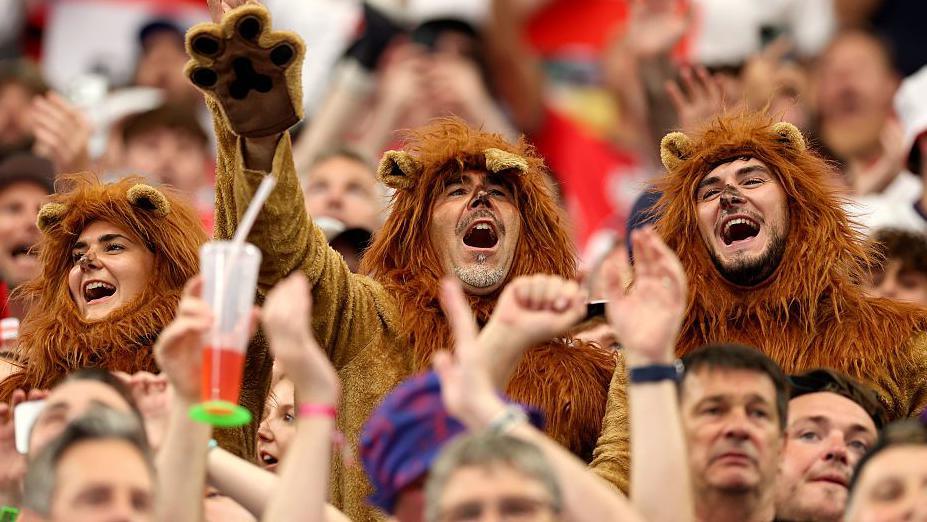
Three lions in the crowd
Ad breaks - call them what they are. The totally unnecessary, momentum-killing, three-minute intervals midway through the halves give the Americans what they have always wanted: a game of quarters for their attention-deficit, commercial-forward nation. They were understandable in Qatar (the fact that the World Cup was held there at all is a totally different proposition), but everyone knows they are not really for hydration here. The rest of the world despises them (the breaks; not the nation - we save that contempt for their president), and the fact the crowds at every game are boo-ing them is testament to their unpopularity. Maybe FIFA will take note of this, but probably not.
National anthems - Scotland win, and I don't mean with Yes, Sir, I Can Boogie. I'm not a great fan of bagpipes, but they certainly make a noise. And I have to concede that when played well, they are a damn sight/ sound better than vuvuzelas. To be fair, those blowing and squeezing out Flower of Scotland in Boston are generally superb. Uruguay are a close second with a jolly, rousing number that makes one want to party. The New Zealand cry-for-help in song is a two-header. Everyone thinks it's finished after the Māori version and then are surprised when the English version kicks in - people might know the words to this bit, but they're bored by the end of it. New Zealand are the lowest ranked team in the tournament, so we're unlikely to hear it too often.
The refs - Ref cam is fascinating. We can watch the match officials try to keep up with the game while staying out of the way, which doesn't look easy - they have to read the game to know where they expect the ball to go and then be near it but not in its path. The view shows what they see of the action and explains why they sometimes need to refer to VAR because their vision is blocked of a potential infringement. It's early days, but I think they're doing a good job, refusing to be swayed by histrionics and giving free kicks for obvious shirt pulls and trippings.
Tiny teams - The extended format of this tournament isn't to everyone's liking (I have questions, including why do some group winners play the second-placed finishers in the next round, while others get an apparently easier route against the best-placed losers?) but it does introduce new countries and their fans to the world stage - namely Cape Verde, Curaçao, Jordan and Uzbekistan. Curaçao (a nation with a population the size of Toowoomba) scored their first ever world cup goal against Germany, and one of the biggest talking points of Week One was when Cape Verde kicked off their first ever World Cup campaign with a point from a scoreless draw against fifth-ranked Portugal. And what's not to love about that?
The crowds - Scotland (again), who have embarked upon a full-frontal love affair with Boston in which they have drunk the city dry, the mayor wants to twin town with Glasgow, and no traffic cones are safe. The colours are a riot - and perhaps fearing this, England fans have been told they cannot hang theirs at stadiums because they might - heaven forbid - cover up the advertising hoardings. See point one about the money-making-morality of this tournament. Apparently images depicting weapons are also not allowed (because we all know how strict Americans are about 'actual' gun control...) so a submarine on a Barrow AFC flag is forbidden entry. The flag of Haiti, however, bristling with six rifles, two axes, two cannons and two piles of cannonballs, is absolutely fine. If you haven't got a flag to wave, you can always hold a baby aloft. We only a week into this tournament and it appears that babies are the new must-have accessory as many folk seem to be thrusting at the cameras for air-time. No, sir/madam, I have no interest in your spawn; I would far rather watch the Norwegian team sitting down on the pitch to celebrate their victory by joining the fans in a Viking row.
I don't usually listen to audiobooks - I prefer the tactile nature of reading a book and will never ceased to be amazed by the fact that printed words on a page can conjure precise worlds in the mind. However, a friend introduced me to BorrowBox, an app affiliated to my local library, where I can borrow books to listen to, and I decided to give it a go.
I am particularly intersted in autobigraphies and other works in which authors read their own words and tell their own stories. Here are five I have listened to and enjoyed so far.
Candid and amsuing autobiography from a young woman who suffered a traumatic childhood, fragile mental health, the death of her son and a terrifying stalking incident that culminated in a home invasion. her voice is authentic as she describes learning about the highs and lows of the music industry (number one singles and mainly male media backlash) in a very public spotlight. Her father, Keith Allen, does not shine through this account despite his obvious assistance in her career - he gave her a recording contract and abandoned her to take drugs at Glastonbury. She is aware of her position of privilege, but also that she has worked hard for her success.
Gabriel Byrne has one of those voices that I could listen to reading the phone book. This is much more interesting than that. He speaks a lot of his youth and his training to be a priest and then a plumber, before trying acting, which he quickly discovered was his true vocation. His is a story of searching for acceptance and finding it in a passion rather than a place. Although he is occasionally sentimental and whimsical about the Ireland he has left behind, he is thankful for his chance to escape and create a life for himself, which he guards against the frivolities of fame.
Not just an amazing footballer, Megan Rapinoe is also a firm advocate of women's rights and social justice. She had a fairly typical loving family upbringing in the semi-rural town of Redding, California, the youngest (with her twin sister, Rachael) in a family of eight. She and her sister chose football - it pains me to read soccer, but she is American so I have to get used it - as an early means of self-expression. She talks of training, of games, of injuries and triumphs as one would expect from a sport memoir. She also talks of the drug epidemic, the penal system, the understanding that she was a lesbian, the reaction to her coming out, and the fight for equal pay. Her stand on taking the knee made her an outcast in her own team and to the likes of Donald Trump and those who want to 'keep politics out of sport' when it suits them to do so. She denies she is unpatriotic - she is proud to captain her country - but is still prepared to call out injustice, which makes many of the target white republican audience mad. "I know what it means to look at the flag and not have it protect all of your liberties." She has a strong work ethic and believes in learning from mistakes and trying to do better. It may sound simple, but it is sadly unfashionable. She also believes in using her platform (and as an olympic gold-medal and two-time World Cup winner, she has a pretty big one) to speak up for those who don't have a voice.
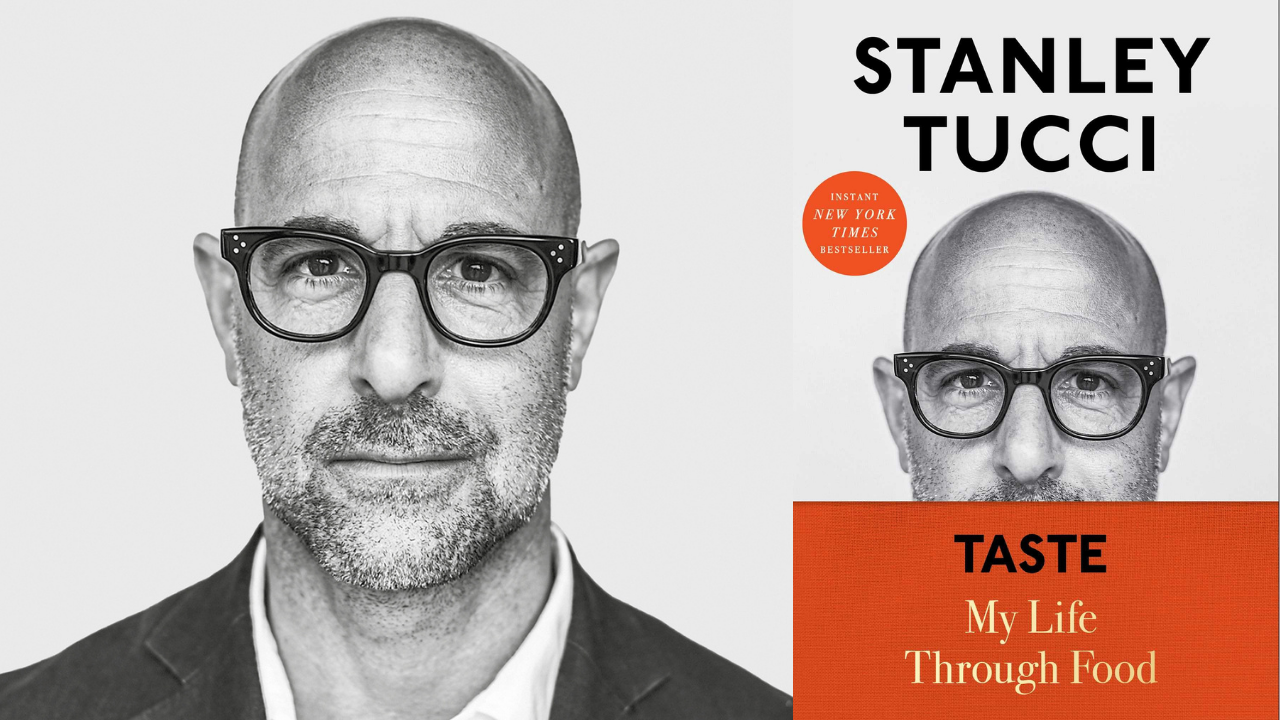
Another beautiful voice, coupled with a love of food and family - this was music to my ears. Stanley Tucci relates his life through important gastronimical touchstones which invoke memories and discoveries as he learns about his culture and his past and relates it all to his present and his career. He has a delightfully sardonic style and a dry humour, which is unusual for Americans, and he tends to steer clear of hyperbole, which is frankly refreshing. Through film narratives, health scares, loss of a sense of taste, and a delight in family and friendships, he shares anecdotes and recipes in a way that has the listener drooling - only partly for the food.
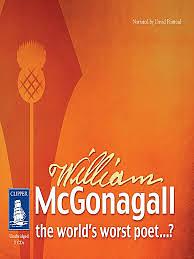
William McGonagall is often lampooned as the world's worst poet. That is a pretty bold claim and I have been insterested as to why he is so called. His poems are bad - they feature endless repetition, deridable rhymes, irrelevant details, poor scansion and weak metre. The mockery existed during his lifetime (1825-1902) and continues today with his work being celebrated with an Ig Nobel award in 2011. (He was also J.K. Rowling's inspiration for the name of her beloved character Minerva McGonagall.) He had no idea of this ridicule and fancied himself as having a calling to write, announcing himself as The Queen's Poet. Despite Queen Victoria refusing him patronage, he walked almost 100 kilmoetres from Dundee over mountainous terrain and through a violent thunderstorm to present himself at Bamoral where he was refused entry and had to return home. He made some money reciting his poems in pubs (the anti-drinking ones were particularly ill-advised), theatres, and the streets. As his reputation grew, his performances were attende by raucous crowds who drowned out his recitations and occasionally forcefully carried him out of venues. He found lucrative work performing his poetry at a local circus where he was pelted with eggs, flour, herrings, potatoes and stale bread. His story has many parallels with that of Florence Foster Jenkins, and one could perhaps feel great discomfort at his treatment (he was very probably on the autism-Apserger's spectrum), were it not for the fact that his self-aggrandising writings are incredibly pompous and dismissive of others. His poems, biography and other works are read by Scottish actor David Rintoul in brilliant fashion. He allows the unintentional humour to shine forth and reveals the terrible poetry in all its magnificent awfulness. It is a thing of unimaginable joy.
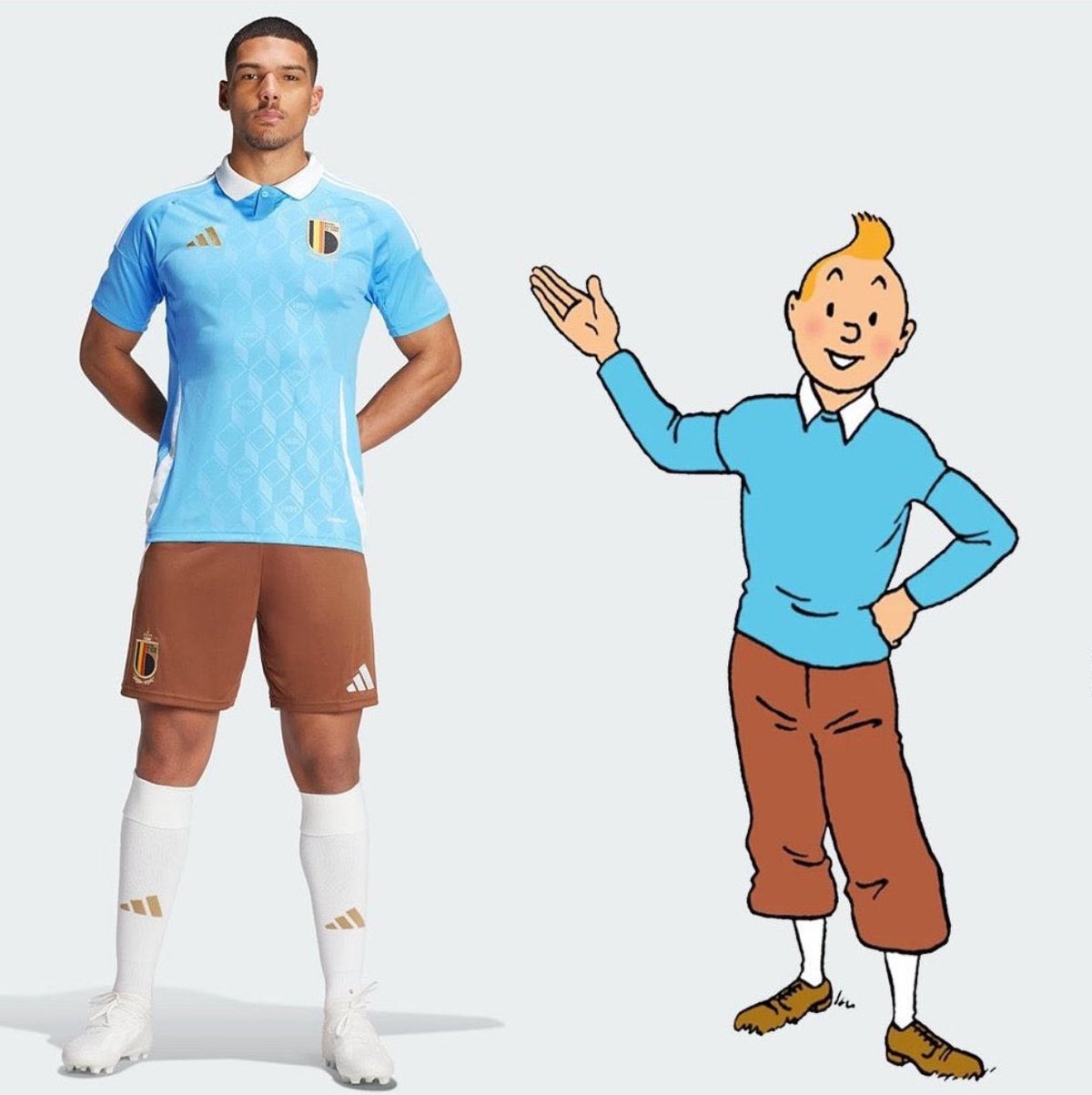
The national Belgian team have announced that their away strip for the World Cup is an homage to Belgian cartoonist, Hergé and the comic character he is most known for: Tintin. The away kit will feature a blue jersey with characteristic white collar, brown shorts, and white socks.
This got me thinking about the children's programmes I used to watch as a child, and wondered if any of them could be appropriate for the English national strip. My favourites were Bagpuss and The Clangers. I also quite liked Zippy from Rainbow, although I wasn't such a fan of Bungle and George. Other contenders that spring to mind are The Pathetic Sharks from Viz, Rupert the Bear and, of course, Noddy.
More recently (or at least since I no longer watch children's TV), we have had Bob the Builder, Danger Mouse, Morph, Pingu, Postman Pat, Shaun the Sheep, and The Teletubbies. So I can picture the likes of Harry Kane paying homage to Noddy, Jordan Pickford with a rubber ring as a Pathetic Shark, or Jude Bellingham and Marcus Rasdhford as Tinky-Winky and Laa-Laa. Which children's characters do you think would inspire a creative and nostalgic England kit?
Here is the latest in the sporadic round-up of TV programs I've been watching. I've got a running list for the past 18 months or so, so here is a list of a few of them over in alphabetical order.
Five TV Shows I've Been Watching:
Beckham (Netflix) - You simply couldn't avoid the hype for this Netflix documentary about the golden couple. As it was aimed at an American audience, I was concerned that it wouldn't cover the actual football, which was the part in which I was interested. David Beckham was a global star because he was attractive, married a Spice Girl, and had an uncanny ability to advertise in all the right places. I knew him as a phenomenal footballer, for whom the category of 'most assists' was invented, who went from a louche kid reviled by the English press for 'losing us the World Cup' to the much-beloved captain of the national team two years later, and who, with his absolutely magical Man Utd. 'class of '92' team of dominated the local pitch when I lived in Manchester. It's all there. The words of wife Victoria, as she deals with his obsessive behaviour and passion (she claims that she still doesn't like football) are an added bonus, giving great depth to the analysis of an icon.
Brassic (ABC iview) - Originally filmed in Bacap, a bunch of friends in a fictional Lancashire town, sort of led by Vincent 'Vinnie' O'Neill (Joe Gilgun - also co-creator), a disturbed young man with bipolar disorder who lives alone in a shack in the woods. His quick-witted confidence, eccentric intensity and great depth of compassion leads to a number of friendships with an odd collective including Dylan (Damian Molony) and Erin (Michelle Keegan). The group commit various petty crimes to get a bit of cash, but many of them begin to wonder if there may be more to life beyond the town. Dominic West has a great cameo role as Vinnie's GP with the worst professional manner you've ever seen. Lucy Mangan of the Guardian wrote, "It is a hilarious, warm, brutal mélange that works because it has heart without sentimentality and authenticity without strain."
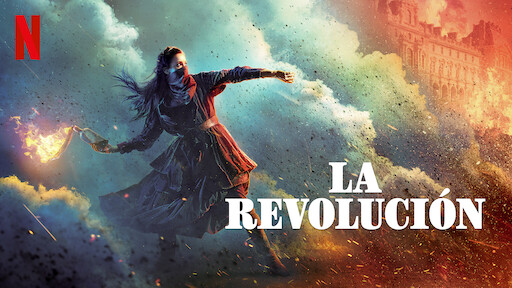
La revolución (Netflix) - It's based around the time just before the French Revolution where the aristocracy have literally got blue blood and have to drink the blood of the peasants to stay alive, thus upsetting the social order. They range from glamorous and conflicted to cruel and twisted. Fortunately, Joseph Ignace Guillotine, discovers the virus and has a potential cure up his sleeve - he just needs to keep his head on his shoulders (other puns are available). Total preposterous nonsense with glorious period costumes and a gothic/ noir style cinematography. I really enjoyed, but Netflix apparently didn't as it was cancelled after one season.
Super Pumped (Stan) - The story of American rideshare start-up company Uber is not pretty. There is rampant capitalism, pursuit of growth at all costs, a vile frat-boy misogynistic culture, and a complete lack of empathy for anyone or anything that gets in the way of making millions. It is narrated by Quentin Tarantino and the part of CEO and slime on a stick, Travis Kalanick, is played to perfection by Joseph Gordon-Levitt. Uma Thurman has a star-turn as the right-wing mentor, which makes a change from the men in polo necks and loafers trope. The whole thing is flashy and entertaining and so crammed full of macho-bullshit that it makes me happy to be a peasant.
The Virtues (Stan) - I really think it's time that Stephen Graham got to play a happy role - one where he isn't an alcoholic with a deeply troubled past who loses his kids because he's an unreliable parent. Meanwhile, he's in this miniseries drama from 2019 co-written and directed by Shane Meadows in which he plays Jospeh, an alcoholic with a deeply troubled past who loses his kids because he's an unreliable parent. It also features Niamh Algar, Helen Behan, Frank Laverty and Niamh Cusack. After a horrifically-well directed drinking binge, Joseph uses the last of his money to return to his estranged sister in Ireland, thereby unearthing traumatic incidents which he has repressed from his memory. The Virtues is a powerful and bruising story that examines the sacrosanctity of the parent/child relationship and the horrific effects that abuse can cause for many years to follow, like the ripples caused by a stone thrown into a stagnant pond.
On a recent trip to Sydney, we went to the World Press Photo Exhibition 2023 at the State Library of New South Wales. The annual exhibition presents the results of the 2023 World Press Photo Contest - the best and most important photojournalism and documentary photography of the last year. The winners were chosen by an independent jury that reviewed more than 60,448 photographs entered by 3,752 photographers.
We all know that bad news sells - few people want to read good news stories - and so it is with the photos in this exhibition. There are harrowing images of war, floods, drought, poverty, incarceration, and ecological disasters, leading to a warning such as the one above, and the one below: the photo of the year.
Mariupol Maternity Hospital Airstrike by Evgeniy Malolekta
Iryna Kalinina (32), an injured pregnant woman, is carried from a maternity hospital that was damaged during a Russian airstrike in Mariupol, Ukraine, on 9 March 2022. Her baby, named Miron (after the word for 'peace') was stillborn, and half an hour later Iryna died as well. An OSCE report concluded the hospital was deliberately targeted by Russia, resulting in three deaths and some 17 injuries. The jury felt the photo depicted an attack on the future of Ukraine. Evgeniy Maloletka photographed the image on assignment for Associated Press.
The port of Mariupol on the Sea of Azov was the first city struck when Russia launched its full-scale invasion of Ukraine on 24 February 2022. Civilians were hit hard.
The strategically important port is one of the largest Russian-0speaking cities in Ukraine, a major industrial hub, and vital for the country's steel exports. The territory was also of symbolic value to invading forces as it represented a large step towards building a land bridge between the self-proclaimed Donetsk People's Republic (DNR) and Crimea, which Russia had illegally annexed in 2014.
Images from The Siege of Mariupol by Evgeniy Maloletka
Top: 06 March 2022 - Zhanna Goma (right) and her neighbours settle in a bomb shelter in Mariupol, Ukraine.
Middle left: 11 March 2022 - Serhiy Kralya, a civilian injured during shelling by Russian forces, rests after surgery at a hospital in Mariupol, Ukraine.
Middle right: 11 March 2022 - Russian army tanks move through a street on the outskirts of Mariupol. The Z marking is one of several symbols painted on Russian military vehicles in the early stages of the invasion.
Bottom left: 04 March 2022 - Marina Yatsko and her boyfriend Olesksandr Kulahin bring her 18-moth son Kirill, fatally wounded during shelling, to a hospital in Mariupol, Ukraine.
Bottom right: 09 March 2022 - People place dead bodies in a mass grave in an old cemetery in Mariupol. According to the BBC, on some days during periods of heavy Russian shelling, up to 150 people a day were buried in mass graves.
By early March, Russian forces had completely surrounded the city, restricting water, power and food supplies. Some 200,000 citizens were trapped in Mariupol, as attempts to evacuate them failed. Russian bombardment devastated the city, and included civilian targets such as a maternity hospital and a theatre where people were sheltering. Evgeniy Maloletka, who is Ukrainian, was one of very few photographers documenting events in Mariupol at that time.
Image from The Siege of Mariupol by Evgeniy Malolekta
On 21 April, President Vladimir Putin announced that Russian forces had taken Mariupol, but the city council said that 1,000 civilians alongside thousands of Ukrainian soldiers were holding out in the giant Azovstal steelworks. By 20 May, the soldiers defending the steelworks had surrendered, and the UN and Red Cross were able to evacuate the citizens. The UN Human Rights Office confirmed 1,348 civilian deaths during the siege of Mariupol, stating that the actual death toll was likely thousands higher: Ukraine says that figure is more than 25,000.
At the time of this exhibition in April 2023, Mariupol remained under Russian occupation. Russia has begun rebuilding the city and scrubbing it of its Ukrainian identity by renaming streets and changing school curriculums.
The exhibition includes a short history of World Press Photo: since 1955, World Press Photo has connected the world to the stories that matter. The non-profit organisation remains committed to press freedom and the power of visual journalism by providing platforms that present accurate, diverse, and trustworthy images.
1955 - A group of Dutch photographers organizes the first World Press Photo contest to introduce their work to a global audience
1967 -Although black-and-white pictures still dominate the submissions, and chromogenic printing remains expensive, the jury awards World Press Photo of the Year to a colour photograph for the first time
1972 - The annual exhibition featuring current winners of the World Press Photo contest begins to tour outside the Netherlands. Since then, the exhibition has travelled to 129 countries
1977 - Francoise Demulder becomes the first woman whose work is awarded World Press Photo of the Year
1990 Charlie Cole's photograph of a demonstrator in front of tanks in Tiananmen Square becomes a symbol of peaceful resistance. To this day, this picture remains banned in China
Tank Man, Tiananmen Square by Charlie Cole
2002 - Fourteen years after creation of the JPEG, digital entries surpass analogue entries for the first time in the history of the contest
2019 - John Moore's photograph of a child from Honduras at the US border, which wins World Press Photo of the Year, leads to the repeal of the 'Zero Tolerance' policy that permitted separating immigrant parents from their children when apprehended
2021- To better represent a plurality of perspectives and global voices, World Press Photo introduces a new regional strategy, changing the set-up of the annual contest, the categories, and the judging
2022 World Press Photo of the Year by Amber Bracken
2022 - With her photograph of a roadside memorial commemorating the deaths of indigenous children who attended the Kamloops Indian Residential School in Canada, Amber Bracken becomes the first person to win World Press Photo of the Year without depicting a human figure
Woman, Life, Freedom
This photo-based video project narrates one chaotic night in the life of an Iranian nurse as she saves the life of a young protestor called Reza. The footage offers a rare glimpse into the dangers faced by protestors on the streets of Iran today, situated in the context of an inciting incident: on 16 September 2022, Mahsa 'Jina' Amini, a 22-year-old Kurdish woman, died after she was arrested by the Islamic Republic's morality police for allegedly violation the country's strict rules restricting the dress and conduct of women. The ensuing protests quickly intensified, spreading across the country. The Islamic Republic responded by disrupting internet access and violently repressing uprisings. Because hospitals are controlled by the regime, anyone injured in the protests risks arrest and further abuse upon seeking medical attention.
Iranian photographer Hossein Fatemi encountered the nurse in the video while providing support to local Iranian photographers covering the protests. Images and video for this project were captured by local photojournalists, the nurse herself, and a photographer on assignment to cover her story. Journalists and photographers attempting to report on the protests face reprisals from the Iranian regime, ranging from intimidation to arrest and violent abuse. Due to these efforts, it is difficult to know what is really happening inside the country. Many of the photographers who captured the images seen here will remain anonymous for security reasons.
Images from The Price of Peace in Afghanistan by Mads Nissen
These two images are from a collection that won World Press Photo Story of the Year, which captures the daily life of people living across Afghanistan in 2022. The top image shows Khalil Ahmad (15), whose parents, unable to afford food for the family, decided to sell his kidney for US$3,500. After the operation, Khalil suffers chronic pain and no longer has the strength for football and cricket. The lack of jobs and the threat of starvation has led to a dramatic increase in the illegal organ trade.
The bottom image shows women and children begging for bread outside a bakery in central Kabul, Afghanistan. Bread is a staple in Afghanistan, but soaring prices have forced more and more people to rely entirely on the compassion of others.
In August 2021, the withdrawal of US and allied forces from Afghanistan marked the end of a 20-year long attempt at nation-building. Taliban forces, having sustained an insurgency across the country, returned to power shortly after the collapse of the Afghan state. Consequently, all international aid, which in 2019 accounted for an estimated 80 percent of the country's expenditures, was halted, and 7 to 9 billion dollars of assets belonging to the Afghan state were frozen. Without these two sources of government income, the already fragile Afghan economy effectively collapsed.
National gross domestic product of Afghanistan dropped to around 25 percent of its peak in early 2021. Estimates for 2022 suggest that 97 percent of the population lives below the poverty line and 95 percent of people do not have enough to eat. Nine million people are at risk of famine and, according to the UN, over a million children are severely malnourished. COVID-19, intense droughts, and the inability of aid organisations to bring relief to those in need have all exacerbated the crisis, which is only expected to worsen in 2023.
The Nomad's Final Journey by Jonathan Fontaine
This highly-commended image shows Samira (16) looking out onto Qolodo camp near Gode in the Somali Region, Ethiopia, on 16 May 2022. Her family owned 45 goats and 10 camels, all of which died during recent droughts.
Nomadic peoples of Ethiopia and Somalia depend on their livestock, migrating across their territory to pasture their animals. In recent years water scarcity has threatened these livestock. Exacerbated by the climate crisis, droughts have devastated the region which, according to the World Food Program, now endanger the food security of over 26 million people. With many families forced to seek aid in climate refugee camps, social structures are weakening, precipitating violence against women and a host of mental health crises.
As droughts persist annually, women, who are often responsible for finding water, bear an enormous share of the physical and mental toll exacted by the ongoing crisis.
The text in the image above reads: This map, generated by RSF (Reporters Sans Frontiers) represents the current state of press freedom in 180 countries and territories. To arrive at the results compiled and visualised here RSF conducted extensive research during the past calendar year. In addition to distributing questionnaires among journalists, RSF also employed a panel of experts who ranked press freedom around the world according to five equally-weighted criteria: political context, legal framework, economic context, sociocultural context and safety. Their rankings are coded by colour, with the highest level of press freedom classified as 'good situation'. As you can see, that's pretty much Scandinavia. And that's it.
Part of Me by Nadia Shira Cohen
Surrogate mothers Vin Win (right) and Ry Ly (left) were arrested during a raid to fight trafficking in 2018. They live near one another and their children from surrogacy, Korng (3, left) and Phavit (4, right) often play together. Vin Win is separated from her husband who resents the situation.
This series portrays Cambodian surrogate mothers who have been required to raise their surrogate children as their own ever since Cambodia began prosecuting surrogacy in 2016.
Surrogacy - the act of carrying and birthing a baby for another person or couple - was accepted in practice in Cambodia until 2016, when the government started prosecuting surrogate mothers under already existing human trafficking laws. In 2018, a raid on a house in Phnom Penh led to the arrest and imprisonment of 32 women who were acting as surrogates to predominantly Chinese parents. Nearly all gave birth in confinement and, after sentencing by the Cambodian Supreme Court, all were obliged to raise the babies themselves or face prison terms.
Many of the women sought surrogacy arrangements with Chinese family planning agencies in order to help their families escape impoverishment and, in some instances, indebtedness from microfinance loans. In recent years, Cambodian households have become some of the most indebted on Earth and a major contributing factor has been the poorly regulated microfinancing sector. The rising burden of financial debt has resulted in an increase in child labour and families forced to sell their homes and land. For many of the women portrayed in this series, surrogacy represented a way out of debt, but now with the court ruling against them, their lives have become more difficult. Despite financial, social, and personal challenges, many of the would-be surrogate mothers have formed a deep bond with their children even as they express sadness that their children will not be able to benefit from the economic advantages that their biological parents could provide.
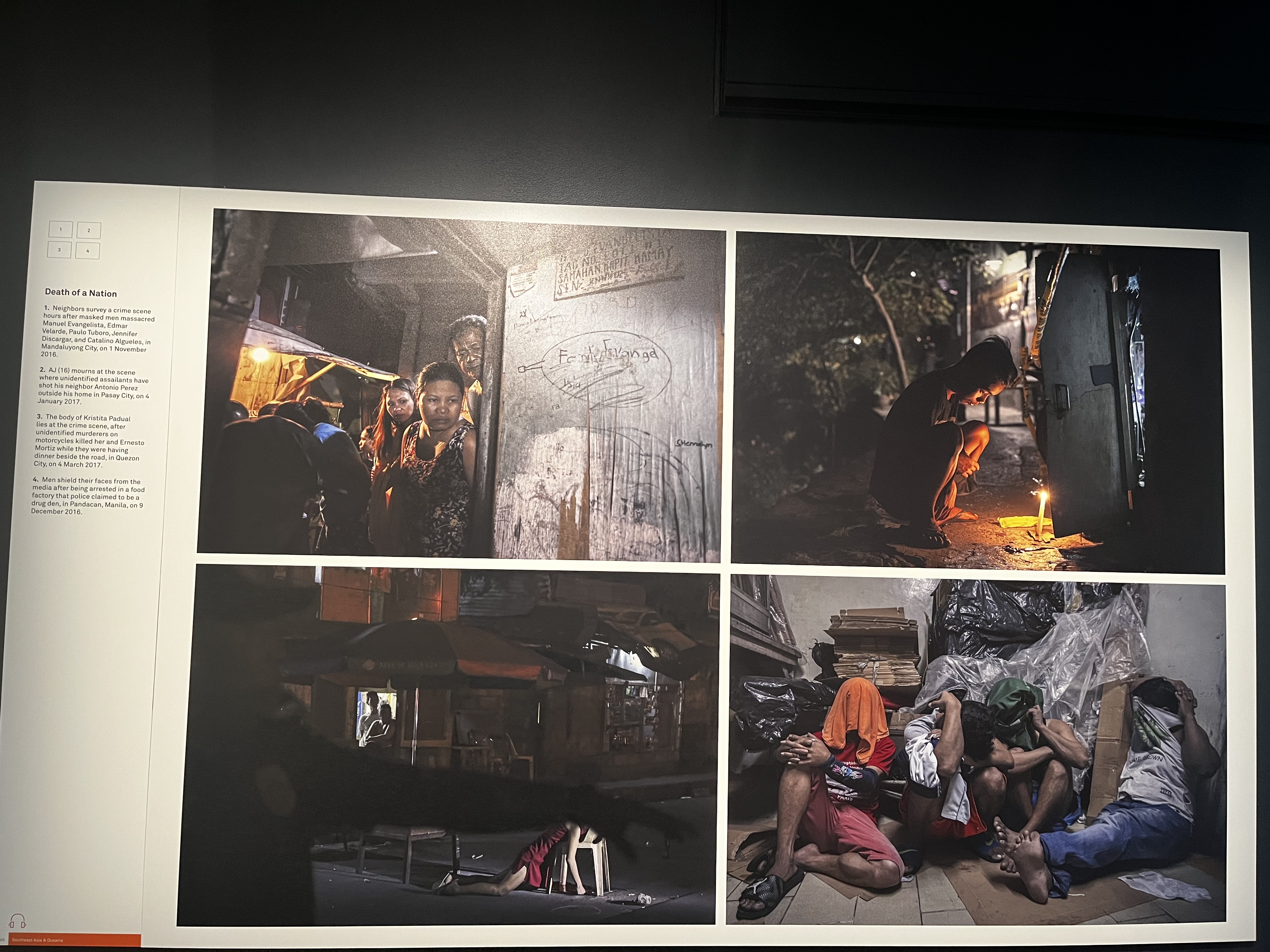
Death of a Nation by Kimberly dela Cruz
Winner of the long-term projects in the Southeast Asia and Oceania category, this project documents the Philippines' drugs offensive from its outset, capturing its broadening focus and the continued impact on families involved. The above photograph shows Jazmine Durana (15) cradling her month-old daughter Hazel on 2 February 2017, at the wake of her partner John 'Toto' Dela Cruz (16), who was shot by men wearing black masks a few days earlier.
Soon after taking office in June 2016, Philippine president Rodrigo Duterte began a concerted 'war on drugs', repeatedly ordering attacks against suspects. A surge of extrajudicial killings followed, perpetrated not only by police but also by masked vigilantes and other civilians. Amnesty International reports that executions mostly target low-income communities. The Philippine National Police admits to more than 6,000 such deaths to date; local human rights organisations put the figure at 30,000. The police appear to act with impunity, with only a handful of these killings being seriously investigated and almost no prosecutions.
Images from Death of a Nation
Top left: November 01, 2016 - Neighbours survey the crime scene hours after masked men massacred Manuel Evangelista, Admar Velarde, Paulo Tuboro, Jennifer Discargar, and Catalino Algueles, in Mandaluyong, the Philippines.
Top Right: 04 January 2017 - AJ (16) mourns at the scene where unidentified assailants have shot his neighbour Antonio Perez outside his home in Pasay City, the Philippines.
Bottom left: March 04, 2017 - the body of Kristita Padual lies at the crime scene, after unidentified murderers killed her and Ernesto Moritz while they were having dinner beside the road, in Quezon City, the Philippines.
Bottom right: December 09, 2016 - Men shield their faces from the media after being arrested in a food factory that the police claimed to be a drug den, in Pandacan, Manila, the Philippines.
According to the United Nations Office on Drugs and Crime, the Philippines has a low prevalence of drug use compared to the global average. Human rights organisations such as the World Organisation Against Torture (OMCT) and Amnesty International say killings often target political opponents, activists or marginalised groups. A Human Rights Watch report found that many of the killings that police attributed to drug gangs to be a veneer to shield themselves from culpability for executions carried out without legal process - an accusation the police refute, claiming self-defense.
Images from Death of a Nation
Top left: 08 September 2019 - Nestor and Alma watch the evening news, in Quezon City, the Philippines. Exactly three years earlier, their son Richard was killed during a police operation - an event that was reported on the news at the time.
Top right: 21 February 2022 - The family of Rovelyn and Richard Cham receive the urns containing their ashes in Tayuman, Manila, the Philippines. Unknown gunmen killed the couple at home in 2016.
Bottom left: 22 November 2019 - Mothers and widows of war-on-drugs victims rehearse for a theatre performance in Tondo, Manilla, the Philippines. Sarah Celiz (centre) lost two of her sons in 2016 and 2017 and was left to care for her 12 grandchildren. The performance was organised by Paghilom (Healing), a program started in 2016 by former drug user Father Flaviano Villanueva for the families of victims of the war on drugs, providing them with support and counseling.
Bottom right: 14 February 2022 - Mary Anne Domingo stands outside a courthouse after giving testimony, in Caloocan, the Philippines. She brought a case against the police after her husband and son were killed in a raid in 2016. The trial commenced in 2021.
In 2020, Fatou Bensouda, then the prosecutor of the International Criminal Court, said there was a 'reasonable basis to believe' that crimes against humanity had been committed in the Philippines in connection with President Duterte's drugs offensive. In July 2022, Duterte's successor President Ferdinand Marcos Jr. announced a refocus of the anti-drug offensive onto rehabilitation, however, killings continue and reforms have not yet been made to rehabilitation programs, according to Human Rights Watch.
The photographer has been documenting the war on drugs since its outset, and the jury commended her ability to capture the continued impact on families involved.
The Dying River by Jonas Kako (winner of the North and Central America, Singles category)
Alfredo, Ubaldo, and Jose tend beehives near Wenden in the Arizona desert, United States. A substantial decrease in rainfall in the area means that the men must now provide water for the bees in troughs. Heat and drought weakens bees, making them more susceptible to pathogens and parasites, and impacts the pants from which they feed. Between 2019 and 2020, colonies of managed honey-bees declined by 43.7% across the US. Bees are vital for pollinating many crops, and so play an important role in food security for humans.
This image is part of a broader project on how the climate crisis and increasing water demand are affecting the Colorado River, which flows nearby. Annual flow in the Colorado River has shrunk 20 percent in the past 30 years, according to a river program manager. The Colorado relies on snow melt from the Rocky Mountains and precipitation in upstream forests that collects in lakes and natural reservoirs. Drought and global heating have accelerated evaporation from reservoirs, and melted snowpack faster, so that rivers run dry earlier in the season. Hot, dry conditions have also parched the soil, which soaks up precipitation before it even reaches the river.
Water diverted for agriculture accounts for up to 80 percent of consumption in the Colorado River Basin, and a series of dams along the course of the river - providing drinking water to more than 40 million people and hydroelectric power to meet the needs of some seven million - further shrinks the flow.
In late 2022, the US government implemented severe restrictions on river-water use in states along the course of the Colorado River, cutting Arizona's annual allocation by 21 percent.
Jury comment: This portrait of beekeepers is visually clean and sparks interest and curiosity to understand the issue at hand. The image is subtle and understated, and the jury was impressed by the composition of bees across all thirds. While the topic resonates at ag global level, the image itself encourages us to sit with these particular people and consider how they might be impacted by the ongoing environmental crisis.
Oil Spill in Lima by Musuk Nolte
On 15 January, nearly 12,000 barrels of crude oil spilled into the sea while a tanker was unloading at Repsol's La Pampilla refinery. Repsol, the Peruvian government, and the Italian tanker company each disputed the cause of the spillage, trading accusations of negligence, inadequacy of equipment, and mismanagement.
The spill extended over 7.13 square kilometres, polluting beaches, killing wildlife, and impacting livelihoods in what the Peruvian government termed the country's worst ecological disaster in recent memory.
The oil reached three marine protected areas: Lomas de Ancon, the Pescadores Islets, and Punta Salina. The plankton-rich Peruvian Pacific waters sustain a chain of marine life, from anchovies to dolphins and seabirds. Marine mammals and birds are especially vulnerable, as the oil affects their eyes, nasal tissue and their insulating capacity, potentially leading to suffocation and hypothermia. Commercial fisheries, people relying on tourism, and local communities dependent on seafood for their diets also suffered. UN experts believe the effects of the spill will last up to ten years.
Alpaqueros by Alessandro Cinque
Vital to the livelihoods of many people in the Peruvian Andes, alpacas face new challenges due to the climate crisis. Part of the camelid family, alpacas can endure the high altitudes of the Andes and are a critical source of income for farmers in an environment where few or no crops can be cultivated. They are primarily bred for their fine fibre (wool) which is highly prized for knitwear and woven cloth. Tens of thousands of Andean families depend on raising alpacas or dealing in their fibre for subsistence. Among local Indigenous communities such as the Quechia, alpacas are also embedded in cultural and ritual life.
The climate crisis is putting alpacas and the communities they sustain at risk. Shorter rainy seasons and more intense, longer periods of drought are shrinking natural pastures and reducing the quality of the grass on which alpacas feed. In addition, meltwater from Peru's glaciers, which supports high meadows during the long dry season, is declining rapidly. Peruvian glaciers retreated by 53 percent between 1962 and 2016.
These challenges threaten not only the alpacas, but the loss of high-Andean cultural identity, as alpaquero (alpaca-farmer) communities are forced to move to even greater altitudes, or to abandon their lifestyles entirely and seek work in low-lying cities. Scientists hope to help address the problem using biotechnology to create alpaca breeds more resistant to extremes in temperature. This would help the animals to survive harsh nights at higher altitudes, as well as thrive at lower elevations, since alpacas also suffer in warmer temperatures, from illnesses not present in highland areas.
It's fair to say that the images and the situations depicted are extremely grim. A brief summary of the Year in Review attempts to explain 'What Happened in 2022?' "Photojournalists working in 2022 brought stories of the war in Ukraine and life under Taliban rule in Afghanistan, of use and abuse of river water in Central Asia and the United States, flooding in Australia, oil spillage in Peru, and people with dementia in Ghana. But a tough judging process and the limitations of how to visualise certain stories means that some major stories discussed by the jury did not make it through to the final selection:
Anti-LGBTQI+ Violence - April 2022, Kenya - Sheila Adhiambo Lumumba, a non-binary lesbian, is found raped murdered in Karatina, Kenya. Human rights organisations call attention to institutionalised homophobia in Kenya and other nations across the continent including Ghana, Nigeria and Uganda.
Uvalde School Shooting - May 2022, Uvalde, Texas, United States - On 24 May and 18-year-old gunman kills 19 children and two teachers at Robb Elementary School in Uvalde, in the deadliest school shooting in the US in a decade.
Abortion Law Overturned - June 2022, United States - The US Supreme Court overturns Roc v Wade, the legislation that made access to an abortion a federal right in the United States. The move leads to nationwide protests.
Sri Lankan President Resigns - July 2022, Sri Lanka - President Gotabaya Rajapaksa flees the country and resigns, after months of protest against the country's economic crisis had culminated in popular occupation of the presidential palace.
Death of Mahsa Amini - September 2022, Iran - The death of Mahsa Amini after being arrested by Iran's 'morality police' for allegedly not wearing the hijab in accordance with regulations sparked some of the largest demonstrations in Iran in years.
Kanjuruhan Stadium Disaster - October 2022, Jawa Timur, Indonesia - More than 130 football fans die in a crush apparently sparked by police firing tear gas as a crowd-control measure, while leaving the Kanjuruhan Stadium after a match, in one of the world's worst stadium disasters.
'Lula' Wins Brazilian Presidential Elections - October/ November 2022, Brazil - Luiz Lula da Silva wins a majority in the Brazilian presidential elections. Former president Jair Bolsonaro does not initially concede defeat, but President Lula da Silva is inaugurates in January 2023.
Ethiopia and TPLF Declare Truce - November 2022, Ethiopia - Ethiopia's federal government and the Tigray People's Liberation Front (TPLF), which controlled much of Tigray province, agree to stop fighting after a two-year conflict that has caused a dire humanitarian crisis.
White Paper Protests - November/ December 2022, China - Protests spread through cities across China, as demonstrators held up blank sheets of paper to oppose on-going government COVID-19 restrictions. In January 2023 China revoked its Zero-COVID policy.
An image from Net-Zero Transition by Simone Tramonte
In the above image (13 July 2021), people swim at Amager Strand, Denmark, near a wind farm which is co-owned by 8,552 electricity consumers, and serves more than 40,000 Copenhagen households. Upwards of 15,000 Danish families are members of similar wind turbine co-operatives.
Winner of the Europe, Long-term projects category, this sequence is a rare positive view of the world around us, which is why I felt the need to include it in this post. The project documents different technologies that offer possible routes of transition to a net-zero economy. The photographer visited innovative facilities across Europe, from Iceland to Italy, from 2020 to 2022.
Human-induced climate change is the largest, most pervasive threat to the natural environment and society that the world has ever experienced, according to the UN Human Rights Office, OHCHR. This prompted the European Union to establish targets to cut greenhouse emissions by at least 55 percent by 2030. European companies seeking ways to achieve these goals are exploring renewable energies, new technologies for food production, and the circular economy as potential ways forward.
Image from the series World Champions by Tomàs Francisco Cuesta
I wanted to finish this on a positive note, which is why I have placed this image last. It is a scene of jubilation as Argentinians revel in their country's return to World Cup dominance, Buenos Aires, Argentina, 18 December 2022. An estimated five million people took to the streets to participate in the parade and join the national team members in one of the greatest public demonstrations in Argentina's history. For striker and star player Lionel Messi the win cements his legacy as one of the greatest footballers of all time. Argentinian photographer Tomàs Francisco Cuesta said about taking these photographs,
"You really just feel good looking at those images, and those are ones that may resonate. It's just the beauty of sports. And it's the beauty of imagery, the beauty of pictures. Soccer in Argentina is so much more than a sport. It's more important than Christmas, more important than the New Years. For many people, it's more important than their jobs. That's why you saw five million people crowding the streets of Buenos Aires. It was the first time that I saw such a union in the streets without any discrimination. People were really united to celebrate and to let the players know that they were supporting them."