The World Cup has kicked off and there is plenty to think about. I will not venture into the tactics of teams or specific match reports in these posts, and I will do my best to stay away from the politics of the Resident Evil. But there is plenty of other chat around the grounds.
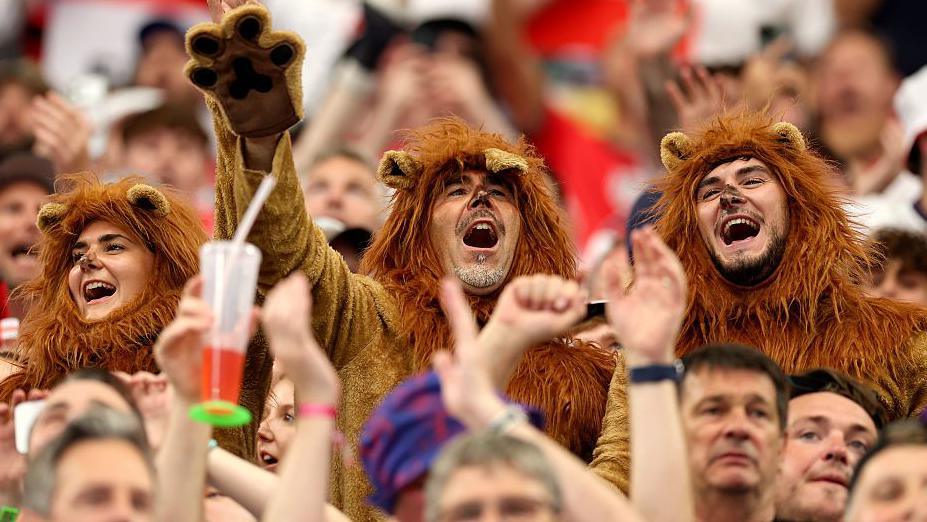 |
| Three lions in the crowd |
- Ad breaks - call them what they are. The totally unnecessary, momentum-killing, three-minute intervals midway through the halves give the Americans what they have always wanted: a game of quarters for their attention-deficit, commercial-forward nation. They were understandable in Qatar (the fact that the World Cup was held there at all is a totally different proposition), but everyone knows they are not really for hydration here. The rest of the world despises them (the breaks; not the nation - we save that contempt for their president), and the fact the crowds at every game are boo-ing them is testament to their unpopularity. Maybe FIFA will take note of this, but probably not.
- National anthems - Scotland win, and I don't mean with Yes, Sir, I Can Boogie. I'm not a great fan of bagpipes, but they certainly make a noise. And I have to concede that when played well, they are a damn sight/ sound better than vuvuzelas. To be fair, those blowing and squeezing out Flower of Scotland in Boston are generally superb. Uruguay are a close second with a jolly, rousing number that makes one want to party. The New Zealand cry-for-help in song is a two-header. Everyone thinks it's finished after the Māori version and then are surprised when the English version kicks in - people might know the words to this bit, but they're bored by the end of it. New Zealand are the lowest ranked team in the tournament, so we're unlikely to hear it too often.
- The refs - Ref cam is fascinating. We can watch the match officials try to keep up with the game while staying out of the way, which doesn't look easy - they have to read the game to know where they expect the ball to go and then be near it but not in its path. The view shows what they see of the action and explains why they sometimes need to refer to VAR because their vision is blocked of a potential infringement. It's early days, but I think they're doing a good job, refusing to be swayed by histrionics and giving free kicks for obvious shirt pulls and trippings.
- Tiny teams - The extended format of this tournament isn't to everyone's liking (I have questions, including why do some group winners play the second-placed finishers in the next round, while others get an apparently easier route against the best-placed losers?) but it does introduce new countries and their fans to the world stage - namely Cape Verde, Curaçao, Jordan and Uzbekistan. Curaçao (a nation with a population the size of Toowoomba) scored their first ever world cup goal against Germany, and one of the biggest talking points of Week One was when Cape Verde kicked off their first ever World Cup campaign with a point from a scoreless draw against fifth-ranked Portugal. And what's not to love about that?
- The crowds - Scotland (again), who have embarked upon a full-frontal love affair with Boston in which they have drunk the city dry, the mayor wants to twin town with Glasgow, and no traffic cones are safe. The colours are a riot - and perhaps fearing this, England fans have been told they cannot hang theirs at stadiums because they might - heaven forbid - cover up the advertising hoardings. See point one about the money-making-morality of this tournament. Apparently images depicting weapons are also not allowed (because we all know how strict Americans are about 'actual' gun control...) so a submarine on a Barrow AFC flag is forbidden entry. The flag of Haiti, however, bristling with six rifles, two axes, two cannons and two piles of cannonballs, is absolutely fine. If you haven't got a flag to wave, you can always hold a baby aloft. We only a week into this tournament and it appears that babies are the new must-have accessory as many folk seem to be thrusting at the cameras for air-time. No, sir/madam, I have no interest in your spawn; I would far rather watch the Norwegian team sitting down on the pitch to celebrate their victory by joining the fans in a Viking row.

The Museum of London had been recommended to me by my super-in-law, so I took a tube there one day while in the city.
As the Olympics have been held in London three times, and everyone has caught the fever, there was an exhibition in the foyer on the subject. This one hopes to be the most sustainable games to date – for example, the top ring of the Olympic stadium is made from surplus gas pipes.
I skipped through exhibitions about London before London and Roman London (not literally skipped, you understand, that would be weird). The city was burned in AD60 by Boudicca and was then rebuilt and expanded. By AD100 it replaced Colchester as the capital of Britannia. Glass cases contained bones and pottery, models of amphitheatres, stone sculpture tools, coins and horseshoes, but I was being selective, and pressed on.
I was intrigued by the remaining part of the London Wall, however. The first fort was built in AD120 for the soldiers in Londinium. There were remaining mosaics from AD 200 when these walls were strengthened and incorporated into a city wall to protect London. In AD410 the Romans abandoned London; the city declined as it was empty for nearly 400 years and the wall began to collapse.
The Saxons moved in (in AD886), repaired the walls, and added towers for extra protection against Viking attack. They built houses right up against the wall, but they were destroyed in the Great Fire of London (1666). In the nineteenth century, warehouses and shops again abutted the wall. World War II bombing caused extensive damage to both the wall and the buildings, and when archaeologists dug up the ruins, they found sections of the original wall, one of which is displayed here, looking secretive in the summer sunshine. I love how the stones are steeped in history.
Real children were playing in a reconstructed house in the Medieval Britain section. Here the displays feature weapons, keys, chain mail, pottery, preserved doors and altarpieces, rings, paintings, books, manuscripts (bibles and primers from the 1400s) and illustrated letters. There’s a collection of London Delftware pottery, and the Cheapside Hoard, a treasure of Elizabethan and Jacobean jewels discovered in 1912 under the cellar floor of a seventeenth century house in Cheapside.
Again, I raced through this bit, but was morbidly interested by the display on the Plague, Black Death and Pestilence caused by the stink and filth of the city. The ‘War Plague and Fire’ section also interested me as it has a model of the Rose Theatre from 1587 and the three copper plates of the 1559 Copper Plate Map – fifteen plates made up a map of London, and only these three survive, although there is no contemporary printed map.
Oliver Cromwell’s death mask is also on display here. He is claimed to have said, in a 1656 interview, “I am as much for a government by consent as any man; but where shall we find that consent?”
London was teeming – furniture, models of 1660s timber houses, and pictures of the Great Fire illustrate this state. Donald Lupton wrote in London and the Countrey (1632), “London is the great beehive of Christendom... she swarms with people of all ages, natures, sexes, callings... she seems to be a glutton, for she desires always to be full.”
One-fifth of the population died in 1665 due to the Great Plague. In an effort to ward it off, people wore bunches of herbs; lavender, cloves, and pommo d’ambre (a mixture of whale vomit, animal scents and flowers – thought to be efficacious). And then came the Great Fire.
London booksellers stored all their books and papers in the crypt of St Paul’s Cathedral for safety, but it was covered in wooden scaffolding which caught fire, the lead in the roof melted, the cathedral burned down, and everything was destroyed. Fortunately London Bridge had a gap between shops in it (from a previous fire), which prevented the fire from spreading to Southwark, and causing further loss of life.
The gaolers took pity on the debtors in prison at Newgate, and released them to fend for themselves. People pulled down houses and Charles II himself helped with throwing water on the conflagration which raged for five days, destroying 13,000 homes – the King arranged for bread to be delivered each day to feed the many homeless.


