Showing posts with label World Cup. Show all posts

Saturday, 4 July 2026

Friday Five (on a Saturday): World Cup Wonderings Week Three

Herewith, the latest instalment:


  1. The stars are out to play. Mbappe and Haaland may be taking over from Messi and Rondaldo as the newer generation of super strikers. Goals galore are also expected from the likes of Kai Havertz and Vinicius Junior, while I am quietly keeping an eye on Harry Kane and Jude Bellingham. it was also noted that Mo Salah scored his first World Cup goal helping Egypt to win their first World Cup match (3-1 v NZ). How have they not done this before now? They are now in the round of 32: let's hope their successful run continues.
  2. Meanwhile, other so-called celebrities are less illuminating. Those from the realm of music and film are recognisable: Mick Jagger; Matt Damon; Penelope Cruz; Javier Bardem; Tom Cruise; Billy Bob Thornton; Rob Lowe; Owen Wilson; Sofia Vergara; Alanis Morisette; Ryan Reynolds, to name but several. There are also plenty of former footballers out and about, notably David Beckham, Roberto Carlos, Ronaldo, Alexia Putellas, Zinedine Zidane, and Luis Suarez. The VIP lounges are full of champagne and prawn sandwiches, but the English commentators hilariously fail to recognise any 'stars' of American sports. The cameras pan to the supposed superstar who has no interest in the match and is purely there to be seen and dead air ensues while the commentator is clearly being told who that might be, before they announce it is of course some legend from letters (NFL; NBA; MLB). Until last week I had never heard of Patrick Mahomes, Marshawn Lynch, Jalen Brunson, Dirk Nowitzki, or Aaron Judge, I'm pretty sure many of the UK commentators hadn't either. Welcome to Corporate America.
  3. Staying with transatlantic travesties, what are they trying to do to our language? When did transition become a footballing term? I know what it means, as a team tries to play out from the back through the midfield towards the opposition goal, but of course Americans need a new way to explain moving from DEEfence to OFFfence. While we're here, it is nil not zero, pitch not field, shirt not jersey, clean sheet not shut out, boots not cleats, manager not coach; striker not forward; squad not roster, and definitely club not franchise. Franchises have no place in sport. And teams are plural. You may be You Ess Eh? But We Are England.
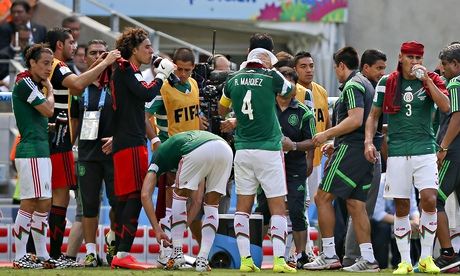
  4. On the subject of FIFA faffing, it never rains but it pours. We are now all aware of the sporting rain and weather protocols: we learned that U.S. sporting protocol requires a mandatory wait time of thirty minutes after the last observed lightning strike or thunder before play can resume. Every time a new lightning strike occurs within the designated danger radius (typically 8 miles or 13 km), the 30-minute countdown clock resets completely. So, after the start of the Mexico v Ecuador game was delayed by an hour, we were all expecting that there would be no hydration break, especially because FIFA announced that there wouldn't be. However, as the temperatures plummeted to 14 degrees, everyone was adequately cool and refreshed, and the momentum of the match was cracking along exceptionally energetically, Fox must have called FIFA and reminded them of the money they were making through the ads, and so we were 'treated' to one after all. What an absolute shower.
  5. The super-subs: Over 20% of goals scored have been by substitutes, and many of these within mere moments of the sub coming off the bench. There are plenty of reasons for this, namely, it's only the second World Cup that has allowed teams to make five substitutions, and also, the fatigue of the existing players means the fresh legs are particularly valuable. It's hot, it's humid, some stadiums are at altitude, and this combination of factors causes players' performances to drop off towards the end of the match. It makes thing interesting if nothing else. Mattias Svanberg scored in the 84th minute for Sweden in their 5-1 victory over Tunisia, 18 seconds after stepping onto the pitch and with his very first touch in a set piece. Romelu Lukaku made a near-instant impact for Belgium in the 66th minute against Egypt. A mere 22 seconds after his introduction, his powerful run forced an Egyptian defender to turn the ball into his own net, rescuing a 1–1 draw. Coming on as a late tactical change in the 90+5 minute against Algeria, the Austrian Saša Kalajdžić met a crossed ball with his first touch to power home an equalizer just 61 seconds later. The dramatic finish meant that Iran were knocked out of the tournament as a 3rd place getter with insufficient points. When Switzerland played Bosnia and Herzegovina in their group-stage match, four of the five goals were scored by subs. As always, fans are often disappointed when their favourites are subbed off, but when it works, the manager is considered a tactical genius. Conversely, Australian manager Tony Popovic subbed on experienced captain, Matthew Ryan in the 119th minute of extra time to replace starting goalkeeper Patrick Beach for the penalty shootout against Egypt. The high-stakes strategic gamble ultimately backfired, as Ryan was unable to save any of Egypt's four penalties, resulting in elimination for the Socceroos in the round of 32.

Friday, 26 June 2026

Friday Five: World Cup Wonderings Week Two


Carrying on where we left off last week - I've not actually left off at all to be honest - here are some more musings from the highest echelons of the beautiful game.
  1. The individuals - Yes, it's a team game. But the golden boot competition is for single strikers, and it's alive and kicking. Of course we have to mention Lionel Messi. At 39 years old he is leading the race, scoring a hat-trick in Argentina's opener against Algeria. He went on to bag a brace against Austria, leaving his team top of their group and breaking a whole heap of records in the process, some of the most eye-catching being: the most goals scored at a men's World Cup; the oldest player to score a hat trick in World Cup History; the most World Cup matches played by a single player. It seems it is almost impossible to chat about Messi without bringing up Cristiano Ronaldo - the two have been pushing each other (in the media's headlines if not their own minds) for as long as they've been playing. Ronaldo also knocked in a couple in Portugal's second game making him equal with Messi in scoring at six different World Cups. He's two years older than Messi so has got the better of him on that front. A quick Google comparison indicates that Messi is the leader in many statistics, "most notably leading in goals, assists, total goal contributions, and by winning the World Cup trophy in 2022." While that last statistic may be the one that counts the most, what really interests me is that Messi has four times the number of assists and more than double the 'goal contributions'. One of these players knows it is not all about them.
  2. The defenders - as a former right back, one of the things that annoys me a bit about the media and the punditry is the focus on the attackers. A goalless draw can be fascinating if one appreciates the art of a good block or an off-the-line-clearance. I know there is also a golden glove contest for the keepers, but most of the time folk bemoan the lack of goals as if they're the only consideration. It's like watching cricket and ignoring the bowlers' skill, claiming a match is only interesting if there are lots of runs, without acknowledging the wickets taken. True, a lot of the challenges are tough and it's not always pretty, but it is crucial. Unfortunately, we saw the worst of it when the tackle from Qatar's Assim Madibo resulted in a broken leg for Canada's Ismael Kone, and a red card and five-match ban for the guilty midfielder. However, I maintain that if France win the World Cup (and they are my favourites to do so), it will be largely due to their impeccable defence.
  3. The managers - There's always a bit of debate about who controls the team - the manager, the captain, the talisman player, the bloke who's good for the dressing room (which appears to be the reason Jordan Henderson is in the England squad), or the media darling (see Cristiano Ronaldo). Tunisia thought the manager had pre-eminence and sacked Sabri Lamouchi after their first-round 5-1 defeat by Sweden. It didn't do them much good, however, as they finished bottom of their group with no points and a goal difference of -10. They have form at this, having previously sacked their manager, Henryk Kasperczak, two games into the World Cup in 1998, from whence they proceeded to also finish last in their group. Meanwhile Didier Deschamps will miss the largely exhibition match between France and Norway as he flies home for his mother's funeral. The team will show their support and undoubtedly play their finest football in respect. And the manager of Ecuador, Sebastian Beccacece, acts as if his country's victory against Germany is all due to him as he prances up and down the touchline, hugging his entourage in the crowd, tennis-style, and drawing all attention to his antics before finally congratulating his players, basically carrying on like a pork chop, as they say in these parts. 
  4. The new rules - FIFA enjoys faffing about with the rules of the game just before big tournaments (silver goal, anyone?). The changes are usually introduced to make things more 'exciting', to give more impetus to the attackers and to speed up the run of play. This time round the new rules largely relate to time wasting and affect tardy throw-ins, substitutions and VAR decisions over off-sides and corner kicks. As mentioned in the previous post, the referees are being relatively consistent and, despite the three red cards in the first game of the tournament (Mexico v South Africa), are letting the games flow. One new rule which has has immediate dramatic results, however, is the one about covering the mouth in a confrontational situation. In a Champion's League game, a Benfica player was accused of making discriminatory remarks to Real Madrid’s Vinícius Júnior, but because he covered his mouth, lip-readers (who are employed for exactly this sort of thing) could not verify the accusation and so it went unpunished. Paraguay’s Miguel Almirón was the first to fall foul of this new regulation as he was sent off in his team's group match against Türkiye. We may not know what he said, but he knows he shouldn't have said it, and he definitely shouldn't have tried to hide it. He can't say he wasn't warned.
  5. The commentators - Most of them are knowledgeable and informative, guiding the viewer through the games with helpful understanding. Andy Townsend is, of course, my favourite and has been ever since I met him at a book signing in 1994, and Peter Drury is particularly solid with his mix of enthusiasm and expertise. And then we have the Americans. Brad Friedel has experience despite a complete lack of apparent personality, but he is infinitely preferrable to John Easton who blurts out bullsh*t at an incredible rate. The epitome of someone who has never been told that if he hasn't got anything interesting to say, he should remain quiet, he barely listens to his fellow commentators, and just repeats what they might have said more loudly and more crassly. It was actually a relief when someone killed the sound during the Netherlands v Sweden match so we could concentrate on the football rather than the banal yahooing. At least we are spared the Fox fiasco, in which Alexi Lalas has apparently managed to ghast the flabber of even the most insouciant Henry with his verbose vapidity. It is painfully embarrassing to all in the studio and at home what a glaring division there is between the 'soccer' sycophants and the rest of the world.

Thursday, 10 July 2014

2014 World Cup: Today's Talking Point - The Pain of Penalties


Penalties are like democracy, which, in the words of Winston Churchill, 'is the worst form of government, except for all the others.' For the neutral, they provide thrilling entertainment, for the team that wins, they are wonderful; for the team that doesn't they are crushing. And either way, you have to live with the result.

But what is the alternative? Knock-out games need a result. You could make the teams play on and on and on, adding further periods of extra time by the half hour until there is a result. This gives the opposition time to reply and sets a fair expectation - as in those interminable tie-breaks in tennis. You could go for the 'golden goal' option (this used to be called 'sudden death' but the term was deemed to have 'negative connotations' and removed from use in 1993) as FIFA have sometimes done.

This was basically a 'next goal wins' scenario whereby if the match was drawn at the end of normal time, there were two extra halves of 15 minutes played each way and if a goal was scored in this time then the game was won instantly. If not, the match then proceeded to penalties. Detractors complained that this led teams to play defensively (as if this were a bad thing) focusing on not conceding a goal rather than scoring one. 

Then there was the 'silver goal' introduced in 2002, whereby if a team scored in extra time, that half was concluded and the game was not stopped automatically, but if the goal had come in the first half, then the second half wasn't played. Furthermore, it was up to each tournament to decide which rules they were going to implement. Confusing? Yes, well that might well be why FIFA resorted to penalties.


Some say penalties are a lottery. Not really. If you are going into a tournament that may be decided on penalties (and a fifth of all World Cup knock-out matches since 1974 have been decided on penalties), then you practice taking them, and the side that performs best at penalties wins. This is proven by empirical evidence. 

England have been involved in three penalty shoot-outs at the World Cup; they have lost all of them. After their shoot-out defeat (by Argentina) in 1998, manager Glenn Hoddle admitted that his squad had not practiced taking penalties. Prior to the 2014 World Cup, England had lost more penalty shoot-outs than any other nation. Incidentally the teams that have won most penalty shoot-outs in the World Cup are Argentina and Germany. Bring on the final.

Wednesday, 9 July 2014

World Cup 2014: Today's Talking Point - The Case for the Defence


What else could we possibly talk about other than that defeat? Hosts Brazil, who haven't lost a home game since 1975, let in seven goals; five in nineteen minutes in the first half. The final score of 7-1 to Germany could have been greater. And every non-partisan supporter cheered for football.

The Brazilian team has been appalling in this World Cup. Their football has let them down; they have relied too much on Neymar and have left gaping holes in defence, as Germany exploited to their delight and Brazil's bemusement.

Brazil aren't the only ones; the defending at this World Cup hasn't exactly been spectacular. All the focus in the early stages was on Neymar, Suarez, Ronaldo, Messi, van Persie, Robben, and even Rooney, but no one bothered about what was going on (or not) at the back. The games in the group stages were largely goal-fests, which may have entertained the masses, but it didn't bode well for the future of football. It was clear that the teams that were going to succeed in this World Cup would be any one which paid equal attention to both ends of the pitch: bringing a fresh interpretation to the cliche, 'a game of two halves'.


But it was more than that. The tricks, flicks and flairs of traditional Brazilian football were infrequent in this tournament. Crowds have been turned off as the boys from Brazil have hacked, fouled, shoved, barged and kicked their way through to the semi-final. The fact that they have appeared to win more than their fair share of referee's calls has also looked ugly. It has been far from aesthetically pleasing, and football fans are unimpressed. And so there are very few regrets as the Germans go marching on. So long, samba; the party's over.


Tuesday, 1 July 2014

World Cup 2014: Today's Talking Point - The Heat!


It's hot in Manaus. And Fortaleza. And many (but not all) other Brazilian cities where World Cup games are being played. It's humid too, with 80% humidity recorded at the Italy v England game, creating extremely unpleasant conditions. Especially if you're not used to them. 

Of course, these footballers are professional athletes and most of the European teams have an entourage of fitness experts to help them to acclimatise. Apparently the Italian squad prepared by running on treadmills in the sauna, and the English 'wore extra layers', which admittedly isn't particularly high-tech and something my Dad used to recommend when we ran out of heating.

It's no surprise then, that the teams who have had their group stage matches in the hotter and more humid locations have suffered unduly high incidents of heat-related ailments from heat exhaustion to cramp and dehydration, all of which take time from which to recover. Predictions were that the European teams who played here would particularly struggle, and this proved to be the case. Italian midfielder Claudio Marchisio claimed he had been hallucinating during his team's clash with England in Manaus.

It was also outrageously hot at USA 94, when FIFA banned water breaks despite the temperatures soaring to 46 degrees Celsius. John Aldridge had a famous meltdown on the touch-line as players were refused refreshments during the game between Mexico and Ireland. Since then the rules have changed, and FIFA now allows water breaks 'if health professionals deem conditions to be dangerous'.


These breaks are not mandatory, but a Brazilian judge has ruled that the referee must give a water break if any game is played in a temperature above 32 degrees Celsius in the Wet Bulb Globe Temperature index, which takes conditions such as wind speed (or chill), cloud cover, humidity, and UV radiation into account.

To switch sports for a moment, nearly every year there is controversy at the Australian Open as tennis players in Melbourne struggle with blistering heat. In 1998 an Extreme Heat Policy was introduced, with measures such as the ability to close roofs, longer breaks between games and sets, and the possible suspension of matches. In 2007 on-court temperatures reached 50 degrees, and this year not only the players were affected; a ball boy fainted and more than a thousand spectators were treated for heat exhaustion.

So why is this controversial you ask? Because some people say they should just get on with it. Their argument goes that these people are paid (and paid phenomenally well) to entertain us. The conditions are the same for everyone, so no-one has an advantage. 


My refutation is partly that the audience or spectators are denied the peak performance of these athletes, because no-one can achieve physical excellence in such heat. Also, basic humanity should stop you from wanting to torture people by forcing them into oven-like situations. They are sports-folk, not gladiators. Surely we don't want to watch them harm themselves? That's not sport; it's sadism.

Thankfully common sense has prevailed, with the introduction of three-minute cooling breaks used for the first time in the game between Mexico and The Netherlands. And officials have clearly realised that it is absolutely ridiculous to host games in places where it is too hot for comfort. Oh, wait... did someone say Qatar?


Monday, 30 June 2014

World Cup 2014: Today's Talking Point - Changing of the Guard?


The beautiful game is often referred to as the world game; it is played in and by more countries than any other sport. For all of it's global appeal, however, it has historically been dominated by teams from Europe and South America. Since the first World Cup in 1930, the winners have come from Europe ten times and South America nine times. (There were no World Cups in 1942 or 1946 due to WWII.)

Now it seems the old guard may be giving way. As in 2010, only six European teams made it through to the knock-out stages. Obviously I was disappointed (but not surprised) by England's premature exit, although one could argue they were in good company with Spain, Portugal and Italy all booking early flights home. By contrast, Central American and African nations are performing well and adding extra excitement to the tournament. 

And what about the U.S.A.? No one really expects them to progress much further; even if they beat Belgium (which is not outside the realms of possibility), they will probably be facing Argentina, which may be too high a hurdle to overcome. But how exciting to see them get this far. Their TV viewing figures suggest their football team is the most-watched national side the country has ever produced. This is great news for football (America and Australia are the only two countries in the world that don't call it football) and encouraging for the good of the American public.

It is also amusing to note the vitriol of certain neo-Conservative American columnists trying their best to deride football as dull, unskillful or noncompetitive. I'm not actually sure what they are watching. I would post a link, but I don't want to give them any more publicity. Suffice to say these are people who think being called a socialist is an insult.


Friday, 11 February 2011

What Achievement!/?


Depending on your point of view, the punctuation after that headline is an exclamation or a question mark. The All Whites (New Zealand's football team, because they have to give everything nicknames here) won this country's highest sporting/ popularity vote at the Halberg Awards.

Their coach, Ricki Herbert won coach of the year for getting his team to the World Cup and ensuring that they didn't lose a game. They achieved more than New Zealand has ever done before in this global competition, contested by almost 200 countries (ten times more than play rugby world-wide). They had previously never got a point at the World Cup.

However, neither did they win a game - and therein lies the problem. There has been controversy stirred up by the awarding of the team of the year accolade to a team that didn't win anything. One of the members of the judging panel has resigned in protest - he is a rugby supporter. The All Blacks were also nominated (they have won all but one test this year) Hamish Bond and Eric Murray were finalists in the team award (they won gold at the world rowing championships) as were the Kiwis (the Rugby league team who beat Australia in the final of the four nations) and the Silver Ferns (gold medal in netball at the Commonwealth Games).

Many of the comments on news and sporting blogs have become quite snide and spiteful, such as the following sample:

"The All Whites shouldn't have even been there. Giving them the team award is an insult to all the sports men and women who actually won something - not get knocked out of the first round of a multi-round competition."

"I don't know how a team that didn't win anything can scoop the awards."

"Congratulations New Zealand for rewarding mediocrity, Way to show the youth of today that participation is the key."

It all begs the question - what are the criteria? If it means winning above all else, then no, the All Whites didn't do that. If it means achieving more than your country has ever achieved, then yes, they did. Incidentally, Julian Dean would have been my sportsman of the year - he completed every one of the UCI World Tour events, a phenomenal achievement which no New Zealander has ever done before.

If it means capturing the attention of the nation and bringing the sport to national recognition, then they have certainly done that. Football is the most popular (both player and spectator) sport in the world and New Zealand's fastest-growing sport. Apparently winning is not explicitly mentioned in the voting criteria, whereas showing 'sporting excellence on a world stage against high-quality opposition' is.
 
The decision was reported in USA Today - "Rugby-mad New Zealand has awarded its highest sporting honor to its national football team which was unbeaten at last year's World Cup in South Africa." It's a big talking point it seems. Don't hold your breath, but they might even stop calling it soccer. So, what are your thoughts?

Wednesday, 14 July 2010

End of the World (Cup) as we know it


So the World Cup is over for another year. I will miss it. I won’t miss the vuvuzelas, but I will miss the World Cup. Football begins again soon, though – Liverpool’s first real game is in less than a fortnight as they kick off their Europa campaign.

People have said that the World Cup wasn’t very exciting this year. That is because they are rugby supporters. This year seemed to be all about defence, and I used to play right back, so I am happy enough with that. It was all very well to display your silky skills up front, but if you were leaking goals at the back then you weren’t going to get through to the next round.

Spain may not have scored the most goals, but they conceded the fewest and that’s why they lifted that amazing 18 carat gold trophy. New Zealand have the distinction of being the only unbeaten side in the 2010 World Cup – that will be a pub quiz question for many years to come, in this country at least.

The media here is paranoid that football is edging out rugby in the popularity stakes. Actually, they call it ‘soccer’ (although the New Zealand Football association officially calls it football, along with every other country, apart from America), and refuse to give it the correct status as the beautiful game; more watched globally than any other sport.

The media make a lot of money out of rugby, so they don’t want to admit that more people are interested in football. New Zealand are top of the IRB World Rankings – there are apparently 95 countries that play rugby, approximately 20 of them competitively (Namibia and Romania are included in the top 20). 207 countries play football – a quarter of the way down that list we find New Zealand at 54, after gaining 24 places from their strong World Cup performance.

Glamour attaches itself to the All Blacks – there is a myth in this country that real men are hard and stoic (think monosyllabic and unresponsive – like your stereotypical Yorkshireman). They are afraid of emotion as it might demonstrate weakness (i.e. personality), so despise the fact that footballers hug each other in delight after scoring. A true New Zealander merely does a war dance and sticks his tongue out at the opposition – much more mature.

More children play football – just look at the sports fields of any city in the country on any weekend, but then they are lured away to the oval ball. Just in case this might not happen, they are reminded that they must worship the scrum. When the FIFA World Cup was on the television and graced the front cover of the SKY magazine – it is after all the most watched event in the world – the Kiwi press wrapped a picture of an All Black around it. They weren’t even playing any games that month. Running scared? I’d say so.

Sunday, 4 July 2010

Semi-Final speculation

Reports of the demise of European football have been somewhat previous. We heard so much about the dominance of South American football, and yet there are three European teams in the quarter-finals. Sure; the superstars have fallen by the wayside – Anelka; Cannavaro; Rooney; Ronaldo etc. – but the team-play rather than silky skills are rising to the top, and that is exactly what I like to see.
First up – Brazil v The Netherlands; the one everyone expected the world champions to win, including the world champions themselves. Expectation is a terrible thing – ask England – and the Netherlands quietly went about the business of puncturing Brazil’s illusions. Having scored a goal from an error (Felipe Melo was credited with the own goal), the Netherlands defended well and even managed to score again.

I heard the expression ‘Kuyt to the rescue’ and mention of his impressive work rate on several occasions. Just as Ferdinand might as well be christened ‘Given-away-by’, I seriously began to think that Kuyt’s sobriquet is ‘Unselfish-play-by’. Is there a prize for the most assists? If so, he should definitely be awarded it – perhaps it could be called the golden sock.

Melo’s game went from bad to worse when he was sent off for a dirty foul, stamping on the hamstring of Arjen Robben that could have ended his career. Actually, everyone in a blue shirt had a pop at Robben who spent most of the match flying through the air or rolling on the ground. The match became increasingly ill-tempered towards the end as Brazil were no longer the impressive exponents of the beautiful game and cards flew for deliberate hand-balls and simulation – forty fouls were given in all and Brazil showed more Gallic than Latin temperament problems; I can’t see Germany doing that.

The commentator quipped, “If Brazil are going out of the World Cup they are going out with a fight – quite literally.” He also referred to the Dutch defence as resembling “an orange jelly, just wobbling there – no wonder they’re nervous.” He must have so much fun thinking these things up...

I watched the Ghana v Uruguay game propped up in bed with a couple of female friends in a hotel room; there was honestly nothing dodgy about this (although the discussion about how nice the Ghanaians looked in their red and yellow strip against the bright green turf was a little iffy).

There was everything dodgy about Luis Suarez hand-balling Dominic Adiyiah’s definitely goal-bound extra-time shot off the line. He was given a red card and sent off. Ghana were awarded a penalty as the last action of the game – Asamoah Gyan should have scored and Ghana should have been in the semi-finals. He hit the cross-bar and they’re not.

The match went to penalties, the first of which Gyan took and scored with commendable coolness. Mensah and Adiyiah couldn’t convert their penalties – only one Uruguayan missed, and it’s all over for Africa. Penalty shoot-outs are a lottery: exciting when your team isn’t involved; sickening when they are. One of my friends was demanding, “Why can’t the ref just give a goal?” It’s a fair enough question, and I’m sure she’s not the only one asking, but them’s the rules and although there will a call for them to be changed in future, for now Uruguay are justifiably into the final four.


Asamoah Gyan was understandably distraught. So, slightly less understandably, were my tender-hearted maternal friends. “He’s not your son” I pointed out. “Yes, but he’s some poor mother’s son” one of them snuffled, somewhat illogically. I have seen this happen to England before and wasn’t going to waste my tears on other countries’ sons.

Speaking of cheating hand-of-God South American nations, I thought I might have split loyalties when it came to Argentina v Germany; who do I dislike least? After all; we’ve fought wars against both these countries (okay, so it might be hard to find a country that Britain hasn’t found itself in conflict with over the centuries). As it happened, all it took was one look at the puffed-up pigeon-chested Maradona to make up my mind and have me screaming at the TV, “Come on Germany!”

And they are a good young side with decisive passes and innovative play – of course, the word ‘clinical’ is never far from any description of the Fatherland, and it was a definitive demonstration of what to do with that unpredictable beach ball – split the defence and put it in the back of the net – but it was sublime to watch.

I like Lionel Messi and I like Javier Mascherano; in them I think Argentina has the best striker and defensive midfielder in the world, but as we have seen; this isn’t a tournament for individuals; it is a exhibition of cooperation and the Germans worked together as a tight unit, yes, alright, even an efficient one. There was added satisfaction in the fact that we put two goals past them and Argentina couldn’t even manage one. England don’t look quite so woeful in that light.

And then there’s Spain... People have been calling them under-performers, but they are through to the semi-final after grinding out a 1- 0 victory against Paraguay. The game had end-to-end missed penalties, disallowed goals, retaken penalties, unawarded penalties, squandered free kicks and one of the tightest mid-field contests seen so far in this tournament. Spain may not have set the footballing world alight, but you don’t have to play pretty football to win.

The only bet I have that is still vaguely alive is for Torres to pick up the golden boot. It doesn’t look like it’s going to happen, but he could always prove me wrong by bagging a swag of goals against Germany and progressing through to trounce the Dutch (assuming, as I do, that they beat Uruguay) with yet more bulging of the old onion bag. Like I said, it doesn’t look like it’s going to happen.

Sunday, 27 June 2010

Hats off to the fans

Do you see what I did there? I went two whole posts without mentioning football, kind of pretending that I wasn't chewing off my fingernails as we limped through to the last 16. I'll be getting up in the middle of the night to watch England against Germany. I don't expect it to be good for my heart. In the meantime, I have loved all the drama and the passion and the headgear of the group stages. Here are some of my favourite images.


While I still dislike the vuvuzelas intensely, I do like the makarapas. These modified miners' helmets are as much a feature of this World Cup as that intensely irritating horn, and they are a lot more welcome and entertaining.