Showing posts with label sexism. Show all posts

Wednesday, 26 June 2024

Cringeworthy Attempt To Be Modern: According to Yes

According to Yes by Dawn French
Penguin
Pp. 365

Rosie Kitto, an eccentric primary school teacher from England, finds herself a position as a nanny/ au pair/ governess in an uptight house in Manhattan’s upper East Side for the Wilder-Bingham family. She has recently suffered a breakup, and she desperately wants to have a baby, so she decides to say yes to everything, hence the title, and sleep with every male in the household, despite the fact they are already in relationships. Her resulting pregnancy is the opposite of the immaculate conception as she has been intimate with the father, Kemble, son, Teddy, and randy old goat grandfather, Thomas. By the end of the book, no one knows who’s the father, so they all decide to help her raise the baby together, which is so preposterous that it really doesn’t count as a spoiler.

We are meant to take against the matriarch and grandmother, Glenn, because she is so cold that the men can’t help themselves but fall into bed with the plump, voluptuous and voracious Rosie. Glenn tries to control her family and replaces affection with obedience. “She has forgotten that if you don’t stoke the fire, it goes out.” She is upset when she is ignored by her family and she sits, “suspended in time, wondering if she matters”, while everyone fawns over Rosie.


Rosie takes the young twins, Red and Three, on trips to museums and parks to teach them things – one almost expects her to pop through a chalk painting on the pavement. She knows more about the city than those who have lived there all their lives because she is special and curious and connected.Of course, the boys pay attention and learn what they are meant to; they all take up gardening and plant new life in the plot on the roof. The boys want their parents’ attention, but as they don’t get it, they are sad and Rosie offers life lessons in a mawkish manner. 


The novel is crammed with out-dated clichés, about the lack of sophistication in England, which the U.S. market will love. The whole thing is written in the present tense, which is almost as irksome as her attempts to be ‘one of us’, which come across as cringe-worthy. She is apparently bold and direct. She teaches the boys to shout ‘Penis’ as loudly as they can get away with in public spaces. Hilarious. If you’re six. Why should others going about their business have to be disturbed by you indulging yourself with profanity?


When Thomas finally reconciles with Glenn, he tells her, “I wish I could shrink your fear, Glennie, then you could just come home and be my wife, Kemble’s mother and the boys’ granma. The real true you. Not the one you try so hard to pretend to be.” So, all that is left for a woman to have a happy ending is in her relation to men. Or to have a baby. Give me a break. This novel is infuriating in its middle-class conservatism and sexism. Dawn French’s alternative comedy status is long gone, as the cover endorsement by the Daily Mail should indicate.

Wednesday, 12 June 2024

Can you pass the acid test? Trout Fishing in America


Trout Fishing in America by Richard Brautigan
Canongate
Pp. 122

The novella immediately announces itself as a surreal work of post-modernism, deconstructing itself as even being a book. It is not really about trout fishing, but it hangs loosely together around that conceit as it spawns ideas and floats off down streams and meandering tributaries.  The chapters are very short – a page or two at most – and the first one explains the purpose of its own cover. The language is hallucinogenic and often touchingly whimsical as the book defies all conventions in an extremely self-aware manner.

First published in 1967, the novella has a strong element of The Machine in the Garden about it, as Brautigan seems to reflect on nature and the destruction of the environment. A child thinks he sees a waterfall, but really it is “just a flight of white wooden stairs leading up to a house in the trees.” The author remembers how he once mistook an old woman for a trout stream in Vermont. “‘Excuse me,’ I said, ‘I thought you were a trout stream.’ ‘I’m not,’ she said.” In another chapter, an abandoned shack has a notice nailed to the front door. “NO TRESPASSING 4/17 OF A HAIKU”


It is nostalgic in the way that it captures a moment in time, but then suspends it. The contemporary context may be a poor pretext for the sexism that was prevalent in the era, but it can’t excuse the fact that some passages are misogynist and highly distasteful. Brautigan was a contemporary of Kerouac, Burroughs, Kesey and other (always male) beat writers. He usually refers to “the woman I was travelling with” and women are peripheral, mentioned only in relation to their use to men. “The only woman he could find up there was a three-hundred-pound Indian squaw. She had twin fifteen-year-old daughters and he wanted to get into them. But the squaw worked it so that he only got into her. She was clever that way.”


Trout Fishing in America writes letters; it is a slogan written on the backs of first graders in chalk by a gang of sixth graders; it is a pen nib, “with a stroke of cool green trees along the river’s shore, wild flowers and dark fins pressed against the paper”; it moves to Alaska to escape the heat of New York, leaving a forwarding address; it has Maria Callas for a girlfriend; it is its own autopsy as if “it had been Lord Byron and had died in Missolonghi, Greece, and afterward never saw the shores of Idaho again”; it is an item for sale at The Cleveland Wrecking Yard where it is sold by the foot length, “You can buy as little as you want or you can buy all we’ve got left… We’re selling the waterfalls separately of course, and the trees and birds, flowers, grass and ferns we’re also selling extra. The insects we’re giving away free with a minimum purchase of ten feet of stream.”


There are oddly specific similes, many of which are fancifully extended. Dead fish “had been turned white by death, like frost on iron doors. Their eyes were large and stiff.” Some descriptions are gloriously visual. “The streets were white and dry like a collision at a high rate between a cemetery and a truck loaded with sacks of flour.” Others are nonsensical and absurdist for their own sake, such as when mentioning small wooden markers in a graveyard for the poor. “Eventually the seasons would take care of their wooden names like a sleepy short-order cook cracking eggs over a grill next to a railroad station.”


Sometimes Brautigan falls into a simpler writing that comes close to being a studied imitation of Hemingway’s plain style or even a parody of it. When travelling, the narrator gets picked up by a farmer in a truck. “The farmer did not ruin his audition for the Metropolitan Opera by making a sound. He just nodded his head again. The truck started up. He was the original silent old farmer.” He can deflate situations before they even begin. “The garbage was a problem for a little while and then we discovered a way to get rid of it.” And he can include universal transcendent hallucinogenic passages: “You made love standing, sitting, lying on the dirt floor with pigs and chickens around you. The walls, the floor and even the roof of the hut were covered with your sperm and her come.”


The book resembles an LSD trip, as if Lewis Carroll were writing it on acid. There’s clearly a time and place for this sort of this – I’m just not sure it’s here and now.

Tuesday, 18 July 2023

Gardeners' Sexist Time: Mr. Macgregor


Mr. Macgregor by Alan Titchmarsh
Pocket Books
Pp. 341

English gardener, broadcaster, TV presenter, poet and journalist, Alan Titchmarsh, has written a novel. Sticking to the advice of ‘write what you know’, he has set it in the glamorous world of TV gardening shows, and the stereotypical gender roles of the 1980s. Apparently gardeners are sexy these days and a valued staple of any TV station’s talent. From the lights of the studio to the marquees of the Chelsea Flower Show, it’s full of bitchy gay presenters, man-eating female news reporters and division of women into the categories of young, attractive and nubile or old, fat and ugly. There are plenty of adjectives, and a couple of jokes, but none of them are original. According to a quote on the jacket, Jilly Cooper found it ‘absolutely charming... made me understand a lot more about men.’ I sincerely hope not.

Rob MacGregor becomes TV’s latest sex symbol, which alienates quite a few people, including the expert he replaces and his girlfriend, an investigative journalist. We don’t learn a lot about her. Women are invariably described by their appearance and how it fits the male gaze. “Miss Menopause. No one’s ever seen her legs. Greenhouse expert at that difficult time of life.” “Hair the colour of marmalade and the face of a Welsh cob.” “Monstrous limbs he gazed upon now, which made the Michelin man look anorexic.” The socially-acceptable attractive women don’t fare any better, and pretending to be writing from the character’s point of view does not excuse the crude and leering sexism, not least because we learn way more about a character’s appearance than their actual character. “The neatly tailored matching jacket was open wide enough for Frank’s all-invading eyes to notice that underneath her ribbed turtle-necked sweater was a perfect pair of breasts.”

Class distinctions are also broad and satirised at the most basic level. Roofing contractors obviously have “an East London accent, with more than a hint of the cowboy about it”. The cheerful cleaning lady drops her aitches as she muddles her metaphors. The speech of these characters is rendered phonetically, while all other accents are unremarked upon.

Everything is as expected and the plot is totally predictable. Reviewers on Goodreads have described it as a light and comfortable holiday book in which very little happens. Add twee and sexist to the description and that just about sums it up.

Tuesday, 7 December 2021

Rookie Errors: Knots and Crosses


Knots and Crosses by Ian Rankin
Orion
Pp. 226

In a new introduction, Ian Rankin explains that he didn’t know Detective Sergeant John Rebus was to become such a huge fictional figure going on to star in more than a dozen novels. He notes his rookie errors in giving Rebus a complex back story and knowledge about things he might not have known (art and literature), combined with lack of understanding of things that he should, such as police procedure.

There is more than an element of Colin Dexter’s Inspector Morse about Rebus as Rankin is keen to show off his education with mixed metaphors and a classical background. “The skies were as dark as a Wagnerian opera, dark as a murderer’s thoughts.” He has faith, but does not hold with organised religion and he reads his Bible for comfort. “Ah, but it was not a nice world this, not a nice world at all. It was an Old Testament land that he found himself in, a land of barbarity and retribution.”

Rebus is patronising towards ideological students; needing to disassociate himself from others’ language; to prove himself better than that (he reads Dostoevsky’s Crime and Punishment, don’t you know), he positions himself above the students who come into ‘his’ city. “Edinburgh was all appearances, which made the crime less easy to spot, but no less evident. Edinburgh was a schizophrenic city, the place of Jekyll & Hyde sure enough, the city of Deacon Brodie, of fur coat and no knickers (as they said in the west).”

Much is made of the city’s underside, hidden from the tourists and the students, but known to the likes of him. Rankin has created this world and he is proud of its darkness. As it becomes clear there is a criminal delighting in killing girls and taunting Rebus, many are shaken that this occurs in the Scottish capital. “But here, in Edinburgh! It’s unthinkable. Mass murderers belonged to the smoky back streets of the South and the Midlands, not to Scotland’s picture-postcard city.”

Rebus has a secret past – of course he does; he was a Para and trained for the SAS with a special Crack Assignments group.  He has buried his SAS experience in his subconscious, but it is clearly important to the case he finds himself investigating. Indeed, there are so many references and near flash-backs that the reader knows this trauma has something to do with the crime, even if he doesn’t. When he decides to delve into his subconscious, it is no surprise that the mind is a deep and curious place, with many layers, just like Edinburgh itself.

As well as being firmly fixed in place, Rankin sets his novel in a particular time, where pubs served different measures, and computers and digitisation are new. Rebus’s colleague tells him that the time is coming when all files will be on computers and work-horses like him will be obsolete. “It’s progress, John. Where would be without it? We’d still be out there with our pipes and our guess-work and our magnifying glasses.”

Unfortunately, another thing that anchors this novel in its time is the casual sexism and portrayal of women. Gill Templar is suspected of being a “ball-crusher” because she has opinions and stands up for herself, although she has appallingly unnatural dialogue. When she inevitably has sex with Rebus she is described less as a woman than as a doll. “She smelt good, like a baby on a fireside towel. He admired the shapes of her twisted body as they awoke to the thin, watery sunlight. She had a good body all right. No real stretch-marks. Her legs unscarred. Her hair just tousled enough to be inviting.” At least she fares better than another woman he picks up, who is written more like a cow in a herd than a human individual with thoughts and feelings.

And then there is his (unsurprisingly) ex-wife, whose body he describes as “pressed, pushed and prodded into a shape attainable only with the aid of some super-strong girdle. She was not, he was relieved to find, wearing as well as their occasional phone conversations would have had him believe.” Currently there are 23 John Rebus novels. Apparently Ian Rankin is now writing the character as a real policeman rather than a graduate’s ideal. We can only hope he has sorted out that adolescent misogynistic streak as well.

Tuesday, 28 September 2021

'God's Chosen People': Tanamera


Tanamera by Noel Barber
Corgi
Pp. 736

Tanamera (from the Malay meaning ‘red earth’) is the saga of the eponymous house and all who live in her, namely the Dexter family. It is a tale of a dynasty, narrated by John Dexter, and, by extension, a novel of Singapore. Of course it is a white colonialist’s view of Singapore and contains all the inherent classism, racism and sexism one would expect to find in a novel written in 1981. It claims to be both a witness to the change in the country before and after the Second World War, and a love story, but it is so partisan that it can barely be either, especially as the women are very poorly drawn caricatures.

The descriptions of Singapore are as viewed by an ex-pat; there are tennis clubs and gin and tonic on the veranda. And it is hot, and full of insects. The Dexter dynasty, and the house, was established by Grandpa Jack who made his money through rubber (Dunlop), railways, shares in tin mines, and setting up Raffles. The novel condenses the history of rubber and those who control the price and the export of it. The colonialist attitudes are jarring but not unusual: the casual racism and exploitation of the local people is hugely unpalatable but typical of the time. This attitude of superiority extends to gender and sexuality, as the narrator says of his brother, “even though Tim’s sickness manifested itself in his trousers, it was the head that needed attention.” He also refers to Tim, as “that fairy” and “a bugger boy”.


The narrator cannot write a credible female character. Julie, his love interest, is docile, compliant and beautiful, like an ex-pat’s colonial dream of an Asian woman. She is happy for him to take her virginity and does not mind that she is not allowed in his tennis club or at his parties, saying demurely, “I’ll always be yours if you want me.” Her looks and desirability to other men raise her value in his eyes and he admits to a “fierce feeling of possession and intimate knowledge of showing Julie off. Of course Johnnie marries and has children with someone else, while claiming to retain undying love for Julie. He tries to justify his actions as Julie forgives him for sleeping around and marrying someone else because there is licence to cheat during the war, apparently. She is light-hearted and never remonstrates with him but quotes poetry instead in a parody of the accommodating oriental mistress.

It is unlikely that he appreciates a woman’s ability to enjoy herself sexually; he has sex with a friend, Vicki, when they are both married to other people and she tells him, “Every married woman secretly dreams of being raped – by a friend of course.” Later, Julie repeats this nonsense, with the exact same words. This dangerous fantasy of his displays a complete lack of respect and understanding. Dramatic scenes later in the novel linger on the prurience of a gang-rape of his wife and sister, Natasha.

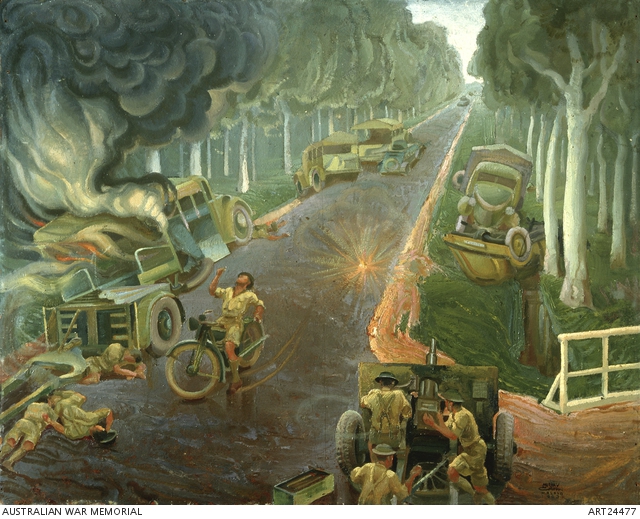
Action at Parit Sulong, January 1942 by Murray Griffin

There is some merit within the book, however, and it is in the description of war and how it affects Singapore (as seen through a colonialist’s eyes). There is a strong ‘end of an era’ atmosphere as can be expressed when viewing it in hindsight. War, when it comes, is initially just another reason for exploitation and profiteering, as it is seen from a distance as capitalists prepare for its approach. Eventually Singapore falls and the war comes directly to the Dexters, as John fights in the jungle, and there are detailed descriptions of making bamboo bombs and the sadistic torture methods and general savagery of the Japanese. As Barber’s reflections become more political and less personal, he includes footnotes to historians’ writing as if to back up his fiction with fact. He is better at understanding the big picture than individual motivations.

As a rambling novel of a family saga with Singapore as a backdrop, this is an ambitious work. One is reminded of James A Michener’s Tales of the South Pacific. He couldn’t write women either and approached the situation from a white male colonialist viewpoint, but it won him a Pulitzer Prize in 1948 when that was the only perspective that mattered. Hopefully times are changing.

Wednesday, 15 September 2021

Hiding Her Light Under a Bustle: Agent Sonya


Agent Sonya: Lover, Mother, Soldier, Spy by Ben MacIntyre
Viking
Pp.328

Spies, especially female spies, capture the imagination. Ursula Kuczynski, codenamed Sonya, was a German Jew, a dedicated communist, a colonel in Russia’s Red Army, and a highly trained spy. From planning an assassination attempt on Hitler in Switzerland to spying on the Japanese in Manchuria and helping the Soviet Union build the atom bomb, Sonya conducted some of the most dangerous espionage operations of the twentieth century. Ursula Kuczynski married several times – she had many names, both real names and codenames. The novel is subtitled ‘Lover, Mother, Soldier, Spy’, and, although she had many lovers, none of her partners ever betrayed her. MacIntyre, meanwhile, is obsessed with her conflicting duties towards the party and her family, which he embodies by talking about making jam and baking cakes.

Ursula had a relatively comfortable and privileged background, and became a communist through ideology. She moved to Shanghai, where she was appalled by the discrepancy in conditions caused by wealth. Bored and sickened by her life in Shanghai, she was anxious to do something more meaningful. She was clearly passionately idealistic, but with sexism bordering on misogyny, MacIntyre is unable to believe that she supported the Communist cause for reasons of ideology alone and frequently espouses the theory that she was attracted to the glamour and the excitement of espionage. “Ursula was committed to communism, but also increasingly addicted to danger, the romance of risk, the addictive drug of secrecy.”

Throughout the book he clearly points us in a certain direction, editorialising in a blunt fashion as if he doesn’t trust the reader to make up their own mind, or perhaps he mistakes condescension for humour. He is also critical of other authors, which is spiteful and unprofessional, merely heightening the sense of smugness. There is a lot of repetition, suggesting the lack of a disciplined editor and, whereas this is a great story and would make a great film or novel, this biography has got both a muddled and didactic approach. He sets the scene very well, even if he does it multiple times, and he clearly enjoys the complicated details of the meetings between handlers and recruits in which two people walk towards each other “holding a green book in one hand and a tennis ball in the other, exactly as Sonya had instructed. At 4pm on the dot, a stocky man appeared, wearing a pair of gloves and holding a second pair in his left hand.”

In 1932 when Japanese forces attacked Shanghai, Ursula was “dispatched” to the war zone to discover if Japanese incursions into China presented a potential threat to the Soviet Union. Later she was sent to Mukden, a city in Manchuria in Inner Mongolia (invaded by the Japanese in 1931) “to liaise with the communist partisans, provide them with material assistance, and transmit military and other intelligence to Moscow by radio.” She built her own radios (which she had to bury in the fields) and assembled aerials on the roof (which she had to dismantle each night). She moved to Switzerland, where she ran a spy network, using the “peaceful land of cowbells and cuckoo clocks” as a base to launch operations into enemy territory. 

Threatened by possible exposure, she left Switzerland and took her family to England where she settled in Oxfordshire. When Ursula moved to Great Rollright, she cycled into the countryside to put messages in a hollow tree and receive drops with her instructions, but there were no communications and she began to worry. Basically, the GRU had got the wrong tree. After the war, Ursula continued to spy for the Communist Party, and in 1949, she went to Berlin where she continued her work in East Germany. She worked with many ‘famous’ spies, including Alexander Foote, a radio operator who spied for Russia and Britain, and Klaus Fuchs, who supplied information from the American, British and Canadian Manhattan Project to the Soviet Union during and shortly after WWII.

It seems incredible that Ursula was not caught. Her brother and father were already under surveillance by MI5 and the whole family were considered suspicious. She had been made a colonel in the Red Army – the only woman to rise so high in Soviet military intelligence. All of her previous husbands, lovers and many of her recruits were interrogated, but none betrayed her. Many men couldn’t comprehend that a woman could be a spy. MacIntyre writes, “Some in MI5 wondered how Ursula could possibly have time to spy since ‘her hands are fairly full with domestic duties.’”

She became dissatisfied with the Communist regime due to instances such as Stalin’s Great Purge, the crushing of the Hungarian revolt against Moscow in 1956, the building of the Berlin Wall in 1961, and the put down of the Prague Spring in 1968, but she still believed she was helping to make the world a safer place by stealing atomic secrets from one side and sharing them with the other. Her own children did not know anything about her life as a spy until she published an autobiography, Sonja’s Rapport in 1977, which would probably be a great read. MacInytre’s attempt to place her experiences into a domestic and female context is clearly done for dramatic effect, but somehow manages to undermine the commitment and consequences of this remarkable woman.

Wednesday, 2 June 2021

Women's Health Matters: Pain and Prejudice


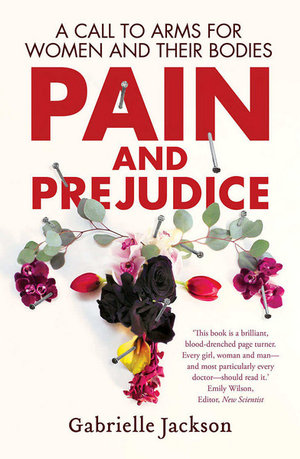
Pain and Prejudice by Gabrielle Jackson
Allen & Unwin
Pp. 321

Subtitled ‘A Call to Arms for Women and Their Bodies’, this book focuses on how women have been badly treated by the medical profession in the ‘Western World’ (there are many studies, figures and reports, all from the UK, the USA, Australia and New Zealand) and suggests that the times are ripe for revolution. It centres on the fact that medicine was traditionally a male profession and that the male was considered the default, so the difference in women was barely acknowledged let alone appreciated. In a similar line to that taken by Caroline Criado Perez in her book, Invisible Women: Exposing Data Bias in a World Designed for Men, Jackson argues that women are being ignored at best and killed at worst due to this gender bias in medicine.

In general women live longer than men, but they are in more pain. They are not taught to know their bodies or talk about their ailments; they are meant to nurture and support others before themselves. Women aren’t accustomed to discussing ‘female ailments’ – menstruation, menopause and sexual pain are still relatively taboo topics. Many women can’t identify their reproductive organs on a diagram and are certainly not meant to talk about them, as it is considered shameful. An influential study by Melissa Parker on Australian girls found that 93% of them experienced some period pain. About 20% experience severe pain, 24% say their period interferes with four out of nine life activities, and 26% miss school because of pain. “So a quarter of girls are missing school because of pain, and nobody thinks it’s a problem?”

When women demand attention, over their health or issues of equality, they are often labelled as hysterical, and “As an insult, ‘hysterical is still disarmingly effective.” Yet, when men present with the exact same symptoms, it is called shellshock or PTSD. Traditionally medicine was a male profession, and women are often not believed about their own health. In the late nineteenth and early twentieth century, “medicine became an elite profession and took over from religious institutions as the primary enforcers of the social roles of women.”

Because the default case study for all ailments is male, “We assume that the ways in which women are different from men must be the ways in which women are inferior or broken or diseased when in fact it might be that women are just different.” Symptoms of heart attacks are different in women and often misdiagnosed. A World Health Organisation report explains, “It has traditionally been thought of as a man’s disease which has led to deadly consequences for women – in 2004, 7.4 million women over 60 years of age died of cardiovascular disease compared with 6.3 million men.” Stress is a factor in heart disease, but women are often dismissed as suffering from nothing but anxiety when men who present with the same symptoms are diagnosed with heart disease.

Before 1993 there was no legal requirement to include women in clinical trials 

Many clinical tests only use men in their trials, which can prove fatal to women. In 1993, the US Food and Drug Administration and the National Institutes of Health mandated the inclusion of women in clinical trials. Before then, trials were routinely carried out on men only, including: a twenty-year longitudinal study (began in 1958) to explore whether taking an aspirin every day could reduce the risk of heart disease (conducted in 22,071 men and no women); a 1982 trial looking at whether dietary change and exercise could help prevent heart disease (conducted in 13,000 men and no women), and even a trial in the 1960s to investigate whether supplementation with oestrogen was an effective preventive treatment for heart disease (conducted in 8341 men, and no women).

Women generally experience more chronic pain than men – they suffer pains that cannot be seen, so they are often discounted, and pelvic pain is “also beset by stigmas and taboos that make it difficult for women to talk about their sex organs or anything related to them.” When women are believed about experiencing pain, they are often thought to be exaggerating. “Even female doctors, after training and working in the heavily masculinised medical culture, can view this language as confronting and histrionic.”

Women suffer more chronic pain than men

There are several overlapping pain conditions and women who suffer from one are likely to also suffer from others. These include endometriosis; vulvodynia; fibromyalgia; chronic fatigue syndrome/ myalgic encephalomyelitis; interstitial cystitis/ painful bladder syndrome; temporomandibular joint disorders; irritable bowel syndrome; chronic tension-type headache; chronic migraine and chronic low back pain. “Chronic pain conditions aren’t conditions that kill us but they radically alter our opportunities to reach our full potential in life… Pain doesn’t actually kill people – it keeps women in the home and out of work, which has no effect upon the power structures of society, providing no incentive for action.”

Doctors don’t really want to see patients who are difficult to diagnose and harder to fix as it looks bad for their figures and solved statistics: they even call them ‘heart-sink patients’. Women are aware of this stigma, and when they are told they have medically unexplained symptoms, anxiety, depression or are disbelieved, they can move from doctor to doctor in order to find a diagnosis or treatment relief. “In an exasperating development, ‘doctor-shopping’ has come to be seen as an indicator that pain is made up, rather than a result of pain doctors won’t believe.”

Women’s pain is not treated as seriously as men’s pain, and Jackson suggests that women should not simply accept this, but educate themselves about their bodies and demand that they be treated with equal funding and respect. It would be a brave and/or stupid person who would argue with that.

Tuesday, 23 March 2021

Bigotry in Bournemoth: Whatever Happened to Margo?


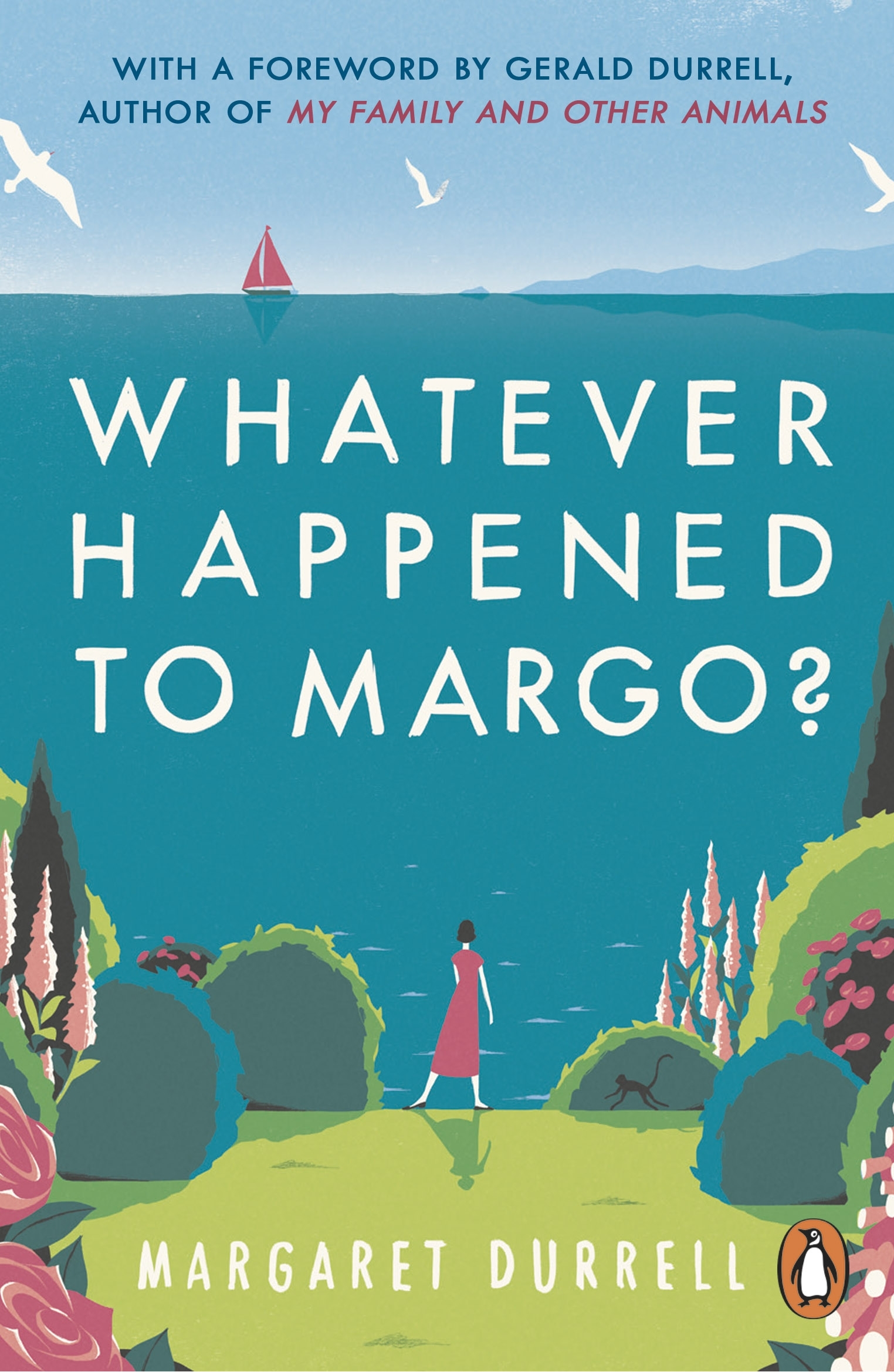
Whatever Happened to Margo? by Margaret Durrell 
Penguin
Pp. 259

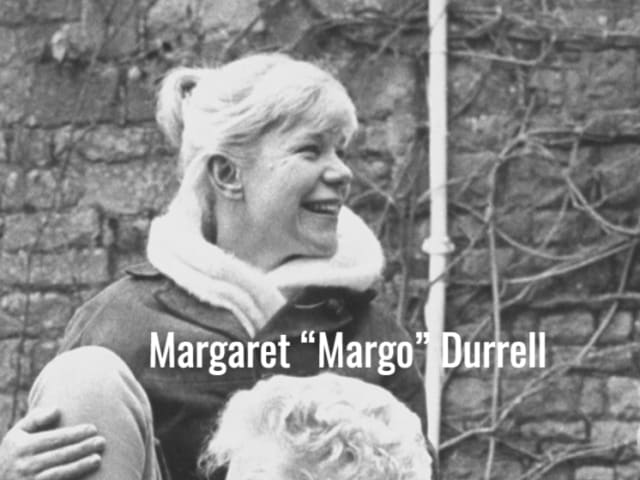
Those who read Gerald Durrell’s Corfu Trilogy about the escapades of the Durrell family on the Greek island in the 1930s, will be familiar with the character of Margo, and may indeed be interested in discovering what became of her. Fortunately for them, she has written a book about her subsequent life as a landlady in a Bournemouth boarding house. Unfortunately, she is not as entertaining a writer as her brother, and, whereas his anthropological remarks on animals were amusing and informative, hers on people are snobbish and dated.

After prompting from an aunt, Margo decides to buy a property across the street from her mother’s house, with money which was “a legacy from my father – dwindled somewhat”. She is ‘respectable’ and ‘middle-class’ with a divorce and two male children to her name, but there is no evidence of actual work. Her plan to take in a series of lodgers is a decent one especially since (one suspects) she has no employable talents.

It is 1947 and attitudes were different then, but the language and assumptions about her lodgers are quite ugly when related to modern readers. Edward Feather is a flamboyant red-bearded painter, leading to words like ‘nonce’ and ‘pansy’ being bandied about and smirks about men who wear tight trousers. Harriet is an eccentric old lady who accuses others of stealing her belongings while removing all the lightbulbs in the public spaces; when the residents gather over psychology books to decide what is wrong with her, at first they think she is “on the change”, a theory they quickly discount as “she’s too old for such capers”. Nelson is an obnoxious Billy Bunter type schoolboy (whom we are supposed to like for some inexplicable reason) and his harassed mother, who have fallen on hard times as their father/husband is in prison serving time for assault of her mother; he broke a plate over her head and she had to have twenty stitches.

Other residents include a man who abuses his wife – no one does anything until they dislike the noise – There is also Jane, a spinster, who is mercilessly ridiculed for being unattractive; a man who comes into money, which makes him a catch; a pair of musicians, one of whom Margo falls in love with; two glamorous nurses; and a bloke trying to get a job and a partner with equally limited success – he has a relationship with an Eastern European woman whom Margo, when she discovers she is transgender, reports to the police and a psychiatrist. All the women are in competition for men’s attentions, and the men are all expected to drool over attractive young females, while making fools of older ones. “It was surprising what a compliment from another man could do, lifting the drabbest of married women almost to prettiness.”

In a nod to her brother’s writings on animals, there are some in the house, including a dog (a present from her brother, Leslie) that cocks a leg over anything it chooses, including the baby’s pram. Gerald himself brings a python and a troop of monkeys for her to look after, and of course they escape with hilarious consequences. Meanwhile, the insufferable Nelson breeds mice to sell, causing Margo to display one of her many peculiar views as she remarks that there are “white mice breeding in the back lavatory like Communist China”.

The descriptions of her mother as an uptight suburbanite are a long way from the courageous woman who took her children to a Mediterranean island in search of a better life, and mingled with a cast of colourful characters in Gerald’s books. Here she is judgmental and small-minded, referring to a lovelorn woman as “walking barefoot like some male aborigine with twigs in her hair”. Margo packs her own children off to their father and takes Nelson on a trip to the seaside. She seems more interested in him than in her own offspring, and one wonders whether they will in time write their own account of these days in a never-ending family spiral. If they do, let’s hope it is in the style of their uncle rather than their mother.

Thursday, 10 September 2020

Get Orf My Land: The Shepherd's Life


The Shepherd's Life: A Tale of the Lake District by James Rebanks

Penguin

Pp. 287

Sheep are big business. Last month (August 2020) in Lanark, Scotland, a sheep called Double Diamond sold for a world-record sum of £367,500. James Rebanks knows that sheep are important. As a shepherd, he understands that farming and shepherding are crucial to the economy and the livelihood of many. He explains that this is hard work but that he loves it and enjoys the connection that he gets from the land. What he doesn’t seem to understand is how privileged he is and how many of the people he scorns would love to have been given his opportunities.

The Shepherd’s Life is not particularly well-written but Rebanks received an advance from an agent before he had written it. Although he appears to despise people who don’t do his work, they seem to be interested in him. He writes a sort of auto-biography, which also contains a lot of information about farming and a lot of assumptions about what non-farmers think of him and his industry. Many of his blunt and antiquated attitudes are irritating and arrogant, such as his inherent sexism and antipathy towards intellectuals, but the sections on sheep-farming itself are interesting and the most engaging.

As a child he followed his grandfather around the place knowing that he would inherit the farm because he is male. He has sisters, but it was “different for girls…their role is to leave and do something else to earn respect.” This knowledge of his purpose in life means that he feels ownership of the land. “We owned the earth. We’d been here forever. And we always would be. We would get battered from time to time, but we would endure and win.”

For him and his family, “our sense of belonging is all about participation. We belong because we are part of the work of this place.” And what if we can’t inherit a farm? Will we never ‘belong’? He dislikes Alfred Wainwright, Chris Bonnington and William Wordsworth because they’re ‘not from round here’ and so have no right to talk about ‘his’ land; he thinks climbers, poets, walkers and daydreamers are pointless, and that tourists are “minor irritants, like ants – they got in the way and they had strange ideas, but a little bit of bad weather and they’d be gone again to get on with stuff that mattered.”

The book itself is poorly written, grammatically clunky and very repetitive; a lot of sections start out telling us what someone is doing in the present tense, as he tries to set a basic scene: “My father is wielding a white-handled meat saw…” “My mother is sitting on a wooden chair in our barn…” “We are working in the sheep pens.” The use of generic pronouns is also problematic, for example, he writes of his grandfather, “He had a rough whiskery face when you kissed him goodnight.” This begs the questions, when did I kiss him, and what was his face like when I didn’t? He acknowledges, “We are, I guess, all of us, built out of stories” and yet, he doesn’t narrate his own very well.

He became inspired by books when he picked up a copy of A Shepherd’s Life by W.H. Hudson (the story of a shepherd called Caleb Bawcombe) and says he admires “the brilliant plain storytelling, no messing about”. It is predictable when he talks of reading; it is of male authors – Camus, Salinger, A.J.P. Taylor, Orwell – and that his biggest inspiration is the hyper-masculine Hemingway. After criticising the poets, he tries to write his own, and I certainly hope he’s a better sheep farmer.


He is at his best when writing about the sheep, the dogs, and the cyclical nature of farming. When told without prejudice, these snippets are interesting and engaging, including the shepherding chores of lambing, making hay, shearing (“It is a carefully choreographed thing in which the sheep is turned, shuffled and rolled in clever purposeful ways”), dipping, and training sheepdogs.

He divides the book into four seasons, as everything they do is connected to the weather and the natural cycle. In many respects, shepherding and farming have not changed in centuries. “You could bring a Viking man to stand on our fell with me and he would understand what we were doing and the basic pattern of our farming year. The timing of each task varies depending on the different valleys and farms. Things are driven by the seasons and necessity, not by our will.”

If you remove the tractors and the machinery, the farming practices are ancient, and it upsets him that these traditions, skills and knowledge are being lost or dismissed. He commends the ‘old ways’ and wants future generations to see the reality of farming and agriculture. His book is almost a call to arms to protect the natural mechanics and importance of farming.

James Rebanks is a tough person to like – he has some interesting things to say about sheep and the farming of them in the Lakeland fells, but he tells them in a didactic and hectoring tone. If he could climb down from his privileged perch, his message about sustainable farming might be easier to hear.

Tuesday, 11 August 2020

Childhood entitlement: Birds, Beasts and Relatives


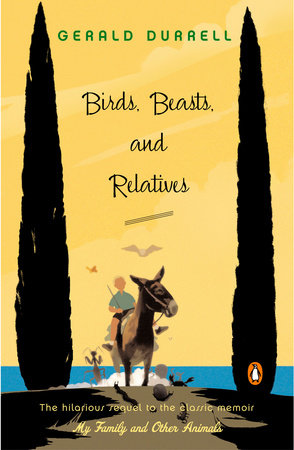
Birds, Beasts, and Relatives by Gerald Durrell
Penguin
Pp. 245

This is the second instalment of Gerald Durrell’s Corfu Trilogy in which he continues with stories from the first book because the family say he has missed out all the best bits. As it is the same time period as the previous work, we don’t really need re-introductions, although it is interesting to see what the family members thought of their portrayal.

Gerry introduces several extra characters to us, mentioning Larry’s many friends who come to visit, including Max and Donald, and Sven who plays the accordion. We are also introduced to Countess Mavrodaki, “the recluse par excellence”., and we learn about his tutors, such as George, and his final (for this book) tutor, Kralefsky, a keen aviculturist (a person who keeps and rears birds) and a storytelling fantasist. He also provides greater depth to characters we have already met, and he describes his meeting with Theodore Stephanides, to whom the book is dedicated ‘in gratitude for laughter and learning”.

Gerry still collects animals for his menagerie: an owl called Ulysses; three dogs; and “there were rows and rows of jam jars, some containing specimens in methylated spirits, others containing microscopic life. And then there were six aquariums that housed a variety of newts, frogs, snakes and toads. Piles of glass-topped boxes contained my collections of butterflies, beetles and dragon-flies.” I remember things that I learned from reading these books as a child, such as the fact that snails are hermaphrodites.

Gerry has a child’s viewpoint and assumes that people and things exist for his entertainment. He experiences bucolic activities such as harvesting olives, but also is witness to live birth, and his reaction is less palatable. The description is anatomical but also unpleasantly dispassionate, perhaps because the human is foreign. “I was so used to the shrill indignation of peasants over the most trivial circumstances that I did not really, consciously, associate Katerina’s falsetto screams with pain. It was obvious that she was in some pain. Her face was white, crumpled, and old-looking, but I automatically subtracted ninety percent of the screaming as exaggeration.”

Furthermore, his description of the gypsies is somewhat uncomfortable in a modern setting. “I had always wanted to get on intimate terms with the gypsies, but they were a shy and hostile people… and although they would allow me to visit their camps, they were never forthcoming, in the way that the peasants were in telling me about their private lives and their aspirations.”

When Mother receives unwanted attention, and even a proposal of marriage, from a ‘disgusting old brute’, Captain Creech, she is naturally horrified and a little bit afraid. The children all laugh and ridicule, and she counters, “When there’s a real crisis, you children are of absolutely no use whatsoever.” Yes, this is an amusing anecdote, but she is a single woman in a foreign country in the 1930s with no respectable family to protect her.

Gerry writes of people as though they were specimens to be studied as his animals, birds and insects; because they are foreign (or female), they are other and this dispassionate approach is a little off-putting. These are still great stories of their time, but a deeper look reveals some more unsavoury aspects, which can be excused from a child’s account, but not really as an adult reader.

Monday, 20 July 2020

Gently Hurling: After She Left


After She Left by Penelope Hanley
Impact Press
Pp. 337

This novel focusses on three generations of women and in particular the mother/ daughter relationship, but the characterisation is shadowy and they all blend into one. Penelope Hanley obviously has things that she wants to say about Irish immigrants, illegitimacy, art, Sydney, politics, and the Women’s Liberation Movement but the forced plot and the unnatural dialogue does her story a great disservice. The granddaughter, Keira, is trying to do a photo essay project on her grandmother (Deirdre Wild)’s art, but her mother, Maureen, resists saying much about her, creating a sense of mystery. It transpires she had an illegitimate child after an affair with a married man; this is not a scandal today and the consequences of it then aren’t covered well enough for it to merit the supposed shock.

There are ways of blending historical detail seamlessly into a novel, which Penelope Hanley ignores. She uses newspaper articles to fill in details, or clunky discussions about conscription and the Vietnam War; Whitlam’s speeches are transcribed. Neither does the author follow the advice given to every aspiring author of ‘show; don’t tell’. The description of Deirdre’s peripatetic lifestyle reads like a route map, and rather than trying to weave the effect of the artworks into the narrative, Hanley chooses to describe Deidre’s art in a mock newspaper review; a three-page long account of the paintings and the artistic style supposedly from the Sydney Morning Herald.

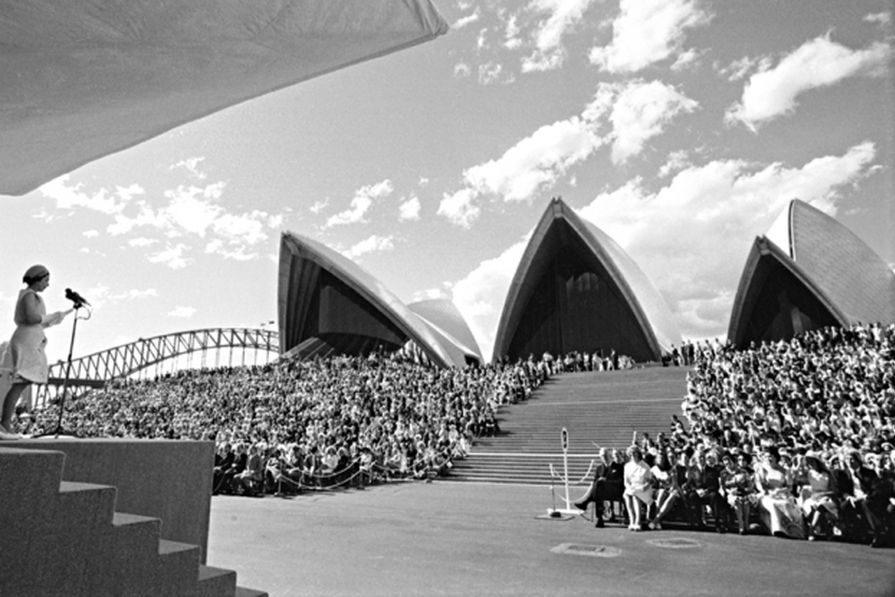
Queen Elizabeth II officially opening the Opera House on 20th October 1973
Characters discuss sexism in art, and the architecture and politics of the Opera House in a way which is simply unrealistic. Keira won’t go to the opening, because the author wants to shoehorn in her opposition to the monarchy. The frequent discussions about gender roles and how women do all of the “domestic stuff” even when they have a paid job too, are clearly important, but are presented as daughters and mothers lecturing each other with full speeches. It plays to the gallery so strongly I feel as though I’ve been hit over the head with a pop-up placard. Earnest debates about apathy and change read more like a social history textbook, and the writing is turgid as no noun is left with an adjective; no verb without an adverb. “When she let herself in, Lady, in a quick dash of woolly curls and wagging tail, hurled herself gently at Keira, barking ecstatically, her paws on Keira’s thighs.” – can a dash be anything but quick? Can one hurl gently?

Depth is implied through what the characters are reading, perhaps hoping their knowledge and ideas might be inferred; all books are mentioned from Iris Murdoch and Erica Jong to Germaine Greer and Simone de Beauvoir. Apparently constant mention of characters’ outfits is also a substitute for giving them any personality. This could have been an interesting tale but it is submerged in layers of overblown prose, excessive detail, stilted dialogue and indistinguishable characters.

Friday, 3 July 2020

Friday Five: Cross-Stitch on a Theme

Sometimes everything gets 'a bit much' and, in these times, I have found that working designs from Really Cross Stitch: For when You Just Want To Stab Something a Lot helps. Of course, I am not advocating violence, but I am hoping for progress, and there is a theme in my latest five patterns about who or what I would like to change. As previously, all the words are from Rayna Fahey, and all the complete lack of ironing is my own.

"Politicians and toddlers have a lot in common. They are both prone to tantrums and act unreasonably, especially when they don't get their own way. Every now and then - just like a toddler - you have to give them a good talking-to!"
"Contending for the misogynist comment of the millennium, a presidential candidate's suggestion that he was at liberty to grab female genitalia due to his privilege was dismissed as 'locker room talk'. Whilst this overheard vulgarity wasn't enough to kill an election campaign, it certainly put feminists on a war footing well before Trump took office.

This pattern attests to the fact that kitty has claws. The only pricks we will tolerate come from our cross stitch needle."
"Now it's really not nice to attack someone you don't like politically based on their appearance. But this time the temptation was too strong.

"For someone who is world-record-breakingly quick to insult someone, Trump's skin does appear to be diaphanously thin when it comes to people discussing the size of his hands. But in the scale of things, this is the guy that reinstated the Global Gag Rule and wants to ban the world's 1.6 billion Muslim people from America. So there's plenty of actual policy to organise around while you're doing this cross stitch."
"Cunts are deep, warm, and delightful; indeed the place from which the majority of us astoundingly enter this fragile world. Yet no single word creates as much division and carries as much power as this little number.

"One thing activists are super-good at is dissecting the meaning of language, until letters break down into pixels. Give us another decade and everyone will know that vagina is 16th century slang for a place to keep your sword. Ouch."
"Language can be used to persuade, amuse, insult, and mobilise action. Few formats can accomplish these goals as ably or succinctly as the protest sign.

"Of course, sometimes the words just won't come. Or there are too many of them to fit on one sign. Or you're just so tired of being angry and upset that you just want to go UGH; which is fine. 'Just, Ugh' conveys all the despair, rage and hopelessness in just seven easy letters, and of course, can be used for virtually any occasion as it works for anything. Plus, it's nice and easy to stitch."

Wednesday, 26 June 2019

Blurred Lines: How to Talk to Girls at Parties


How to Talk to Girls at Parties by Neil Gaiman; illustrated by Fabio Moon and Gabriel Ba
Dark Horse Books
Pp.62

This is the first graphic novel I have read since I sat with a box of comic books at school on those rainy days when we couldn’t access the playground – unless you count Viz, of course, which kept me amused through my late teens. It was published June 2016, although the original short story by Neil Gaiman was written in 2006. The artistic content is clearly as important as the narrative or the words themselves, and here the images are supplied by Fábio Moon and Gabriel Bá: a Brazilian duo (twin brothers), who have won awards and international acclaim for telling stories in comic book form. The pictures feature bright colours with strong outlines and bold details against watercolour-like backgrounds to the panels. It is impressive and efficient to be able to draw pictures in place of descriptions, but it can occasionally lead to confusion as details, humorous asides, and motivations are omitted.

The story is set in East Croydon, told by Enn, and framed as a narrative from 30 years ago. He is a fifteen-year-old boy with all the normal concerns of a heterosexual teenager: namely how to make girls notice him when everyone seems to be attracted to his best mate, Vic. The language is either deliberately teenaged and ignorant or woefully blokey and sexist as he talks of girls as objects. Vic tells Enn, “You just have to talk to them. They’re just girls. They don’t come from another planet”, which is not bad advice, although it may also turn out not to be true.

At a party, Vic abandons him to go upstairs with the best-looking girl present (presumably for intimate encounters). Enn is despondent but forces himself to talk to three girls: Wain’s Wain, who explains that she is a second – she has six fingers on one hand – and thus not allowed to breed; a second nameless girl who claims, “I love being a tourist” and regales him with stories of “swimming in sunfire pools with whales” and learning to breathe; and Triolet, who claims to be a poem.


The story plays upon the need to belong and the fear of being an outsider, with strong implications of other-worldliness. Women are clearly from another planet – Mars and Venus anyone? When Triolet kisses him, it blows his mind. He sees “towers of glass and diamond and people with eyes of the palest green and unstoppable beneath every syllable I could feel the relentless advance of the ocean.” The drawing is of a fantasy land with bridges and turrets; minarets and spires in green and gold – a bit like The Emerald City in The Wizard of Oz.

Vic interrupts his reverie as he runs terrified from the house and Stella stands looking down at him in fury. There are suggestions that he tried to sexually assault her, although it is all rather ambiguous (The short story includes the line, “Her clothes were in disarray, and there was makeup smudged across her face, and her eyes”, which makes it less so). When Enn looks back he finds he remembers impressions of the evening rather than facts, and perhaps it is all a metaphor for the mind-altering universe of teenage hormones.


Neil Gaiman is hailed as a hero by many of my fantasy-loving friends, but I can’t help but feel there is something distasteful about this story. The pictures are beautiful but the sentiments are not. In trying to blur the lines of sexual experimentation and assault, I think this is unhelpful – especially when considering the teenage market at which it is aimed.