Showing posts with label mother. Show all posts

Wednesday, 2 December 2020

On Shifting Sands: Celestial Bodies


Celestial Bodies by Jokha Alharthi
Sandstone Press
Pp. 243

Originally titled Sayyidat al-Qamar (Ladies of the Moon), Celestial Bodies is the third of Alharthi’s novels, but the first novel by an Omani woman to be translated into English and the first novel in Arabic to be awarded the Man Booker International Prize (which Alharthi shared with her translator, the Oxford academic Marilyn Booth in 2019). It spans several generations, from the final decades of the 19th century to the early years of the new millennium, and captures the changing mores and traditions in society, particularly in how they relate to women.

The family tree at the beginning of the book is crucial, and even with constant reference to it, the timelines can be a little hard to follow. The novel focusses on three sisters and their marriage prospects. Mayya marries Abdallah as she is told to after a heartbreak; Asma marries Khalid out of a sense of duty; Khawla rejects all offers while waiting for her beloved, who has immigrated to Canada. It is narrated by an omniscient narrator (who knows all about the women) and alternate chapters (in a different font) by Abdallah (who doesn’t).

Abdallah’s chapters are narrated as he is on a flight from Muscat to Frankfurt and he dreams fretfully of women accused of witchcraft and of the source of his father’s wealth back in his hometown of al-Awafi. Now little more than an oasis for nostalgia, it was once a hub for the slave trade, a practice that was not outlawed in Oman until 1970. It is no accident that the named narrator is not grounded as Alharthi inhabits the liminal space between memory and forgetting; the truth and the stories.

Marriage and childbirth are centre stage: customs are followed or disregarded and everyone has an opinion about how to follow them or not. Asma reads all the books and religious texts that she should, including On Matters of Purity although she finds the chapters so boring that she stops, but not before she gently mocks the highly restrictive guidelines on personal matters. Customs which are only followed for form are ridiculed, whereas those that come from logic and reason are upheld. It is still a patriarchal society, but there are social benefits to marriage. “Now she would be one of the women who sat around their coffee in the late mornings and then again at the end of the day. She would be invited to lunch and dinner, and she would issue her own invitations, since she was no longer merely a girl. Marriage was her identity document, her passport to a world wider than home.”

Women must still strive for individual recognition. When Mayya has her first child, it is a girl, which is considered lucky as it means that boys will follow. “The first one’s a girl, and a girl comes to raise her little brothers.” She calls her London, which name the family ridicule, but Mayya wants to give her a future elsewhere in the world.

The changes are occurring slowly, and the generations have different ideas and ideals. The novel is short and contains vignettes of multiple characters, such as Bedouin businesswomen, slave owners, gossips, poets and arms dealers. Celestial Bodies leaves an ethereal impression of vibrant sketches rather a chronological saga, and it provides a new and appealing voice. In a land of shifting sands, Jokha Alharthi is a shaping energy.

Jokha Alharthi and Marilyn Booth share the Man Booker International Prize for writing and translating Celestial Bodies 

Monday, 20 July 2020

Gently Hurling: After She Left


After She Left by Penelope Hanley
Impact Press
Pp. 337

This novel focusses on three generations of women and in particular the mother/ daughter relationship, but the characterisation is shadowy and they all blend into one. Penelope Hanley obviously has things that she wants to say about Irish immigrants, illegitimacy, art, Sydney, politics, and the Women’s Liberation Movement but the forced plot and the unnatural dialogue does her story a great disservice. The granddaughter, Keira, is trying to do a photo essay project on her grandmother (Deirdre Wild)’s art, but her mother, Maureen, resists saying much about her, creating a sense of mystery. It transpires she had an illegitimate child after an affair with a married man; this is not a scandal today and the consequences of it then aren’t covered well enough for it to merit the supposed shock.

There are ways of blending historical detail seamlessly into a novel, which Penelope Hanley ignores. She uses newspaper articles to fill in details, or clunky discussions about conscription and the Vietnam War; Whitlam’s speeches are transcribed. Neither does the author follow the advice given to every aspiring author of ‘show; don’t tell’. The description of Deirdre’s peripatetic lifestyle reads like a route map, and rather than trying to weave the effect of the artworks into the narrative, Hanley chooses to describe Deidre’s art in a mock newspaper review; a three-page long account of the paintings and the artistic style supposedly from the Sydney Morning Herald.

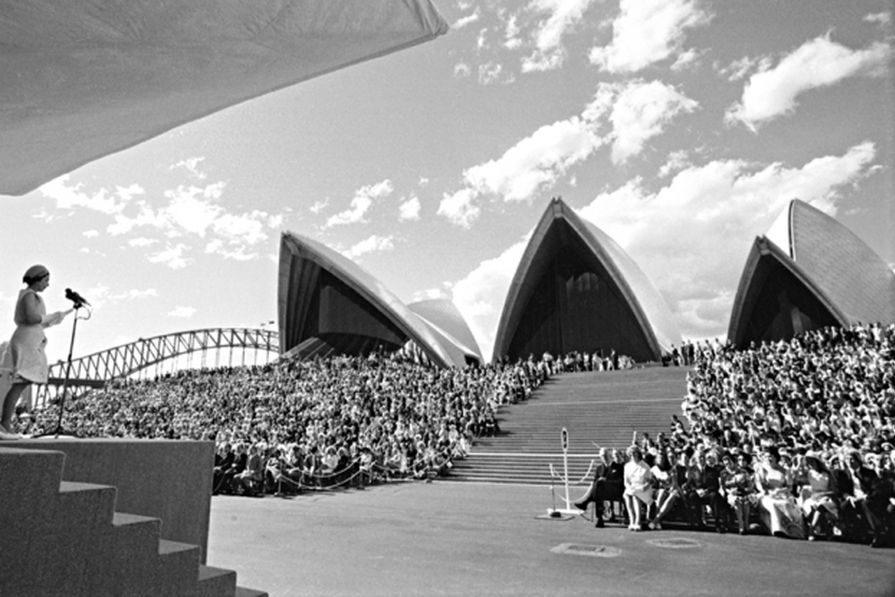
Queen Elizabeth II officially opening the Opera House on 20th October 1973
Characters discuss sexism in art, and the architecture and politics of the Opera House in a way which is simply unrealistic. Keira won’t go to the opening, because the author wants to shoehorn in her opposition to the monarchy. The frequent discussions about gender roles and how women do all of the “domestic stuff” even when they have a paid job too, are clearly important, but are presented as daughters and mothers lecturing each other with full speeches. It plays to the gallery so strongly I feel as though I’ve been hit over the head with a pop-up placard. Earnest debates about apathy and change read more like a social history textbook, and the writing is turgid as no noun is left with an adjective; no verb without an adverb. “When she let herself in, Lady, in a quick dash of woolly curls and wagging tail, hurled herself gently at Keira, barking ecstatically, her paws on Keira’s thighs.” – can a dash be anything but quick? Can one hurl gently?

Depth is implied through what the characters are reading, perhaps hoping their knowledge and ideas might be inferred; all books are mentioned from Iris Murdoch and Erica Jong to Germaine Greer and Simone de Beauvoir. Apparently constant mention of characters’ outfits is also a substitute for giving them any personality. This could have been an interesting tale but it is submerged in layers of overblown prose, excessive detail, stilted dialogue and indistinguishable characters.

Saturday, 22 October 2011

Quick Quintet: Mother's Commandments

Every now and then the topic of mentors and role models is raised, particularly around sporting events. There has just been a rather large one here in New Zealand and with on-and-off-field antics, people are once again questioning whether children should look up to sporting heroes for behavioural models.

I think not. I believe that's what parents are for (or else, what the hell are they actually doing?). No matter what they tell you, mothers do not always know best, but they can give you some pretty good pointers. You learn which to follow and which to ignore, but there are some things my mother taught me I will always value.

5 Pieces of Maternal Advice:
  1. If you can't say anything nice, don't say anything at all
  2. Never say behind someone's back something you wouldn't say to their face
  3. To a couple of people you may be extremely important - no one else cares: don't show off
  4. Don't expose your kidneys; you'll catch your death
  5. Never display your underwear in public; male or female - it's skanky. (I think mother actually used the word 'common', but that's what she meant)

Monday, 21 June 2010

The Great Scone Debate continued

Hi Mum! I know she reads my blog, because she tells me. And she alludes to it in her phone calls and correspondence, without actually mentioning that she read it. I don't know if she is too modest to leave a comment, or prefers writing with pen rather than keyboard but, in her latest letter, she had some fabulous insights into my recent posting on the great scone debate. She writes very well and thoughtfully, my mother, and although she wouldn't commit her opinions in full to something so public, I shall do it for her.

"I have been thinking about scones and the pleasure I get from them. Cutting through the slightly crumbly biscuit, putting a dollop of the gorgeous gooey cream on each half, spreading it over the surface and topping it off with a dollop of strawberry, blackcurrant, or at present, blueberry jam from Oregon.

"I then survey these jewels nestling on my plate before picking one up and biting firmly into it. Oh what joy! What rapture. The coarse biscuit, the thick cream and the slippery jam combining to produce a state of almost ecstacy. The are always so morish and leave you with an anticipation of a future delight.

"As a child on our annual holidays in Devon with my Godmother, they were always an eagerly-anticipated treat on our return from a fun-packed day on the beach and the long walk back. We always had the cream first followed by jam and that is what I continue to do to this day."

So there you have it; mother's always right. Isn't she?