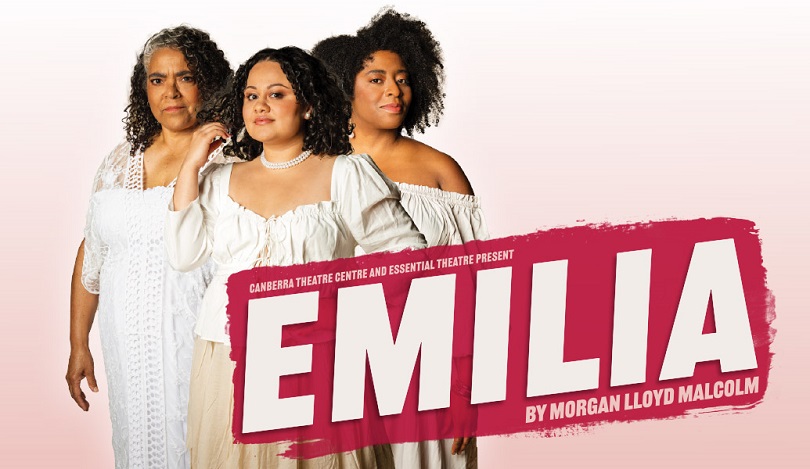
- Emilia - Essential Theatre, The Playhouse, Canberra Theatre Centre: When I read this play, I fell in love with it; it has feminism and Shakespeare intertwined with a glorious delight of language and heritage. It purports that the 17th-century poet Emilia Bassano is not only the 'dark lady' of the sonnets and his sometime lover, but the original writer of many of the works, whose words Shakespeare shamelessly stole to heighten the drama of his plays. Naturally, I was really excited to see this Australian touring version directed by Petra Caliva. Three women play Emilia at different stages of her life - one for her childhood and youth (Manali Datar); one for her young adulthood (Cessalee Stovall); and the third for her as an older woman (Lisa Maza). As each woman tells her story, the other two listen, react, encourage, cajole and reflect from the sidelines. The acting is of a high quality and the dialogue is delivered clearly and with passion. The characters are all played by women with the cowardly, grandiloquent and ultimately pathetic Shakespeare - played by Heidi Arena - getting the best lines and the biggest laughs. The set is minimal, comprising a revolving staircase which represents a multitude of scenes; the costuming brings the modern to the Jacobean (the brightly-colored Converse are a nice touch); and the choreography is eclectic with some snazzy contemporary moves. And yet, it just felt like there was something missing. Perhaps the haranguing and brow-beating tone left no room for nuance or relief so that the final speech, which should be incendiary - "The stakes we have been tied to will not survive if our flames burn bright. And if they try to burn you, may your fire be stronger than theirs so you can burn the whole fucking house down." - felt more like a damp squib, leaving the audience with nowhere to go and no way to react.
- The Tempest - Sydney Theatre Company, Roslyn Packer Theatre: I love the way certain directors interpret Shakespeare to suit their own ends - and why not? In this version of The Tempest (directed by Kip Williams), however, the attempt to force it to fit the 'they stole it from us' colonialist narrative, means Caliban has been made into the good guy by excising all references to his brutal rape of Miranda, Prospero's daughter. Rather than Prospero enslaving him due to fear of his bestial physicality, it becomes purely a white-man-subjugates-a-black-man narrative, and while the white man (Richard Roxburgh) and the black man (Guy Simon) in question are exquisite in their roles, and deliver the bard's blistering words with passionate sincerity, it removes much-needed nuance from the original drama. The set of a big central rock (Uluru anyone?) is inspired as it provides levels, hiding places and dramatic hierarchy, and the lighting effects are spectacular. The rest of the cast are all perfectly cast - Peter Carroll is a waspish and world-weary Ariel; Claude Scott-Mitchell as Miranda gets to speak some of Juliet and Jessica's lines (Shakespeare's other works have been plundered for their poetry), which she does with affecting flair; Susie Youssef is an unexpected boorish delight as Trinculo. Of course, some critics have taken issue with the gender-blind casting, but if they are concerned with straying from 'traditional' portrayals, I would have thought that would be the least of their worries.
- The Importance of Being Earnest - ACT Hub, ACT Hub: Determined to be different, Jarrad West's direction is more cabaret than theatre, including bursts of song (Louiza Blomfield does a lot of heavy lifting as the chanteuse) and outstandingly vibrant costumes designed by Fiona Leach - Lainie Hart as a stylish Lady Braknell presents as a steam-punk-ringleader. Many of the lines have been cut (including the one about never travelling without one's diary so as to always have something sensational to read on the train) and characters' roles trimmed down; Miss Prism (Victoria Dixon in a seething passive-aggressive turn heightened by inebriation) really only serves to be hoodwinked by Cecily (Holly Ross in a wheedling doll-like performance) and for the famous misplaced handbag denouement. The setting is the Bunburry Club, and we are part of the action, with scenes taking place at tables often after audience members have been asked to move to make way for the performers. There is a lot of food and slapstick comedy involved in eating - Cecily and Gwendoline (Shae Kelly making a deliberate mockery of affectation) have a food fight over cake, and Steph Roberts delights in the gluttonous Algernon Moncrieff as she stuffs her face with muffins and refuses to take anything seriously. Joel Horwood has perhaps the hardest role of all as he plays the straight man, Jack Worthing, and with the delightfully gender-blind casting, this is no mean feat. Painting with such broad and colourful strokes, many of the British class nuances are missed but that doesn't seem to matter in this riotous production, which is more of a madcap comedy than a comedy of manners.
- Amadeus - Sydney Opera House, Red Line Productions and The Metropolitan Orchestra, Concert Hall, Sydney Opera House: Let's face it, Michael Sheen is the draw-card here. Peter Shaffer's play is full of words and wit, interspersed with snatches of music and spectacle, and it requires a triumphant actor to bring the bombast and pathos in equal measure. As he looks back on the rumours concerning his part in the untimely death of Wolfgang Amadeus Mozart (Rahel Romain), Salieri (Sheen) interprets events with a satirical detachment and studied indifference, barely concealing his passionate envy and desperate ambition. It is a masterly performance, and his voice and presence command our attention. This is important, because there a few occasions in the second act where the script becomes burdensome and the audience begins to realise that three hours is an awful long run time. Director Craig Ilott revels in the flamboyance and offers plenty of distraction. The costumes are sumptuous (Anna Cordingley and Romance Was Born) with the rich fabrics, sensational colours and flamboyant designs appearing particularly striking on the austere set (designed by Michael Scott-Mitchell). The black steps and folding doors hint at a keyboard, a ladder and an amphitheatre reflecting the action back to us as if we are witnessing our own foibles and Faustian pacts played out before us. Nick Schlieper's lighting design - heavy on the back-lit scenes - creates intriguing shapes, silhouettes and shadows, although some bits of staging can only be fully appreciated if seated in the middle seats as the sight lines from the sides would cut off a lot of the visuals. Besides the brilliant pairing of Romain and Sheen, other stand-out performances come from Toby Schmitz as an endearingly foppish Emperor Joseph II, Belinda Giblin and Josh Quong Tart as the frenetic Venticelli who buzz about the stage transporting news and gossip, and the musicians of the Metropolitan Orchestra who supply Mozart's sublime music which, despite Salieri's best (and indeed, worst) efforts, we all know and love.
- Grapes of Mirth - Contentious Character, Canberra: Merrick Watts hosted an afternoon of comedy at a winery: the more we drink; the funnier they get. The acts were Frankie McNair (who gets funnier at every performance - proving that comedy is hard work), Peter Helliar (telling comfortable and amusing stories like a favourite uncle), Nath Valvo (very energetic and forthright), Dilruk Jayasinha (probably the best of the line-up), and Geraldine Hickey who was not in a good mood and was clearly thrown by the drunken heckling. Although it was baking hot and there was insufficient shade, it was a good, fun day out; not side-splittingly funny, but with plenty of entertaining stories.
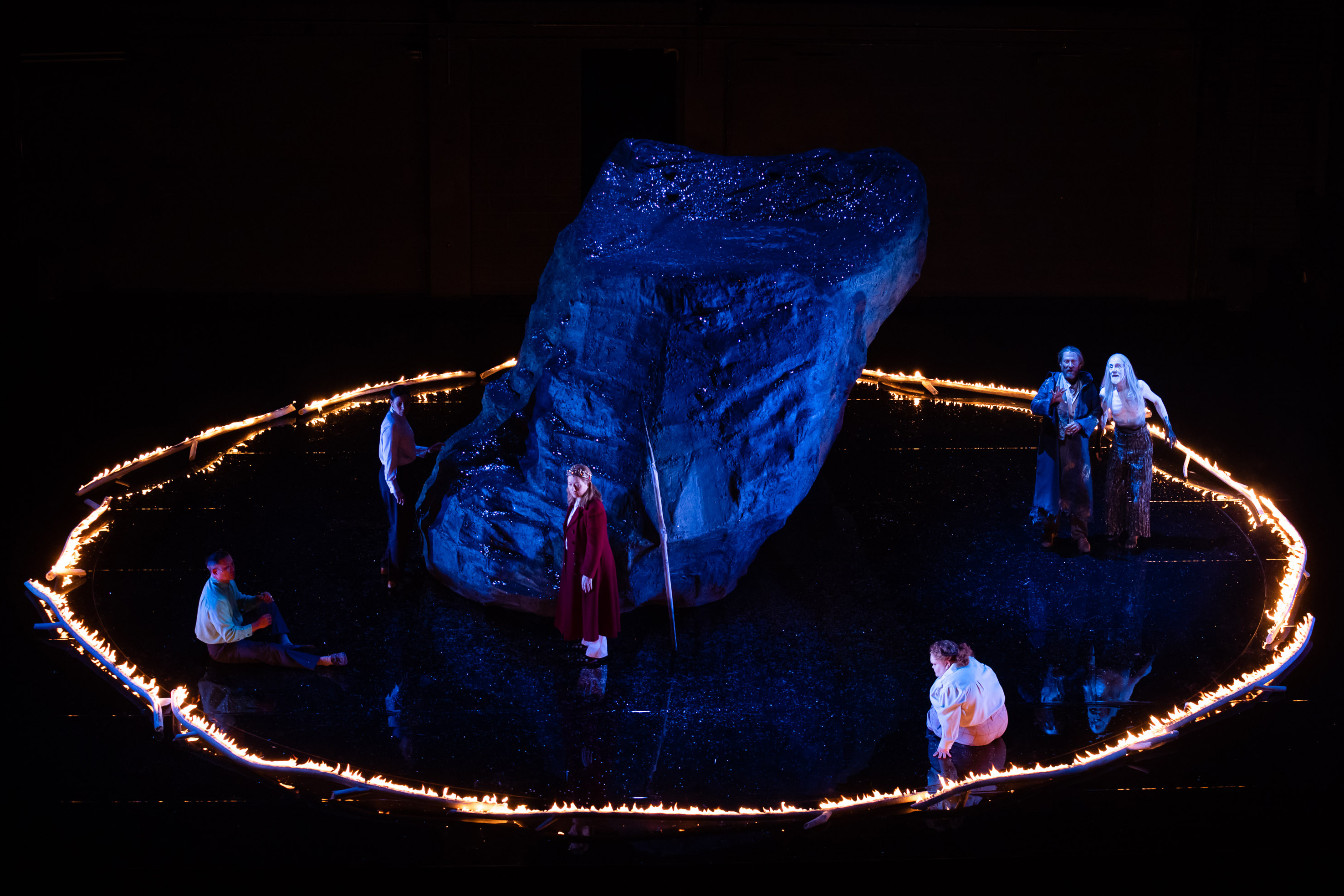 |
| Cast of The Tempest by Sydney Theatre Company |
 |
| Michael Sheen centre stage as Salieri in Amadeus |