Showing posts with label immigration. Show all posts

Monday, 20 July 2020

Gently Hurling: After She Left


After She Left by Penelope Hanley
Impact Press
Pp. 337

This novel focusses on three generations of women and in particular the mother/ daughter relationship, but the characterisation is shadowy and they all blend into one. Penelope Hanley obviously has things that she wants to say about Irish immigrants, illegitimacy, art, Sydney, politics, and the Women’s Liberation Movement but the forced plot and the unnatural dialogue does her story a great disservice. The granddaughter, Keira, is trying to do a photo essay project on her grandmother (Deirdre Wild)’s art, but her mother, Maureen, resists saying much about her, creating a sense of mystery. It transpires she had an illegitimate child after an affair with a married man; this is not a scandal today and the consequences of it then aren’t covered well enough for it to merit the supposed shock.

There are ways of blending historical detail seamlessly into a novel, which Penelope Hanley ignores. She uses newspaper articles to fill in details, or clunky discussions about conscription and the Vietnam War; Whitlam’s speeches are transcribed. Neither does the author follow the advice given to every aspiring author of ‘show; don’t tell’. The description of Deirdre’s peripatetic lifestyle reads like a route map, and rather than trying to weave the effect of the artworks into the narrative, Hanley chooses to describe Deidre’s art in a mock newspaper review; a three-page long account of the paintings and the artistic style supposedly from the Sydney Morning Herald.
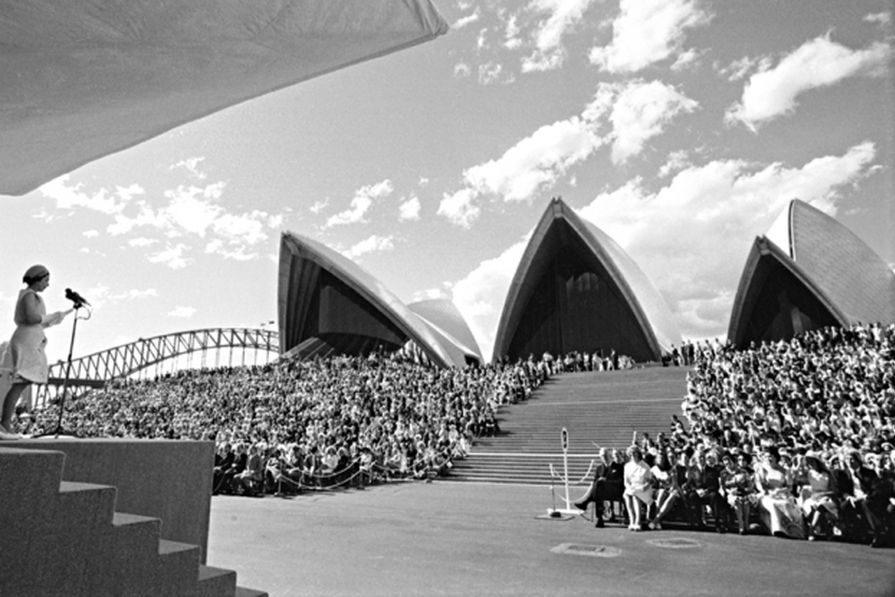
Queen Elizabeth II officially opening the Opera House on 20th October 1973
Characters discuss sexism in art, and the architecture and politics of the Opera House in a way which is simply unrealistic. Keira won’t go to the opening, because the author wants to shoehorn in her opposition to the monarchy. The frequent discussions about gender roles and how women do all of the “domestic stuff” even when they have a paid job too, are clearly important, but are presented as daughters and mothers lecturing each other with full speeches. It plays to the gallery so strongly I feel as though I’ve been hit over the head with a pop-up placard. Earnest debates about apathy and change read more like a social history textbook, and the writing is turgid as no noun is left with an adjective; no verb without an adverb. “When she let herself in, Lady, in a quick dash of woolly curls and wagging tail, hurled herself gently at Keira, barking ecstatically, her paws on Keira’s thighs.” – can a dash be anything but quick? Can one hurl gently?

Depth is implied through what the characters are reading, perhaps hoping their knowledge and ideas might be inferred; all books are mentioned from Iris Murdoch and Erica Jong to Germaine Greer and Simone de Beauvoir. Apparently constant mention of characters’ outfits is also a substitute for giving them any personality. This could have been an interesting tale but it is submerged in layers of overblown prose, excessive detail, stilted dialogue and indistinguishable characters.

Monday, 6 November 2017

Gathering Swallows Twitter in the Skies


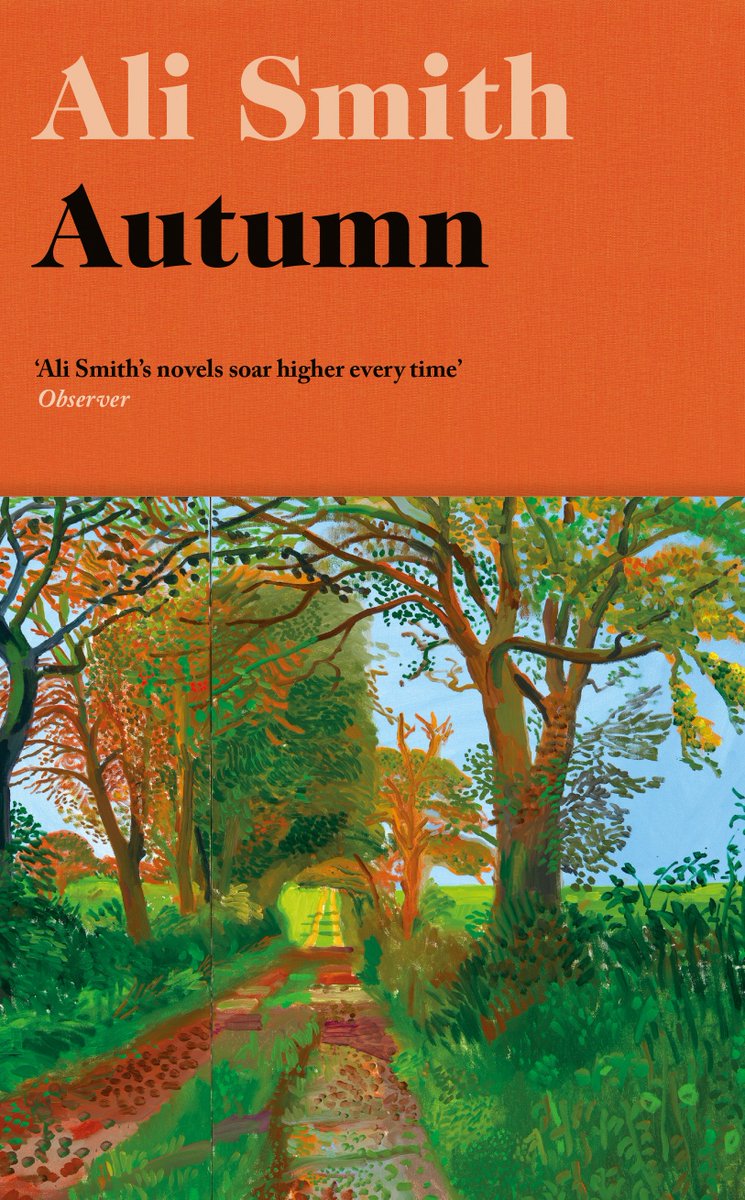
Autumn by Ali Smith
(Penguin), Pp. 260

Shortlisted for The Booker Prize and hailed as the first post Brexit novel, Ali Smith’s Autumn shoulders a weight of expectation for a slim novel. While it stands steady on its exquisite legs, it is also part of a series of novels due to represent all four seasons. It recalls the ode to autumn with its mists and mellow fruitfulness; there is a sense of melancholy but it is also suffused with hope, colour and a love of all things bright and beautiful.

Elisabeth Demand befriends her elderly neighbour, Daniel Gluck, and slowly learns his stories, while he challenges her imagination and perceptions of society. Her mother is horrified that she chooses to spend time with an adult male and cannot conceive that it is entirely innocent. Is it? The novel flicks back and forwards through time but with helpful explanations such as ‘It was a Tuesday evening in April in 1993. Elisabeth was eight years old.’ Daniel described artworks and paintings to her, including the works of the first female pop-artist, Pauline Boty.

Elisabeth later becomes a lecturer in art history, two topics which are intrinsically intertwined. She was told by a lecturer that there were no female pop artists and she is determined to champion Pauline Boty, who refused to fit the boxes created for female artists and died prematurely in 1966. With her witty collages and subversive paintings, Boty becomes a symbol of all those who are “Ignored. Lost. Rediscovered years later. Then ignored. Lost. Rediscovered again years later. Then ignored. Lost. Rediscovered ad infinitum.” Time is fluid; it is linear but cyclical; very messy and frequently repetitive. Now Daniel is in a nursing-home coma and Elisabeth visits him, pretending to be family: he has erotic fantasies about which she will never know. He had experiences of the Holocaust, and there are clear parallels drawn between the treatment of foreigners then and now.

It is self-consciously literary and also aware of the cyclical nature of history. From the opening line – “It was the worst of times, it was the worst of times.” – it is clear that everyone is feeling unsettled as the country tears itself apart.

“All across the country, there was misery and rejoicing… All across the country, people felt it was the wrong thing. All across the country, people felt it was the right thing. All across the country, people felt they’d really lost. All across the country, people felt they’d really won. All across the country, people felt they’d done the right thing and other people had done the wrong thing.”
Britain has just voted to leave the EU. Half of the village isn’t talking to the other half. A mysterious barbed-wired compound has sprung up nearby complete with security cameras and patrolling guards. Elisabeth’s mother, who is obsessed with antiques, decides to get herself arrested by throwing items of historic significance at the enclosure, “bombarding that fence with people’s histories and with the artefacts of less cruel and more philanthropic times”. A house in which immigrants live has the words GO HOME spray-painted on the wall. But later, the words, WE ALREADY ARE HOME, THANK YOU have been added, and bouquets of flowers left by supporters and well-wishers. There are seeds of hope and humanity scattered in this forlorn and morally bereft landscape.

Ali Smith acknowledges the pain of division and the beauty of inclusion. From nature with its seemingly haphazard approach to procreation and fertility, to the apparent clinical approach to grammar and semantics, she suggests that organic development will always triumph over control. Daniel dreams of becoming imprisoned in a tree and returning to the earth. Smith admires the polyglot of languages with words coming from all over the world (such as an intriguing section on a book young Elisabeth reads about a gymkhana).

This is a time of fear and certainty based on lies and fabrications. Daniel explains that the power of the lie is “Always seductive to the powerless.” We make sense of our world through the stories we tell and the ones we hear, whether they are presented as anecdotes or news. “Whoever makes up the story makes up the world, Daniel said. So always try to welcome people into the home of your story. That’s my suggestion.” We need more inclusion; we need more acceptance; we need more open-mindedness; and we need more books by Ali Smith.

Monday, 9 October 2017

And Why Not?


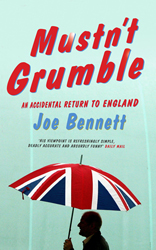
Mustn't Grumble by Joe Bennett
(Simon & Schuster), Pp. 280

Joe Bennett lives in Christchurch, New Zealand where he writes columns for syndicated newspapers and books of witticisms and comment. In the introduction to this book he writes, “I am English, but I have spent most of my adult life abroad. When a publisher asked me if I would like to come back, travel around England for a bit and write a book about it, I said yes.” Well, who wouldn’t? Inspired by the 1927 work of H.V. Morton, In Search of England, he decides to follow his footsteps, but by hitch-hiking his away around the country. He soon falls out of love with both Morton and the attempt to hitch-hike as he finds no one stops.

Although he has lived abroad for nearly 25 years, Joe Bennett still identifies with his home country. “I remain English and will die English. And I am happy with that. In a primal way over which I have no control, I still love the place.” He relishes peculiarities and idiosyncrasies, from the way accents indicate class as much as regions, to the courtesy of motorway driving (he borrows a friend’s Audi to tour the country) or “the remarkable ability of the English to eat ice cream in chilly weather.” He even enjoys the climate, the delight in bemoaning which lends his book its self-deprecating title.

Most of his daily excursions finish at the pub. “I am often asked if there is anything I miss about England. There isn’t. I have lived so long abroad that I don’t yearn. If I did, I’d come back. But there are some things that I relish when I do come back and one of those is pubs.” He is definitive about what constitutes a good pub. “People come in to talk to whoever happens to be there… They laugh a lot. There is nothing that cannot be discussed... It’s a coincidence of paths, a random intersection of lives that will never come again. We meet, we laugh, we go away again. I like that.” As anyone who has left England and returned, he notices the lack of space and the sense of history and culture, “There are few parts of this cramped country that have not been written about. It’s going to be hard to escape literature on this trip. I don’t think I’ll bother to try.”

His attitude is generally affectionate, but he doesn’t love everything. He dislikes the council buildings of the 1950s, thrown up in haste and unfortunately permanent. Like many before him, he bemoans the utilitarian modernity and there is a hint of axe grinding in his scathing assessment, “Cathedrals strive so hard to deny that they’ve become theme parks.”

He is a good writer, able to make the commonplace interesting. Squirrels “ripple across the grass, their spines undulating like waves along a skipping rope…” While mainly direct, he occasionally becomes verbose when he warms to a theme, such as when he writes of the lack of response received at the breakfast table.

Joe Bennett has asked many people (usually in his pub conversations) what it means to them to be English. While many are proud to be so, they have struggled to define it. Some can only express their identity by knowing what it is not, and what it is not is European. (This book was published in 2006; ten years before Brexit). The image of Englishness perplexes him, as he notes that Morton was harking back to an England he expected his readers to want and so he delivered it to them. 

Bennett is frequently told that the old way of life has changed due to progress and immigration. He concedes he is in no position to judge whether England is overrun by migrants, as he has mostly seen the England of the shires. “Yet I have heard any number of middle-class, middle-aged whites, most of them living in towns that are ninety-eight per cent white, telling me that immigration is ruining the country.”

He soon grows weary of H.V. Morton and his elegiac prose, which he feels is calculating and was propagandist even when written. Bennett begins to deliberately stray from Morton and his beaten track because he feels he is being manipulated. “I don’t want stuff packaged. I don’t want my way to be eased...” He would rather drop in unexpectedly on places and take them as they are. 

He is a curmudgeon who won’t be patronised. He thinks of himself as a free spirit, wandering the countryside at will, while most at home propping up the bar and chatting to strangers without commitments or consequences. He finds humour in adversity and fascination in mundanity. If H.V. Morton went in search of England, then Joe Bennett probably found it.


Wednesday, 8 June 2016

A Stranger Comes to Town


Astray by Emma Donoghue
(Picador)

Emma Donoghue’s collection of fifteen short stories is all about changing situations; leaving places and immigration. In her afterword she explains, “By long tradition, Irish writers emigrate. Not always, of course, not nowadays – but still, many of us fly the coop. It’s a small island, after all. It’s rare to find Irish writers who haven’t spent at least a few years abroad or who don’t pass half of their time at foreign universities.”

Whether it is the elephant handler in Man and Boy who has to take his charge from a zoo in England to a performing circus in America, or the woman in The Widow’s Cruse who pretends her husband is dead and presents his will, allowing her to come into a fortune and emigrate as a widow; all of these characters explore new worlds. 

All of these people, and they are usually women, remain outcasts in their new country. In Last Supper at Browns a white woman in Texas kills her abusive husband and goes on the run with her slave. In The Long Way Home a nomadic woman returns straying husbands to their wives who are trying to raise their families.

A man is tortured by paranoid hallucinations in The Lost Seed, and accuses others of lewd acts in a puritan community (Cape Cod 1639) in which he is despised. A boy becomes a ‘man’ in The Hunt when he is forced to rape a girl he has befriended as a casualty of war. Emma Donoghue explains the dual meaning of her collection: “Straying has always had a moral meaning as well as a geographical one, and the two are connected. If your ethical compass is formed by the place you grow up, which way will its needle swing when you’re far from home?”

All of the tales are based on true records, whether from diaries, letters, or newspaper cuttings, from the bunch of counterfeiters whose party is infiltrated by an undercover agent when they break into Lincoln’s tomb in The Body Swap, to the woman in The Gift who gives her child into what she thinks of as foster care until she can afford to support her, but meanwhile the family with whom she is placed adopt her as their own. No one wins in this heartbreaking situation, told through letters to the agency from both sides.

Emma Donoghue explores all these disparate tales and draws them together with themes of belonging, alienation and difference. Everyone is a traveller through life; we are all a little bit strange; and we all deserve compassion and to grant it to others. We may all be straying sheep, biblical or black, but hopefully there is a welcoming fold for all of us.

Monday, 7 April 2014

Holding out for a hero

Bernabe Mendez from the State of Guerrero works as a professional window cleaner in New York. He sends 500 dollars a month.
What constitutes a hero these days? Yes, I know you were wondering too. According to Bonnie Tyler, he's must be strong, fast, sure, 'fresh from the fight' and 'larger than life', whereas Hollywood would have us believe it is a man (only occasionally a woman) in skin-tight spandex, a cape and a dodgy face mask, with superhuman powers like flight, X-ray vision and ridiculous flexibility.

Photographic artist Dulce Pinzon has a slightly different take on the term. In her exhibition The Real Story of the Superheroes, she argues the notion of the 'hero' began to rear its head in the public consciousness more and more frequently after September 11th, as people celebrate the 'ordinary' firefighters, policeman, builders and street-sweepers who made a dramatic difference that day.

Minerva Valencia from Puebla works as a nanny in New York. She sends 400 dollars a week.
Born in Mexico City, she moved to New York aged 21 and is fascinated by the Mexican immigrant worker in NYC. Many of these unnoticed labourers work extraordinary hours in extreme conditions for low wages which they send home. Mexico relies on the money remitted by Hispanic workers just as the United States relies on their labour. Two nations depend on this manual militia of cooks, food servers, truck loaders, policemen, window cleaners, and construction workers.

Superman Noe Reyes from the State of Puebla works as a delivery boy in Brooklyn, N.Y. He sends 500 dollars a week.
Pinzon has photographed Latino immigrants in their work environment but dressed in the costume of an American or Mexican superhero. A short text includes the worker's name, hometown and amount of money they send home each week. The accumulation of these seemingly insignificant details gives them dignity and relevance and demands that values be questioned. 

Is a hero really someone who beats up the bad guys, or is it someone who cares for their family and seeks to create a harmonious environment, quietly getting on with their daily tasks and supporting the future of two countries. It's definitely worth a thought. Now pass me my cape; I've got some crusading to do.

Juventino Rosas from the State of Mexico works in a fish market in New York. He sends 400 dollars a week.