Showing posts with label family. Show all posts

Friday, 8 January 2021

Friday Five: Happy Cross-Stitch

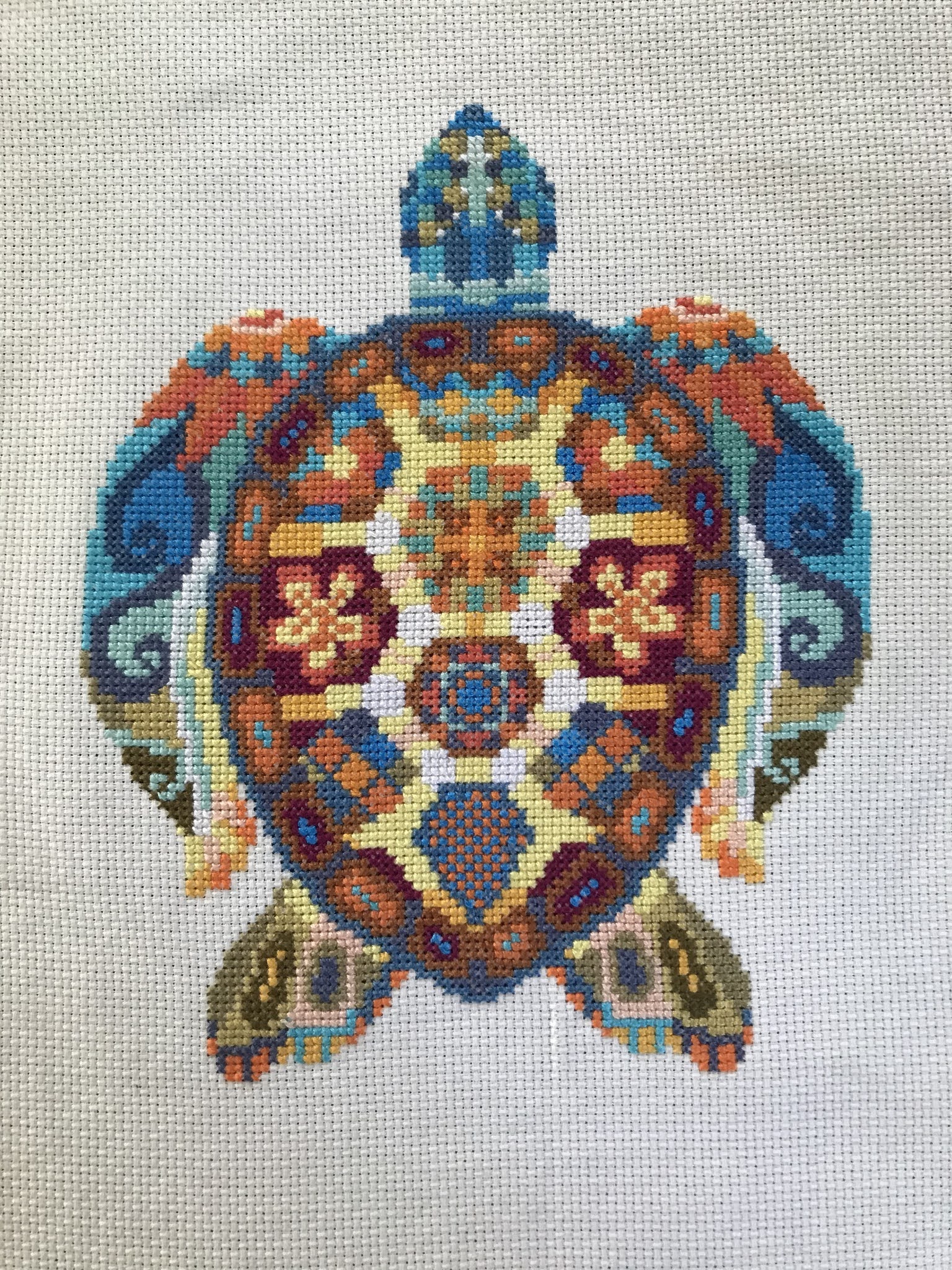
Being as my previous post was about some of the most intricate and exceptional tapestries I have ever seen, I feel somewhat inadequate posting this with the latest examples of my own work. I like doing them, however, so I'm going to continue to share. Let's just not compare though, shall we..?

When my parents were visiting my sister, she bought my mother a cross stitch to help her pass the time and give her something relaxing to do. Apparently my mother is not good at this form of relaxation, and she began it, but after a few rows she gave up. My sister gave it to me instead to complete, which I did, and returned it to her to display, as a memory of family dynamics!

A friend saw this image and thought of me -I can't imagine why! She sent it to me and I turned it into a cross stitch pattern. Now, the question is to who do I give it? There are so many possible recipients!

The following designs are Mandala cross stitch patterns from a calendar that a colleague had at work. She printed them off for me and I enjoyed making them. I didn't always have the exact colours that were specified, but I had a stab (as it were) so they may not be quite true to the original pattern, but I like the art anyway. 

Friday, 25 December 2020

Friday Five: Who's Who on Christmas Day

Obviously many families are separated this year by disease as well as distance, but through the wonders of modern technology, many of us were able to gather and converse through a screen. I miss the hugs and the contact, but I love to see the smiles and hear the laughter. As part of my festive family get-together, I compiled a quiz around the whys and wherefores of Christmas. Round one was 'Who?' and featured the following people, all born on Christmas Day (and they're all in black and white because my colour printer wasn't working). Put your answers in the comments if you're interested, and I'll tell you if you're right.

5 People Born on Christmas Day


Friday, 2 October 2020

Friday Five: Artistic Endeavours (again, counting is nebulous)

Last year, Scarey Sis (who is very good at this sort of thing) arranged a painting 'competition'. Family members who were present were tasked with painting a picture of the view. We were at Inverallt House on the edge of Loch Long, so those views were pretty spectacular, and everyone was free to interpret this as they wished. They were given two hours to get on with it.

Art has never been my strong point, but I do love words, and have always wondered about the adage that a picture is worth a thousand of them; surely that depends on the description? My part in this tomfoolery was to write the accompanying descriptions for the images, as if they were to be hung in a gallery. Incidentally, all of the artists approved the comments and said that was, indeed, what they had been implying with their picture. There were no winners or losers; creativity was the name of the game. If you want to pick a favourite, however, go for it!

8 Images on a Theme:


The confidence and expertise of this image makes the viewer instantly want to be there. The brush strokes are busy and exciting suggesting a story in the movement of the water and the boat, and the dripping of the tree. Painting disparate colours in close proximity reflects the nature of water and creates interest and pleasure. Texture and technique create a tactile impression that invites touch and interaction. If one could pop into a painting, this is the one to choose; the smell of the sea and the tang of the seaweed is in the paint itself -a delight to all senses. It expresses a world of possibilities and adventure if one is only willing to embark on the journey.


There is a beguiling simplicity in this image which is both assured and playful. The sailboats are almost cartoonish in their size and placement and are innocently unaware both of the gathering clouds and the nearby presence of military hardware nosing round the corner. The artist has manipulated the scenery to include Ben Arthur in a distant profile, while cladding the foreground hills in comforting autumnal colours. This combination of the gentle background and sharply-outlined features heightens the dichotomy of the image; the big boats may be threatening or protective, depending on the current viewpoint.


Cleverly here the artist has incorporated the painting position into the painting itself. At once both comforting and disorienting the image highlights the capacity to look both forwards and back simultaneously. Without even placing people in the landscape, the artist implies their presence by the addition of the summer dwelling. Although the doors and windows are closed to indicate the height of the season has passed, there are still hints of warmth in the suggestion of a blue sky and the gentle sloping of the hills. The outline depiction of the sailboat indicates time passing, while the passing resemblance of the gazebo/ tree trunk combination to a teapot registers a persuasion of autumnal domesticity, as we wait for the current storm to blow over.


This is potentially the most creative response to the project. Bands of colour indicate strata layering up over a long passage of time. The colours chosen have a distinctly maritime feel and reflect the tones of the loch and its shores. Superimposing the richness of objects found on the shore enforces the layered approach. The seaweed, leaves, ferns and shells provide the connection between earth, sea and sky highlighted by the layers of colour. By drawing these in dark outline, the artist casts these objects as shadow paintings or cave drawings made by early civilisations to suggest their links to the land before letters and language. The framing can be seen as a border to the lens of the light of the lighthouse or as part of an elaborate tartan pattern which again anchors the drawing to a firm sense of place. It is a defiant assertion of belonging that current political events cannot alter.


What a delight to see such a joyful interpretation of landscape. All of the natural elements are present and correct, from the shore cluttered with rocks, shells and seaweed, to the clear demarcations of the trees on the hills. While these and the lighthouse, along with the tidal movement of the water, are all suggested through colour and wash, the highlight of the image is clearly the Loch Long Monster, presented with more clarity than its surroundings. The inclusion of this mythical beast brings a fanciful element to the reality of the scene. The jaunty tam o'shanter on the monster's head instantly makes it friendly rather than threatening, and the location is obviously Scotland. In troubling times of disunity and encroaching differences, this image seems to welcome all-comers and celebrate diversity.


This image is a faithful representation of the scene, with some excellent layering and shading creating mood and atmosphere. The placement of the featured item in the background provides depth and perspective, while challenging assumptions: generally lighthouses are depicted as pillars of light shining forth, whereas this minute beacon is almost hidden. The viewer is aware that it will make its presence known when necessary and guide travellers home to safety. The suggestion is to look beyond the immediate present for signs of future hope and comfort.


This artist has used a mixture of colours and techniques from dabs and dashes to swirls and blocks of colour. Not wanting to leave anything behind, the artist has revelled in all the tricks of the paintbox. Sky, land and sea are given equal weight in a well-proportioned depiction of the landscape, as seen through an open window. The addition of blobs of colour to represent buoys is inspired. At points laid on thick and in other places applied as a thin veneer to allow the paper to come through, the paint is versatile and becomes a character in its own right. The artist implies that the technique and the method is as important as the result.


With a simple but expressive colour palette and not extending to the edges, this image captures a fleeting moment. The sail boat is central and strong picked out in black and white, but it still manages to portray an element of fragility, surrounded by strong blue water. The dashes of black, green and grey enhance the feeling of uncertainty as the weather reflects a sudden squall of rain. Whereas the green suggests the nearby land, it is not particularly reassuring. This is a passionate painting full of movement and restless energy: unsettling and unpredictable.

A recap

Saturday, 28 March 2020

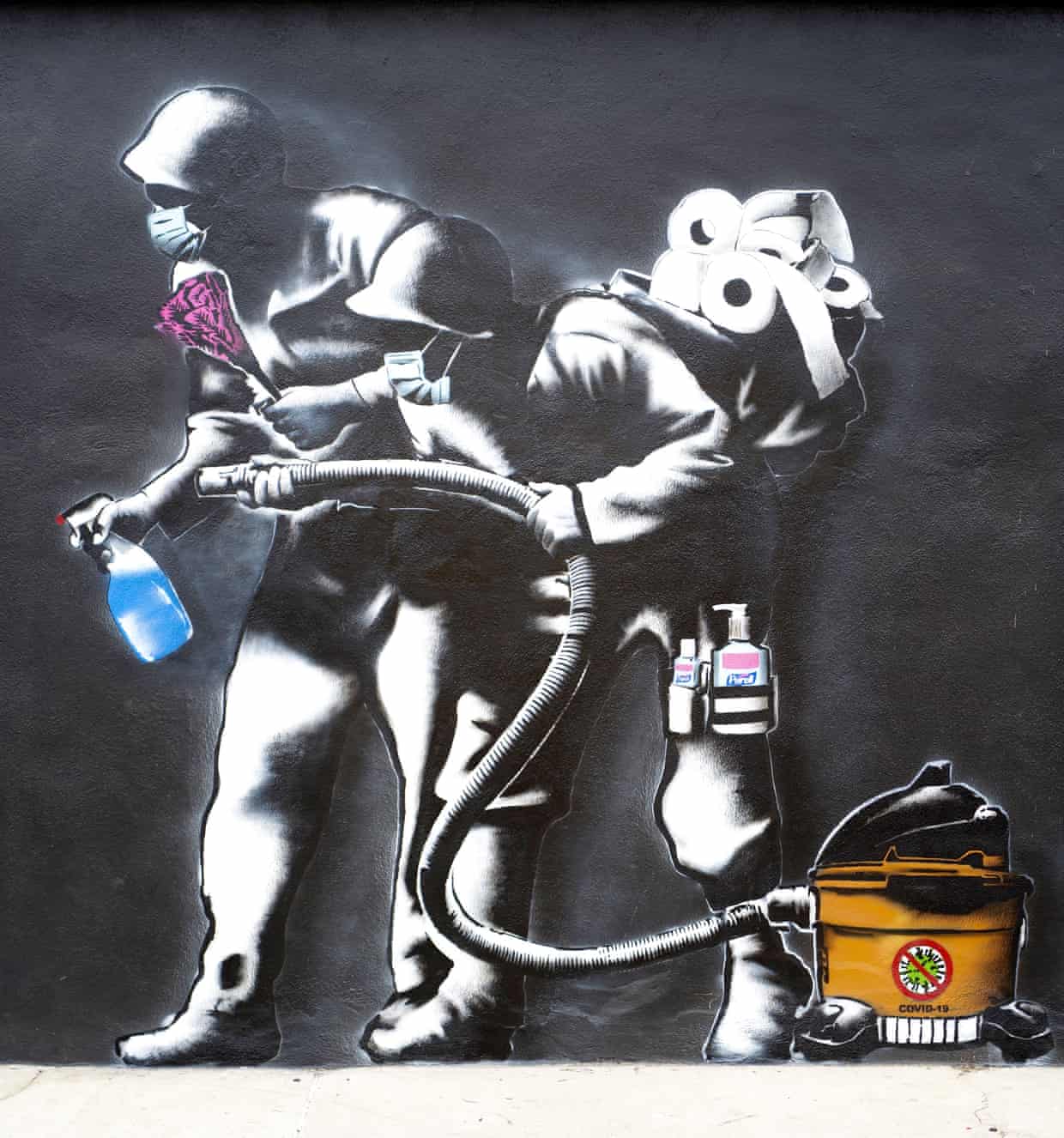
COVID-19: Under Pressure

Street art by @hijackart
There are posts doing the rounds on social media of how this enforced isolation might be good for some of us. People are proposing that we could take this opportunity to create a new work or learn a new skill. I have seen suggestions that people could paint a picture, learn a language, master an instrument, take up horticulture, or improve their culinary skills. Several well-meaning people have asked if this is not the perfect time for me to write my second novel.

The short answer is 'no'.

My fist novel took me about 25 years to write. A lot of that was research, and a lot of it was reflection. To do this I need to feel safe and have a routine; an acknowledgment that if things don't go well, or if I unearth something painful (believe me, memories of death, bombs, muggings and other trauma are not things I deal with easily), I will be able to mentally and emotionally decompress in my chosen environment (a walk in the hills; a swim in the ocean; a pint or two in the pub with my friends). This is clearly not the case at present.

I cannot speak for everyone - there are far too many people purporting to do that at present for my liking - so I shall speak only for myself. The current situation is causing me extreme anxiety. I cannot sleep. I am having frequent panic attacks which cause shortness of breath and nausea. I have a constant headache and am permanently fatigued.  

I worry. I worry about my health and that of my husband (who, performing an essential service, must leave the house every day). I worry about my family - none of them live in the same country as me and I'm not sure when (and in some cases if) I will see them again. I worry about my friends, in different countries around the world with different governments taking different precautionary measures (or not, in some cases). I worry about my community - if I don't support it, will there be one when all this is over?  I worry about losing my job. If there is no community and there is no work for me to do, how can I continue; how can I support anyone else? I worry that I am not being a good enough wife, daughter, sister, friend, neighbour, citizen, employee... when did this turn into a competition?

I try not to think too deeply about anything because I will cry, so I am currently existing on a superficial level, or a submerged one. I do not feel safe. I do not feel secure. I know I am lucky to have a house with a garden and access to fresh air and open spaces. I know others are in a far worse position than me. Anyone who has ever suffered with depression will tell you that this doesn't necessarily help. It makes me feel selfish for having these concerns, and that makes me feel like a bad person. It's a very dark vortex into which I do not want to be drawn.

So, no, do not expect anything creative from me at this time. My imagination is not in a good space. There is too much pressure to perform - and no good performances come from fear. 

Saturday, 21 March 2020

COVID-19: Make Sure You're Connected

A lonely vapour trail
This morning I received a message from a friend in the UK - inviting me to drinks in their mum's kitchen, due to the fact that the country was closing all pubs and clubs, disrupting usual Friday night plans. It was a Zoom invitation, and I joined in. Due to the wonders of technology I could see friends on the other side of the world and I shared a drink with them (tea for me as it was 8am, my time). They had a beer or a wine and we all shared stories and a laugh while checking in on one another, with lots of support, and a healthy dose of ridicule; we're all originally British after, all. There were ten of us on-line, and it felt like old times.  

But these are modern times. As we cannot make physical contact with others, it is still really important to connect and chat - naturally there will be conversations about the virus, but there should also be talk of family events, books read, scents smelled... we need reality in our virtual lives. There are of course, many platforms we can use to stay connected, but many of us have been using Zoom for work meetings and conferences for some time; this step is just the natural progression for more casual communication. 

According to the New York Times, last week 600,000 people downloaded the app, its biggest day ever. While the stock market crashes, Zoom shares have soared this year, valuing the company at $29 billion. That's more than airline companies, even before they were grounded. We had planned a holiday to the UK and France in July - it certainly doesn't look like that will be happening now, as international travel is cancelled until further notice. 

I am sad, because I was looking forward to seeing my family and friends. I still can. Obviously it's not the same as having them in the room, but technology is very powerful if we use it for good. We are fortunate to live in these times. There is a silver lining. Let's stay connected. 
"If you make sure you're connected
The writing's on the wall
But if your mind's neglected,
Stumble you might fall." - Stereo MCs

Wednesday, 3 May 2017

To every thing there is a season

Mr Wigg by Inga Simpson
(Hachette) Pp. 292


Mr Wigg is a widow who potters about his orchard, preserving fruit, listening to cricket, mourning his wife, telling stories to and cooking with his grandchildren, and watching as his new neighbours plant vines on the old farm land. The tagline is, “A novel that celebrates the small things in life”, and there is a gentle feel to the prose as it follows the seasons with planting, pruning, harvesting and preserving. This is deceptive, however, as there are spectres looming at the edges of progress and destruction; Vietnam and family rifts; ageing and loss.

Mr Wigg sees his fruit trees as personalities and imagines that they talk to each other with personalities and petty jealousies. The orchard encapsulates all his memories and aspirations. Inga Simpson writes of the different fruit like a poetic greengrocer, but always in Mr Wigg’s words, conjuring them and their stories from the air and the soil. Who knew that the provenance of these common fruits would be interesting? It is, because Mr Wigg remains in awe of the fruits he grows, engaging the reader with his ruminating non-didactic style.

Fruit isn’t always sweet, and neither, for all its bucolic images of collecting eggs, pruning fruit trees and chopping wood, is farming. Mr Wigg’s son frequently visits him to remind him of the things he can no longer do with his Parkinson’s and forgetfulness. Mr Wigg used to help the blacksmith and now has his tools; making things in his shed with the honest labour of the land. He invents a fruit-drying machine, but when he attempts to build one from his sketches, he has an accident with the bench saw. He fights against modernisation because he enjoys the old ways; why should he use time-saving devices when he doesn’t know what to do with his extra time?

His attitudes are also archaic, and it is his inherent sexism which caused a family schism. It never occurred to him to interest his daughter in the running of the farm; always assuming his son would take over. When he gives the farm to his son and nothing to his daughter, she is understandably upset, and lawyers become involved.

His late wife dominates his thoughts, as one would expect. Their relationship was full of love but not without irritation. He captures the momentous (such as family conflict and illness) along with the mundane: “His wife had buttoned his shirt cuffs for him even before the Parkinson’s came on. His dress shirts, in particular, had such tiny buttonholes.” He initially struggles with the pointlessness of existence without her, but he comes to realise that, “Life had a way of going on whether you were interested or not, and then you found yourself taking pleasure in a few small things, and a few more.”

Future generations provide continuity, and his happiest moments are with his grandchildren, cooking and telling stories. “Not everything that is new is better”; but not everything that is new is bad, either.

Monday, 17 October 2011

Quick Quintet: Aunty Katy

I have been visitng my brother and sister-in-law and niece and nephew in Miri. We have had a great time experiencing their ex-pat lifestyle and some Miri hotspots (at 40 degrees and 98% humidity, it's actually all pretty hot) and, although excited about the prospect of seeing monkeys in the rainforest, were a little sad to leave them behind and move on to the next stage of the trip.

5 Great Things about Being an Aunt:
  1. Fierce unconditional hugs
  2. Information sharing and seeing things from a fresh perspective (snakes can be very pretty, apparently)
  3. Surreal artwork
  4. Story-time
  5. Giving them back

Friday, 11 March 2011

Wonderful Whitby


I love Whitby. I love those North East seaside towns where the houses look like they are about to tumble down to the sea; where the streets are narrow and cobbled with a pub on each corner; where the fish and chips (and mushy peas) are substantial; where the winds are brisk; the cliff-tops walks 'refreshing'; where colourful boats bob in the harbour; where the people are weather-lined but not beaten; and where the sunshine is a gift.


A few years ago, I had a fantastic day out in Whitby with my parents and Scarey Sis, and I always think of it as a special place. This week on Lakeland Cam (a website I look at frequently to make myself homesick) Tony Richards took his camera to town and captured these evocative images. He posted lots of Whitby during the daytime too, which are also worth a look, but I thought I'd share these night-time reflections. Thanks to my mum for reminding me to take a look.


Friday, 24 December 2010

Christmas values


For the past couple of weeks I have been sick with worry for a good friend of mine who has just been diagnosed with cancer. He is generally as solid and dependable as an oak and now he needs all his strength to counter this vicious disease, which is wrapping itself around his internal organs like poison ivy. When terrible things like this happen to people we love, naturally we question our faith and our values.

This time of year is full of added pressure. We are bombarded with messages of a million things we ‘must’ do: buy the presents; tidy the house; deck the halls; prepare the dinner; ice the cake; wrap the presents; dress the tree; write the cards; finish all the jobs at work; send out the emails; clean the windows; sort out the cupboards; dust off the deckchairs… the list is endless.

Looking at one of my dearest friends lying in his hospital bed I realised that none of that matters at all. I know that the doctors, nurses and surgeons are all doing the best they can for him so in many ways it is the best place for him to be. But it’s full of sick people. And he needs to feel invigorated. His many visitors bring him love and support, but they can’t bring him fresh sea-air and pounding waves; it’s that which makes me feel alive.

So I walked on the beach and I thought of all the people I love and care about, and prayed that he’ll be back out soon. I haven’t done half of the things we are 'meant' to do at Christmas, but I shall sing some carols and think of my loved ones and try to spread whatever happiness I can. At the risk of sounding like some ghastly old hippy; Merry Christmas, and love and peace to all.