At the end of last year I went to the National Museum of Australia to see the excellent exhibition, Feared and Revered: Feminine Power through the Ages. The collection of treasures from the British Museum is touring until 27 August 2023, and I would thoroughly recommend attending if you get the chance. A highlight for me was the marble statue of Hekate from Italy (161-200 AD).
In her book, Feminine Power: The Devine to the Demonic, which accompanies the exhibition, Belinda Crerar writes, "The goddess Hekate is one of the most enigmatic deities of the classical world. Her reputation as the infernal 'goddess of witchcraft' has become cemented in modern popular culture and stretched back to classical belief, but it is a narrow characterisation of a complex and multifaceted ancient divinity. To the Greeks and Romans, Hekate was associated with liminal times and places, and, importantly, stood between life and death at the entrance to the underworld; yet her powers encompassed protection and guidance."

Hekate's famous triform image appears in Greek art from the fifth century BC onwards. The statue in this exhibition shows her with three bodies and three faces, each young, with flowing hair and crowned diadems. In her six hands she holds a roe and the handles of torches and daggers. Her flaming torches, common attributes in both sculpture and painting, situate her in darkness, but associate her with guiding light, and she is often also shown holding keys to illustrate her power to open or bar the way.
As a goddess of transition, Hekate is often represented in statues set up in entranceways to private and sacred spaces or at road junctions, where each of her three faces looks down a different path.
Hekate's earliest and fullest description is found in Hesiod's epic poem, Theogony of the seventh century BC, which contains an extended hymn in praise of Hekate just before the birth of the Olympian gods. In Hesiod's account, she is not an underworld deity but is said to hold dominion over the earth, sea and sky. She appears to stand apart and distinct from the gods who follow, as if she is more ancient and more honoured than they are, and Hesiod is keen to stress that even Zeus, king of the Olympians, pays Hekate special respect above all others.
The reason for this reverence is made clear when Hesiod explains that success or failure is determined by Hekate's will: she can stand protectively in harm's way or step aside as she chooses. A primordial but ambivalent force, Hekate was given the epithet kourootrophos, the 'nurse of the young' by Hesiod, and the contemporary but unknown author of the Hymn to Demeter describes her as 'tender-hearted'.
In some later Greek, but particularly Roman literature, Hekate's underworld associations become more pronounced, and she is portrayed as a more sinister force. Her approach was said to be heralded by howling dogs and she is no longer honoured by Zeus but now by Circe, Medea and Erichtho, the sorceresses and witches of classical literature who make sacrifices to her and vows before her altar for aid in their magic.
The shift in the conception of Hekate in literature may have been influenced by actual magical rituals of the Hellenistic and Roman periods. A Greek prayer found in a handbook of incantations and magical formulas from Egypt (dated c. 275-375 AD) describes her in demonic terms as bull-faced, having snakes coiled across her brow, stalking graveyards and consuming the dead.

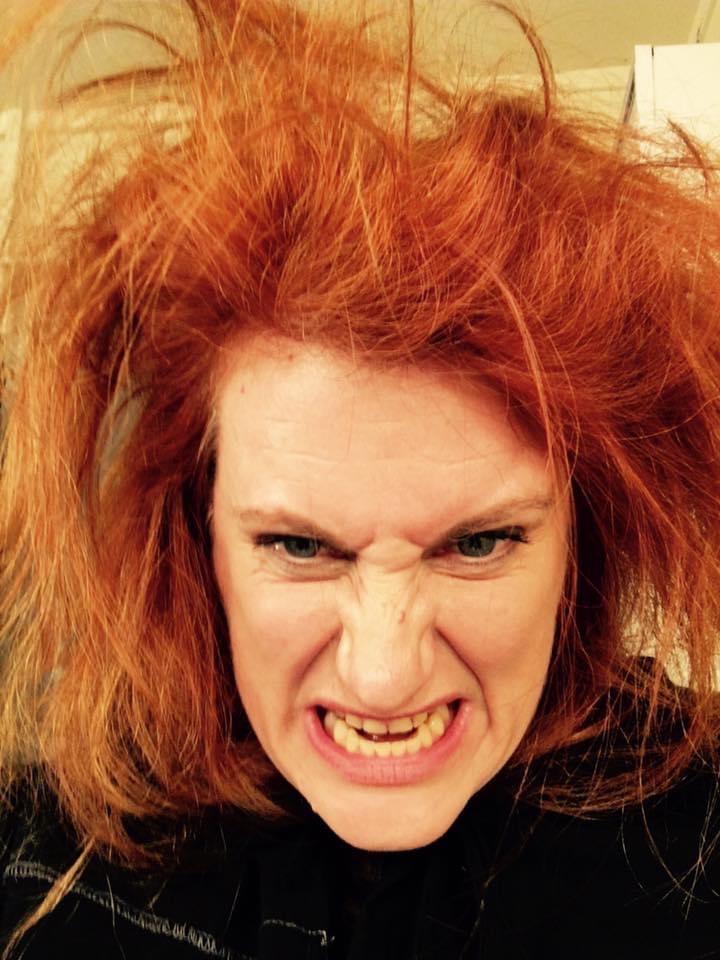
As is often the case, female power is subverted by those who fear it and made to seem evil. Some male observers cannot cope with women being multi-faceted, so they cast them as two-faced as though that is a bad thing. To modern audiences, Hekate is largely known through being the 'leader' of the three witches in Shakespeare's Macbeth. She is presented as a sadistic, controlling and merciless commander of the coven, angry to have been excluded from previous plots and determined to control the prophecies and apparitions in order to maximize their manipulative affect and contribute to Macbeth's downfall. Naturally this has particular relevance for me as I played Hecate in a 2016 production of Macbeth by Canberra Repertory Society.
"I am for the air; this night I'll spend
Unto a dismal and fatal end:
Great business must be wrought ere noon:
Upon the corner of the moon
There hangs a vaporous drop profound;
I'll catch it ere it come to ground
And that distill'd by magic sleights
Shall raise such artificial sprites
As by the strength of their illusion
Shall draw him on to his confusion;
He shall spurn fate, scorn death, and bear
He hopes 'bove wisdom, grace and fear:
And you all know, security
Is mortals' chiefest enemy." - Macbeth (Act III, scene v), William Shakespeare
 |
| As Hecate in Macbeth (2016) |
In keeping with reclaiming mythical and magical female figures from history to embody more empathetic, inclusive and complex interpretations, it is worth noting that since the late 19th century AD, Hekate's relevance has been revived and her spiritual importance has been incorporated into religions such as Wicca and Modern Paganism.
 |
| As a lady in Macbeth (2016) |