I don’t like clothes shopping. By which I mean I don’t like shopping for clothes. If clothes want to shop, that’s fine by me, although perhaps unlikely. According to popular mythology, women love shopping. Sigh. Another way I don’t fit into your boxes.
The first problem is me. My top half and my bottom half are different sizes, which means I can’t easily wear dresses. Apparently if you are over a size twelve anyway, all should wear is black so you can scuttle about your business and return to your house as unobtrusively as possible. Designers don’t want you to be seen in their clothes – heavens; it might suggest there are real women out there, and the sky might fall.
The second problem is the clothes. They are usually badly-made and ill-fitting with shoddy stitching and insufficient lining. My grandmother was a seamstress. She would take the garment between thumb and finger, examine the material and the make-up and then tut loudly and pronounce, ‘Shabby’. It was an experience that to witness was to wither. Many shop assistants are probably still in therapy.
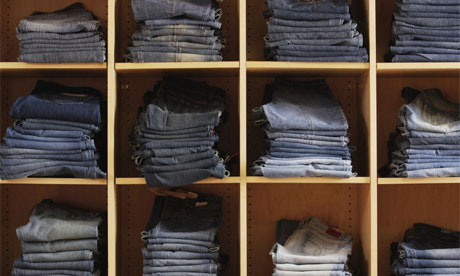
The contribution of high-street fashion to slave labour and sweat shops makes me sick. Certain shops proudly trumpet the fact that they sell jeans for $15. You can bet they have a hefty mark-up on these items, so they are probably purchasing them for $5 or less. That price will include transport from China or Bangladesh or the Philippines or whichever country’s impoverished workforce we are currently choosing to exploit. Slavery was abolished in Britain nearly 200 years ago, and the Universal Declaration of Human Rights banned slavery globally in 1948.
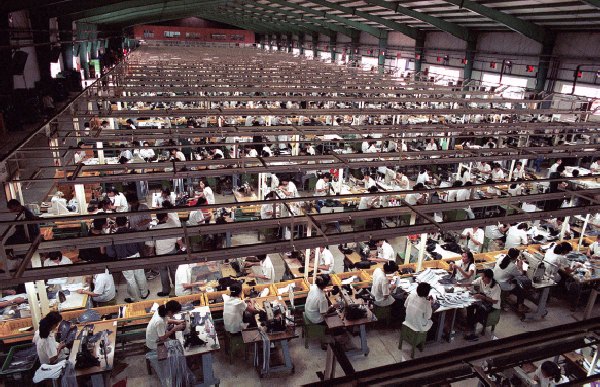
By turning a blind eye because I want cheap jeans (and who doesn’t? I haven't got much money and I certainly can't afford top-end designer gear) I am perpetuating this system. I am not supporting my local economy, manufacturers or designers, and therefore am contributing to the current downturn with its inherent erosion of workers’ rights and might as well vote Tory. I buy Fairtrade, organic and free range products wherever possible and have never illegally downloaded artistic creations. To purchase unethically would betray my principles and yet buying clothes seems to leave me with strictly limited options.
The third problem is the shops. Loud music; fluorescent lighting; confronting changing rooms; neurotic thermostat controls; and as for the staff… It’s really not their fault; they are there to sell and I suppose they get a commission. There is no other excuse for them foisting items onto you that you clearly don’t want or suit and then telling you that they look great on you when you know perfectly well they make you look ghastly but you have been battered by the onslaught of rampant consumerism and you don’t want to look like a failure by leaving the shops with nothing – it is tantamount to admitting you are misshapen and hideous and will never fit in with the thin and pretty people – so you buy something you will never wear and still have achieved nothing through the whole rigmarole except a feeling of self-loathing and an inability to pay the heating bill, and, what’s more, you will have to do it again because you still haven’t got a pair of jeans that fits... And breathe.
Enter my damsel in shining armour: Mim at Veronika Maine. She does not laugh at my size, or make me feel bad about being big. She asks whether I want colour and what styles I would prefer. She recommends things that actually fit (and are well made), and doesn’t seem to mind if I don’t take everything and spend a fortune. She understands my ethical concerns and discusses them with me. The shop is part of a group that is 100% Australian-owned and employs local designers. Almost everything is made in Australia and the organisation works closely with the Textile Clothing and Footwear Union of Australia (TCFUA) to ensure rights and working conditions are honoured. How often have you been confident that the retail assistant in the high street would even know those details, let alone be proud of them?
And the changing room is spacious and pleasant. I leave the store with two pairs of jeans that fit, that aren’t outrageously expensive (but I know that the price I paid means that the people who made them received a decent wage or doing so) and that I know I will wear and be happy with. I also have a good feeling about my ethical consumer choice. For once, I have had an enjoyable shopping experience. Honestly, why would I shop anywhere else?
Showing posts with label workers' rights. Show all posts
Tuesday, 2 July 2013
Tuesday, 2 November 2010
Big Foot Strikes Again!
Recently the New Zealand media has been awash with hysteria over The Hobbit. Because some actors who were part of the union dared to ask for comparable wages with their American counterparts for doing the same job in the same conditions on the same film, the executives at Warner Brothers threatened to take the film off-shore. Suggestions were Poland or Czechoslovakia, because it’s cheaper. There was outcry.
This did lead to some interesting asides as an article in The Guardian speculated where certain scenes might be located if set in Britain (let’s not forget; where the book was originally written). The Shire is described thus; ‘Tranquil and pastoral, the Shire is home to the Hobbits, a bizarre race of tiny, shoeless, greedy, pipe-smoking, badly dressed little men and matronly wives.’ The suggested location was therefore Luton town centre. The forum was opened up to the public to propose where they would shoot The Hobbit – the first answer was, ‘I would shoot the hobbit in the face’. My, how I laughed.
According to some sections of the population The Hobbit can be set nowhere but New Zealand, never mind the fact that JRR Tolkien never even visited here. For a nation that has been proudly churning out ‘New Zealand-made’ garments from sweat-shops in China for years because it’s cheaper, the righteous indignation feels a little hollow. These are probably the same people who illegally download films and music, thereby killing the performance industry to save themselves a few dollars.
Many extras and people who don’t actually make a living through acting are claiming, ‘I’d do it free’. How helpful is that really? For some reason many sections of society seem to think that because actors love their job, they should be paid a starvation existence, if at all. I’m not sure I follow this argument – are we saying that lawyers and surgeons hate their work? After all, no one expects them to work for free.
It seems that the nation has finally woke up to the fact that people don’t adore them the way they think – they just use them because their labour is often cheaper than in other (generally unionised – i.e. fairly paid) countries. So I woke up one morning last week to find that John ‘I made fifty million pounds out of screwing people like you’ Key has changed the labour laws overnight, and denied one of the workers’ primary rights – that of collective bargaining. Yes, you read that right: 300 years of workers’ rights sold to Warner Brothers. It may not be Mickey Mouse, but it’s certainly goofy.
Corporate greed triumphs once again, as you would expect from the despicable I’m Alright Jack politics that epitomised the Thatcher era (during which this particular Jack made his millions), but the fact that a Prime Minister can directly intervene in a commercial venture and bribe a company to come to his country (Warner Brothers will receive $25 million in tax breaks) so it receives worldwide exposure is disgraceful. New Zealand scenery will once again be on the big screen and it will do wonders for the tourism industry (the same Guardian article points out that, ‘prior to those films it was just bungee jumping and binge drinking, but now the spectacular scenery is its own selling point’), but the actors will leave. He has made sure of that.
When all that is left are right-wing propaganda mainstream X-box American remakes in ten years time, people who voted for this slippery snake will have only themselves to blame. I will be boycotting the film of The Hobbit when it finally comes out, even if it does star Richard Armitage. Admittedly, I am only one person and will not make much of an impact on the American/oops, I mean New Zealand (there appears to be little difference) dollar, but like the actors who fought for their rights I am prepared to stand by my beliefs. (Plus The Hobbit is one of only two books I have ever started and not finished out of sheer boredom.)
Meanwhile in France, such things would not pass without a ripple. President Sarkozy’s attempt to raise the retirement age from 60 to 62 drew mass protests and strike action from the workers. It was said to cost the national economy €400 million a day and yet 70% of people supported the unions who called for these strikes. Jean-Luc Hacquart, a representative of the CGT union in Paris (Confédération générale du travail) – the strongest union in France – said (albeit doubtless in French),
"Democracy is not a carte blanche given to people to do what they want between elections. It doesn’t work like that."
George Orwell wrote in Nineteen Eighty-Four, “If you want a picture of the future, imagine a boot stamping on a human face— forever.” If only people were less apathetic and more socially minded in this country, the hard-fought rights of the workers would be safeguarded rather than tossed aside for the benefit of a group of hairy-footed cellar dwellers. I mean the fictional hobbits – what were you thinking?
Labels:
acting,
George Orwell,
John Key,
New Zealand,
politics,
The Guardian,
The Hobbit,
trade unions,
workers' rights
Subscribe to:
Posts (Atom)