Showing posts with label ethics. Show all posts

Tuesday, 27 October 2020

An Age Old Question: The Devil and Miss Prym


The Devil and Miss Prym by Paulo Coelho
Thorsons
Pp. 201

Leo Tolstoy is said to have said, “All great literature is one of two stories; a man goes on a journey or a stranger comes to town.” This is the latter of those two options, and its claim to great literature is subjective, but the author has sold over 175 million of his books worldwide. One day a stranger comes to the town of Viscos (spoiler alert: he is the devil of the title) with a backpack containing twelve bars of gold. He offers one of them to Chantal (the Miss Prym of the title) on the condition that she communicates to the villagers that they will receive the other eleven if they commit a murder.

In essence it is a very simple morality tale; are people intrinsically good or evil? The basic prose may be a matter of translation from the original Portuguese (Coelho is Brazilian) but it suits the elements of fable, incorporating many parables. As it is a philosophical conceit, the narrator is omniscient, the characters are ciphers, and the events are unrealistic. It is cerebral rather than emotional; designed to make the reader think rather than feel.

The village of Viscos is remote and irrelevant, chosen deliberately by the stranger for his experiment. He wants to pit the villagers against each other, knowing that they are all in desperate financial straits and would welcome a windfall. It does not matter to the stranger whom the villagers choose to murder, only that they commit the act, and therefore, this is also an exploration of the conflict between the individual and society. “The story of one man is the story of all men. I need to know if we are good or evil.” Most cultures and religions have tales of the eternal struggle between good and evil. A Native American myth posits that we all contain two wolves; a kind and gentle one and a fierce and vicious one. The one that survives is the one we feed. This is incorporated into the metaphor of the rogue wolf which stalks the forest and terrorises the villagers, keeping them afraid. Many religions also have “a place of punishment, where the immortal soul goes after committing certain crimes against society (everything seemed to be in terms of society, rather than of the individual).”

The fundamental question is whether we are intrinsically good or bad, and what makes us this way. Coelho suggests that we are only good due to the fear of consequences. The stranger says, “I am a man who walks the earth with a devil at his side; in order to drive him away or accept him for once and for all, I need to know the answers to certain questions.” He chose Chantal because she is orphaned and searching for a way to escape her dull life in the village, but she wants someone to rescue her rather than acting for herself. She has several meetings with the stranger – as a single woman these may cause consternation but she has no one to protect her morality and can do as she please. She realises, however, that she too is bound by the fear of the future.

The metaphysical problem is described as game theory – gambling on the actions of others in order to protect yourself. It’s an old conundrum and one that doesn’t really have an answer. Chance exists and bad things happen to good people (the story of Job from the Old Testament is included along with many other myths and legends); perhaps we need the hope to carry on, like the widowed Berta, who sits outside her house every day watching the villagers and commenting on their action with her dead husband. The problem with the severely pedagogic tone is that it leaves little for the reader to do. Just as Chantal is trapped in the village, we are trapped in this narrative and will only be released when Coelho has finished with his lecture.

Tuesday, 2 July 2013

My Newest Favourite Thing: Veronika Maine

I don’t like clothes shopping. By which I mean I don’t like shopping for clothes. If clothes want to shop, that’s fine by me, although perhaps unlikely. According to popular mythology, women love shopping. Sigh. Another way I don’t fit into your boxes.

The first problem is me. My top half and my bottom half are different sizes, which means I can’t easily wear dresses. Apparently if you are over a size twelve anyway, all should wear is black so you can scuttle about your business and return to your house as unobtrusively as possible. Designers don’t want you to be seen in their clothes – heavens; it might suggest there are real women out there, and the sky might fall.

The second problem is the clothes. They are usually badly-made and ill-fitting with shoddy stitching and insufficient lining. My grandmother was a seamstress. She would take the garment between thumb and finger, examine the material and the make-up and then tut loudly and pronounce, ‘Shabby’. It was an experience that to witness was to wither. Many shop assistants are probably still in therapy.

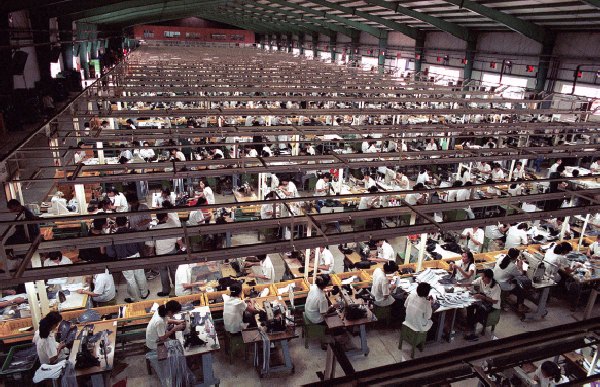
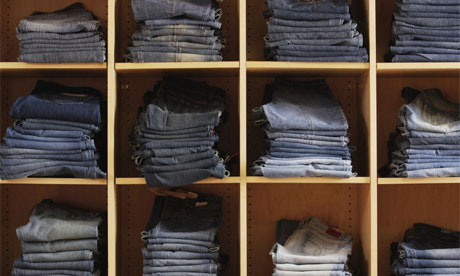
The contribution of high-street fashion to slave labour and sweat shops makes me sick. Certain shops proudly trumpet the fact that they sell jeans for $15. You can bet they have a hefty mark-up on these items, so they are probably purchasing them for $5 or less. That price will include transport from China or Bangladesh or the Philippines or whichever country’s impoverished workforce we are currently choosing to exploit. Slavery was abolished in Britain nearly 200 years ago, and the Universal Declaration of Human Rights banned slavery globally in 1948.


By turning a blind eye because I want cheap jeans (and who doesn’t? I haven't got much money and I certainly can't afford top-end designer gear) I am perpetuating this system. I am not supporting my local economy, manufacturers or designers, and therefore am contributing to the current downturn with its inherent erosion of workers’ rights and might as well vote Tory. I buy Fairtrade, organic and free range products wherever possible and have never illegally downloaded artistic creations. To purchase unethically would betray my principles and yet buying clothes seems to leave me with strictly limited options.

The third problem is the shops. Loud music; fluorescent lighting; confronting changing rooms; neurotic thermostat controls; and as for the staff… It’s really not their fault; they are there to sell and I suppose they get a commission. There is no other excuse for them foisting items onto you that you clearly don’t want or suit and then telling you that they look great on you when you know perfectly well they make you look ghastly but you have been battered by the onslaught of rampant consumerism and you don’t want to look like a failure by leaving the shops with nothing – it is tantamount to admitting you are misshapen and hideous and will never fit in with the thin and pretty people – so you buy something you will never wear and still have achieved nothing through the whole rigmarole except a feeling of self-loathing and an inability to pay the heating bill, and, what’s more, you will have to do it again because you still haven’t got a pair of jeans that fits... And breathe.


Enter my damsel in shining armour: Mim at Veronika Maine. She does not laugh at my size, or make me feel bad about being big. She asks whether I want colour and what styles I would prefer. She recommends things that actually fit (and are well made), and doesn’t seem to mind if I don’t take everything and spend a fortune. She understands my ethical concerns and discusses them with me. The shop is part of a group that is 100% Australian-owned and employs local designers. Almost everything is made in Australia and the organisation works closely with the Textile Clothing and Footwear Union of Australia (TCFUA) to ensure rights and working conditions are honoured. How often have you been confident that the retail assistant in the high street would even know those details, let alone be proud of them?

And the changing room is spacious and pleasant. I leave the store with two pairs of jeans that fit, that aren’t outrageously expensive (but I know that the price I paid means that the people who made them received a decent wage or doing so) and that I know I will wear and be happy with. I also have a good feeling about my ethical consumer choice. For once, I have had an enjoyable shopping experience. Honestly, why would I shop anywhere else?