The following are short reviews of the books that I read in September 2009. The marks I have given them in the brackets are out of five.
 The Post-Birthday World – Lionel Shriver (3.9)
This might well be subtitled a novel of sex and grammar. It concerns middle-class middle-aged navel gazers, debating whether or not to have an affair, yet it is strangely compelling.
The Sliding Doors concept means the book is written with artifice and mathematical precision, almost like a ‘boy book’ but with a female subject matter, reminiscent of Carol Shield’s Happenstance. The first chapter is the same – Irina and Ramsey go out to dinner on his birthday and she is tempted to kiss him despite the fact that she is in a stable relationship with Lawrence. In the words of the author, ‘Thereafter the narrative splits into two parallel universes: the one in which she gave into temptation, and the one in which she remained faithful to her partner and demurred.’
The eternal love triangle is not exactly a revolutionary theme for a novel, but it is observed with such intense scrutiny that many nuggets are familiar, although some of the dialogue is unrealistic.
The two men offer the choice of companionship versus eroticism, and Irina discovers that not all excitement is good and that security is hugely undervalued. Obviously Ramsey and Lawrence are opposite sides of the same coin. “If you put the two of them together – Lawrence’s discipline, intellect, and self-control, Ramsey’s eroticism, spontaneity, and abandon – you’d have the perfect man.” The reader is practically invited to get involved – which man would you choose? In Irina’s situation, what would you do?
The artifice of the novel occasionally intrudes, and Shriver deliberately draws attention to it. In this novel of linguistics and semantics, every word has significance and connotation. Every utterance is analysed for meaning or pretention and the imagined children’s stories that Irina illustrates are both fascinating and relevant.
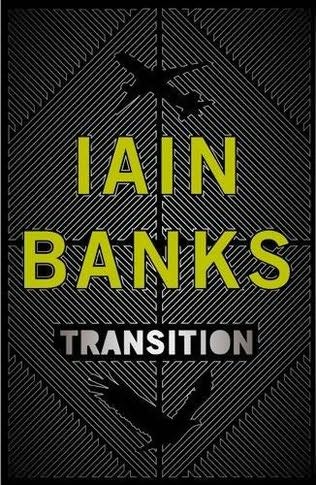
 Transition – Iain Banks (4.2)
This novel is supposedly the mid-way point between Iain Banks and Iain M Banks, so you get the best of both worlds; nitty-gritty realism and fanciful sci-fi imaginings. From the opening sentence – “Apparently I am what is known as an Unreliable Narrator” – you are immediately plunged into chaos and confusion.
The narrator is a transitionary, someone who can flit between worlds where they can interfere and affect outcomes. Some of the tasks of the Transitionary are to do good; to intervene by introducing people to each other, leaving a book lying around for them to discover, stopping them from entering a building that is about to collapse. But these are not the roles the Transitionary relishes and which keep him awake at night.
Some people are able to tandem, which is to take another person with them when they transition. Most transition with the help of a special chemical in tablet form, called septus, although the Transitionary does it by sneezing, like Nadia Popov in Rent-a-Ghost. An organisation controls the transitions and the quantities of septus, but what happens if people can flit or transition without it? Also, some people are able to pervert the natural order by assuming new bodies and simply refusing to age or die. As with all of Iain (M) Banks’ novels there is an element of paranoia and the fear of powerful corporations, and he advocates disorder and natural arbitrariness.
With or without the M, Ian Banks is instantly recognisable and any novel of his will provide a good read. You know what to expect up to a point. His genius is that he can take similar ingredients each time – sex, torture (this gets a bit preachy and there is an obvious swipe at the Bush administration and Guantanamo Bay), drugs, whisky and of course, Scotland – and create an entirely new concoction.
 Desdemona, If Only You Had Spoken! – Christine Brückner, (translated by Eleanor Bron) (4)
This collection of eleven monologues was written by Christine Brückner and translated by Eleanor Bron who adapted them for the stage. Brückner wrote imagined monologues of women who were famous but had never had a chance to be heard. The subjects range from the Virgin Mary to Clytaemnestra or Desdemona. Some of the characters are fictional heroines, others are real characters, like Gudrun Ensslin (part of the Baader-Meinhof group) or Katharina von Bora, who was married to Martin Luther, founder of the Protestant movement.
Each speech is introduced with a concise and informative explanation of the character and their relation to history. In these monologues, many of the women rail against their invisibility, demanding to be considered in their own right, rather than as a wife, mother or unpaid housekeeper. Brückner has given these women a voice; all of which are varied, but all of which are real.
Eleanor Bron seized upon the opportunity to translate these pieces and perform them. She confesses she was helped by the fact that, “Monologues, once the province of after-supper recitation and revue, had recently started to find favour once again. This revival owed a lot to Alan Bennett’s television series ‘Talking Heads’, which resuscitated the form by demonstrating its richness and variety.”
All of the women have things to say, which range from relationships and motherhood to politics and war. All of these women are angry, which makes their emergence from the page to the stage very dramatic. All of these women are powerful. All of them deserve to be heard. And Christine Brückner and Eleanor Bron should be commended for bringing them to our attention. Now we just need to sit up and listen.
 Lucky Man – Michael J Fox (3.8)
When Michael J. Fox ‘came out’ to the media that he had Parkinson’s disease (or P.D. as he terms it) in 1998, the disease came to international attention. He is quick to point out that it affects people differently and their reaction to the drugs they take will vary. He can only relate his story and he does with candour and honesty that is touching and informative.
Dealing with the disease forced him to alter his way of life, deal with his drinking and address his issues with his family and fame. In order to explain what changes he made, he relates details from his career and his lifestyle, some of which he is ashamed.
He describes the world of fame as a hall of mirrors – an unreal world in which you get given free stuff all the time and the police let you off speeding tickets in residential areas. The freedom that came with this fame proved to be his undoing as he constantly pushed the boundaries only to find that there weren’t any and if he wanted some, he would have to put them in place himself.
And then he woke up one morning with a hangover and a twitching little finger that wouldn’t go away. For a long time he denied the symptoms and attempted to carry on life as normal, but eventually he saw an analyst, gave up alcohol and forced himself to confront his illness. “I experience the full panoply of classic Parkinsonian symptoms: rigidity, shuffling, tremors, lack of balance, diminished small motor control, and the insidious cluster of symptoms that makes communication – written as well as spoken – difficult and sometimes impossible.”
He takes medication to quell these symptoms but he can’t stay on it all the time so he experiences a sort of Jekyll and Hyde melodrama depending on whether he is on or off his medication. He arranged his life so that he could act or be seen in public when the drugs were in effect ensuring no-one knew he was sick. When the acting and hiding of symptoms got too exhausting, he finally decided to publicly admit his illness. But he didn’t want pity from his audience; he wanted to be able to do something positive.
He found that breakthrough research is being done into Parkinson’s that cannot be funded – the Bush administration’s stand against stem-cell research is far from helpful, if not downright criminal – but according to a professor of neurological sciences, “of the big three degenerative neurological diseases – Parkinson’s, Alzheimer’s, and ALS (Lou Gehrig’s) – we think P.D. will be the first domino to fall.”
MJF didn’t just want to be a poster boy for P.D. so he set up his own organisation to help researchers find a cure within find a cure within the decade. “Our optimism on this score was matched only by our impatience.” We can only hope that his impetus helps bring a cure for this debilitating disease. And sooner rather than later.
 I hate supermarkets; they sap my soul.
 The music is vile, and the forced jollity of the announcements telling me what’s on special in aisle four makes me want to cry at the thought that the real world is out there somewhere, but it’s not in here. What’s in here is bored-out-of-their mind women pushing trolleys and pandering to their brattish offspring.
 I’m currently reading the brilliant Eating for England by Nigel Slater. He writes of the farmer’s market; “I shop there because I want to meet the people who grow what I eat, to experience the joy of seasonal shopping, to be as close as I can to where my food originates without actually getting my hands in the soil. And I suspect that, as I trundle up the hill with my recycled bag of cheap corn on the cob still in its fresh green husks and a swaying bunch of three-foot-high sunflowers, it probably allows me to feel just a wee bit smug about those shoppers with their supermarket packet of identically sized, overpriced, cellophane-wrapped green beans from Mozambique.”

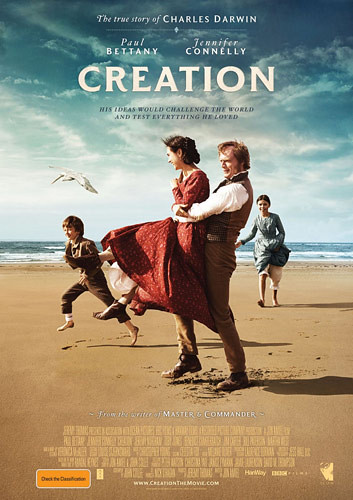
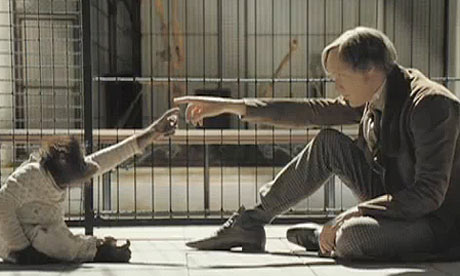
 He questions the rational of a vindictive divinity. Thousands die that only a few may live – what sort of a plan is that? Innes can only answer, “It is not my duty to speculate on the will of God.” Just as there are no atheists in the trenches, Darwin postpones publishing because, although he has proved the triumph of science, he is still afraid to risk his mortal soul. When his daughter’s life hangs in the balance (it is to be supposed that she died from scarlet fever), he is prepared to bargain with God; if you let my child live...

 Great cinematography abounds from the opening credits (cells; sperm; fish; birds; butterflies; wildebeest) to the sped-up cycle of life and the seasonal changes depicting passage of time. The English countryside is stunning with its woodland mammals and rock pool inhabitants. Nature is instructive and it is also a battlefield. In a scene straight out of a BBC documentary, a fox catches a rabbit much to the dismay of the youngest Darwin girl. The moral is left to Annie to explain, “The fox has to eat the rabbit or its babies will die – that’s the balance of things.”




 The flashing blue lights popped up and Him Outdoors was reluctantly pulled over by the unmarked police car. After trading ‘You shouldn’t have pulled out like that’ and “It wouldn’t have been a problem if you weren’t speeding’, the policeman allowed that he had another pressing call to attend and that Him Outdoors was lucky to be let off without a fine. His parting shot was, ‘Just watch who you call a f*&%ing t#%t in future, sir.’ Which goes to prove, you can never be too careful on the road – someone is indeed always watching.