Friday, 6 July 2012

Friday Five: Local TV

Moving to another country is weird in all sorts of ways. Even (or perhaps especially) if you're in a place that speaks that same language and is similar in many ways, you can still get thrown by everyday events, such as 'what's on TV'. Australia appears to be three years behind New Zealand in Coronation Street and, as New Zealand is already at least eighteen months behind Britain, it can all get a bit confusing. Charlie Stubbs popped up the other day, large as life (and twice as ugly)! The second series of Downton Abbey (which I saw in NZ last year) has just begun.

We have got repeats of Doctor Who from the Rose days through the Martha Jones/ Torchwood debacle and the Donna Noble days. I love David Tennant and I really enjoy the Doctor Who Confidential, which strangely manages to add to the magic as it demystifies the secrets. We're also getting old runs of Remarkable Vets, which make me feel nostalgic for the many times Chester visited and was so well looked after. Plus a couple of friends works there, and it's amusing to watch one try and dodge the camera, while another seeks to hog the limelight.


5 TV Programmes I'm Watching:
  1. Silk/ Harry's Law - It may not be fair to put them together, but they are both excellent examples of legal dramas in their own way and representative of their county. Silk is intelligent, well-written, and well-directed, highlighting persoanl, political, and legal concerns. It features great acting from Maxine Peake (Veronica from Shameless and Twinkle from Dinner Ladies), Rupert Penry-Jones (Adam from Spooks) and Neil Stuke (Paul from Grafters) and seems real. As a compariosn, Harry's Law is yet another legal drama by David E Kelly, this time starring the inimitable Kathy Bates with good support work from Nathan Coddry and Mark Valley. It's a lot neater and slicker with jump cuts and obvious musical overlays, and you don't have to think much to follow it, but it's fluffy emotional legal drama and I like it.
  2. Episodes - Relationships, writers, actors, relationships between actors and writers, anglo-American co-operation and miscommunication - it's all there, and it's funny. And Matt LeBlanc is the perfect foil to Stephen Mangan and Tamsin Greig (both from Green Wing among countless other things).
  3. Tricky Business - worth watching for Antony Starr and the scenery (Wollongong), it's billed as 'an Aussie family drama' about a debt collection company. As it's pretty good, and involves real actors, it will probably be axed in favour of yet another reality cooking/singing/home rennovation/ dancing programme.
  4. Once Upon a Time - Everyone is actually a fairy tale character in a parallel universe, and the evil queen prevents them from knowing the truth. It's as fun to imagine which character you might be (I think I'm the gingerbread house witch) as it is to watch Robert Carlyle play Rumplestiltskin.
  5. Death in Paradise - Ben Miller is a stiff-upper-lipped policeman trying to battle island crime while sweating in a suit in the French Caribbean - kind of like Bergerac with better weather, or a cross between Wild at Heart and Doc Martin. An excellent excuse to film somewhere exotic, and fill the screen with sun-drenched clichés.

Tuesday, 3 July 2012

Portrait Gallery - Part Two

The 'Australia Now' gallery features those of current importance, figures in leadership, business, sport, science, medicine, literature, performing arts, film arts, and visual arts.

Fred Hollows by Kerrie Lester
Fred Hollows' portrait by Kerrie Lester is a fabulous image of oil on hand-stitched canvas. The bold, cheerful colours and sharp creases befit someone so instrumental in the treatment of eye disease and improvement of sight.
Jane Campion by Peter Brew-Bevan
The photograph of Jane Campion by Peter Brew-Bevan (1969) really stands out as she sits in front of a bookcase, and her image is reflected in a shiny table, looking at us twice over.
Keith Urban by Peter Brew-Bevan

Peter Brew-Bevan is also responsible for the 2007 photograph of Keith Urban. This is another classic, depicting him slouching against the wall, hands in pockets and looking down as though slightly self-conscious by the celebrity side of musicianship.

David Campese II by Paul Newton
In contrast, Paul Newton's portrait of David Campese (2000) is astonishingly direct. Also dressed in casual black shirt and jeans, he leans against a wall with his arms folded. It's a similar pose to the one adopted tby Keith Urban, but he looks straight at the viewer and, although not arrogant, he seems very confident and comfortable.

Neil Armfield by Adam Cullen
 In Adam Cullen's portrait of Neil Armfield (2010) the theatre, film and opera director is rendered in vibrant oils against a sage green canvas. The vivid colours of his bright pink flesh, blue jacket and yellow dog drip down the canvas as though anxious to escape their artistic confines. Although they are both sitting, it is not comfortably.

Angry Anderson by Sally Robinson
Angry Anderson by Sally Robinson (2006) is an intriguing acrylic on canvas. Although wearing a black singlet and covered in tatoos, he is smiling and looks far from angry. His flesh (both the painted/ inked variety and his naked bald pate) is comprised of coloured dots like an example of pointillism or a pixellated version of an identity-supressed subject, while conversely featuring him in microscopic detail.

Robert Drewe (In the Swell) by Nicholas Harding
Robert Drewe in the Swell by Nicholas Harding (2006) is a fantastic work of oil on Belgium linen. The author is painted in slithers of pastel paints like gelato, looking good enough to lick.

Glen McGrath by Sally Robinson
Glen McGrath by Sally Robinson (2003) is made up of stripes and dashes of synthetic polymer paint on canvas conveying an attitude of movement and deceptive motion as he strokes the ball almost imperceptibly with two long fingers.

Cathy Freeman by Kerrie Lester
Cathy Freeman's portrait by Kerrie Lester (1999), rendered in oil on harnd-stitched canvas, is almost naïf art in style with the black outlinesserving to enhance the power and the strength in the long limbs. Smiling and stretching against a chain-link fence, there is a suggestion of explosive speed and wild spirit wild spirit about to be unleashed.
Eddie Mabo by Gordon Bennet
Newspaper print and aboriginal symbols against a skyline of modern buildings make the perfect background for Eddie Mabo's portrait by Gordon Bennet. The passion of the land rights decision with all its inherent shame, hurt and justice is evident in this synthetic polymer paint on canvas.

Senator Neville Bonner by Robert Campbell Junior
Senator Neville Bonner was Australia's first indigenous parliamentary member. In this 1990 portrait by Robert Campbell Junior, he is surrounded by stylistic depictions of animals with the red, black and gold flag of the aboriginal people.

Patrick White by Brett Whitley
The 'star' of the show is a featured exhibition of portraits of author Patrick White by artist Brett Whiteley to coincide with the one-hundredth anniversary of White's birth. There was an artistic and ideological stoush between the pair, which gives this exhibition a particular edge.

Monday, 2 July 2012

Portrait Gallery - Part One

When I go to a new country, one of the things I love to do is go to their national portrait gallery. I think you can learn a lot from these places, such as who is important to the nation and why.

The National Portrait Gallery, Canberra, contains a visual snapshot of Australians. The portraits are predominantly of politicians, athletes, generals and soldiers, activists and Indigenous rights' campaigners, chefs and restauranteurs, newsreaders, fashionistas, artists, authors and musicians, architects, doctors and scientists.

Some are against blank backgrounds; others have elaborate settings, which can be as significant as the subject themself and can help you guess their occupation.

Dr John Yu by Ah Xian
A glazed ceramic head of Dr John Yu by Ah Xian was my starting point. Dr John Yu was Australian of the Year in 1996; as a paediatrician and administrator, and noted for his collection of Chinese ceramics and love of art and music, this torso with little child figures crawling over it makes perfect sense, and it is the first 21st century porcelain bust in the National Gallery's collection.

HRH the Crown Princess of Denmark by  Jiawei Shen
I love this portrait of Mary. She stands in a stunning blue gown with a sash, accessorised with a Danish elephant, looking frankly at the viewer. On one side is a Danish column, and on the other is an open widow, through which can be glimpsed the Opera House which, as it was designed by Dane Jørn Utzon, cleverly combines her background with her future representing the two countries.

George Tjungurrayi by Matthÿs Gerber
George Tjungurrayi was an artist, of the Pintupi/ Luritja/ Ngaatjatjarra language group from Kintore, NT. He has become one of the masters of Pintupi art, and his huge dazzling paintings of the Tingari Cycle are represented in the National Gallery of Victoria and the Art Gallery of New South Wales, as well as European collections. Matthÿs Gerber has painted his image as a series of coloured planes, contour-mapping the artist's face as a cartographer might, to evoke Tjungurrayi's colourful depictions of the country.

Nick Cave by Howard Arkley
Howard Arkley's synthetic polymer on canvas portrait of Nick Cave (1999) is one of my favourites. It combines bright colours and bold sweeps of spray paint with the singer's uncompromising glare. The two knew each other vaguely in Melbourne in the late 1970s. Arkley came to see no sense in the Australian preoccupation with paintings of the bush, when such a small percentage of the population engages with the bush itself.

Instead, over twenty years of experimentation, he developed a distinctly psychadelic and incandescent airbrush style, which he employed in immaculately finished depictions of suburbia. After representing Australia with such works at the 48th Venice Biennale in June 1999, he travelled to London to plan an album cover for Cave, and then to Los Angeles for a sell-out show of his paintings. He died a few days after his return to Melbourne, and this was one of his last completed works.

Christos Tsiolkas by John Tsiavis
When you look ast the photograph of author Christos Tsiolkas by John Tsiavis, the first thing you see is your own reflection against the black background covered in glass, and then you notice his judgmental look as he seems to lurk in sepia in the top corner. Unnerving.
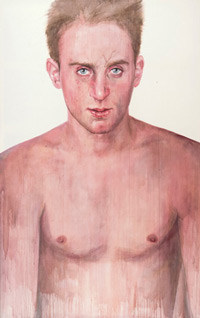
Simon Tedeschi unplugged by Cherry Hood
The giant canvas of Simon Tedeschi Unplugged (by Cherry Hood) in watercolours that run down his bare torso makes him look more like a swimmer than the pianist he apparently is, so you can't guess them all!
Geoffrey Gurrumul Yunupingu by Guy Maestri
Geoffrey Gurrumul Yunupingu's portrait (by Guy Maestri) is another huge and powerful work. He was born blind, learned guitar, keyboard, drums and didgeridoo to play in The Saltwater Band. His debut album in 2008 (entitled Gurrumul) won four ARIA awards. The portrait seems to reflect depth and harmony.

While I was roaming aimlessly between galleries, the chap I had previously left my stuff with in the cloakroom approached me. He was finishing his shift and said he wanted to show me some of his favourite works in the gallery. I'm pretty sure that wasn't a euphemism, because the first thing he showed me was Ned Kelly's death mask!

Captain James Cook by John Webber
Next he showed me a fabulous portrait of Captain James Cook by John Webber. It used to hang on the wall of Alan Bond's office until he was declared bankrupt and it was given to his liquidator. The National Portrait Gallery bought the painting for $5.13 million - it is the most expensive art-work in their collection.

Deborah Mailman by Evert Ploeg
The guide also showed me the People's Choice Award, which is a portrait of Deborah Mailman by Evert Ploeg (1999). She is an actor of Maori and Aboriginal parents, and the rendering of oil on jute makes for an interesting background.

Nora Heysen self-portrait
His own favourite is a self-portrait of Nora Heysen which he points out (correctly) has a 3-D-like effect, and wherever you stand in the room it appears as though she is watching you, and her image stands out from the canvas.

Still of Cate Blanchett from a video by David Rosetzky
Finding out what I liked, he took me to a video by David Rosetzky of Cate Blanchett explaining her acting process, and he left me to watch the ten-minute documentary. She explains that acting is a "constant pull between wanting to be seen and not wanting to be seen." To assume a character you've got to get to a place of neutrality; to see the horizons of a character and know you won't fall off the edge. Characters are there to do something, like figures in a dream. They are real, but when you wake up... they're shadowy. "Who I am is constantly changing." She stands, sits and dances in an empty warehouse, and it is entirely compelling.

Friday, 29 June 2012

Friday Five: Romantic Comedies


Following the sad death of Nora Ephron (writer; director; producer), tributes are flooding in, all of them mentioning her memorable romantic comedies such as When Harry Met Sally, Sleepless in Seattle, and You've Got Mail. These were great films in a genre I don't particularly favour, but she really made both the romance and the comedy work by providing great scripts for both male and female, which were delivered expertly by appealing actors.

I realise the blogosphere will be full of favourite romantic comedy lists, but I am not averse to joining in. Now, the definition is a bit tricky - there are comedies without romance and romances without comedy. I don't consider myself an expert in the field, but I know what I like: both the male and the female leads have to be convincing; there has to be chemistry; the dialogue has to be good, by which obviously for this category we mean funny; and it has to tug at your heartstrings a wee bit.

They are pretty standard, by definition, but I've yet to see a good same-sex romantic comedy - I'm not saying they don't exist; just that I haven't seen one. Perhaps this is because rom-coms are typically light-hearted and a bit fluffy, with a requisite happy ending. While films such as My Beautiful Laundrette or My Summer of Love are excellent, I'm not sure they fit the formula.


5 Favourite Romantic Comedies:
  1. Almost anything starring Hugh Grant. I know this is a bit of a cop out, but otherwise the entire list would be made up of films such as Four Weddings and A Funeral, Love, Actually, Notting Hill, Bridget Jones' Diary, Music and Lyrics, About a Boy, Two Weeks Notice... See, that's the whole list right there!
  2. Pretty Woman - an absolute classic fairytale with a hooker
  3. Shakespeare in Love - I don't usually like people messing with Shakespeare, but in this case, I'm fine with it
  4. Please Don't Eat the Daisies - of all the 'old' films I saw when I was a child, this one from 1960 with Doris Day and David Niven always stuck with me; they did things differently then, and with more than a touch of class
  5. Working Girl - I'm not sure why, but my mum loves it and it always make me think of her, so that's got to be a good enough reason. Plus it has great acting, really strong roles for women, it's an ode to New York, and has a theme tune that makes me cry. You go girl!

Monday, 25 June 2012

Literally Lying

Apparently a new season of X-Factor is due in Australia. I know this because a season of The Voice has just finished. Now, rather than programmes being ruined by endless previews of 'singers' popping up to stand and scream on stage, while people twitter on about them being awesome and giving them goosebumps (it would appear this is a very pimply nation) we have to endure promotions in which presenters blather on about how great it felt in the last series of X-Factor when they made their latest discovery, which they proceeded to inflict on the general public in a frenzy of unmerited hype and hoopla.

The most recent offender is some bimbette (Natalie Bassingthwaighte apparently, who used to be in Neighbours) who prattles that when she saw someone or other perform, it was so good that her jaw literally hit the floor. At last; something that would have been worth seeing!


Unfortunately, I suspect she is merely another in a long line of 'celebrities' who think that mangled grammar and excessive use of hyperbole make them sound intelligent, or even interesting. I know that language is fluid and that words assume new meanings and connotations, but 'literally' has a pretty fixed meaning, surely. I suggest you learn what it is, or try to keep the aforementioned jaw firmly shut.

Friday, 22 June 2012

Friday Five: Child's Play


The Bible tells us that when you are a child you speak as a child and understand as a child, but when you become a man, you put away childish things. I’m not so sure. I prefer the bit about there being a season for everything and a time for every purpose – “a time to weep, and a time to laugh; a time to mourn, and a time to dance” etc. And I think that the time to be childish and play with games does not finish with childhood.

I recently bought my nephew some Lord of the Rings LEGO (sorry if he hasn’t already opened his present, but he’ll know soon enough…) with a little Gandalf, a hobbit and a horse and cart. One of the pictures on the box showed Gandalf feeding the noble steed a carrot, which was bigger than the horse’s head – it was all I could do to wrap up the box without tearing it open for a quick play. I loved LEGO as a kid, and it seems I still do.

It made me think about my favourite toys as a child. Of course, there were the cuddly animals who went everywhere with me – they were great companions and could be dressed up and made to play all sorts of games. They were often lined up in front of a blackboard while I taught them stuff. I’m not sure I was a very good teacher because I definitely had favourites who got most questions right (little swats) and some who were very thick and had to be beaten with the bamboo cane to improve their learning ability – yes, I’m afraid this was the 70s.

Some of them remain in my old room at my parents’ house, some are in a box in the attic and some have travelled around the world with me. There is a scene at the end of The House at Pooh Corner, in which Christopher Robin must go to school that breaks my heart. “But wherever they go, and whatever happens to them on the way, in that enchanted place on the top of the forest a little boy and his bear will always be playing.”

Books were my other great love, and I disappeared into them for hours and then made up adventures and stories of my own to play – they were fantastic for imagination and literacy development, but I’m not sure they can be counted as toys. The games I played (either with friends or aforementioned cuddly animals) were interactive, but the books themselves weren’t.

When it was the last day of term at school, people brought in board games to play – do they still do that, or is the whole of schooling just one long doss these days? Others had Buckaroo or Operation. I used to like Monopoly but the game usually lasted for hours and ended up in tears and tantrums (when Dad said we had been ganging up on him. He was right, we had). For some reason I was never a fan of Scrabble or Cluedo – too much unnecessary speculation resulting in frustration.


I liked Guess Who, although I didn’t have my own version and it took me a while to work out the right questions to ask. (“Is it third from the left in the second front row?”) I had a game called Headache which I loved. I used to draw up tournaments between all my cuddly toys (which went from group stages to knock out rounds) and play it for hours in my bedroom. I think it was the Pop-o-matic bubble in the centre of the board that held most appeal.

I went through a cards phase as a teenager, although I didn’t really know any games except gin rummy, whist and patience. I used to play Racing Demon with Our Gracious Hostess and her sister in a furious frenzy when I was meant to be doing my homework. It got pretty raucous and her parents tried to ban us from playing it, which meant that we just did it more – oh what fun we had ‘but at the time it seemed so bad...’ Well, we were hardly sniffing glue or nicking cars were we?

I had a couple of dolls, but mainly I liked their accessories. Sindy had a horse and a tent, so she could go riding or camping. When my sisters were at big school and I wasn’t yet, they very kindly made me a whole set of school books and a uniform for her – I think they made a hockey stick and PE kit as well – which was wonderful, but they wouldn’t actually play any games with her (or me, for that matter).

My brother ‘played’ with me – by which I mean that he threw my cuddly toys down the stairs (or out of the window) claiming they had found a secret passage. He would wait until I had gone down to collect them and returned upstairs again before he threw the next one down. It was hours of entertainment – for him.

I also remember a game in which we ‘raced’ cars along the hallway. This involved hurling the toy vehicles as far as we could along the carpet until they thudded into the skirting board (sorry, Dad). We raced them in pairs and, again, I drew up a knock-out tournament. The ambulance was pretty good, although the articulated lorry was crap, especially when it was carrying plastic pipes.

And then there was the stuff we did outdoors: playing football, shooting the netball, whacking a tennis ball against the side of the house, skipping (both ‘normal’ with a rope and French with knicker elastic), rollerskating along the footpath, and batting a shuttlecock back and forth with Our Gracious Hostess. We had favourite shuttlecocks and always tried harder with those ones so they could win the tournament – I think there may be a theme developing...

And I loved my bike. Mum always said ‘Stay where I can see you’ but she wasn’t actually watching. I rode my bike up and down the kerb a lot (sorry, Dad) and once Our Gracious Hostess rode hers into the river and I had to sneak home and find some dry clothes for her to change into while she hid in the bushes so her parents would never know. Yep, we were dangerous. Our man in London says we used to ride round and round the green cackling in a terrifying manner, but I don’t believe it (the cackling bit).

So, I guess if I had to sum it up (and I really should), this would be it.

5 Favourite Childhood ‘Toys’:
  1. Cuddly toys
  2. Books
  3. Board Games
  4. Cards
  5. The Great Outdoors

Wednesday, 20 June 2012

Tales of the Unexpected


England are through to the quarter-finals of the 2012 European Chanpionships. I wasn't expecting that! They topped their group, which was also unexpected, and they managed to defeat the co-hosts, Ukraine, with a single goal scored by Wayne Ronney (which is probably slightly more expected).

So next, England get to play Italy. I cynically suggested penalties would make an appearance as in the knocked-out-of-quarter-finals-due-to variety, but Him Outdoors insists that Germany must be part of that particular equation.

We haven't got the satellite package that allows us to watch the live games and have to make do with highlights each evening on terrestrial TV. Apart from the England games, which I get up in the middle of the night to follow on the Guardian live blog. It's anxious stuff sitting in the dark biting my nails by the glow of the computer screen, while the rest of the street/ city is alseep. I hope it continues, although I don't really expect it to...