Friday, 22 October 2021

Friday Five: Halloween Cross-Stitch

It does feel very odd to me that the seasons are back to front here and certain festivals occur at the 'wrong' time of the year. Halloween falls between Harvest Festival and Guy Fawkes Night. It occurs as the nights begin to draw in and there are more shadows and misty corners in which things can lurk and our fears and anxieties can grow if left unattended. To me it is tied to the Gaelic festival of Samhain, which marks the end of the harvest season and the beginning of winter or the 'darker-half' of the year. 

As with many things the ancient pagan, mythical, religious roots have largely been consumed by consumerism and capitalism. I dislike that intensely. I do, however, like the idea of making the connections with the liminal world more comforting and less frightening. To this end, I have enjoyed stitching these designs. 

5 Halloween Cross Stich Designs:

Wednesday, 20 October 2021

Macho Noir: Paint It Black

Paint It Black by Mark Timlin
Victor Gollancz
Pp. 256

Nick Sharman has been around for a while apparently; this is the eleventh novel in a series of nineteen and counting, starting in 1988 (this one was first published in 1995). He is the narrator of these novels about himself, a South London ex-policeman now private detective, in a world where women exist only to be rescued or revenged, and full of the sort of hard man dialogue and soulless quips that would even embarrass Guy Ritchie. But author, Mark Timlin, is very popular – one doesn’t publish nearly twenty books in a series without being – and reviewers consider him to provide an “answer to the hardboiled noir of 1940’s America, uprooted lock, stock, and barrel to the dingy back streets of 1980’s south London”. I suppose I didn’t realise anyone was asking the question.

Nick Sharman gets a call from his ex-wife Laura in Glasgow to tell him that their daughter, Paula, has gone missing. He and his wife, Dawn, track her down to a field in Banbury where she is with a bunch of travellers, having accompanied her friend, Paula. Paula is a ‘bad influence’ and they have taken drugs, but she has a heart of gold; yes the clichés are that obvious. At this point, he could simply take the girls back home, “The case of the private detective’s daughter webbed up in the rave scene has come to a satisfactory conclusion.” Of course he chooses instead to track down the dealers and blow up a shipment of their drugs. They take their revenge by killing Dawn and their unborn child. He then retaliates in a plan that goes horribly wrong but involves a lot of killing, guns and explosives.

Ah yes, the guns. Timlin loves sex, violence, cars and travel routes. He describes ammunition as though it were a fashion accessory. He does love his detail – desperate to prove his tough-guy credentials like something out of a bad Ross Kemp documentary. He enjoys deadpan wisecracks; when he arrives at a secret location and is told, “We’re here”, he replies, “Everybody’s got be somewhere” as if that means something deep. 

When he gets onto his obsession with cars and directions, however, he sounds more like a boring salesman at an unspeakably tedious conference team-building dinner. “We got back into the Mondeo and took off down the secondary road in what I guessed to be a southerly direction for a few miles until we came to a village called Frating Green, where the A133 bisected the B1029, and we swapped cars again. I found a Volkswagen Golf GTI neatly parked on a grass verge, whose doors opened to my hoister’s key.”

And then there’s the bit where, despite the fact he has a teenage daughter whom he apparently adores, he still has sex with her friend, Paula, after she has specifically told him she is fifteen. “I had my arms full of a tiny, slippery little female who wanted a fuck. So I gave her one. Right or wrong, that’s what I did. And I enjoyed it, and so did she.” That is statutory rape; there is no question about this – it’s wrong.

There is clearly a market for this macho storytelling. It is a market that doesn’t get irony, and probably thinks that giving women their rights is as bad as giving them credible characterisation in a novel. This novel was published 25 years ago; that (fortunately) feels like a lifetime.

Saturday, 16 October 2021

Friday Five COVID-19: More ISO TV


We're coming out of lockdown today - hurrah! While we will be cautiously allowed out to pubs, cafes and restaurants; theatres and cinemas are not operating at capacity so there will be more TV watched for visual input. Meanwhile, these programs have been on my recent watched list. 

  1. Atlantic Crossing (SBS On Demand) - A Norwegian/ American drama miniseries addresses the issue of trying to get Allied support for Norway against the Nazis, who had invaded their country in WWII. Allied intervention was not assured, as the forces were busy on multiple fronts, so while the King of Norway and the Crown Prince Olav were in England, trying to drum up European support, Crown Princess Martha took her children to the U.S.A., where she becomes the guest of President Franklin D. Roosevelt. because this is a drama, the script implies there may be more than friendship between these characters. Production values are sleek, design and costumes are exquisite, and the acting varies from subtle and inscrutable to histrionic. Soapy romance elements aside, the politics is fascinating to view from a different historical perspective.  
  2. The Head (SBS On Demand) - This Spanish-made, English-language psychological thriller ticks all my boxes; set in a snowy, cold location (The South Pole), a group is left in isolation as the Winterers remain at Polaris VI Antarctic Research Station to continue their research to assist in the fight against climate change. Immediately cracks begin to appear. Fast forward to six months later when the summer team return to find all the Winterers are dead or missing and there is a killer on the loose. Flashbacks indicate that everyone was shifty with a metaphorical axe to grind or a point to prove. It is logical, but I didn't work it out until the very end. It's like Agatha Christie on ice.

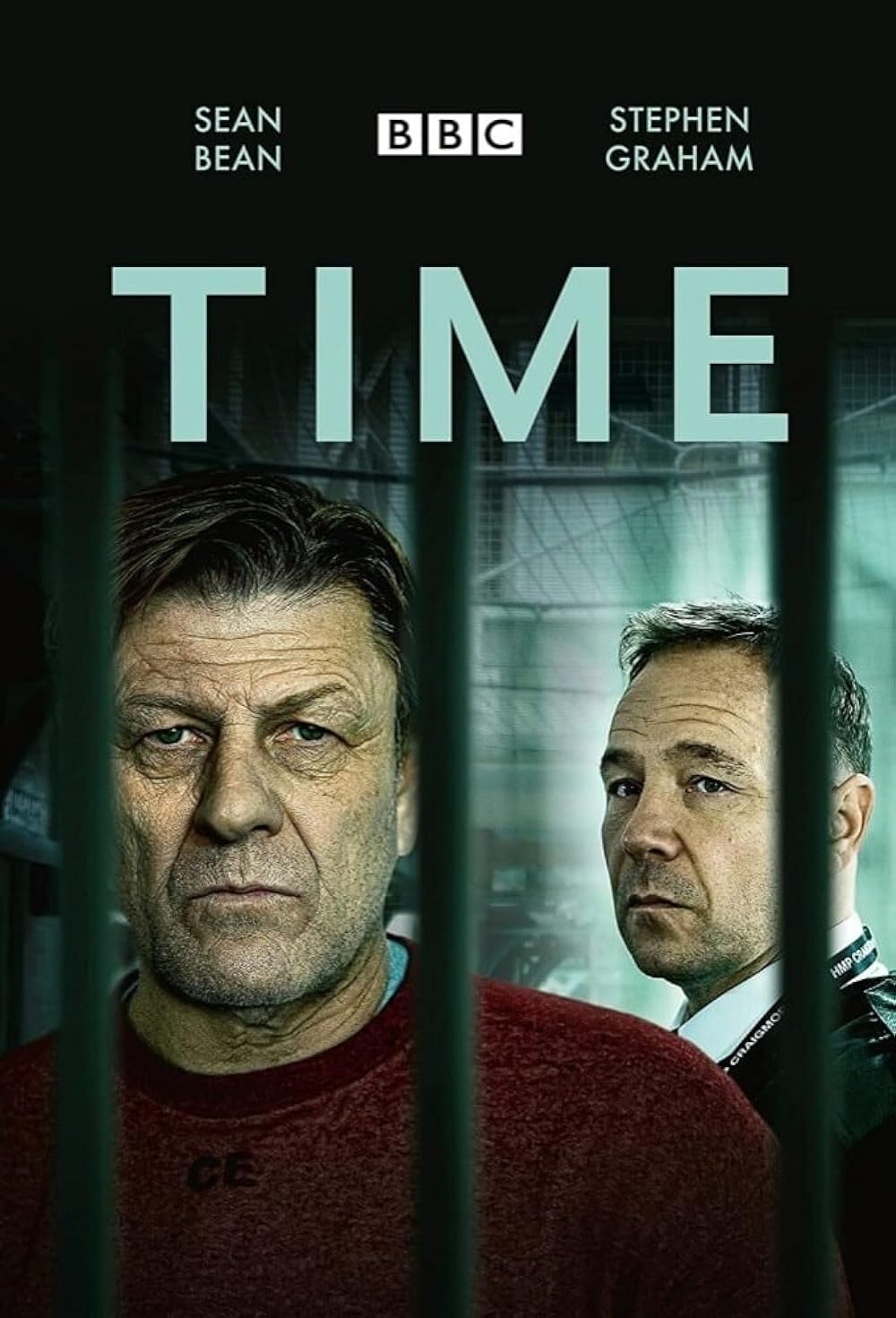
  3. Time (BBC First) - All praise the new three-part drama miniseries by Jimmy McGovern set in a prison, starring Stephen Graham, Sean Bean, Sue Johnston and Siobhan Finnernan. It's exactly as cheery as one would expect, but the acting and the writing is almost criminally good.
  4. Wentworth, Season 5 (ABC iview) - I'm a long way behind with this series - Season  5 finished in 2017, and Season 8 is halfway through (with filming interrupted due to COVID). It chucks in every prison cliché - don't go in the showers; get on gardening detail if you can; beware the butch lesbian; the kitchen deals drugs; most of the screws are bent, but it is one of few mainstream TV dramas that passes the Bechdel Test.

  5. War of the Worlds, Seasons 1 & 2 (SBS On Demand) - There are a lot of versions of this story. According to this one (produced by Fox Networks Group and StudioCanal-backed Urban Myth Films), if you send Nick Cave songs out into the cosmos, you might get invaded by aliens from the future. "I don't believe in an interventionist God" has never seemed so apt. The bleak and deserted landscapes are reminiscent of 28 Days Later or The Day of the Triffids, but Gabriel Byrne lends it a touch of gravitas, and the blend of English and French gives it a certain je ne sais quoi. 

Tuesday, 12 October 2021

How Beauteous Mankind Is!: Circe


Circe by Madeline Miller
Bloomsbury
Pp. 333

The retelling of classical stories and myths from the female perspective is currently all the rage (The Penelopiad by Margaret Atwood; The Silence of the Girls by Pat Barker; A Thousand Ships by Natalie Haynes) and Madeline Miller is part of this welcome revolution. Here she tells the story of Circe, a semi-goddess often described as a witch, best known for her role in Homer’s Odyssey, where she detained Odysseus and his men, turning some of them into swine. Miller relates this tale in the first person, providing a back-story and reasons for Circe’s behaviour, like the unravelling of a fairy-tale.

Circe (1911) by Beatrice Offor

Circe is the daughter of Helios, Titan god of the sun and, from childhood, she is ridiculed for not shining brightly enough in his eyes. Her name means Hawk because of “my yellow eyes, and the strange, thin sound of my crying”. The gods think her voice is weedy and screechy, but it transpires it is simply like that of a mortal. She is fascinated by humans and shares an affinity for them with Prometheus, who shaped man out of mud. As a child, Circe asks Prometheus what a mortal was like and he tells her, “There is no single answer. They are each different. The only thing they share is death.” She questions how they bear the burden of this knowledge and he replies, “As best they can”.

Bored with the smooth symmetry of the gods, Circe loves the diversity of humans. She is fascinated by mortals, and her words are like those of Miranda in Shakespeare’s Tempest or reminiscent of Doctor Who, who admires mortals but is not one. She has no god-like powers, although she does have knowledge of herbs and potions; medicine to be used for healing and harm, the Greek word for which is pharmakis, ‘a preparer of drugs, a poisoner, a sorcerer’, from which we derive the word pharmacy, and which wisdom led her to be called ‘witch’.

The Wine of Circe (1900) by Edward Burne Jones

Just as she studies the mortals, she also philosophises about the gods. She knows that they are cruel and curious, and that they rule by fear through a hierarchical chain that recalls various political parties and governments.

The gods also “love their monsters” because it gives them something to threaten mortals with, and something for heroes to challenge. They look down upon mortals and heroes, and enjoy toying with them – the Trojan War and its consequences are all a result of their petty squabbles – and they like to see what the mortals will do next when put into impossible situations. “Gods love novelty… They are curious as cats.” These gods are equally childlike and cruel, with a unique morality. “They do not care if you are good. They barely care if you are wicked. The only thing that makes them listen is power… They take what they want and in return they give you only your own shackles.” They also punish those who help mortals; they want the mortals to be afraid because they give better offerings.

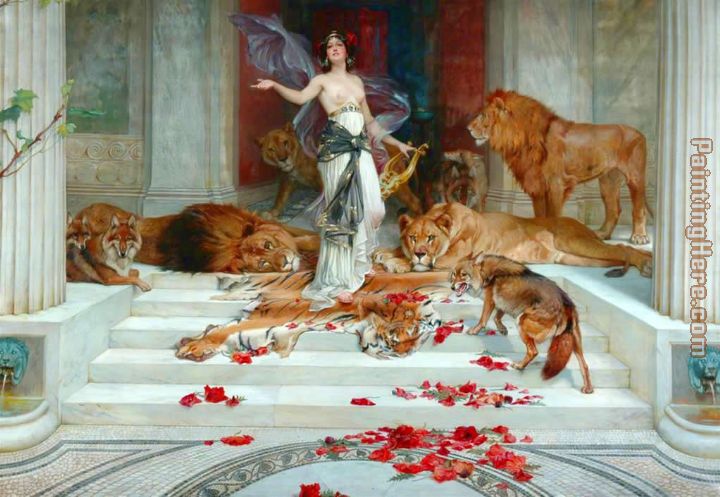
Circe (1889) by Wright Barker 

The most important thing to these gods is their reputation. They are similar to the Knights of King Arthur, who vied for quests to prove their honour, but these gods want only fame – they don’t care how they come by it. Most mortals also want fame above anything: when Odysseus travels to the underworld to consult Tiresias, the blind seer, Achilles tells him it is better to live a quiet life than die a hero’s death. He disagrees. When Telemachus turns down Athena’s offer of adventure, she is bewildered. “There will be no songs made of you. No stories. Do you understand? You will live a life of obscurity. You will be without a name in history. You will be no one.”

Miller uses the style of Homeric language and epithets about Helios, “My father’s chariot slipped into the sea and began to douse itself in the waves” but she also has an individual style as she reinterprets classic myth from a modern angle and damns the ostensible glory of the gods.

After displeasing her father, Circe is exiled to an island, Aiaia, which she cannot leave, but she can receive visitors (including Hermes, Jason and Medea, Daedalus, and, of course, Odysseus). She becomes a magnet for reckless and randy sailors (these are the ones she turns to swine as they try to rape her) and her island a place for disgruntled fathers to send their disobedient daughters, like some mythical convent. She casts her feminist viewpoint on her treatment. “Brides, nymphs were called, but that is not really how the world saw us. We were an endless feast laid out upon a table, beautiful and renewing. And so very bad at getting away.”

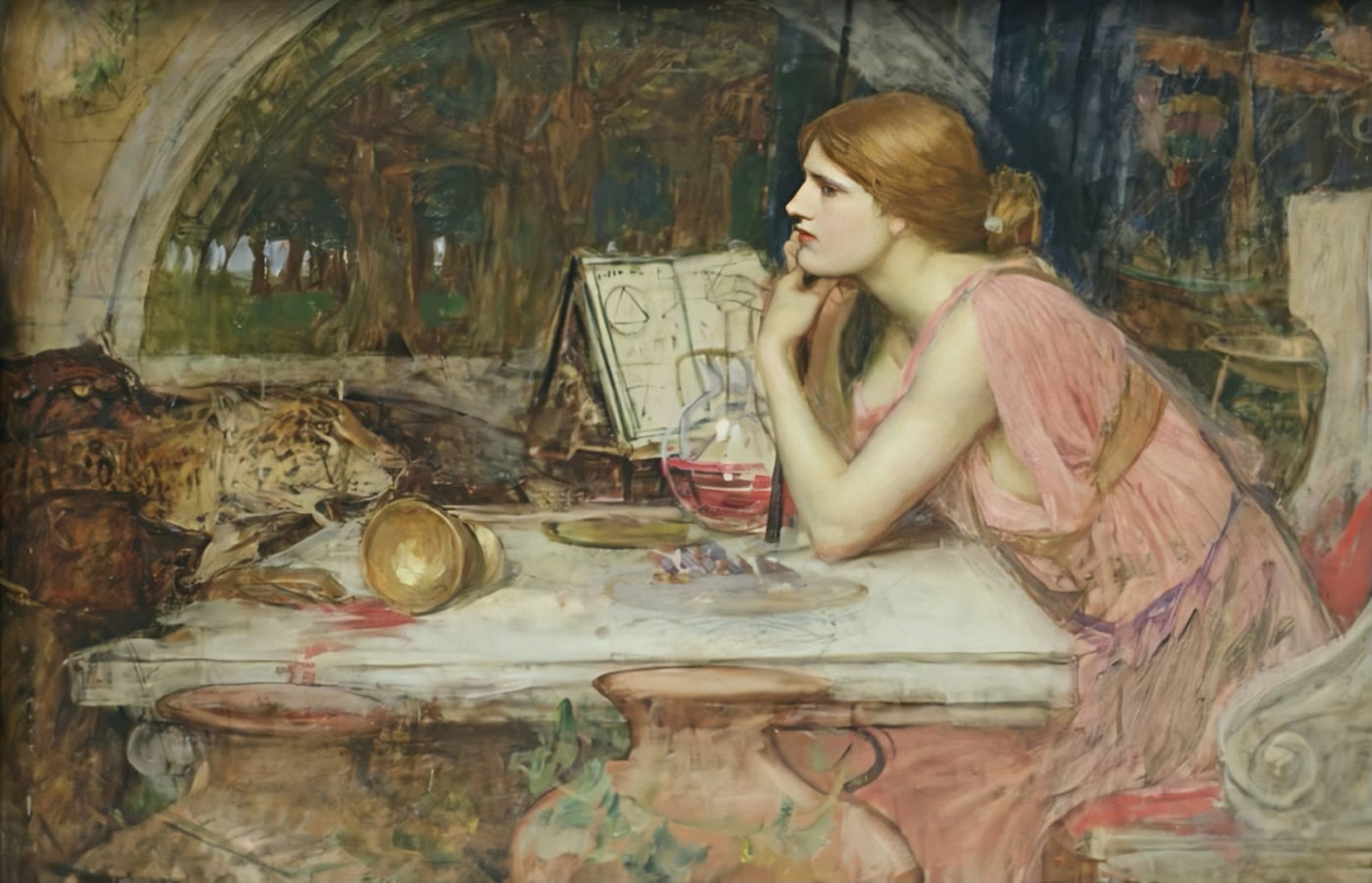
The Sorceress (1911) by John William Waterhouse 

Circe’s story is one that has only previously been told through the eyes of others and the tangential effects she has on their narrative. Miller presents us with another side to wily Odysseus, “The spiral shell. Always another curve out of sight.” She also shows us a fresh perspective on Penelope when Odysseus’ wife and son visit Circe on Aiaia, and the use of the word ‘weaving’ to describe spells and craft unites the women through something other than the lover and mother trope.

Circe is immortal, and she sees many changes, but she does not wish to see destruction. During her early experiments, Circe discovers the limits of her powers. “However potent the mixture, however well woven the spell, the toad kept trying to fly, and the mouse to sting. Transformation touched only bodies, not minds.” To her mind the greatest transformation is life into death. The idea that there is an undying spirit is comforting; it is the same as a story which can be endlessly retold. And this is a version I would be more than happy to hear again.

Circe and Her Swine (1896) by Briton Riviere

Friday, 8 October 2021

Friday Five: Street Libraries

One of the things I have enjoyed about lockdown is the walking I have done around the suburbs. With limited time allowed for exercise and a limited radius in which to do it, I have been varying my routes close to home. These wanderings have taken me past many delightful street libraries, which inadvertently showcase their suburb. Yes, there are different shapes and sizes, and they contain different books aimed at different readers, but one thing they all have in common is a desire to share with their community, and I think that is rather wonderful.

Five Street Libraries:

  1.  

Wednesday, 6 October 2021

My Newest Favourite Thing: Pieces of Shakespeare

Shakespeare's London
I have been posting updates on my blog about the puzzles I have been doing, but I feel that this one deserves a post of its own. This beautiful and rich image is by Adam Simpson; the puzzle is by Laurence King Publishing; and it was lent to me by Purple Lady.

There is an accompanying sheet (text by Neil Carter) that tells us all about the picture - it's superbly educational for younger folk interested in the bard, or those of any age starting out on their knowledge gathering, or those with experience who just want a bit of fun recognition. It states, "Shakespeare's London is alive with activity. The River Thames winds past the Globe Theatre on the South Bank, under London Bridge, and by the Tower of London in the east. Houses are tightly packed together in the city centre, but the outskirts quickly give way to open spaces and woodland nearby."

Naturally, when piecing the puzzle together, I did the river first, partly because the colour stood out, and partly because it is my river. I then did The Globe, because, well, it's the Globe.
 
The Globe
Henry V
The bear pit
Inside the Globe, there is a rehearsal for A Midsummer Night's Dream featuring the characters of Bottom, Titania and Oberon with an entourage of fairies and (my favourite thing) William Shakespeare with script and quill in hand overseeing the rehearsal. Outside "a man stands on a box addressing the crowd, wearing a crown and armed with sword and shield: this is Henry V delivering his rousing 'Once more into the breach, dear friends' speech." Nearby is the bear pit in which a bear has escaped its chains and is chasing its keeper, with a nod to the famous stage direction, ‘exit pursued by a bear’ from The Winter's Tale.

Macbeth
A Midsummer Night's Dream
Gravediggers on the edge
Next, I did the Macbeth scene, where the three witches are "engaging in nefarious practices", as Macbeth and Banquo ride up on their horses. At the edge of this scene are the pairings from A Midsummer Night's Dream (Demetrius; Lysander; Helena; Hermia) watched by Puck from the tree marvelling at 'what fools these mortals be'. In another section of the puzzle, the gravediggers from Macbeth lean on their spades for a break in their work. 

Hamlet
Romeo and Juliet
King Lear
Julius Caesar
Scenes from all the greatest hits are scattered throughout the picture. Let's start with the tragedies... Hamlet offers Yorick's skull to Ophelia in front of Gertrude and Claudius, while the ghost of Hamlet's father hovers above the scene. Romeo climbs up some steps to get to Juliet, who is hanging out of a tower, while Tybalt and Mercutio fight a deadly duel below. King Lear is flanked by his daughters Goneril and Regan, "desperately haranguing him on each side, while a third quieter and more beautiful daughter (Cordelia) watches from the sidelines." He is also accompanied by his fool and a mad beggar (Edgar).  

The Julius Caesar scene is interesting because, as a way of getting around the fact that it is totally anachronistic (even more so than the play itself), this is described as, "in a field a group of children playing dress-up in Roman costume are having a mock battle in the vein of Julius Caesar". Lurking on the edge of this vignette is an alchemist, trying to turn base metals into gold, "watched from the shadows by Ben Jonson frantically scribbling notes for his next play." This is not the only time Simpson places one of Shakespeare's contemporaries in the periphery.

A tavern featuring a scene from Othello in the foreground and Falstaff on the roof
Andrew Aguecheek and Sir Toby Belch from Twelfth Night
Malovolio from Twelfth Night
Outside one of the taverns, “Othello and Iago are watching another man, Cassio, talk to Desdemona. Iago is whispering poisonous lies into Othello’s ear.” I love the fact this occurs underneath a pub sign of Shakespeare. Behind this tavern, "some are settling debts with a moneylender (perhaps even Shylock from The Merchant of Venice).”

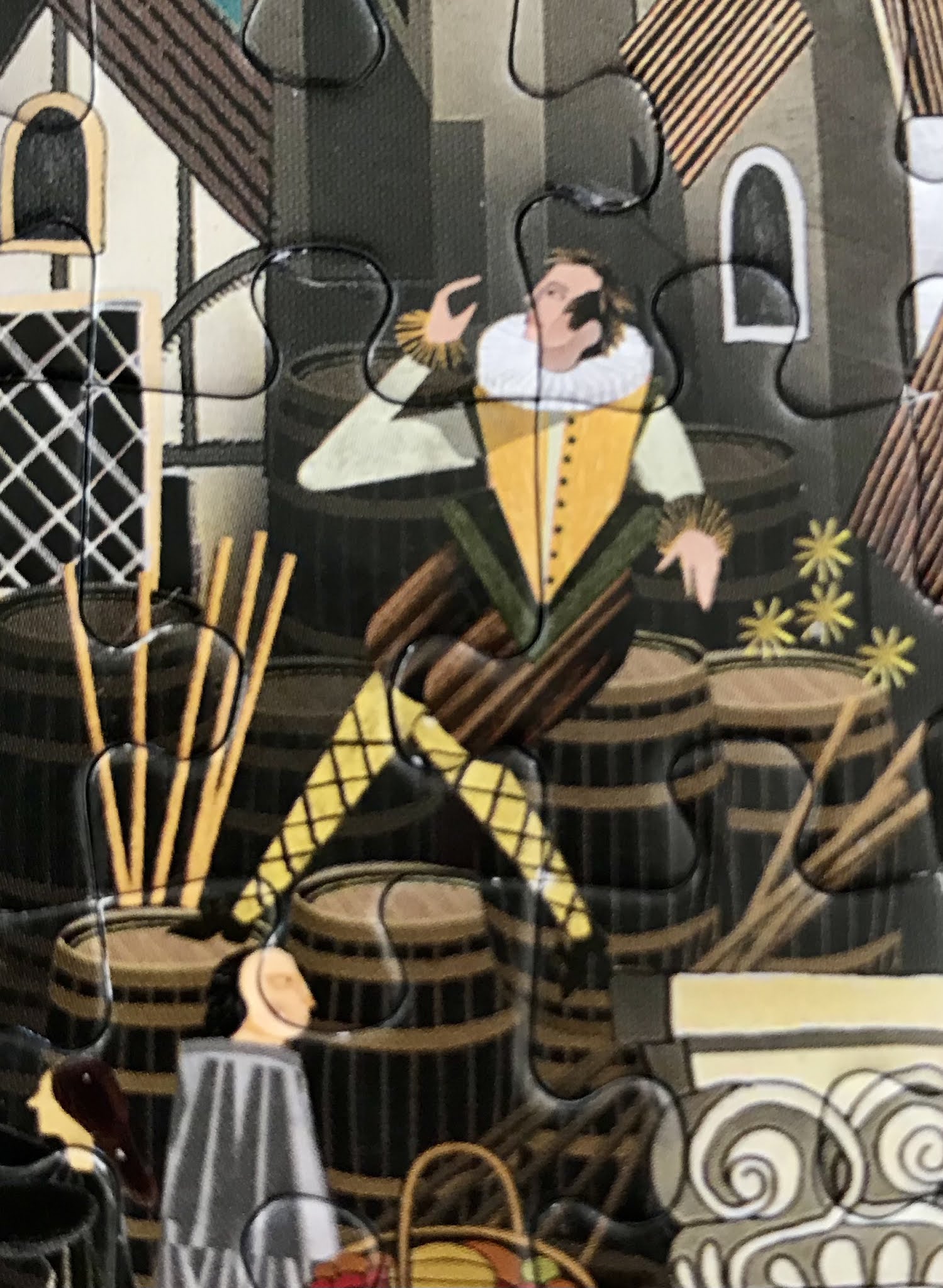
On the roof, “Falstaff is in full drunken flow, holding court and being extremely obnoxious, with his flagons of ale held aloft. The tavern is lively. Andrew Aguecheek and Sir Toby Belch (both of whom hail from Twelfth Night) debate loudly as they eat and drink their fill.” Meanwhile, “Malvolio sits forlornly at the side of the bridge in his cross-garnered yellow stockings, wondering where it all went wrong.”

Prospero and Miranda from The Tempest
Caliban from The Tempest
Dogberry and Verges from Much Ado About Nothing in the centre of the scene
The Tempest is alluded to by Prospero in the brow of a boat “with his staff in the air attempting to conjure up a storm while his daughter, Miranda, waits at his feet, slightly annoyed.” Looking back at the pair from on land, Caliban “can also be found lurking on the riverbank.” Okay, he looks more like the Jolly Green Giant than 'abhorred slave', 'hag-seed', 'monster of the isle', 'a most perfidious and drunken monster', 'moon-calf', 'a born devil on whose nature/ Nurture can never stick', and an 'abominable monster', but at least he gets in the picture. 

Between Caliban and the King Lear grouping on the path, we see that, “Two bumbling night watch constables totter along the riverbank (Dogberry and Verges from Much Ado About Nothing). They are being pursued by rats, which populate many areas of the city and cause recurring plague epidemics.”

The Tower of London
Richard III
The Comedy of Errors
The Tower of London is another fantastic setting which includes a number of references to Shakespeare's plays and contemporaries. As well as the previously mentioned Hamlet consortium, we have a scene in which, “Two young boys - could they be the Princes in the Tower? - are playing watched on by someone who looks suspiciously like Richard III.” Meanwhile, “in the tower’s inner courtyard two masters are discussing comically confusing orders for twin servants (referencing The Comedy of Errors).” 'Comically confusing' is an interesting description of that play, and I'm not sure all would agree. Incidentally, the figure leaning out of the window of the Tower above them is Walter Raleigh who "is being held prisoner: he gazes out on to the water longingly.”

Benedick and Beatrice from Much Ado About Nothing
QEI
Sir Francis Drake on the Golden Hind
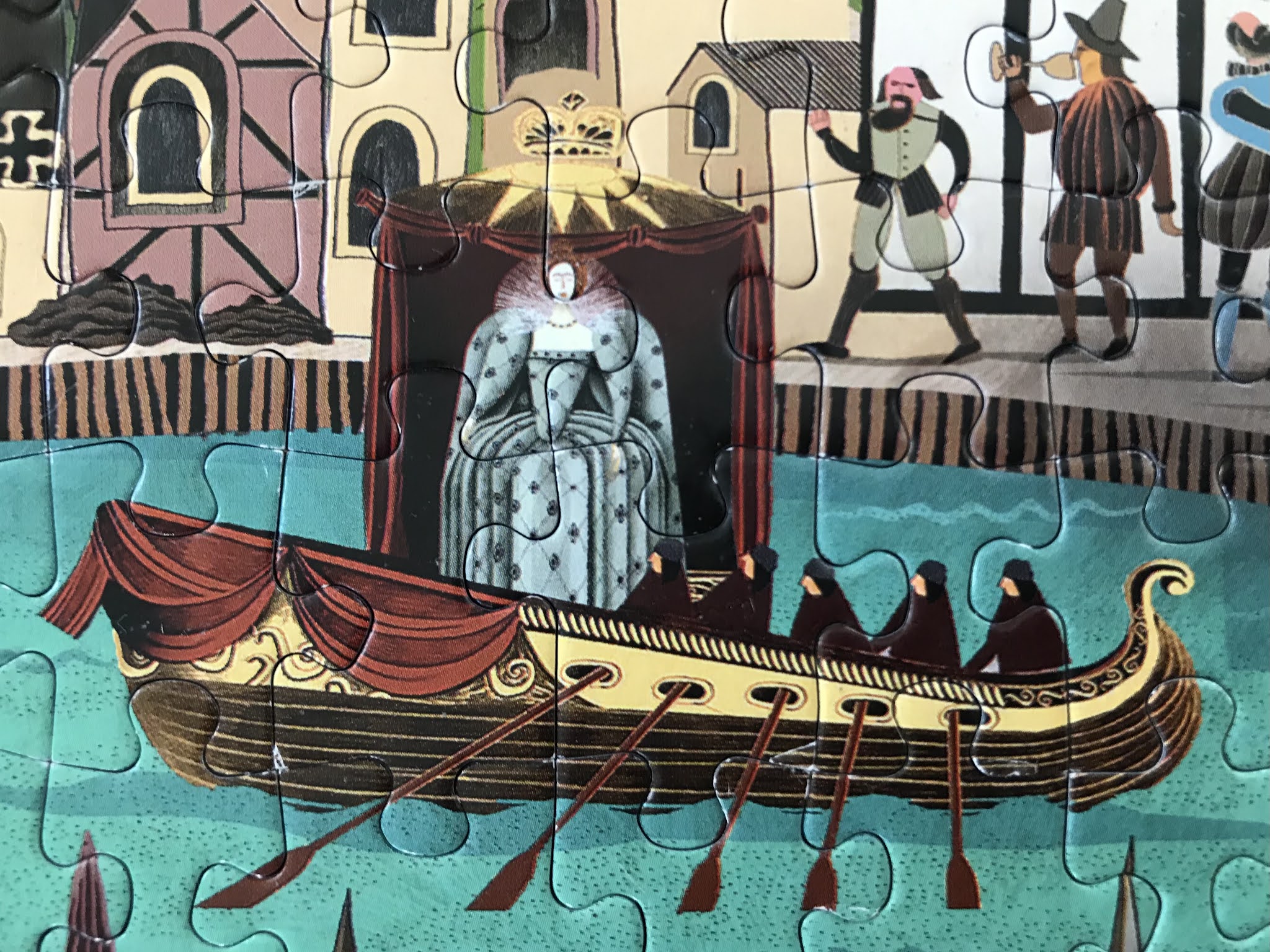
I wouldn't have guessed these characters, but apparently “Two small boats are quite close to each other and Benedick and Beatrice are quarrelling across the water.” There are other great figures upon the water too: at one side of the picture is Gloriana, Queen Elizabeth I herself, “on the deck of her royal barge, attended by various lords, making her way to the theatre” and at the other side, downriver, Sir Francis Drake buckles his swash on the deck of his famous ship, the Golden Hind.

Christopher Marlowe
John Donne
Christopher Marlowe is featured being stabbed, recalling the rumours of his death in a fight over a bill. It is described thus: “In a back alley behind the theatre a drunken brawl is taking place, and Christopher Marlowe is fighting a loosing battle with an assailant.” Another contemporary at the edge of the puzzle is John Donne. “In a room in the city’s northeastern outskirts John Donne is reluctantly waking up, light streaming through the window, which annoys him (referencing  his famous poem ‘The Sun Rising’).” Interestingly, the annoyance felt in this poem is because the poet would rather linger in bed with his lover, although in this sanitised version, he is alone. The makers would like this puzzle to be pieced together by children, and clearly violence and death is a lot more acceptable to show them than sex and healthy physical relationships. This bothers me on many levels, but this is not the place...

London Bridge
Heads on spikes
Speaking of the violence, there are heads on spikes at the end of London Bridge. The Old Medieval Bridge (1209-1830) was lined with buildings, shops, houses and churches. For over 600 years this bridge was the key crossing point of the Thames in London, ferrying people, goods and livestock across the river. It was an iconic feature of the City of London, not least due to those heads. (Digression alert.)

In a very informative blog, Paul Asling tells us all about it. The severed heads served as a warning to anyone thinking of challenging the Crown. The first head to be placed there is thought to be that of William Wallace in 1305 after the Scot was found guilty of leading a campaign against Edward I. Other celebrity dead heads included Jack Cade (who led a rebel army to overthrow the government), Thomas Moore (who refused to accept Henry VIII as the supreme head of the Church of England), Guy Fawkes (part of the Gunpowder Plot of 1605), and some of those who had signed the death warrant of Charles I (in 1660 when the monarchy was restored with Charles II). They ended the practice in 1678 when the heads of the most important traitors were displayed at Temple Bar instead.

The silent heads became a tourist attraction, drawing visitors from far and wide. To ensure longevity, the heads were parboiled and coated in pitch. Once put on the spike on one of the gates at the end of London Bridge, they were left to the elements to rot and eventually fell into the Thames; when the original bridge was pulled down, workers found skulls in the mud. The Keeper of the Heads had full managerial control over this section of the Bridge. I wonder if the power went to his head... (Digression over.)

May Day fete
I love the charmingly skewiff perspective. I love the little drawings of dogs and musicians popping up all over the place. And I love the inclusion of entertainments such as jugglers outside the Globe, and the merriment of the May Day fete. “The land between the South Bank and the city’s eastern edge (towards Bermondsey) is host to a May Day fete, with food and drink flowing freely, and displays of maypole dancing and archery.” 

This is an utterly charming puzzle and I am very grateful to Purple Lady for letting me borrow it. I shall now look out for others in their range, which include The World of Charles Dickens; The World of Jane Austen; The World of Frida Kahlo; Pop Art Puzzle; The Story of the History of Impressionism; The Dream of Surrealism (in 1,000 jigsaw pieces); The World of Sherlock Holmes; The Wonderful World of Oz; Inside the Chocolate Factory and The Mythical World, among others.