Showing posts with label Animal Farm. Show all posts

Friday, 4 June 2021

Friday Five: The Shows Go On

As mentioned in a previous post, I am trying to see as much theatre as I can, dependent on my other commitments, and I shall try to report back (in chronological order of viewing).

5 Shows Seen So Far This Year:

  1. Animal Farm - shake & stir theatre co., The Playhouse, Canberra Theatre Centre: This is an absolutely fantastic interpretation of one of my favourite novels. People are falling over themselves to draw parallels between the Trump administration and the propaganda within the play - but it remains as firmly rooted as ever in Orwell's concerns about communist doublespeak. The ensemble of actors portray all the anthropomorphosised animals with excellent gestures and expressionism, maintaining an outstanding physicality throughout. The set is bleak and brilliant in equal measure. Lighting and sound blend artfully into the overall presentation and despite the grim truths of the production, there are still laugh-out-loud moments - the hen rebellion is dealt with humour until it suddenly isn't, and the transformation of beasts into men and back again is wry and poignant. A teacher of year eights (13-14) said her class went to see it and were disappointed that it didn't feature real animals. I never thought I'd say this, but sometimes theatre is wasted on the young.
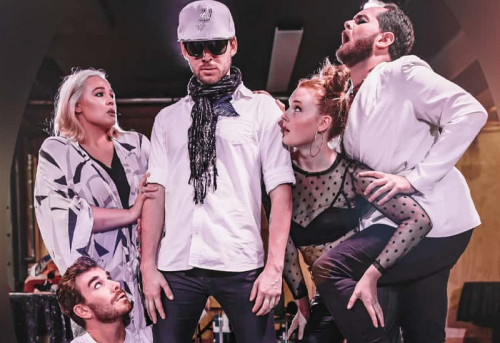
  2. Don Juan - A Slightly Isolated Dog, Bicentennial Hall, Queanbeyan: Pretending to be a famous French theatre troupe - 'We are very famous' 'And very French' gives this Kiwi ensemble of five actors the perfect opportunity to have fun with flamboyant stereotypes and outrageous accents. Theirs is a modern and collaborative approach and they encourage photos, which they then later share through their social media channels - direct marketing for the non-traditional theatre goers. Through a mixture of audience interaction (nothing confronting), song, dance, visual interpretations (a boat tossed on a stormy sea is a cardboard box on a tarpaulin, shaken about by the audience), and a voice distortion box, we learn a different side to Don Juan from any we had previously known. It is engaging and great fun for a cold mid-week night, reminding us why we need to get back into performance spaces.
  3. A German Life - The Gordon Frost Organisation, The Playhouse, Canberra Theatre Centre: Robyn Nevin delivers this fantastic script by Christopher Hampton as if she were born to play this role. Brunhilde Pomsel is an unassuming woman with good shorthand skills who, almost by chance, came to work in Joseph Goebbels' Propaganda Ministry. She survived the war and its aftermath (after five years in prison) and now, near the end of her life and in a nursing home, she recounts what she recalls of those days. The sparsely furnished room for an elderly resident throws up echoes of incarceration while projections of Nazi rallies, mass evacuations, ruined cities and concentration camps, are starkly presented in black and white on the walls for all to see. It is disturbingly intimate and asks us to question how much we think she knew (every time she denies knowledge, she stumbles over her words or questions her receding memory) and what would we honestly do in her situation. Neil Armfield directs one woman to capture our attention throughout the running time, and the play raises many questions about personal responsibility, communal culpability and the veracity of memory. She opines, "Nowadays, I don’t think people would be stupid enough to fall for the kind of nonsense we fell for. All that hot air, I don’t think you can get that past people anymore.” Well, the audience all felt uncomfortable at that moment - apart from the smug ones who missed the point.
  4. Jekyll & Hyde - A Slightly Isolated Dog, Bicentennial Hall, Queanbeyan: And we're back for more from A Slightly Isolated Dog who bring their seemingly chaotic but totally controlled performance style to the story of Jekyll and Hyde. All of the ensemble get a go at being the man with a dark side within ('but he pushes it down') donning a wig and glasses to play the evil alter-ego, but their physicality is more important than their props and they literally embody character acting. The sound and lighting production is excellent and the timing is superb - it takes a lot of hard work to make something look this effortless, and they are a joy to watch. Both this and the previous offering are conducted in traverse staging, drawing the audience into the unfolding drama in a non-confrontational manner; the performances are short and leave the audience laughing and wanting more - they are a triumph.
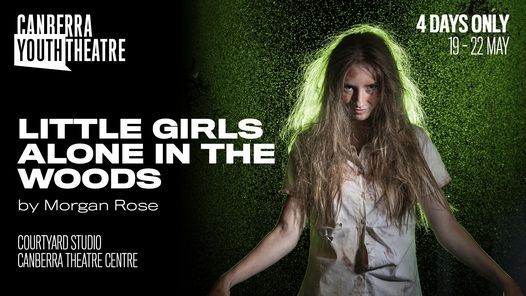
  5. Little Girls Alone in the Woods - Canberra Youth Theatre, Courtyard Studio, Canberra Theatre Centre: The Bacchae by Euripides is an ancient Greek drama which has captured imaginations for years, and lent itself to many interpretations as playwrights, authors, composers and directors seek to assign meaning and moral to a tale of violence, cynicism, divination and control. Among others Joe Orton, Caryl Churchill, Ingmar Bergman, Brian De Palma, Wole Soyinka, Friedrich Nietzsche, Gustav Holst, Thomas Mann and Henrik Ibsen have pondered the dichotomy between protection and imprisonment. Morgan Rose views the cult and legend of Dionysus through a feminist lens as her play suggests that young women are disappearing into the wilds of the woods to cavort and rebel against the confines of the patriarchy. Luke Rogers directs this version with a large cast of varying ability, and he is adept at playing to their strengths. Some of the ensemble work is excellent as the actors work together with both movement and voice, but when they try to stand out and compete against each other, it becomes discordant and incomprehensible. Whether they are lounging about in a study group preparing for exams and completing assignments on their laptops, or play fighting in pyjamas with pillows, they portray the messiness of youth that some adults try to streamline and corral. Change, transition, adolescence, questions and exploration can be uncomfortable for those who want to control, such as the police force who issue tagging bracelets that all females must wear for their own safety, to prevent them from going astray. The staging is bold with a man-made metal cage-like structure hinting of capture and confinement from a prison to a zoo, and as the action spills off the set into the audience space it suggests that our wilderness could either be part of the problem or a solution. Sound and lights are incorporated well to highlight some of the more confrontational aspects of isolation and power imbalance, although the musical ending doesn't pack the punch that perhaps it hoped it would. In general, this is a highly promising piece of work that delivers a deliberate sense of unease.
Friday, 23 August 2013

Friday Five: Animal Tales

Recently I re-read The Silver Brumby by Elyne Mitchell. I loved this book as a child with its wild stallions and blissful backdrop. I was hooked from the opening sentence.

"Once there was a dark stormy spring, when deep down in their holes, the wombats knew not to come out, when the possums stayed quiet in their hollow limbs, when the great, black flying phalangers that live in the mountain forests never stirred."
Although I had no comprehension of this landscape, I loved the book and vowed one day to go to the Snowy Mountains. Having now been, I have a whole new appreciation for this evocative set of books.

It reminded me of how much I enjoyed animal stories as a child, and still do as an adult, even though they are often terribly sad. Him Outdoors and I went to see the National Theatre production of War Horse and as I shed a tear and looked to him apologetically (expecting a comment along the lines of, ‘what’s up now, you daft apeth’) only to find him snivelling and snuffling himself.

So here is a list of favourite animal stories. Of course, there are some omissions. When I read Goodnight Mr Tom, the old man’s dog made a strong impression on me, but when I looked up a synopsis, there was no mention of the dog at all, so I probably can’t classify that as an ‘animal story’. The same goes for Roald Dahl’s The Witches although (SPOILER ALERT), when the boy gets turned into a mouse and knows he will only have a short lifespan, he is content because he doesn’t want to out-live his grandmother, and because, “it doesn’t matter who you are or what you look like so long as somebody loves you.”

Everybody knows that Animal Farm has very little to do with animals, and Winnie the Pooh doesn’t count because the animals are stuffed toys. Please feel free to add yours.

5 Favourite Books about Animals:
  1. The Wind in the Willows – Kenneth Grahame: I grew up with Ratty and Mole and Badger and Mr Toad. Their river was my river and their woods were my woods. I loved them. And I wholeheartedly agree that “there is nothing – absolutely nothing – half so much worth doing as simply messing about in boats.”
  2. Black Beauty – Anna Sewell: the death of Ginger broke my nine-year old heart. This book is described in the Encyclopaedia of Animal Rights and Animal Welfare as “the most influential anti-cruelty novel of all time”. Anna Sewell’s depiction of the cruelty of the bearing rein (used to keep horse’s heads held high while pulling carriages) caused outrage and the practice was subsequently declared illegal in Victorian England.
  3. The Incredible Journey – Sheila Burford: Cats and dogs can be friends! And they travel through Canada together! And it has a happy ending!
  4. Watership Down – Richard Adams: The Animal Farm of the rabbit world. Adams places the individual and the collective against the corporate and the establishment. I can never look at fluffy bunnies in the same way again.
  5. Tarka the Otter – Henry Williamson: one of the most stressful endings ever.

Monday, 31 October 2011

Quick Dectet: Last Lines

Because it is the last day of October and hence the last of my quick quintets, I thought I would choose closing lines from novels for my subject. Opening lines get all the credit, when the credit should really come at the finish. Some of my favourite books don't have great last lines (and the last line of Jane Eyre is not 'And reader, I married him' - that's the first line of the last chapter for all you pedants out there - you know who you are!)

And because there are quite a few to choose from, and it is my blog and I can do whatever I want, I have decided to go for ten things rather than five (in chronolgical order):

Top Ten Last Lines in Literature: 
  1. 'Come, children, let us shut up the box and the puppets, for our play is played out.' – William Makepeace Thackeray, Vanity Fair (1847–48)
  2. ‘It is a far, far better thing that I do, than I have ever done; it is a far, far better rest that I go to than I have ever known.’ – Charles Dickens, A Tale of Two Cities (1859)
  3. 'So we beat on, boats against the current, borne back ceaselessly into the past.' – F. Scott Fitzgerald, The Great Gatsby (1925)
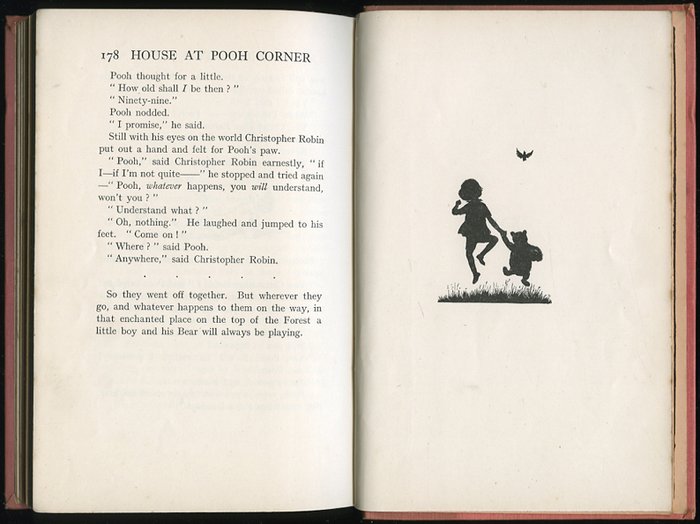
  4. 'But wherever they go, and whatever happens to them on the way, in that enchanted place on the top of the Forest, a little boy and his Bear will always be playing.' – A. A. Milne, The House at Pooh Corner (1928)
  5. 'The creatures outside looked from pig to man, and from man to pig, and from pig to man again; but already it was impossible to say which was which. – George Orwell, Animal Farm (1945)
  6. 'He loved Big Brother' – George Orwell, 1984 (1948)
  7. 'Oh God. You’ve done enough. You’ve robbed me of enough. I’m too tired and old to learn to love, leave me alone for ever.' – Graham Greene, The End of the the Affair  (1951)
  8. 'Are there any questions?' – Margaret Atwood, The Handmaid’s Tale (1986)
  9. 'I thought they were supposed to be dead, but in real life they’re just going to go on singing.' – Salman Rushdie, The Ground Beneath Her Feet (1999)
  10. 'Very few castaways can claim to have survived so long at sea as Mr. Patel, and none in the company of an adult Bengal tiger.' – Yann Martel, Life of Pi (2002)

Wednesday, 24 September 2008

Enclosure

Continuing the theme of the last post about the Simple to Sumptuous exhibition, I've been writing more poems.

This one was inspired by the fine examples of leather-bounds volumes. Leather was the most popular binding until the nineteenth century with domestic farm animals being used for every purpose available. The leather was treated with salt to produce a creamy white colour, very popular in Germany, whereas vellum was treated with lime.

The raised bands are due to the thick leather being sewn, and the corner pieces and raised studs are to protect the leather from rough surfaces. In many instances the dyed leather with a simple border framing the open space caused the primary ornament to become the natural grain and texture of the leather.


All of this got me thinking about the Enclosure Acts between 1750 and 1860, during which 21% of common land in England was enclosed by the landowners. Farmers moved to urban areas and began taking labouring jobs for wages. Marxist economists believe that this was the beginning of the proletariat and capitalist social relations.

Which naturally led me to think about George Orwell and his famous last lines of Animal Farm; "The creatures outside looked from pig to man and from man to pig, and from pig to man again; but already it was impossible to say which was which." And so I wrote the following:


Enclosure

Domestic farm animals:
Calf; pig; sheep –
Thoroughly used for meat to eat
And hide to hide
The words of wisdom
Or otherwise
Contained within.

Treated with salt
To preserve and render
Tough but tender,
The creamy white hue is
Popular for palimpsests,
Kept from rough surfaces
By raised bands and studs.

Natural grain and texture
Is the primary ornament.
The simple border encloses
An open space,
Valuable to owners of
Domestic farm animals
Without the common

Drifting to town from forbidden acres
The country folk become
The man on the street, while
Landowners make laws with learning.
Noses in books they are
Hard to tell apart;

Clean and clever animals.