Showing posts with label plays. Show all posts

Friday, 4 June 2021

Friday Five: The Shows Go On

As mentioned in a previous post, I am trying to see as much theatre as I can, dependent on my other commitments, and I shall try to report back (in chronological order of viewing).

5 Shows Seen So Far This Year:

  1. Animal Farm - shake & stir theatre co., The Playhouse, Canberra Theatre Centre: This is an absolutely fantastic interpretation of one of my favourite novels. People are falling over themselves to draw parallels between the Trump administration and the propaganda within the play - but it remains as firmly rooted as ever in Orwell's concerns about communist doublespeak. The ensemble of actors portray all the anthropomorphosised animals with excellent gestures and expressionism, maintaining an outstanding physicality throughout. The set is bleak and brilliant in equal measure. Lighting and sound blend artfully into the overall presentation and despite the grim truths of the production, there are still laugh-out-loud moments - the hen rebellion is dealt with humour until it suddenly isn't, and the transformation of beasts into men and back again is wry and poignant. A teacher of year eights (13-14) said her class went to see it and were disappointed that it didn't feature real animals. I never thought I'd say this, but sometimes theatre is wasted on the young.
  2. Don Juan - A Slightly Isolated Dog, Bicentennial Hall, Queanbeyan: Pretending to be a famous French theatre troupe - 'We are very famous' 'And very French' gives this Kiwi ensemble of five actors the perfect opportunity to have fun with flamboyant stereotypes and outrageous accents. Theirs is a modern and collaborative approach and they encourage photos, which they then later share through their social media channels - direct marketing for the non-traditional theatre goers. Through a mixture of audience interaction (nothing confronting), song, dance, visual interpretations (a boat tossed on a stormy sea is a cardboard box on a tarpaulin, shaken about by the audience), and a voice distortion box, we learn a different side to Don Juan from any we had previously known. It is engaging and great fun for a cold mid-week night, reminding us why we need to get back into performance spaces.
  3. A German Life - The Gordon Frost Organisation, The Playhouse, Canberra Theatre Centre: Robyn Nevin delivers this fantastic script by Christopher Hampton as if she were born to play this role. Brunhilde Pomsel is an unassuming woman with good shorthand skills who, almost by chance, came to work in Joseph Goebbels' Propaganda Ministry. She survived the war and its aftermath (after five years in prison) and now, near the end of her life and in a nursing home, she recounts what she recalls of those days. The sparsely furnished room for an elderly resident throws up echoes of incarceration while projections of Nazi rallies, mass evacuations, ruined cities and concentration camps, are starkly presented in black and white on the walls for all to see. It is disturbingly intimate and asks us to question how much we think she knew (every time she denies knowledge, she stumbles over her words or questions her receding memory) and what would we honestly do in her situation. Neil Armfield directs one woman to capture our attention throughout the running time, and the play raises many questions about personal responsibility, communal culpability and the veracity of memory. She opines, "Nowadays, I don’t think people would be stupid enough to fall for the kind of nonsense we fell for. All that hot air, I don’t think you can get that past people anymore.” Well, the audience all felt uncomfortable at that moment - apart from the smug ones who missed the point.
  4. Jekyll & Hyde - A Slightly Isolated Dog, Bicentennial Hall, Queanbeyan: And we're back for more from A Slightly Isolated Dog who bring their seemingly chaotic but totally controlled performance style to the story of Jekyll and Hyde. All of the ensemble get a go at being the man with a dark side within ('but he pushes it down') donning a wig and glasses to play the evil alter-ego, but their physicality is more important than their props and they literally embody character acting. The sound and lighting production is excellent and the timing is superb - it takes a lot of hard work to make something look this effortless, and they are a joy to watch. Both this and the previous offering are conducted in traverse staging, drawing the audience into the unfolding drama in a non-confrontational manner; the performances are short and leave the audience laughing and wanting more - they are a triumph.
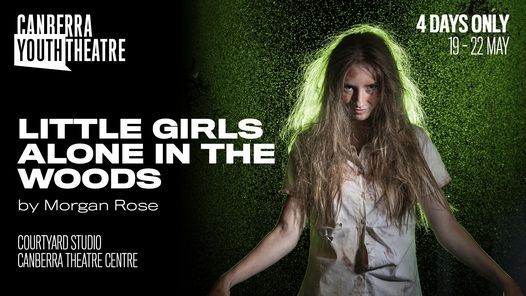
  5. Little Girls Alone in the Woods - Canberra Youth Theatre, Courtyard Studio, Canberra Theatre Centre: The Bacchae by Euripides is an ancient Greek drama which has captured imaginations for years, and lent itself to many interpretations as playwrights, authors, composers and directors seek to assign meaning and moral to a tale of violence, cynicism, divination and control. Among others Joe Orton, Caryl Churchill, Ingmar Bergman, Brian De Palma, Wole Soyinka, Friedrich Nietzsche, Gustav Holst, Thomas Mann and Henrik Ibsen have pondered the dichotomy between protection and imprisonment. Morgan Rose views the cult and legend of Dionysus through a feminist lens as her play suggests that young women are disappearing into the wilds of the woods to cavort and rebel against the confines of the patriarchy. Luke Rogers directs this version with a large cast of varying ability, and he is adept at playing to their strengths. Some of the ensemble work is excellent as the actors work together with both movement and voice, but when they try to stand out and compete against each other, it becomes discordant and incomprehensible. Whether they are lounging about in a study group preparing for exams and completing assignments on their laptops, or play fighting in pyjamas with pillows, they portray the messiness of youth that some adults try to streamline and corral. Change, transition, adolescence, questions and exploration can be uncomfortable for those who want to control, such as the police force who issue tagging bracelets that all females must wear for their own safety, to prevent them from going astray. The staging is bold with a man-made metal cage-like structure hinting of capture and confinement from a prison to a zoo, and as the action spills off the set into the audience space it suggests that our wilderness could either be part of the problem or a solution. Sound and lights are incorporated well to highlight some of the more confrontational aspects of isolation and power imbalance, although the musical ending doesn't pack the punch that perhaps it hoped it would. In general, this is a highly promising piece of work that delivers a deliberate sense of unease.

Friday, 12 July 2019

Friday Five : The Evolving Book Pile

At the beginning of the year I took a picture of the pile of books on my bedside table. By the end of year, I expect I shall still have a pile of books, but I would like them to be different ones. This is the six-monthly record of the evolving nature of that pile.

Bedside book pile January 2019
In January I read My Absolute Darling by Gabriel Tallent, The Sympathizer by Viet Thanh Nguyen, and All in the Timing by David Ives from my pile. I picked up the former while in Powell's City of Books in Portland. I was considering reading it over Christmas, but Christmas is supposed to be cheery and this book is anything but, so I waited until afterwards to embark upon it. A fourteen-year-old girl grows up dealing with nature and approaching adulthood through adventure and grit; like a female version of Huckleberry Finn with an added whack of abuse that is agonising to read. Happy New Year! 

The Symapthizer was lent to me by a friend who claimed the prose is beautiful. He's right. Mind you, it won the 2016 Pulitzer Prize for Fiction, so he's not alone in thinking that. It covers a range of genres from espionage thriller to darkly comic political commentary, and, because it deals with the Americanization of the Vietnam War, it nods somewhat vigorously towards Graham Greene. 

David Ives' All in the Timing is a collection of fourteen short plays set in surreal situations. Overlapping scenes, non-linear time, multi-faceted characters, literary allusions and fluid language make these a thoroughly entertaining cerebral challenge. David Ives is a comic genius who has put the play back into playwright. 

I also read Wicked Sisters by Alma de Groen, which was not in the pile. I am part of a committee which is producing this fantastic play in a couple of months in which four women meet up after the death of one of their husband's and learn more about him and themselves in the space of a wine-fueled evening than they ever knew or wanted to know.

Books read from pile: 3/11

Bedside book pile February 2019
In this month I read The Overstory by Richard Powers from the pile, and several others that weren't in it. The Overstory was shortlisted for the 2018 Man Booker Prize - it considers the narrative of life above ground, while maintaining that everything is connected beneath it. There are diatribes upon trees; growth; concentric circles; timelines; length of time taken to replace and regenerate; the fact that we have missed our opportunity and are now all doomed.

I also read The Mars Room by Rachel Kushner, which was similarly shortlisted - set in a women's prison and told in the first person through flashbacks, it details the lives of the inmates with a combination of mind-numbing boredom and bone-crunching brutality. We learn that these women are largely incarcerated due to poor choices made in the face of so few opportunities.

In keeping with the theme I read the winner of the 2017 Man Booker International Prize, A Horse Walks into a Barby David Grossman (translated by Jessica Cohen). It is a very short but very complex novella about a comedian who falls apart on stage. It is set in Israel and packed with lines that are certain to offend, but it presents a clever comparison between the individual and society, and how disease spreads from within to become all-consuming. 

The plays I read were Melancholy Play by Sarah Ruhl, which is admirably bonkers and addresses the issue of why we find sadness so attractive, and A Doll's House Part 2 by Lucas Hnath. I've never been a fan of people penning sequels to the works of others, but I have been asked to audition for this play, so I thought I should at least read it. I like the ideas and concepts about the need for equality in all things, but I'm yet to be convinced of its necessity.

Books read from pile: 4/14

Bedside book pile March 2019
March's reading was quite varied and included a few from the pile. Oscar Wilde's The Happy Prince, the Selfish Giant and Other Stories is full of tales of practical characters in fairy-tale situations where beauty is admired above all, which leads to bitterness and anger when youth fades. I read it as a child and dug it out again after seeing both the film The Happy Prince and the play The Judas Kiss in the space of a couple of weeks.

Silent Women: Pioneers of Cinema edited by Melody Bridges and Cheryl Robson is a collection of essays about the women who helped to shape the film industry: actors; directors; editors; marketers; producers; managers - there is a lot of historical content explaining how roles were not so strictly delineated (many women had creative control but were not called directors) and how various movements in the past affected their status in Hollywood and elsewhere. More recently, 1995 was “the peak of female director hires in the United States. For the next twenty years, women directors would face stasis and decline in employment.” In fact, only 1.9% of directors of the top-grossing one hundred films of 2013 and 2014 were women.

I'm not usually a fan of stream-of-consciousness novels (James Joyce and Virginia Wood test my patience to the limit), but the self-obsessed need to express every tiny thought no matter how banal, fits the teenage narrator of Milkman perfectly. Anna Burns' 2018 Man Booker Prize winning novel is set in Northern Ireland during The Troubles, (or 'the problems') as they are called here: it is almost comical (in a Monty Python People’s Liberation Front sort of way), but people are killed for these minor details, so the humour is very dark.

Having heard nothing about Of Love and Techno by Anthony Marra, I got it out of the library on a whim due to the title and am so glad I did. The multi-layered story about censorship and art, which covers many decades, nine narrators and a variety of styles, remains absolutely engaging throughout. It is one of those weird coincidences that one of the characters mentioned in the novel is Russian poet Anna Akhmatova, the titular character of Alma de Groen's time-travelling The Woman in the Window, in which anything is possible in a world where quantum physics explains different dimensions.This play, with its dual narrative thread of repressing poetry in the past and future for political purposes will be produced by Canberra Repertory later in the year. It's a great story with powerful themes and plentiful scenes - I'm looking forward to seeing it.

Books read from pile: 8/16

Bedside book pile April 2019
In April a friend lent me Bridge of Clay by Markus Zusak, and I liked The Book Thief, so I gave this a go. Big mistake. And I mean big. Huge. It is clearly meant to be an homage to Homer but, while Homeric epithets may work in epic poetry; repetitive descriptors, sonorous syntax and quirky sentence length are tiresome in this novel. The novel revolves around five boys growing up in a rural suburb in New South Wales, and at almost 600 pages, it reads as if Zusak doesn’t know where to start, or finish, or even what to say.

The Essex Serpent by Sarah Perry was a lot more successful, in which (to copy from a Guardian review), 'An Essex village is terrorised by a winged leviathan in a Gothic Victorian tale crammed with incident, character and plot'. From the book pile I also began to read Every Last One by Anna Quindlen, until I realised that I already had, and so returned it to the library.


Books I read that never made it into the pile were The Mao Case by Qiu Xiaolong (the sixth outing for Chief Inspector Chen, who has to solve a crime in Shanghai and Beijing, which may or may not involve Chairman Mao), The Graveyard Book by Neil Gaiman (which I read to help a student at work with a school project), and The Long Take by Robin Robertson. The latter was another shortlisted nominee for the 2018 Man Booker Prize and is a poetic work of brilliance, historical worth and impermanence, as the noir narrative exposes the black and white cinematic qualities of city developments and PTSD.

I also read Escaped Alone by Caryl Churchill because she is my favourite playwright and I am trying to find plays with strong female characters - this has four of them (all over sixty) who chat in the back garden with dialogue charged with incident and heightened reality.


Books read from pile: 11/18

Bedside book pile May 2019
I persisted with Anna Quindlen in May and read Still Life with Bread Crumbs. It's fine; gentle and comforting although occasionally it can also be a touch clichéd. The novel deals with loneliness, depression, mental illness, and creative temperament. These are big issues, which are important to address, but the treatment at times feels a little superficial. In the Blood by Lisa Unger is a perfectly readable thriller about missing college friends and maniacal children that didn't make me lose any sleep.

You Say Potato: A Book about Accents by Ben Crystal and David Crystal, on the other hand, is an absolute ripper. The father and son combination, with an almost intimidating knowledge of acting, Shakespeare and linguistics between them, riff on the topic of accents: where they come from; how they evolve; how they are influenced by fashion and attitude; and how "we think people should be proud of their accent, whatever it is.”

Not in the pile (but I read them anyway), were How to Talk to Girls at Parties by Neil Gaiman (about which I feel rather conflicted), and Votes for Women and Other Plays edited by Susan Croft - still on the lookout for strong female roles, I thought I could do worse than approach this anthology of plays, sketches and monologues to celebrate the centenary of the Suffragettes. It is, indeed, fascinating in its range and scope. 

Books read from pile: 14/ 21


Bedside book pile June 2019
I managed to read two book from the bedside pile in June, and what wonderful ones to choose. Simon Armitage wreaks amazing magic with his translation of Gawain and the Green Knight, which is funny and modern, while adhering to the style and traditions of the original. I read it and then I read it again out loud, because the words are supremely satisfying and they cry out to be spoken.

I also read Bad Feminist by Roxanne Gay, which is a well-written series of essays about feminism and other things: from the traumas of fat camp to the triumphs of scrabble tournaments; good journalism and social responsibility; lessons learned from teaching and the guilt of enjoying reality TV and rap music. 

Because we went for a long weekend to the coast and because I like to read books set in similar habitats to my environs, I finished off the mid-year by reading The Alphabet of Light and Dark by Charlotte Wood (an over-wrought piece about a woman drawn back to her home town after her father - the lightkeeper's - death, which won the Australian Vogel Literary Award in 2002 and readds like it was written by a creative writing graduate. It was.) and Dance upon the Air by Nora Roberts (in which three women represent earth, fire and air, and have brown, red and blonde hair and combine their spiritual powers to defeat men and commune with nature and blah, blah, blah...).

Books read from pile: 16/24

Total number of books still in the pile from the beginning of the year: 3/11