Showing posts with label Christchurch. Show all posts

Friday, 17 June 2011

72 Hours in Christchurch


Saturday

2pm - Today was going to be the first time I had flown with Jetstar. Problems with checking in our bags proved to be problems with checking in at all – the flight was cancelled because ‘your plane is broken; it can’t fly’. Not terribly reassuring, but the staff at the desk (and at the Air New Zealand desk, where we booked a flight later in the day) were very helpful and pleasant. That can’t be easy when everyone is moaning at you.

3pm – After checking our bags onto the Air New Zealand flight, we went to a café over the road and had coffee and cake – carbo-loading for the race tomorrow. Or maybe just an excuse to pass the time with coffee and cake.

5pm – We arrived in the new bit of Christchurch Airport to be met by Wide Boy Steve. We had less than an hour to find the Horticultural Society (‘somewhere on Riccarton Ave’ according to Him Outdoors) and collect our race packs. WBS drove us in laps round Hagley Park – his attempts to ‘dive down this side road’ being thwarted by the fact that said side road was closed due to piles of earthquake rubble and unsound buildings. We got there with seconds to spare and collected our race packs containing our number and packets of goo.

7pm – Back at Lyttleton for dinner with our friends. Witch 3 had previously sent me a text asking, ‘Apart from beer, do you need anything special for dinner?’ She must be under the mistaken impression that we are athletes and take these race things seriously. We said no and so we had a delicious roast followed by pear halves and ice cream. And lots of beer. The scarlet reptile (their teenage daughter) is very vocal about her dislikes – pumpkin; pears; carrots; etc – but not so forthcoming about what she does like. When (if ever) does this change?

Sunday

7am – This is not a normal time on a Sunday for me. Him Outdoors woke me up with a cup of tea and two slices of toast; then bundled me into the car and drove me to Lincoln. I tried to navigate but it wasn’t easy with half of the roads blocked off. Christchurch hasn’t got many landmarks, but the few there were and now destroyed. In the daylight you can see the scale of destruction and it’s really quite depressing.

The Christchurch Marathon, Half Marathon and 10km used to follow a pretty pleasant route along the Avon. It can’t now, of course, and has been re-routed to Lincoln. The roads are long and straight and (most crucially) unimpeded by rippling concrete, liquefaction, and other earthquake consequences that the rest of the city displays. It has been a massive task getting this event up and running, as it were, and the organizers are to be commended for continuing. Traffic management is a bit of a problem as there is limited access to the university campus where the race begins, so the start is delayed by half an hour to let everyone arrive. Damn, foiled in that plan, then!
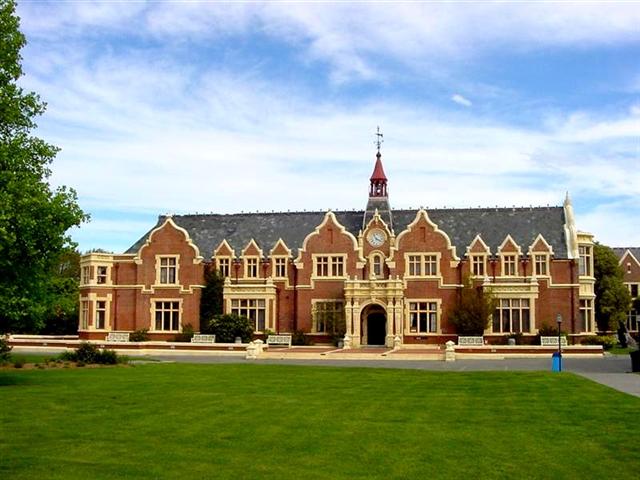
10am – Lincoln University has some impressive buildings – we scuttled around them looking for the start. Pre-race the talk was tough (‘Christchurch is back on its feet’; ‘We are up and running’ etc.) but the queue for the toilets was tougher!

11.30am – due to the staggered start times and the fact that he ran twice as far and almost twice as fast as I, Him Outdoors and I finished at about the same time. I was really just interested in making sure my knee held up to the distance (it’s the first race I’ve done since I damaged my knee about a year ago), and was going to run without a watch because the time wasn’t important and I knew it would only depress me. I couldn’t do it, though – I had to know my time (a very slow 1:02:57 if you’re interested) – what’s that about? At least I now know that if I carry on with all this boring gym and intensive physio stuff, I can run 10km again.

12pm – While waiting for prize-giving we went off to Hillyer’s Café to read the Sunday papers. It’s a pleasant wee spot which appears to be cycle-friendly (judging by the jerseys hanging outside and the pictures on the walls) and does great pies. Moving on for a change of scenery, The Bridge in Prebbleton had a warm fire, a comfy sofa and Speight’s Distinction.

4pm – Prize-giving was full of emotional speeches (Brian Taylor, a former race director and the chairman of the Christchurch Marathon Trust Board, was killed in the February earthquake) and seriously good holidays as spot prizes. We didn’t win any, although Him Outdoors picked up a rucksack for being second old git and 24th overall.

6pm – Once more back to Lyttleton where Witch 3 fed us pumpkin soup. After that and a bath I felt warm on the inside and the outside, so we headed out into what’s left of the town to celebrate. Keeping the local economy afloat we spent money in the Loons (drinking up their selection of good bottled beers) and the only recently re-opened Wunderbar. Apparently tonight is cross-dressing Sunday. The bloke behind the bar had gone to some effort (well, he’d put lipstick on, although he hadn’t shaved his beard) and informed us, ‘I’m a lady’. But of course you are.

Monday

10am – Witch 3 and Wide Boy Steve took us for a walk with their dopey dog. They can’t walk in the hills on their usual route because boulders and liable to come tumbling down. The buildings are all skewiff with leaning porches, broken brickwork, toppled chimneys and shattered windows. It felt wrong to catalogue this misery so instead WBS pointed out the yachts on the water, loosely tethered and free to escape. My knee began to hurt a little (clambering over the rocks probably isn’t the best exercise for it) so we walked back along the road through abandoned subdivisions full of previously desirable residences where no one wants to live anymore.

2pm – Met some friends in Becks Southern Alehouse. We had been going to somewhere else but it was closed; this is how you arrange to meet people in Christchurch now. Over a couple of beers and a bowl of wedges we discussed the damage to people’s homes, their access to fresh water, and the council’s job of keeping everyone informed with the most recent information while various departments bicker over supremacy and protocol. There is no other topic of conversation up here. My friend told me she was almost as fed up with talking about it as she is with the constant aftershocks.

6pm – The boys went out to get Chinese takeaways and fish and chips while we stayed in to talk more nonsense, of which there seems to be an endless supply. We ate dinner while watching the final episode of Sherlock, which we taped last night. Benedict Cumberbatch is brilliantly self-interested as Holmes and Martin Freeman (somewhat of a favourite of mine) is a powerfully under-stated Dr Watson. I wasn’t sure about dragging this classic drama into the present with all the technical gizmos and flash filming techniques, but I have thoroughly enjoyed this miniseries – and am more than slightly disappointed that it’s over.

We had an early start in the morning (when we finally flew Jetstar after all) so we took ourselves off to bed for another shaky night. Yep, the earth moved for us, but I’m sure that ‘joke’ has worn very thin in Christchurch. We were only there for three days and although I was happy to catch up with friends, I was also glad to leave it all behind.

Thursday, 14 April 2011

Community Matters

In the aftermath of the Christchurch earthquake, many buildings have been damaged. This is nothing compared with lives lost, but it still has a big effect on the civic community. People identify with buildings; be they churches, cinemas, schools or theatres.

Children are sharing schools; they are taking it in turns to use the classrooms and facilities, causing great disruption to the parents who have to drop them off and collect them at odd times, and putting added pressure on public transport already coping with infrastructure challenges, but at least education (and some semblance of normality) is being continued. Iconic buildings such as cathedrals and art galleries must be demolished or rebuilt as they are structurally unsound.

The Christchurch Repertory Theatre, where I performed in a prodction of  Emma in 1998 
Dramatic socities have to cancel their productions as the sets are damaged, the theatres condemned, and, in a couple of horrific cases, the actors are dead. There is hardly a person in Arrowtown who doesn't know someone affected by the earthquake. Local schools are innundated with Christchurch refugees; anyone with family and friends in Canterbury has had extra visitors, and we all share their grief and anguish.

The day the 6.3 magnitude earthquake struck, I had a rehearsal planned for the evening. I am directing a play for the Arrowtown Entertainers who perform annually at the Arrowtown Autumn Festival. Usually I don't allow the outside world to intrude on the rehearsal space (check your daily woes at the door; we are here to work), but looking at the glum faces around me and feeling shaken myself, I knew I had to address the situation.

Putting all this into perspective, you have to wonder - does theatre really matter? I think so. As humans we draw strength from the support of our neighbours and community. Theatre is community by its very nature; individuals working together to produce something greater than the sum of its parts. I believe that theatre and the arts in general raise us to another level. And community spirit is clearly evident in local theatre productions.

Meanwhile in Britain, David Cameron's party are busy slashing the art's budget. There have been a few howls of indignation from the left wing press and the thespians themselves, but mainly this has passed under the bridge with barely a ripple. I was disappointed, but not suprised. After all, what else would you expect from a party that infamously declared, "There's no such thing as society"?

Wednesday, 23 February 2011

Christchurch Earthquake


Thank you everyone who has asked; I am fine. The earthquake that has devastated Christchurch was felt here in Queenstown but there was no damage. So far as I know, all my friends in Christchurch are okay, although obviously severly shaken and traumatised. Some have lost their homes and their belongings but none have lost their lives. My thoughts and love are with all those affected by the earthquake.

Friday, 3 July 2009

Creative craftsman


Chris Cree Brown has forgotten I am coming to interview him. He emerges from the side of his house, wiping his hands on his cords. He has been building a chicken coop, but he is quick to stop and invite me in. His wife makes us a pot of coffee and home-made biscuits miraculously appear on a plate. This is Canterbury hospitality after all.

Soon we are sitting in Chris’ studio as he plays fragments of his electro-acoustic music through the massive speakers attached to his computer. He talks me through Icescape and Under Erebus, fascinating compositions that emerged from a two-week stint in Antarctica as a result of the Artists in Antarctica programme in 1999.

Despite the bright sunshine and the tui in the trees outside, the drums, cymbals and bells transport me to the coldest continent. Chris has mixed ‘real’ sounds of footsteps crunching through the snow and the raucous aggression of skuas with the almost unbearable pitch of strings conjuring daggers of ice plunging into the frigid sea.

He takes pity on me desperately clutching my coffee cup for warmth and we turn our attention instead to Pilgrimage to Gallipoli. He worked on this during a sabbatical in 2008, but the original sounds were collected on his trips to Turkey in 1994 and 2001. It is a highly-charged piece in which the sound of a camera shutter clicks between interviews, battle sounds and speeches from a tour guide showing them around the former battlefields.

Flies buzz, soldiers cough, shots fire and Abide with Me blends seamlessly into a muezzin’s prayer. It’s all incredibly evocative and was premiered a month before our interview at a cinema in Christchurch. Chris explains that he thinks of himself as a New Zealand composer and as such, he makes work about New Zealand themes. “I guess it’s an interest of mine to find out who I am and where I belong and that is in New Zealand so that’s where I work.”

Chris lectures in music and composition at the University of Canterbury School of Music, and he was able to work on this piece due to a research grant. Having spent his formative years living on porridge, he is extremely grateful to be the recipient of a steady income and these grants, but he is slightly wary of the way they are awarded. You get ‘brownie points’ if your work is played overseas, but as a distinctive Kiwi composer, Chris isn’t sure how much foreign interest his compositions will garner.

As we ascend to the kitchen and a blazing log-burner, Chris explains his theory on composition. “Composing is about finding out more and developing; getting an idiosyncratic voice. You create a personality in sound, but it needs developing.” His eyes light up as he explains his latest project – a piece for clarinet and tape.

“I’m getting the clarinettist to take the bell off the instrument which slightly alters the pitches, so it’s not a true scale. And then in another part she’s taking the clarinet apart and putting it together again without one piece so there is a whole series of different notes. The challenge is to try and get to know those notes and try and find out what works and what doesn’t, but that’s very interesting – that’s developing and learning.”

Electro-acoustic music has come a long way since Chris started out 30 years ago. Back then he says there were probably fewer than 20 people doing it. “I started out with tape recorders before there were computers, and you had to use a razor blade to cut these things and press them together, so technology has altered particularly electro-acoustic or sonic art immensely.”

I am a bit baffled by the whole concept, but he patiently explains it to me in simpleton’s terms. “Electro-acoustic music means you use any sound source at all – usually one from the real world rather than an electronic synthesised one – and you use the computer to manipulate that, so you can get down to a pure level of sound – a bit like a biologist getting down to the cellular DNA in a molecule and seeing why someone might have red hair rather than brown.”

Just as I think I’m beginning to understand how all this works, Chris introduces another string to his bow, if you’ll pardon the naff musical metaphor. He also likes to design and construct sonic sculptures, such as sea tubas, which produce sounds in reaction to the waves. His brother, a civil engineer, helps him with the drawings, and then he likes to build the prototypes.

There is interest from the Dunedin City Council in his sea tubas, but they have not been built as yet. He worries that part of the problem might be the current economic downturn. “Even if they had the money to build it, or to raise the money for it, they might not like to be seen at a time where people are losing their jobs, to be building expensive artworks.”

Chris is most proud of his Aeolian harp (which makes music when the wind passes over the strings). He drew the line at the plastering, but he enjoyed learning to weld and is happy to do these things himself. “I like to think that I’m hands-on. If I’m going to do something I’ll do it if I can. Not only do you save money, but by doing it you get better insights into what you’re trying to do, and you’re more likely to come up with something that will work.”

I ask him if he likes the contrast of the very practical side with the more creative aspects of his job and he smiles ruefully, “I think I would have to say yes. I mean if you asked me halfway through building a chicken coop, using wood that had built a cubby house that was hardly ever used and trying to get nails out, you might not get a positive answer”.

He is practically bounding with eagerness to show me the prototype of the harp so we head out to the paddock where it sits curved and beautiful and, unfortunately, silent. There is no wind today. Perhaps Wellington City Council should install one.
In 2002 one was displayed in the Christchurch Botanical Gardens as part of the Urban Arts Biennial. “I was scared it might not work. But when I put it in there and heard the sounds they were just beautiful. I knew that the whole thing, sonically at least, was going to be a wonderful success, and I was just over the moon.”

On his
website, Chris explains the physics that make this instrument sing, which is probably just as well. In the Middle Ages several people were burnt at the stake for witchcraft as a result of making these magical instruments that played by themselves. I think we’re all grateful that those times are behind us – none more so that Chris Cree Brown.

Wednesday, 10 June 2009

What's the point of prison?


A couple of weeks ago, when down in Christchurch, I was given a tour of the women's prison. It's clean and, although not exactly comfortable, every necessity of food and shelter and many of well-being are provided for.

Facilities include a library, a mini gym and a games room. Some prisoners share villas with a couple of other inmates. Mothers and babies have special areas for family development. Legislation states that a baby born in prison stays with the mother for the first 6 months, although this may be extended with approval.

With a heavy dose of understatement, the corrections officer explained, "It's not the baby's fault - it's quite strange. The legislation currently is looking at extending that to the age of two which in itself is going to create a lot more issues. Currently our self care unit is the area where we keep mums and babies because you can’t be locked in the cell with a baby from 5-8; it doesn’t work. But toddlers in prison; where are we going to keep them?"

Prison nurse, Anne Hofmeester, tells me that some people don't feel prisoners are entitled to health-care or indeed any benefits at all. "They are quite shocked that we provide prisoners with any help. They think they should get absolutely nothing. People in the community get cross that they have to go to their doctor and pay – it’s $70 to go to after-hours – but prisoners get it for free."

When the prisoners have demonstrated that they are ready to be rehabilitated and they are no longer a threat to others, they are relocated to 'villas' within the prison, where they share with three others in a flatting type situation, learning to budget for their food and toiletries and getting a small allowance for these necessities once a month. According to the Department of Corrections, the average cost of keeping an offender in prison is $90,747 a year.

They work in various 'industries' which includes the sewing room, kitchens, gardens and painting and decorating. Some of them take courses through the Open Polytechnic. As a corrections officer said, "Why wouldn't you? You've got the opportunity there to make something - to better yourself."

Again, some people disagree with this. They argue that they would like to study and learn to sew or play a musical instrument, but they are busy working every day to pay for food, clothing and shelter. How can it be right that those who have committed crimes, get the perks? Well, I can see their point, but I guess it comes down to the purpose of a prison. Do you want to punish, or do you want to rehabilitate?

She says she connects with the prisoners by talking about their family. Many of them miss their children more than anything while they are locked up and, for those who break the cycle of re-offending, they do so because they want to spend more time being a parent and less being absent or detained.

The prisoners are locked in their cells for a couple of hours over midday so that the corrections officers can have their lunch and do their paperwork. They are also locked up alone (for now - there is talk of introducing double-bunking in some prisons, but that is a separate issue) from 5pm until 8am, unless they have special duties. The cells they are locked in are tiny. I spent three minutes in one and I got claustraphobic.

There is a sense of menace in this place, compounded by the close proximity and the boredom of the inmates. They are constantly watched and frequently resentful. No matter what these people have done, the corrections officer I spoke to explained that her job is to ensure the "safe, secure and humane containment" of the prisoners.

"Getting through the day safely without any incidents is always a good one, and ensuring that your prisoners are safe. That to me is your challenge every day – that yourself and your colleagues are okay, and your prisoners are okay. The judging has already been done, which is why they’re in prison. It’s not up to me to judge again."

Naturally, everyone who enters and leaves the prison is searched and monitored. There may be wide blue spaces above, but there are razor-wire perimeter fences around the premises. In The Ballad of Reading Gaol, Oscar Wilde refers to "that little tent of blue that prisoners call the sky". When he learns that one of his fellow prisoners is to be hanged, he declares, "Dear Christ! The very prison walls/ Suddenly seemed to reel,/ And the sky above my head became/ Like a casque of scorching steel;"

To be deprived of freedom is a terrible thing. It may well be a necessary thing, but what do you do with people when you have locked them up? If you don't agree with the death penalty, which I don't, then surely you intend to release them back into society at some point. And hopefully they will have managed to have altered their behaviour in such a way that they will never want to return again.

Having seen the inside of a prison, albeit a nice new one with pleasant facilities, I know that I never want to be in there again, and certainly not if the means to get out don't rest in my hands. What price do we put on freedom? I know that I value it at more than a pool table and an open polytechnic course.

By the way, you can click on any of these pictures to make them bigger. The inmates can't.

Tuesday, 9 September 2008

Beervana: Tasting notes (Part 2)

One of my favourite beers of the night was the Yeastie Boys’ Pot Kettle Black. This is an American style porter and very dark. With a bit of an interactive theme, punters were asked to state whether they preferred the handpull or the pressurised tap version.

Not just to be awkward, I preferred the smoother texture of the hand-pull, but I felt the chocolate and hop flavours came through better from the pressurised tap. Him outdoors stuck his nose in the tasting glass, took a swig, smacked his lips and muttered something about ‘orange and pine’.


I confused the boys at Croucher Brewing Company by waffling on about Peter Crouch. As you do. They were very kind and they also serve a damn fine drop of pale ale. This beer looks good, smells good and tastes good. It is good, and it has a hoppy, fruity, grassy feel that lingers – I would definitely try this again. It comes from a boutique brewery in Rotorua and is available in several outlets in Wellington (the website above has a full list of locations). I shall be looking out for it!

To my mind, Monteith’s is one of the best mass-produced beers in the country. I recently had a heated debate about whether or not it was a boutique beer. I said not. If you are owned by DB Breweries you are not, by definition, a boutique. They do, however, have a
great advertising campaign which is neither sexist, ageist, or insulting to the intelligence, so that’s a refreshing change. They won the packaging award – I’m not sure whether this has anything to do with the adverts, but it’s all part of the same marketing department.

We tried a beer which I think (and I’m struggling to read my handwriting at this stage) was called 140W. It is a West Coast Pale Ale Reproduction and I’m pretty sure I liked it, but I would have to try it again to be sure.


I would also like another pop at the
Emerson’s Old 95 . This was billed as an old English ale – how could I go wrong? The combination of hops and fruit is very well balanced and the nuance of toffee is not too sweet. Him outdoors sampled the Piny Stout (aged in pinot barrels, 5% stout), new for the festival apparently, and was again heard to mutter something about oranges – I think this may be his new obsession. On the other hand, it did win a silver medal in the ‘fruit, spiced and herb flavoured beers’ category, so perhaps he knew what he was talking about after all.

We paid a visit to the
Dux de Lux brewery which again brought back memories of our time in Christchurch, although we never really took to the one in Queenstown. The lady at the stall said people had been coming up to her all night saying they had fond memories of the beer from when they were at Canterbury University . Weren’t they supposed to be studying, dear me, these students, tsk, tsk.

I tried the Sou’wester because I don’t remember having it before. I’m afraid I still don’t remember having it. I’m not sure whether this says more about the state of the ale or the state of me at this stage. Maybe I should have had the Ginger Tom, which always wakes me up!

Green Man Strong is exactly what it says on the tin (6.5%). When it was first released it sold out in 11 days, and it picked up a bronze medal here. It’s a Doppelbock aged in whisky barrels for 3 months, and then blended with best bitter. It’s quite sweet, as you would expect from this combination, but dangerously drinkable. It cost double beer tokens and I’m glad I only discovered it at the end of the night, or things could have got quite messy!

Incidentally, the Green Man brewery also won the accolade of Best in Class for their Enrico’s Cure. At 14.5%, this is a barley wine beer brewed without sugar by a German brewmaster. Scarred by memories of Carlsberg Elephant and other nasties in golden tins drunk by people in supermarket car parks, I avoided this particular brew, although I heard others say it was very nice. I think it’s odd that the class it won, is titled, ‘Experimental and non or low alcoholic beers’. Isn’t that a massive difference?

I finished up with a beer from the Twisted Hop, and although I don’t know which one, this seems in keeping with my usual experiences there. The whole thing has a sort of magical mystical quality to me. I know the bar is
tucked down a side street in Christchurch, and I have had a couple of very good nights there. But I can never remember how to get there when I’m sober. It’s like Diagon Alley. Anyway, I know from previous experience that the Challenger is exceptional – well, I’m always up for it! Oo-er missus.

So, to sum up, I drank lots of beer, I like hops and I had a great night. My top three, entirely unscientifically based upon the way I was feeling at the time are Epic Pale Ale, Yeastie Boys' Pot Kettle Black, and Croucher Brewing Company Pale Ale. Anyone else?