Showing posts with label Rimini. Show all posts

Sunday, 30 November 2008

Coffee Culture in Italy

In a bustling café in Rimini men stand at the counter and knock back tiny cups of powerful caffeine – ristretto is ‘very short black coffee’ – shuddering as they swallow, almost as if it is a chore – so why do they do it? It costs more to sit down.

I ask for a latte and receive a glass of milk. If you ask for a caffe é latte, you also get a small jug of coffee (a shot of double strength coffee – not espresso) which you add to your milk and watch the colours and flavours mingle. These are generally only drunk at breakfast and made in the privacy of your own home (and certainly without froth).

They are akin to the French café au lait, and what Americans call a latte would be considered an abomination on the continent. US lattes were first made in Berkeley in America and are basically a cappuccino with extra milk added. What they call a latte; New Zealander’s call a flat white. This is all getting confusing.

But don’t worry, because you can only drink milky coffee in the mornings unless you are uncouth or a tourist – which seems to amount to the same thing. Otherwise you have an espresso, or an espresso doppio (a double espresso) or a caffe Americano which is an espresso served with a jug of hot water so you can make your own – they can’t bring themselves to adulterate the coffee in this way. New Zealanders call that a long black.

Italians are also known to drink moccaccino (which is a third of espresso with two thirds of steamed milk mixed with chocolate), caffe macchiato (espresso ‘stained/marked’ with a dash of milk) or latte macchiato (vice-versa; i.e. milk ‘stained’ with a dash of espresso). They do not drink triple Venti nonfat decafe latte white chocolate blended mocha frappucino whip. Without froth.

They do get a bit weird though with the old espresso confuso, which is a sort of coffee desert – espresso mixed with a chocolate gelato. Very confuso indeed. And the freddoccino is a cold (freddo) cappuccino. I’m not sure if they make these specially or just leave them lying around until they get cold. My mum’s good at that. I bet they don’t then put them in the microwave and forget about them though.


My very favourite is the caffe corretto, which is a shot of espresso, 'corrected' with a shot of grappa. Wow! That's enough to blow your socks off. We were walking in the snow in Dolomites for four hours and stumbled back off the mountain to a cutesy cafe by a lake when we discovered these. I could have done the walk all over again. Well, maybe not, but for about ten minutes I thought I could. Mind you, I thought I could leap tall buildings in a single bound. I was wrong.

Friday, 28 November 2008

What to buy in Tuscany/Rimini

In Rimini my sister finds a pair of leather boots lined with sheepskin for 39 euros, marked down from 120 euros. She is pleased with her bargain and puts them on at once hoping to be more seasonably dressed – Italians don’t sell things out of season, which is why there are no sandals on display.
A saleswoman breaths down her neck in another shop where she tries on hats and leather jackets – the goods turn to tat the further we walk from our hotel. She reckons we must be at the posh end.

Buying food is an experience – there are shelves of pasta twists and twirls and packets of alluring biscotti. Jars of marinated things glisten in anti-pasti paradise although I don’t want to look too closely as one of the delicatessens reminds me of an eighteenth century medical laboratory – I’ve seen too many pictures of pickled specimens.

You have to weigh your own fruit and veg in the supermarket, while punching into the machine the details of what you’ve got in your basket. Fortunately there are pictures as well which help you select the appropriate sticker. It’s a great game – my nephew would love it!


Later, in Florence, we spend many hours strolling through the markets of San Lorenzo, eyeing up the leather goods, pashminas and silk ties. We buy a stylish leather jacket for Him Outdoors, a bright green handbag for me (‘But will it go with anything?’ Men!)

We buy presents for mums and brothers, but keep our hands firmly in our pockets after we’ve had a drink. Never buy anything unless you’re completely sober; that’s my motto. Actually, I’ve only just made it up, but I quite like it and I think I’ll keep it!

There are shops selling extremely expensive paper embossed with the Florentine lily. It looks a lot like the French fleur de lis but is different and they get very upset if you make the blundering mistake of calling it such. The Florentia paper is of the highest quality, and the highest price, and is I'm sure, well worth it, but beyond our budget so I make do with a leather bookmark.

I love the toy shops which, although full of an alarming array of rubbish, have some classic shiny wooden toys that gleam from the shelves. Like something Gepetto's workshop, they wait for you to turn your back so that they can come to life. I try to catch them at it, by just pretending I'm not looking, but they have me sussed and stay fimly put.

At the Mercato Centrale I am impressed by the fish counters with their bright red tuna, tentacled squid and octopus, and other creatures of the sea. There are bins of porcini and sun-dried tomatoes which are ridiculously cheap by non-Mediterranean standards.

We drift through aisles of fresh produce, buying cheese; ham; bread; wine; pesto and olives – staples of a meal negotiated in our stumbling and stunted Italian. We find a park bench to sit on and eat our simple meal, pushing in the cork (they seem reluctant to switch to screwcaps) and swigging from the bottle like cheerful vagabonds.

Friday, 7 November 2008

Travels and Tribulations 2

The travel hassle begins again. Taxi to Rimini train station; 12 Euros. Waiting on the platform for an hour – Him Outdoors still has dodgy guts and is doing a lot of groaning. We find a seat on the train to Bologna and a place to store our luggage which is very fortuitous as the train soon fills up; standing room only.

We are at one end of the carriage and when the train pulls into the station at Bologna and the doors don’t open, it turns out to be the wrong end. We have to clatter and bang our cases (never travel with a bike!) all the way down the aisle then negotiate a way across the station to the Aerobus (5 Euros) to the airport.

Here we pick up a car and drive to Florence; quite a baptism of fire for Him Outdoors on the wrong (right) side of the road. There are lots of tunnels (of course you never check where the lights are on a hire car that you pick up in broad daylight!) and lots of trucks whizzing by very close. He keeps drifting right and we are missing the trucks by inches. I don’t wish to turn into my mother (sorry, mum), but I keep flinching and telling him to keep his eyes on the road when they are drawn to the glorious Tuscan countryside.

We find our hotel relatively easily. It’s a delightful villa, quite peaceful, surrounded by trees and a half-hour walk out of town. We dump our bags, the bike and the car and then thankfully walk into town.
I take Him Outdoors on a quick walking tour and we race through the sites – Ponte Vecchio, dazzling with its array of gold jewellers; the Uffizi , outside which I point out the Room With A View moment (there are lots of people taking photographs but the beautiful view is ruined by a massive crane in the way); and the Palazzo Vecchio, which he decides is his favourite building.

The Piazza della Signoria is as I remember, with all its fabulous sculptures including Ammannati’s fountain of Neptune, Giambologna’s statue of Cosima I de’ Medici and his Rape of the Sabine Women, and (my favourite) Cellini’s Perseus, having just slain Medusa. There are also copies of Michelangelo’s David and Donatello’s Mazocco, the heraldic Florentine lion.

We pass the Bargello; Casa di Dante (where the poet supposedly lived); Orsanmichelle; and the cathedral, campanile and duomo. It’s all incredibly impressive stuff, and quite breathtaking. The Lonely Planet writes,

“The French writer Stendhal was so dazzled by the magnificence of the Basilica di Santa Croce that he was barely able to walk for faintness. He’s not the only one to have felt overwhelmed by the beauty of the city – Florentine doctors reputedly treat a good dozen cases of ‘Stendhalismo’ each year.”

A very short queue beguiles us to duck into the baptistery – the first one of which was built in the 5th or early 6th century AD; this one was reconstructed in the mid 11th century. Bronze doors, marble floors and mosaics on the roof add to the majesty of the place which is credited with launching the Renaissance.

We wend our way through the streets and walk back more leisurely to the Piazza Pitti – the Pitti were the rival family to the Medici; the Palazzo now houses a number of museums – and Café Bellini where we have a beer and pizza. The pizza here are thin and crispy and swimming in sauce and mozzarella. I have one with artichokes, olives and ham – bellisimo!

I collapse into bed but I find it hard to sleep as my mind is full of images and cultural icons crowding in upon each other. Or maybe it’s the cheese.

Thursday, 6 November 2008

Race Action

I watch some of the World Duathlon Championship junior and elite races in Rimini. The marshals are very officious: some with whistles; some with guns. A Brit wins the junior women’s race – it’s good to hear the anthem. Vanessa Fernandez flies through the elite race, blitzing the field and showing up the lack of depth.

I cheer on the Brits and the Kiwis and feel very egalitarian. One woman asks if I can cheer for Canadians and I don’t see why not. South Africans are cheering Brits and Kiwis; Americans are cheering their own massive team, and some folk are supporting everyone – it’s a good atmosphere.

Him Outdoors talks to everyone – Americans; Canadians; South Africans; Australians – okay, anyone from an English-speaking nation; he just smiles and nods at the others. The Brits say it is impressive we can support so many of our team by name – they don’t even know who half of theirs are.

A young American lad comes last in the junior race and promptly bursts into tears. I know how this feels. His coach says he has come from being a big fish in a very small pond and is now floundering at the World Championships – chalk it up to experience and note what you need to improve for next time.

Him Outdoors stubs his toe while practicing his transitions. I mock, I must confess, until I see it – all purple and swollen; not ideal for a race. He sits around all morning whingeing that he’s bored and wants to be on holiday, annoyed with his cold and his ‘herpes’.

I go down to the beach to watch him run and cycle up and down the front. Supposedly the folk on motorbikes arte pinging people for drafting, but I don’t see much evidence of the pinging, although there is a lot of drafting going on. It’s a good job that I’m not relied upon to count the number of bike laps because I get it wrong and stand waiting for him to complete his last bike leg when he’s already started his last run.


We race from side to side of the course for a couple of hours, especially through the convoluted and contrived running course. It is hard to know where people are placed, but apparently Him Outdoors comes first Kiwi in his race. He does really well and I’m so proud of him, even if it’s not his best race ever. At one point Dad asks, ‘He looks very white – is that normal?’ No, in a word. He runs his little heart out, or certainly his stomach, the contents of which he leaves behind a tree in the finish area.

Back at our hotel with my parents we crack open the champagne. Him Outdoors has half a glass and needs to go to bed. Committed supporters that we are, we finish the bottle for him. He gets up later and we go to the evening ‘do’. All the age group folk get awarded their medals and the bianco is soon finito – unusual for these athletic types to drink their wine.

It is customary at these functions to swap apparel and the Kiwi kit is in high demand – Him Outdoors leaves with a new Brazilian team jacket.

Tuesday, 4 November 2008

Domestic chores abroad

Doing domestic chores in a foreign country can always be interesting. Here a few things we struggled with in Rimini:

  • Washing underwear in the hotel sink and trying to tie it to a line without pegs
  • Buying stamps for England and New Zealand from the post office when a policeman comes in and leans nonchalantly on the counter with a gun loose in his holster
  • Trying to explain that we want smelly foot powder and cold sore cream to the pharmacist – the man behind the counter points at Him Outdoors’ face and loudly says ‘Herpes!’ Thanks very much
  • Looking for a postcard from this beautiful village of cobbled streets and Roman ruins that doesn’t feature a woman’s arse in a thong and glitter.

Monday, 3 November 2008

Parade of Nations

Watching the parade of nations provokes mixed emotions. Him Outdoors reckons things start to get serious from here and he begins to feel the competition – if we didn’t despise the expression so much, we would probably say we were getting to the business end of the contest.

Although I am proud to see him march beneath the New Zealand flag, my heart still feels British. He tells me there are numerous Kiwis and Aussies who are representing Great Britain so I suppose that evens things out.


Some of the lads do the haka, turning round and facing the other competitors. South Africa, used to seeing this and knowing how to respond, push through Portugal, Poland and Qatar (they are lined up in alphabetical order) to front up to the challenge. It is good to see the skinny white blokes putting passion into it.

South Africa sing harmonies as they parade, Canada hand out little flags, Japan wear strange constumes, and France and Italy contest the best-dressed award.

Meanwhile the Great Britain team fly the union flag upside-down which is either a great insult (lese majeste) or an international distress signal.
Him Outdoors points out that this isn’t the best look before a race, and no one had even noticed.

Saturday, 1 November 2008

Scenes from Ravenna

It’s hard to drive into a place when you haven’t got a map. The only thing I can find to locate from is the train station and it’s tough to get there when the streets are one-way but not marked as such. Finally we reach an information place to gather up leaflets and I am sent off on a scouting mission to find a suitable café.

On my travels I pop into the covered market to go the toilet and I get stuck. All sorts of things run through my mind; can I climb out of the window? Not really as I’m on the second floor. Could I phone someone? Who? My dad’s phone doesn’t work here and Him Outdoors didn’t bring his. I could ring the helpdesk and try and speak to someone at our hotel but I don’t know what the operator’s number is in Italian. And I don’t know any Italian to ask a question even if I get through. And what could they do in Rimini about me being stuck in a toilet in Ravenna anyway?

I think of shouting for help, but I don’t know what that is in Italian either. Eventually I pound on the door calling, ‘Help!’ I am trying to stay calm and not panic, although I can feel the stress level rising. There is much gabbling of things I don’t understand and then the door flies open to reveal a party of bemused tourists, in a queue that reaches all the way back down the steps. I hurry past and return to my parents.

I decide to abandon the coffee and go straight for a beer at lunch to restore myself. I accompany it with an insalata mare which consists of baby octopus, squid rings and all sorts of other fishy treats. Suitably fortified from further mishap, we set out to explore.

According to the Lonely Planet, “The city had been the capital of the Western Roman Empire ever since 402 when the ineffectual Emperor Honorius moved his court from Rome because Ravenna’s surrounding malarial swamps made it easier to defend from Northern invaders. However, the barbarians simply walked around him and marched into Rome in 410. Honorius was unable or unwilling to react, preferring to vegetate in Ravenna until his death in 423, and the city finally followed 50 years later.”
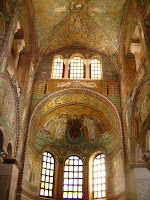
This doesn’t sound mightily inspiring but the city is famed for its mosaics that adorn its churches and monuments, eight of which are Unesco World Heritage Sites. I like the look of the buildings with their red brick and the contrast of the green or oxidised copper – was this intentional or did the architects/builders stumble upon the colour combination by happy accident? My top five tourist sites (and sights) are:

1. Basilica di San Vitale – the red brick façade which looks impressive in the sun but fairly nondescript otherwise, belies a “dazzling internal feast of colour”. Mosaics represent scenes from the Old Testament and apart from the cupola which is painted, everything else is indeed a dazzling vision of millions of little tiles stuck to every conceivable surface – that DIY project must have taken many a wet weekend!

2. Mausoleo de Galla Placida – a mausoleum constructed for Galla Placida, the half-sister of Emperor Honorius, although it’s unlikely she ever lay here – that’ll be “the ineffectual” Emperor Honorius again. The Lonely Planet says, “the light inside, filtered through the alabaster windows, is dim yet, supplemented by a single central lamp, is sufficient enough to illuminate the city’s oldest mosaics.”

The roof has a specific number of stars (four hundred and something) which represent something I’ve forgotten. It’s true that when they light up with sunshine they are something to behold. Apparently during the summer months you can tour these at night – I’m sure the effect will be very different.

3. Basilica di Sant’Apollinare Nuovo – this contains the largest surface area of mosaics from the Byzantine period, or some such spurious claim. Apparently the procession of 26 martyrs heading towards Christ in majesty with his apostles on one wall, and the complementary one of virgins on the other are typical examples of the Byzantine style. I like the three wise men bearing gifts and the boats in the Chinese harbour.

There is a school for making mosaics here which would be fun, but I wonder how difficult it is? Don’t you just sketch a picture (and let’s face it, none of them are particularly realistic) and then just stick some stones on? Like cross-stitch or paint-by-numbers, it’s very intricate and meticulous, but is it creative and talented? I suppose, as father says, you have got to draw the picture first.


4. Battistero Neoniano – the most ancient monument of Ravenna, this dates to the 4th or 5th century BC and is thought to have started life as a Roman bathhouse. It was converted to a baptistery in the 5th century. The image in the cupola depicts John the Baptist baptising Jesus in the River Jordan, the personification of which looks on. The concentric circle features the twelve apostles and there are eight little alcoves around the marble fountain, each with fabulous mosaics of their own.

5. Museo Arcivecovile – this is a small museum in the Archiepiscopal Palace with works from the old cathedral, which has been destroyed. The most impressive of these is the intricately carved throne of the 6th century carved by Byzantine artists and considered to be “one of the greatest ivory masterpieces of all times” according to their tourist literature.

Ravenna has heaps of festivals, none of which are in evidence when we attend. There is a Dante festival – he wrote most of The Divine Comedy here and is buried in a tomb with an eternally burning lamp. Florence supplies the oil for this as a perpetual act of penance for having him exiled (in 1302 – he lived in Ravenna until his death in 1321).

There is a festival of music and dance; one of authors “shows and parties with murder”; a Nightmare Film Fest; walks with mystery; jazz festivals; a festival for October or autumn featuring concerts, horror stories, fireworks and wine tasting; European heritage day with guided tours of archaeological excavations; a marathon in November; a Japanese festival featuring cinema, board games, cuisine, performance arts and origami; a wine festival promoting Sangiovese di Romagna; debates between philosophers and awards for publishing houses; and festivals for both bread and chocolate.

It would seem that it terms of pulling the tourists, there is always something happening in Ravenna – sounds a bit like Arrowtown!

Thursday, 30 October 2008

Italian hilltop towns

San Leo is a beautiful little town with a massive fortress atop a rock. The town itself has cobbled streets, hills and steps, and a square with a fountain enclosed with shops and restaurants. The food is a delight in these wee villages and just what you think holiday cuisine should be – spaghetti al pomodoro e basilica and a bottle of healthy red wine (well, it’s full of anti-oxidants so they tell me).

From the fortress there are commanding views of the countryside, so you can see any potential attackers. There are parade grounds and turrets, narrow steep staircases, tiny rooms used for cells, small windows for firing ammunition and wooden doors with thick clunky bolts.

Various items are displayed: suits of armour, cannons and guns, used right up to the Second World War; medical apparatus and herbs as discoveries were made to heal and cure; and instruments of torture to harm and wound – even more thought has gone into this. Cruel spikes, heavy irons, sharp blades, evil spikes and barbs, stretching racks and wheels are all enclosed in dim, underground punishment cells.

Feeling ill, we have to be careful not to think about it too much or to imagine the pain. Back in the streets of the sleepy little village it feels an age away from such horrors and we sit against a sun-warmed wall eating gelati while a black and white cat slinks about our legs.

Tavullia is the home of Valentino Rossi, number 46 motorbike rider and, according to Sports Illustrated, one of the highest earning sports personalities in the world, having earned an estimated $34 million in 2007. You know this is his birthplace as soon as you enter the little town; there are banners everywhere and all of the trees sport yellow ribbons – it’s his colour, apparently.

There is a fan club with a shrine to the great (little) man featuring a bike, a leather suit, a whole load of photos and a guest book to sign. A shop sells every kind of Rossi-related tat imaginable – little figurines and helmets; clothing; mouse-mats; key rings; wallets; magnets; bedspreads; everything!

The local café has yet more photos and delivers cappuccinos to the table with 46 written on the top in chocolate and froth.

The speed limit here was recently lowered from 50 to 46kph, and there is one of those LED signs that flashes up your speed as you drive past. I stand and watch as grown men, who really ought to know better, steady their speed to make the sign display 46 as they drive beneath it.


San Marino – the guide books say, ‘Tis a silly place’, and perhaps it is. Lonely Planet suggests that, ‘you’re unlikely to ever see a greater density of kitsch souvenir stands’. Again, this may be true, but I really liked it!


Another catty comment remarks that it is like one of Rimini’s theme parks – indeed, there are local soldiers in this republic and a palace which they guard, albeit probably not particularly effectively. There are four of them and when we watch them shuffle out to change the guard, one of them nearly drops his dagger. I suspect they are students on a holiday job.

Tiny streets lead up (or down, depending on your perspective) through the republic to three impressive fortresses at the top of the hill. They jut out over sheer cliff faces, connected by ramparts that at times meander through verdant woods – these places are strongly fortified, alright!


There are battlements, heraldic flags, turrets and towers, doorways, gates, portals and secret passages aplenty. Sure, the cobbled streets swarm with tourists buying tat (we pick up a garish fridge magnet – we have a collection – and a replica San Marino football shirt) but there are also leather bags and belts that look like bargains.

This is the place to come if you are in the market for Murano glass and Carnivale masks; liqueurs and jewellery; candles and crossbows. Weapons are everywhere – it seems odd and slightly scary to see quite so many guns casually on display.

Montebello has apparently remained virtually untouched for centuries. When we visit it is slightly eerie: a combination of out of season, midweek, and miserable weather mean that it is deserted. The only signs of life are an old woman carrying a bundle of sticks, an old boy on a bicycle, and a cat curled up on a chair.

We are in search of coffee and there is something that looks like a café but it is on the uninviting side of empty. It’s incredible how unwelcoming closed shutters can be – there’s nothing quite like it. I think they’re delightful, but they can close up a town and make you feel like you don’t belong. I get a feeling that this is like a plague town – sealed and evacuated. Picturesque though it is, I can imagine zombies creeping out of the narrow alleyways and I am glad to move on.

Verruchio was apparently chosen as an ideal place to live over 3,000 years ago by early settlers who appreciated its strategic position, on top of a hill with great surrounding views. It was the home of the Malatesta family – the dynasty that ruled the Rimini area from the Middle Ages to the Renaissance.

I have the best panini I think I’ve ever tasted – cheese, tuna, mayonnaise and tomato – simple fresh food and simply delicious. Once again there is no one on the streets and we have the place to ourselves. It is cold and begins to rain so we do some speed tourism, racing around the town from church to monastery to tower while our map gets soggy.

Saturday, 25 October 2008

Rimini out of season

Down at the beach there are regimented rows of changing huts and folded deckchairs – it is grim to imagine the place sizzling with sun worshipping holiday-makers in season. The Italian mod website suggests it is the best place to organise a mod rally at the end of summer. I wouldn’t know about that. Now it has an off-peak melancholy familiar to all seaside resorts.

I am reminded of Morrisey’s ‘Every Day is Like Sunday’, although I’m not advocating bombs or Armageddon unlike the King of Glum. A quick browse of the lyrics corrects my assumption of stray dogs licking at your hand and face – apparently the proper words are, ‘Trudging back over pebbles and sand/ And a strange dust lands on your hands/ And on your face’. I think I actually prefer my version.

Men fish on the quay all bundled up in jackets in scarves – in our sandals and short sleeves we look out of place, not to mention grimly desperate. Hardy souls plunge and rear through the waves as they leave the safety of the harbour. A couple of fishing boats are moored to the quay and people flock to buy fresh fish from their decks. My sister says it is sad to see all these dead sea creatures caught in the nets – collateral casualties of trawling. I think this style of fishing is outlawed in the UK and NZ (unless you’re Maori).


We head to the old town, which is very old indeed with a triumphal archway from 27BC – a great ancestor of the Arc de Triomphe – piazzas, fountains, statues, castles, churches, campaniles, excavations of Roman streets, and a very old arched bridge. People cycle around the narrow streets and wide open squares of the old town on bright red commuter bikes; there are no vehicles, but you have to dodge out of the way of the approaching bicycles.

Borgo San Giuliano is just over the Tiberius Bridge but it’s like another world. The pastel houses huddle together in shades of yellow, pink, blue and green, hiding behind their shutters and pots of geraniums on the window ledge. Many of the walls are decorated with murals, mainly depicting sea scenes.


The lazy, sleepy atmosphere is broken only by old women in headscarves as they pedal their bikes – baskets laden – back from the market, wheel their shopping trolleys or sweep their yards, calling out ‘Ciao Maria’ to their neighbours, all of whom appear to be called Maria for ease of memory.


Back over the bridge I get trapped in the bustle of the market at Piazza Malatesta where leather goods (vera pelle) and fresh produce are everywhere. I walk around the stalls skirting the cathedral for about an hour looking for comfortable leather sandals (like the ones they sell in NZ, made in Italy, for about $150). There aren’t any – they must export them all.

I suspect the Italians don’t do comfort, eschewing it for pure style. One must suffer pain for fashion it seems. The shoe repair shop in the centre of the old town has window displays of the various stiletto heels that can be re-fixed to your shoes after you have wrecked them among the cobbles and doubtless twisted your ankle.