| 'Our' Penelope - Elaine Noon in The Penelopiad by Margaret Atwood |
![]() |
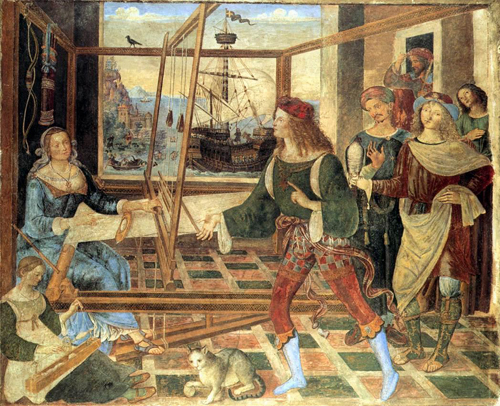
| Penelope with the Suitors (1509) by Pintoriccio |
![]() |
| Penelope (1514) by Domenico Beccafumi |
![]() |
| The Patience of Penelope (1849) by John Roddam Spencer Stanhope |
| 'Our' Penelope - Elaine Noon in The Penelopiad by Margaret Atwood |
![]() |
| Penelope with the Suitors (1509) by Pintoriccio |
![]() |
| Penelope (1514) by Domenico Beccafumi |
![]() |
| The Patience of Penelope (1849) by John Roddam Spencer Stanhope |
Through the use of alternating chapters between Lizzie and Ross, we are drip-fed information about the developments and social mores of the times, ranging from scientific progress to insights into the working of and attitudes to the police force, and personal relationships.
London is changing and the era is
one of rapid development: the capitalist society dictates the rich will get
richer while the poor are further oppressed. Mr Fletcher runs the construction
company which is building the station on the grounds of the housing Mrs Parry
sold to the railway for development. He doesn’t want the police involved on his
worksite, because people are fascinated when a body is found. Mrs Parry is
equally uncomfortable. “No one wants to be known as a slum landlord and after
Madeleine’s body was found there, she liked even less the idea that people
would associate her with the place.”
![]() |
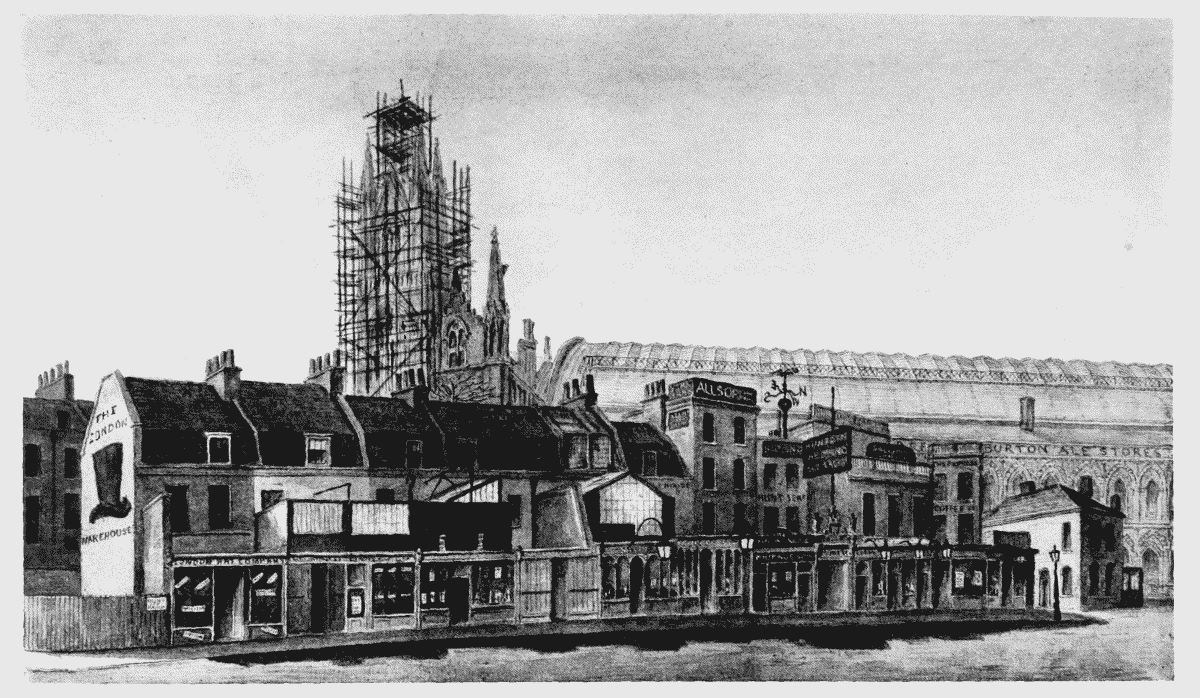
| St Pancras Station in the course of building (1871) |
Morals and attitudes to women are
also questioned. The supposedly religious and upstanding Dr Tibbett expresses
his conservative reactionary views to Lizzie in a manner that demonstrates the
constraints within which she must work. “I am sorry to say I find increasingly
that there is a type of modern young woman who fancies she may speak as freely
as a man. I am an old-fashioned fellow who believes that woman is the greatest
ornament to her sex when she realises the boundaries Nature has set for her.” He,
and others, blame female victims when they are exploited and abused. “We did
not know the circumstances of Madeleine’s death. Whatever Tibbett had to say it
would amount to declaring that it was all her own fault.”
This is a world in which class
distinctions are rife and supremely hierarchical. Inspector Ross comes from
mining stock and has risen through the ranks; his superiors dislike him because
he is working class. He notes that the social strata extends to the upstairs/
downstairs milieu of the masters and servants. “I reflected that below stairs
there existed a world which, in true Darwinian fashion, had evolved quite
differently to society above. Had the great naturalist set himself to study it,
he might have found as much of interest there as he had in Terra del Fuego.” Although
this is the first in the series about Benjamin Ross and Elizabeth Martin, it is
evident that there will be more, and that Lizzie and Ben will end up together;
they are both honest and self-aware with a strong moral backbone.
I'm in the middle of rehearsals for The Penelopiad by Margaret Atwood, which is a retelling of The Odyssey, focussing on Penelope, who was left behind while Odysseus went off to war and then travelled around having adventures rather than returning to her in a timely manner. I'm co-producing and directing the play which will be on at the Courtyard Studio in Canberra from 7-17 July. I have always loved mythology and the value of storytelling, so have thoroughly enjoyed providing a bit of context to some of the characters mentioned in the text. This is Part Three (See Part One and Part Two).
| The Birth of Venus by Sandro Botticelli |
1. Aphrodite
Aphrodite is the Greek goddess associated with love, beauty, pleasure, passion and procreation. Her major symbols include myrtles, roses, doves, sparrows and swans, and she is consistently portrayed as a nubile, infinitely desirable adult (having had no childhood as she was born fully-formed from sea foam caused by the severed genitals of Uranus - it's complicated), and usually nude. Her Roman equivalent is Venus, hence the famous Bananarama song (okay, I know it's not originally theirs), female razor products (exactly the same as the male ones but twice as expensive because, you know, pink), the fly trap (because stupid creatures will entrap themselves and die for nubile beauty) oh yes, and the above painting.
In The Odyssey, Aphrodite is married to Hephaestus (blacksmith to the gods who makes all sorts of wonderful gadgets, like Q in James Bond) not by choice but through some bargaining with Zeus - she is given to Hephaestus as a bribe (sound familiar?). Aphrodite is frequently unfaithful to her husband, and her lover include Ares, the god of war (Mars in the Roman versions). Hephaestus sets a trap for the lovers and casts a golden net in which they are caught the next time they have sex upon the marital bed. Hephaestus invites all the other gods to laugh at the adulterous pair, but many of the (male) gods have sympathy for Ares and Poseidon agrees to pay Hephaestus to release Ares. Meanwhile, Aphrodite was humiliated and returned in shame and ignominy to Cyprus where she was attended by the Charities (or Three Graces). What's that you say? Rhymes with stubble dandards?
![]() |
| Charybdis before she was a sea monster |
2. Charybdis
Charybdis was a sea monster who dwelt in the Strait of Messina. She swallowed large amounts of water of water and then belched them out, creating large whirlpools that resulted in the destruction of passing ships. She was the offspring of Poseidon and Gaea (Water and Earth) and helped her father in his quarrel against Zeus by flooding large areas of land with water - don't you just love how all cultures have a creation and a flood myth? Zeus was angry (it seems to be his default setting - grumpy head god) and punished Charybdis by turning her into a monster that would eternally swallow sea water and create whirlpools.
![]() |
| Scylla, the Huntress, from Game of Heroes |
3. Scylla
Scylla was a sea monster who haunted the rocks of a narrow strait opposite the whirlpool of Charybdis. Ships who sailed too close to her rocks would lose six men to her ravenous, darting heads. Homer describes Scylla as a creature with twelve dangling feet, six long necks and grisly heads lined with a row of sharp teeth. Her voice was likened to the yelping of dogs. In classical art she was depicted as a fish-tailed sea-goddess with a cluster of canine fore-parts surrounding her waist. According to late classical writers she was once a beautiful nymph loved by the sea-god Glaukos, but her jealous rival, Circe, transformed her into a monster. Older poets, however, envisaged her as simply a monster born into a monstrous family.
![]() |
| Scylla and Charybdis by Emmique on DeviantArt |
Being between Scylla and Charybdis is an idiom along the lines of 'between a rock and a hard place', 'between the devil and the deep blue sea', 'to choose the lesser of two evils' or 'out of the frying pan; into the fire'. The situation implies that one must seek to chose between two equally dangerous extremes which will inevitably result in disaster. Scylla and Charybdis were regarded as maritime hazards (a rock shoal and a whirlpool respectively) located close enough to each other that they posed an inescapable threat to passing sailors; avoiding Charybdis meant passing too close to Scylla and vice versa. According to Homer's account, Circe advised Odysseus to pass by Scylla and lose only a few sailors, rather than risk the loss of his entire ship in the whirlpool.
![]() |
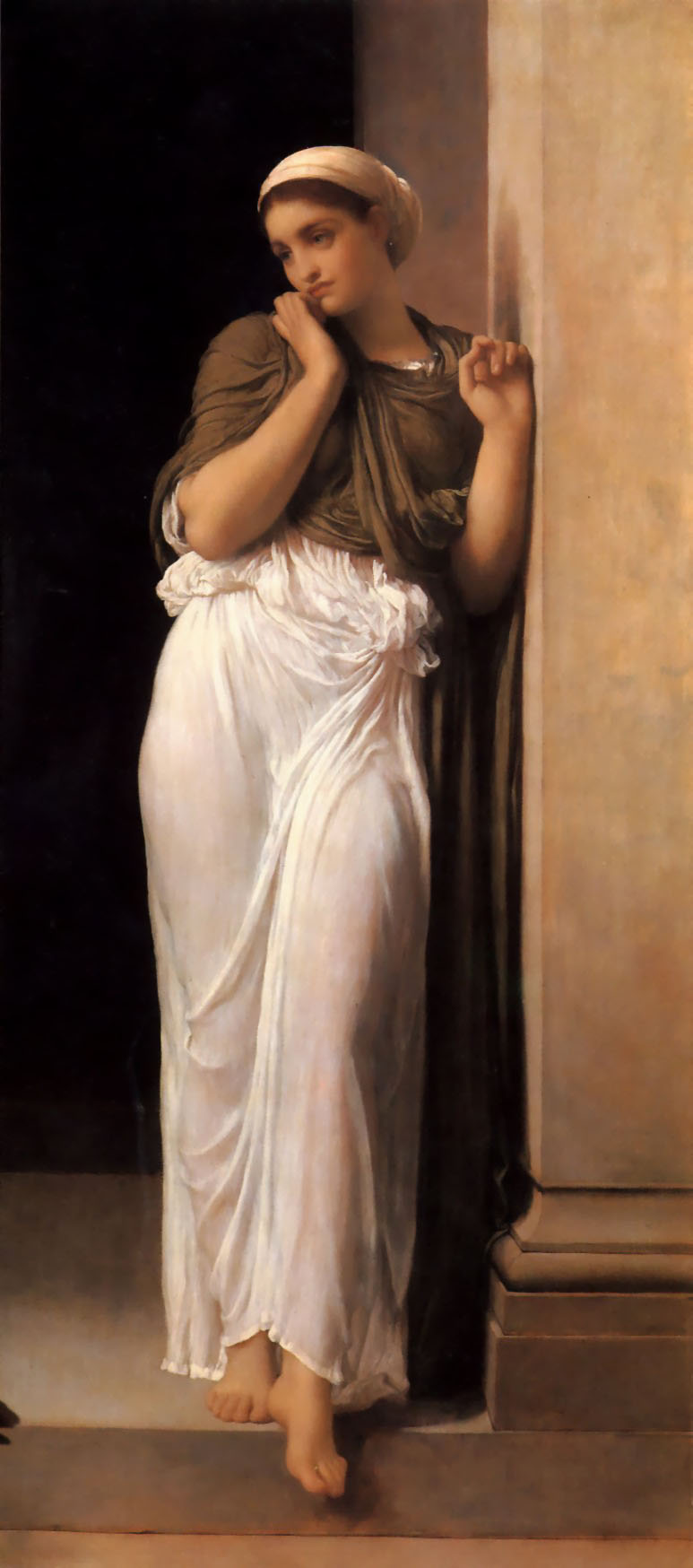
| Nausicaa by Frederic Leighton |
4. Nausicaa
After leaving Calypso, Odysseus is shipwrecked on the island of Phaeacia, where he is awakened by Nausicaa (daughter of King Alcinous and Queen Arete) and her handmaidens as they wash their clothes at the seashore. He emerges from the forest, completely naked, and the servants all run away terrified. Nausicaa remains and agrees to help him, giving him some of the laundry to wear and advising him to go to her parents' house and make his case directly to her mother, Arete. She and her maids go ahead of him as she doesn't want to give rise to gossip by walking with a stranger. He does as she says, which is a good move because apparently Arete is much wiser than her husband, and when Odysseus wins her trust, she allows him stay with them as a guest. In return for their hospitality, Odysseus recounts his adventures to the court - this forms a substantial proportion of The Odyssey itself. Alcinous then generously gives Odysseus a ship to help him return to Ithaca.
Margaret Atwood interprets all this in her inimitable fashion in The Penelopiad thus:
"After seven long years there of kissing and woo,
He escaped on a raft that was drove to and fro,
Till fair Nausicaa's maids that the laundry did do,Found him bare on the beach - he did drip so!"
Nausicaa is young and very pretty, and she is presented as a potential love interest. She may have had unrequited feelings for Odysseus, but he wins Arete's sympathy and she is determined to help him get home to his wife and child, rather than being tempted to dally with yet another romantic entanglement. There is a deep affection between the two of them, however - she tells him, 'Never forget me, for I gave you life' (which is oddly maternal) - and of all the women he met on his adventures, Odysseus never tells Penelope about Nausicaa. Some accounts say that Nausicaa eventually married Odysseus' son, Telemachus. Could this be a rare occurrence in classical literature of a man actually respecting a young and beautiful woman?
| Ulysses and the Sirens by John William Waterhouse |
5. Sirens
According to legend, sirens are beautiful seductresses who lured sailors to watery graves with their stunning singing voices. Apparently the sailors, bewitched by the voices, would steer their ships too close to the rocks and end up wrecked. In other versions (particularly Indian myth), their sweet sounds lull the sailors to sleep, and then the Sirens set upon them and tear them to pieces.
They were believed to look like a combination of women and birds in various different forms. In early Greek art they were represented as birds with large women's heads, bird feathers and scaly feet. Later they were represented as female figures with the legs of birds, with or without wings, playing a variety of musical instruments, especially harps and lyres. Originally sirens were shown to be male or female, but the male Siren disappeared from art around the fifth century BC. Because we all know that only women can fulfil the role of evil tempter, right?
Homer tells that Odysseus wanted to hear the Sirens, and so he acted on the advice of Circe (yep, her again) getting all his sailors to plug their ears with beeswax and tie him to the mast. He ordered his men not to release him no matter how much he ranted and raved. As he passed the sirens he screamed for his men to untie him. In the words of Simon Armitage's translation he begged,
"Untie me now. Now. Untie me, you bastard scum.Zeus, hear me. I'll sacrifice everything in your name.All my flocks and herds, all my lands and estates...All my servants and slaves... these men... take them...My son, Telemachus... my wife, Penelope...Take them all but guide me into these voices...Zeus, kill me afterwards, but show me their faces...I CAN'T LIVE WITHOUT KISSING THE MOUTHS OF THE SIRENS."
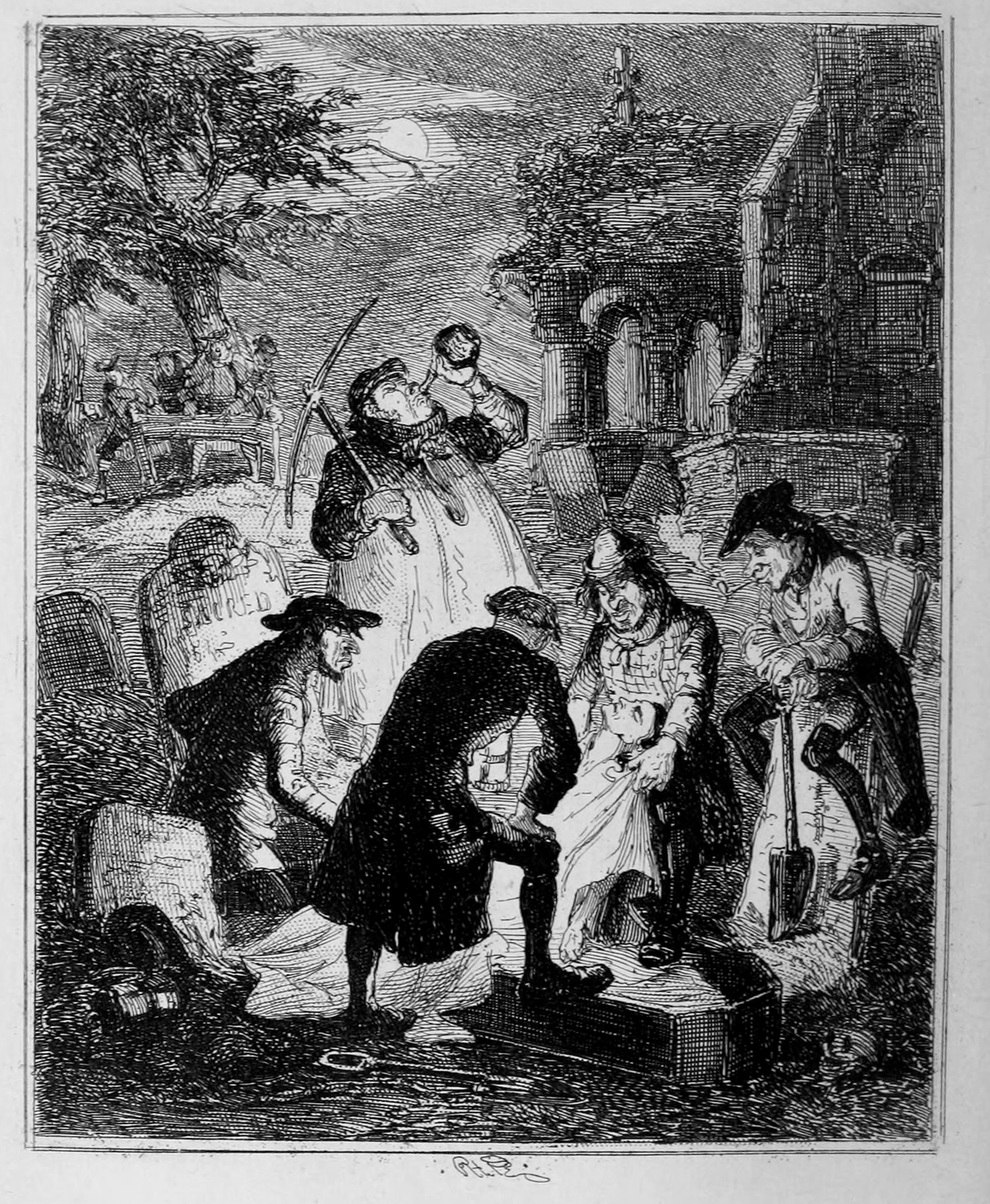
One of the
grave robbers in The London Supply Company, Max Wilder, is actually a nobleman
in disguise, trying to find out what happened to his step-sister who has
disappeared and he fears she has been murdered. This scenario is interesting,
but it all goes rapidly downhill when Abby goes to the home of the leader of
the gang, Big Jack, to recover the money they took from her. She is captured
and she falls in love with Max, who supposedly protects her, but also initiates
her sexually while holding her captive; it’s all very distasteful and the
sexual fantasy element seems misguided.
Abby dreams of
being a surgeon, although women are forbidden from practicing medicine. Supposedly
she has some feminist leanings, but she still likes to be dominated and falls
for her captor. She refers often to the plight of women in the late Regency
period, “Because she refused to adopt the role society tried to press upon her,
she had always fought to fit in, even at the college. Lecturers and students
alike couldn’t understand why she couldn’t be content to sit in the corner and
darn socks.” Women have few options, apart from to go to the alms-houses, which
“provided such a cruel and meagre existence that no one wanted to end up there”,
and of course, there is prostitution.
There are offerings
of historical information which do not blend with the plot, and land with a
clang, such as the mention of “Sir Robert Peel’s new police force” or “the
notorious gentleman’s guide to the current brothels and prostitutes in London – Harris’s List of Covent Garden Ladies.”
It is as though Novak wants to educate as well as titivate, and she is far from
subtle with the introduction of knowledge, but she also writes of England for
an American market, as evidenced by her slips of language. Although Max is a
high class noble (Lucien
Cavendish, the Duke of Rowenberry), he tells Abby to, ‘Quit being so
smug”, which is not an English expression of any era.
![]() |
| Interior with a Sleeping Man and a Woman Darning Socks by Wybrand Hendricks |
Abby admits her
love for Max only to discover he is betrothed to another woman through an old
alliance between families; of course it wouldn’t do for him to have any romantic
attachment to anyone but her. Although she is now pregnant with his child (and
we have been told about the consequences of unwed motherhood), she does the
‘decent thing’ by not telling him. “If she loved him, she would support him in
what would make him the happiest, and she knew what that was.” This is patently
ridiculous and a romance novel trope; one of many. There are long scenes of
what Max and Abby feel for each other, but the actual plot hurries towards the
end. In the last few chapters there are stabbings, abduction, hangings, and circumnavigations
of the globe which appear to take weeks rather than months.
| Helen of Troy (1898) by Evelyn De Morgan |
| Helen a la porte scee (1888) by Gustave Moureau |
In stories, Helen is a prize; a possession; a temptress and seductress; she forces men to act a certain way and her beauty has been portrayed as potent and destructive. But here's the thing; she is always passive - things are done to her and because of her and for her, but never by her. She is born from rape, abducted, captured, stolen, rescued, contested, and never gets to tell her own story. We know that she is beautiful, but not a lot else, and if beauty is in the eye of the beholder, then she is a blank canvas on which we project our own ideology. Gustave Moreau portrays her as faceless in his painting of her witnessing the destruction of Troy.
In The Penelopiad, Margaret Atwood refers to Helen as "the sceptic bitch" and "poison on legs". She redresses the balance, however, in her 1995 poem, Helen of Troy Does Countertop Dancing, in which Helen understands that her 'beery worshippers' would like to 'watch me/ and feel nothing. Reduce me to components/ as in a clock factory or an abattoir./ Crush out the mystery./ Wall me up alive/ in my own body." If we're talking about Helen's influence on poetry and plays, we cannot ignore Chritopher Marlowe's lines from his 1604 tragedy Doctor Faustus, in which the titular character sells his soul for (among other things) a night of passion with Helen of Troy, and when he first catches sight of her remarks,
"Was this the face that launch'd a thousand ships,
And burnt the topless towers of Ilium?
Sweet Helen, make me immortal with a kiss.
Her lips suck forth my soul: see where it flies!"
![]() |
| Odysseus Wants to Embrace the Ghost of His Mother (1901) by Jan Styka |
Odysseus’ mother Anticleia is a shady character in the Odyssey; we meet her only in the Underworld, where Odysseus has gone to seek the advice of the dead prophet, Tiresias. Initially Odysseus rebuffs his mother as he is waiting for the prophet to approach, but after speaking with Tiresias, he allows Anticleia to come near and lets her speak. She asks him why he is in the underworld while alive, and he tells her about his various troubles and failed attempts to get home. Then he asks her how she died and inquires about his family at home.
Anticleia says that she died from a broken heart, longing for him while he was at war and having given up hope of ever seeing her son again. She also says that Laërtes (Odysseus' father) "grieves continually" for Odysseus and lives in a hovel in the countryside, clad in rags and sleeping on the floor. Penelope has not yet remarried but is overwhelmed with sadness and longing for her husband while Telemachus acts as magistrate for Odysseus' properties. Odysseus attempts to embrace his mother three times but discovers that she is incorporeal, and his arms simply pass through her. She explains that this is how all ghosts are, and he expresses great sorrow.
Odysseus’ futile attempt to reach out to her could be seen as an indication of his distant relationship with his mother. His warm memories of planting trees in the family’s orchard with his father is not matched by any such memories of his mother.
![]() |
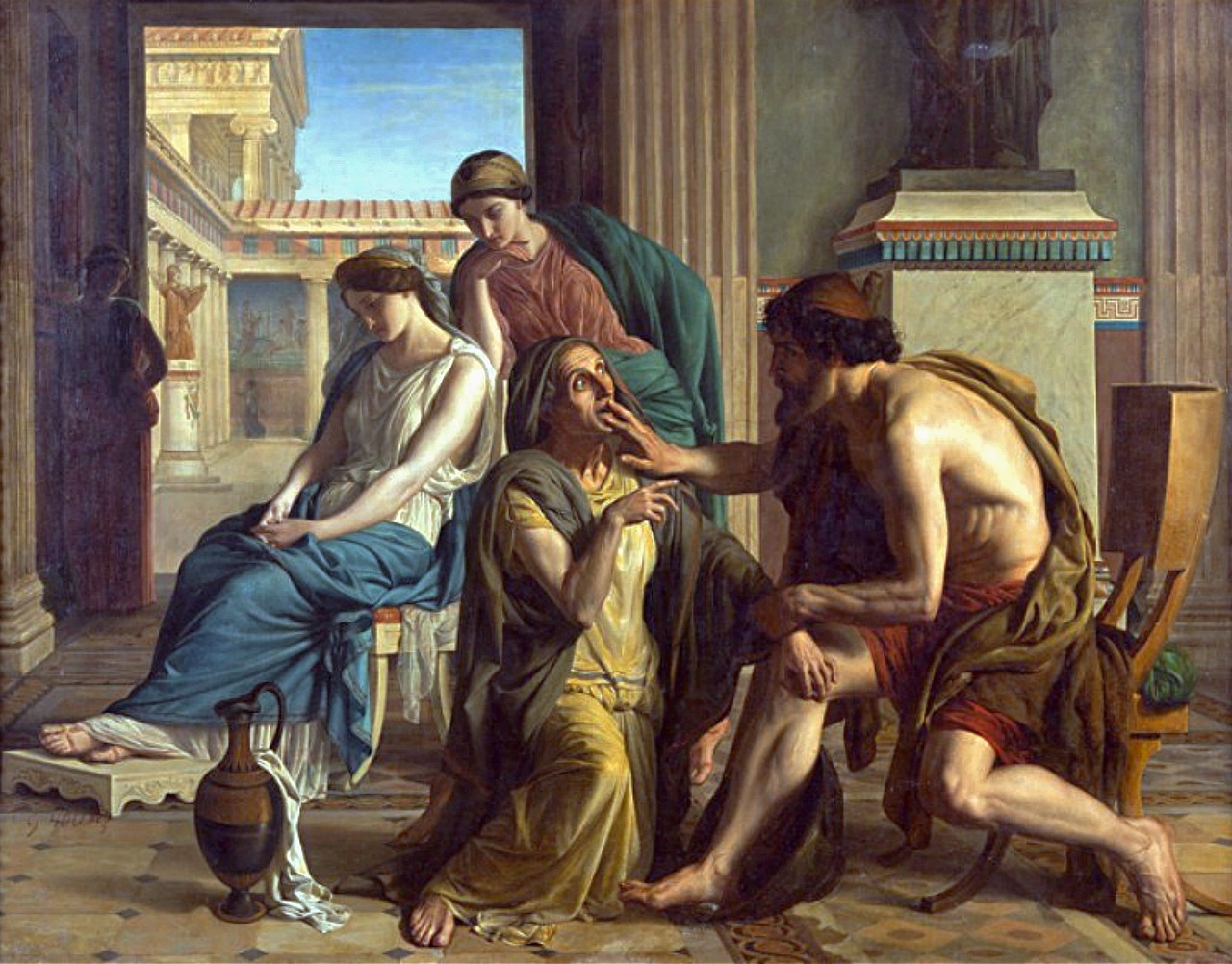
| Ulysses Recognised by Eurycleia (1849) by Gustave Housez |
3. Eurycleia
As a girl, Eurycleia was bought by Laertes, Odysseus's father. He treated her as his wife, but she was never his consumated lover, so as not to dishonour his real wife, Anticleia. She later nursed Telemachus, Odysseus's son. The name Eurycleia means 'broad fame', while Anticleia means 'anti-fame'. The tension between the meanings of their names can be seen to reflect the tebsion between the aspects of Odysseus's life.
Odysseus was born to Anticleia, a noble woman, but nursed and raised by Eurycleia, a lower-class maid. Odysseus's fame came from his role as a noble hero paralleled to his role as an anonymous beggar. His heroism was essential for capturing Troy; his skills as an orator and a schemer as well as his strength and tactics on the battlefield were instrumental in the success of the Greeks. However, he disguised himself as a beggar at critical moments, such as when he entered Troy and killed the unsuspecting Trojan soldiers, and when he returned to Ithaca and killed Penelope's suitors.
Eurycleia was the only person to recognise him without him first revealing himself (as he did to Telemachus) when he returned home after the Trojan War. She then informed him which of his servant girls had been unfaithful to Penelope during his absence, conspiring with Penelope's suitors and becoming their lovers. His son, Telemachus, hanged the twelve maids that Eurycleia identified.
Eurycleia supports Telemachus in much the same way as she had Odysseus before him, giving Telemachus provisions and supplies before he left for Pylos to seek out news of his father. She swore not to tell Penelope he had left until twelve days had passed, as Telemachus did not want his mother to be any more worried than she already was, or indeed to prevent him from going.
Some classicists argue that the woman who anoints Jesus in the Gospel of Mark is a direct reference to Eurycleia. She is the only one to recognise Jesus, and what she has done will be widely known in the same way as Eurycleia is the only one to recognise Odysseus and whose name means 'widely known'.
| Artemis, Goddess of the Hunt, a Roman copy of the original by Leochares circa 325BC |
![]() |
| Calypso (1869) by Henri Lehmann |
5. Calypso
If Helen of Troy is the face that launched a thousand ships, then Calypso is the name that launched almost as many products, including ships. Tributes to her come in the form of a drink (rum, peach schnapps, orange juice and grenadine), a dance, a style of music, video games, software companies, space craft, British Navy ships, an underwater camera, and a 1942 British minesweeper that was later repurposed as an oceanographic research ship operated by Jacques-Yves Cousteau.
The name means to cover, conceal or hide, and in Greek Mythology, she is a nymph who 'detained' Odysseus on the island Ogygia for seven years when he was attempting to return home to his wife, Penelope in Ithaca. In some accounts this 'detainment" resulted in two children. In others, Odysseus pines for his wife until Athena intervenes and begs her father, Zeus, to order the release of Odysseus from the island.
Zeus orders the messenger Hermes to tell Calypso to set Odysseus free, as it was not his destiny to live with her forever. She is furious and points out the double standards that allow gods to abduct females willy-nilly, but that punish goddesses who have affairs with mortals. Eventually she reluctantly concedes and sends Odysseus on his way after providing him with wine, bread and the materials for a raft. She then takes up the same position on the rock looking out to sea and pining for him, as he had previously sat longing for his Penelope. In The Odyssey, this is the section of the adventures that begins the tale, before it plunges back into flashback, thus positioning it as an important highlight of the journey.
It clearly strikes a chord as it
won the 2019 Los Angeles Times Book
Prize for Best Mystery/ Thriller, the 2020 British Book Award for Crime &
Thriller Book of the Year, and it was longlisted for the 2019 Booker Prize. As
well as being critically praised, it is also popular with the public, and won
the 2019 Amazon Publishing Reader’s Award for Best Debut Novel. It is certainly
easy to read with short chapters (all with a one or two word title) and a fairly
universal theme – we may not all have murderous siblings, but many of us understand
sibling rivalry and family dynamics.
As the oldest, Korede is obliged
to care for her younger sister, Ayoola, and now, she literally cleans up her
sister’s messes. It doesn’t help Korede’s mental state to feel that her sister
is outstandingly good-looking, and to constantly compare herself unfavourably. “The
resemblance is there – we share the same mouth, the same eyes – but Ayoola
looks like a Bratz doll and I resemble a voodoo figurine.”
Ayoola carries a knife on dates
and she seems to have little compunction in disposing of her suitors, she
claims in self-defence. Korede wants to believe her, but there is a touch of
the Oscar Wilde loss of parents about her narrative; after all, she has killed
three people; “Three, and they label you a serial killer”. Ayoola is seemingly
remorseless and is back partying and posting on Instagram and Snapchat straight
after she has killed her partner. She apparently believes that she is entirely
innocent: “Her actions were the fault of her victims and she had acted as any
reasonable gorgeous person would under the circumstances.” The implication is
that she is excused because of her looks – it’s different if you’re beautiful.
When Ayoola shows interest in the
doctor with whom Korede works, he of course reciprocates it, despite never
having noticed Korede’s passionate feelings towards him. This might inform her questioning
her sister’s version of events, at which Ayoola accuses her of victim shaming. “Victim?
Is it mere coincidence that Ayoola has never had a mark on her, from any of
these incidents with these men; not even a bruise?” At a time when we are
struggling to believe women, this seems irresponsible, but education is not the
duty of the author. Indeed, in her interview, Braithwaite contends, “I like to
have fun. The books where I can tell I’m being taught something are a trial in
the reading. If there’s a story and you learn something along the way; it’s a bonus.”
It transpires that the girls’
father subjected them to traditional and tribal cruelty, and Korede is
concerned that Ayoola may have inherited some of this inherent brutality. “More
and more, she reminds me of him. He could do a bad thing and behave like a
model citizen right after. As though the bad thing had never happened. Is it in
the blood? But his blood is my blood and my blood is hers.”
There are some things which may
seem a little far-fetched for a genuine crime thriller – how could they
possibly not get caught? One explanation is that the police force is highly
corrupt, as are many other institutions in Nigeria, and they can be bribed to
look away. Another consideration is that this is not meant to be forensically
accurate. The page numbers are in a font that looks as though letters have been
cut from newspaper print, or perhaps a graphic novel where all the information
is condensed into one frame. It is currently being considered for film, which
will be dramatic but not exactly realistic.