Showing posts with label American Civil War. Show all posts

Tuesday, 29 May 2018

Time Marches On


Lincoln in the Bardo by George Saunders
(Bloomsbury), Pp. 343

Although George Saunders is considered a champion of the American short story, this is his first novel. It is daring in form and subject and it won the 2017 Booker Prize. The bardo of the title is a transitional realm in Tibetan tradition where spirits mingle. From here they will either ascend to Nirvana and escape human suffering, or fall back through a series of increasingly wild and scary hallucinations until they are born again into a new body. The Lincoln of the title is either President Abraham or his son, Willie, who died of typhoid fever in 1862. The boy is interred in a Georgetown cemetery and his distraught father visits the crypt alone several times to hold his son’s body. From these slim facts Saunders embroiders a story of fantastic hyperrealism dealing with grief and loss and moments of bawdy humour.

The graveyard is populated with characters from many different eras and circumstances with a strong sense of Rabelaisian machismo; like Dantesque damned souls the spirits manifest with hideous deformities that relate to their erstwhile lives. The spirits refuse to use the word ‘dead’ and believe they are merely unwell or in a sick-box (coffin), fiercely resisting the urge to move on.

Narrated through multiple voices, the novel offers differing opinions on the same thing. Some of the quotes are from characters in the bardo; others come from books and newspapers and we cannot believe any of the accounts, no matter how scholarly they appear with their references and footnotes. On the night of a party in which Lincoln’s son became feverish, none of the eyewitnesses can agree on the presence, size, shape or colour of the moon. Similarly the colour of Lincoln’s eyes varies according to each description. These differing viewpoints extend to his involvement in the war: is he “an idiot”, “weak and vain”, a “tyrant” with speeches that “have fallen like a wet blanket”? Or is he one of the greatest presidents the US has ever known? We see what we want to see, and memory is unreliable. Saunders suggests that history is constantly reinterpreted, and portents and patterns only appear retrospectively.

The voices become a cacophony, bickering like characters in a Beckett play and retelling old tales. Saunders had originally conceived these grave-bound scenes as a play and they remain entirely rendered in speech as the narration is handed from voice to voice. We are guided through this bardo by a Greek chorus with three main narrators: Hans Vollman, a man who was about to finally consummate his marriage when he was hit on the head and so has a large erection; Roger Bevins III, a man who slit his wrists over his homosexual lover and then realised he had made a mistake as he lay bleeding on the floor, and the Reverend Everly Thomas, a man who managed to get to the Final Judgement but was sent to Hell and so ran away back here as a sort of waiting room to try and work out what he done that was so bad.

The young are not meant to tarry here, and if they do they get subsumed by Gothic-style creepers that bind them. Our heroes try and persuade Lincoln to let his boy go so that he will not have to succumb to this fate. If the deceased has truly gone to a better place, why do we grieve? We grieve for ourselves; not for the departed, and the way we remember someone after their death is not necessarily the way they really were in life. We are all in a constant state of flux from dreams to wakefulness, from life to death, and perhaps beyond. Lincoln realises that nothing is permanent.

Before people leave the bardo they flicker through all their incarnations; the people they have been but also the possibilities they have not been – their future-forms they had never alas succeeded in attaining. Every time a person leaves, the same sentence is repeated like a stanza an epic poem: “Then came the familiar, yet always bone-chilling, firesound associated with the matterlightblooming phenomenon.” Many resist this phenomenon and cling to the earth, but they cannot leave the cemetery into which they are penned by a “dreaded iron fence” which recalls something out of The Walking Dead.

What is the future for these souls? Does a terrible judgement await us all? If there is Fate or Destiny, how is anything our own fault? There is no question of return, but there is a suggestion of progress. “Time runs only in one direction and we are borne along by it, influenced precisely as we are to do just the things that we do. And then are cruelly punished for it.” This bardo combines many belief systems into one peculiar magical realism, and in the middle of it all is an attempt to come to terms with death, grief and loss, and a man’s need to mourn his son.

Tuesday, 22 October 2013

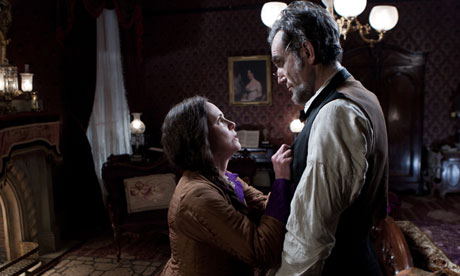
Daniel Day-Lewis IS President Lincoln


In Britain we have a royal family to obsess over. America has their presidents. Some have achieved legendary status for good or bad, but the good can barely be questioned. Abraham Lincoln is among these monolithic myths, and, with his latest film, Steven Spielberg has added to the general hagiography.

Just over twenty years ago Oliver Stone made a film about JFK which was equally reverential and full of similar examples of good actors struggling with a tedious script. In other words, it is incredibly worthy and desperately dull. Sally Field, Tommy Lee Jones, James Spader, David Strathairn and, indeed, the entire supporting cast are excellent, but this is a star vehicle for one man only, and Daniel Day-Lewis embodies the eponymous character to a frightening extent.


DDL (as he is referred to in the Hollywood press) is a notorious method actor and apparently he didn’t drop his assumed accent or stoop for three months of filming. The physical similarity is remarkable and when he stirs in his chair in the opening scene, it is as though the great Lincoln memorial has come to life. His voice is almost atonal and though there is fire in his argument it is not apparent in his delivery. He shuffles, looks down when he talks, chuckles to himself and presents as a shambling and slightly delusional drunkard.

He is also constantly telling anecdotes, gathering his staff around him like a luvvie director holding court before his sycophantic crew. His wife (the indomitable Sally Fields) reflects, “How the people love my husband. They flock to see him on public events”. However, great sympathy is shared with the Secretary of War, Edwin Stanton (played by Bruce McGill) who rails, “I don’t believe that I can bear to listen to another one of your stories!”

Lincoln must be impeccably researched and the ponderous dialogue is probably taken from transcripts – there is such a lot of it. Lincoln was a lawyer, and there are plenty of lectures which would feel at home in a courtroom. We are reminded that he was a political genius and favoured rational justice and stirring speeches rather than flamboyant gestures or theatrical fanaticism. He frequently repeats his salient points and resorts to Euclidean geometry to strengthen his message – “Things that are equal to the same thing are equal to each other – this is self evident”.


Doubtless there is meticulous attention to detail and the beautifully-framed set pieces would make an excellent stage for a play. The interior décor almost certainly suits the period (1865) perfectly, but it’s very stuffy and there are a lot of dark rooms, which makes it tiresome to view. Titles appear across the screen as each member of the confederacy or other important political figure is introduced, highlighting the documentary feel.

Lincoln attempts to do anything to win support for his 13th Amendment, which will abolish slavery and involuntary servitude, except as punishment for a crime, and is not above boardroom deals. Despite a tense voting scene, the action is severely limited for a film set in the midst of the bloodiest period of American history – more American men died in this conflict than in all other American wars combined.


We are also presented with a very simplistic view in which the Civil War was fought entirely over slavery between the Slave South and the Free North. While Lincoln preaches, “We begin with equality. That’s the origin isn’t it? That balance, that’s fairness, that’s justice” his detractors counter, “Congress must never declare equal those whom God created unequal”. There is hours of this stuff, as the debate drones tireless on. While we modern enlightened viewers clearly know which side is right, we cheer to Thaddeus Stevens’ (Tommy Lee Jones) interjection wishing to know when we can see an end to this “interminable gabble”.


As one of his black and white treatises on slavery, I prefer Spielberg’s Amistad. Watching Lincoln, the viewer may be forgiven for imagining they are back at school and being forced to sit through a fairly elementary history lesson. Lincoln himself confirms, “I could write shorter sermons but when I get started I'm too lazy to stop”.

Apparently the fear is that if slavery is abolished the men will have to be enfranchised. Whatever next; votes for women? They needn’t have worried – another 100 years had to pass before emancipation. Lincoln claims, “I’ve found that prophesying is one of life’s less profitable ventures,” which was perhaps just as well.

With the war over and the amendment passed, it remains to Lincoln to lead the country “with malice toward none; with charity for all... to bind up the nation’s wounds”. Of course, he will have far more personal wounds with his assassination (not shown on screen as the viewer is in another theatre when the fatal shot is fired), but he will belong to history.

To a score by John Williams, Lincoln strides into the dust to cast a shadow like a spectre over all American politics. References resound of George Washington, John Quincy Adams, James Monroe, and Thomas Jefferson throughout the film. It is self-evident that Abraham Lincoln takes his rightful place in this sparkling quintet. It is also obvious from the opening credits that DDL will earn an Oscar for his character portrayal. It is less clear whether the film is as assured.