
In Britain we have a royal family to obsess over. America has their presidents. Some have achieved legendary status for good or bad, but the good can barely be questioned. Abraham Lincoln is among these monolithic myths, and, with his latest film, Steven Spielberg has added to the general hagiography.
Just over twenty years ago Oliver Stone made a film about JFK which was equally reverential and full of similar examples of good actors struggling with a tedious script. In other words, it is incredibly worthy and desperately dull. Sally Field, Tommy Lee Jones, James Spader, David Strathairn and, indeed, the entire supporting cast are excellent, but this is a star vehicle for one man only, and Daniel Day-Lewis embodies the eponymous character to a frightening extent.

DDL (as he is referred to in the Hollywood press) is a notorious method actor and apparently he didn’t drop his assumed accent or stoop for three months of filming. The physical similarity is remarkable and when he stirs in his chair in the opening scene, it is as though the great Lincoln memorial has come to life. His voice is almost atonal and though there is fire in his argument it is not apparent in his delivery. He shuffles, looks down when he talks, chuckles to himself and presents as a shambling and slightly delusional drunkard.
He is also constantly telling anecdotes, gathering his staff around him like a luvvie director holding court before his sycophantic crew. His wife (the indomitable Sally Fields) reflects, “How the people love my husband. They flock to see him on public events”. However, great sympathy is shared with the Secretary of War, Edwin Stanton (played by Bruce McGill) who rails, “I don’t believe that I can bear to listen to another one of your stories!”
Lincoln must be impeccably researched and the ponderous dialogue is probably taken from transcripts – there is such a lot of it. Lincoln was a lawyer, and there are plenty of lectures which would feel at home in a courtroom. We are reminded that he was a political genius and favoured rational justice and stirring speeches rather than flamboyant gestures or theatrical fanaticism. He frequently repeats his salient points and resorts to Euclidean geometry to strengthen his message – “Things that are equal to the same thing are equal to each other – this is self evident”.
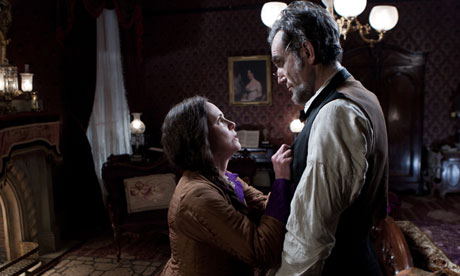
Doubtless there is meticulous attention to detail and the beautifully-framed set pieces would make an excellent stage for a play. The interior décor almost certainly suits the period (1865) perfectly, but it’s very stuffy and there are a lot of dark rooms, which makes it tiresome to view. Titles appear across the screen as each member of the confederacy or other important political figure is introduced, highlighting the documentary feel.
Lincoln attempts to do anything to win support for his 13th Amendment, which will abolish slavery and involuntary servitude, except as punishment for a crime, and is not above boardroom deals. Despite a tense voting scene, the action is severely limited for a film set in the midst of the bloodiest period of American history – more American men died in this conflict than in all other American wars combined.

We are also presented with a very simplistic view in which the Civil War was fought entirely over slavery between the Slave South and the Free North. While Lincoln preaches, “We begin with equality. That’s the origin isn’t it? That balance, that’s fairness, that’s justice” his detractors counter, “Congress must never declare equal those whom God created unequal”. There is hours of this stuff, as the debate drones tireless on. While we modern enlightened viewers clearly know which side is right, we cheer to Thaddeus Stevens’ (Tommy Lee Jones) interjection wishing to know when we can see an end to this “interminable gabble”.

As one of his black and white treatises on slavery, I prefer Spielberg’s Amistad. Watching Lincoln, the viewer may be forgiven for imagining they are back at school and being forced to sit through a fairly elementary history lesson. Lincoln himself confirms, “I could write shorter sermons but when I get started I'm too lazy to stop”.
Apparently the fear is that if slavery is abolished the men will have to be enfranchised. Whatever next; votes for women? They needn’t have worried – another 100 years had to pass before emancipation. Lincoln claims, “I’ve found that prophesying is one of life’s less profitable ventures,” which was perhaps just as well.
With the war over and the amendment passed, it remains to Lincoln to lead the country “with malice toward none; with charity for all... to bind up the nation’s wounds”. Of course, he will have far more personal wounds with his assassination (not shown on screen as the viewer is in another theatre when the fatal shot is fired), but he will belong to history.
To a score by John Williams, Lincoln strides into the dust to cast a shadow like a spectre over all American politics. References resound of George Washington, John Quincy Adams, James Monroe, and Thomas Jefferson throughout the film. It is self-evident that Abraham Lincoln takes his rightful place in this sparkling quintet. It is also obvious from the opening credits that DDL will earn an Oscar for his character portrayal. It is less clear whether the film is as assured.


