Showing posts with label Art Deco. Show all posts

Friday, 9 April 2021

Friday Five: Food and Drink in the Blue Mountains


1. It should be no surprise to anyone that we couldn't visit the Blue Mountains without dropping by the brewery there. DJ and Harriet McCready have opened Mountain Culture in a former newspaper office in Katoomba. The architecture is apparently 'inter-war free classical', with high ceilings, open beams, secret staircases, rooms of various sizes and an outdoor are to catch the mountain sun. But it's the beer we're here for, and it is definitely very fine. 

I particularly enjoyed the Status Quo New England Pale Ale (very hoppy, bitter and tropical with 'massive late and dry hop additions'), the VHS & Chill Retro IPA (orange rind, fresh grapefruit and dank pine), the Double Red IPA (the Holy Grail of beer), and the Big Richard Imperial Stout (big, boozy dark dried fruit and chocolate).

Big Richard Imperial Stout at Mountain Culture

2. Also new to us is Cafe 92 at the Conservation Hut. We had planned to do the National Pass Walk, but sections of the route are closed due to rockfalls and other hazards. Instead we did the Undercliff Overcliff Walk (yes, the wombling free song was sung), and found this cafe at the top of the aforementioned cliffs. The meals looked excellent, but we had eaten a hearty breakfast, unaware that we might encounter such a delight, so we made do with coffee and cake, and spectacular views from the verandah. The artwork inside is also very impressive - it is by Reinis Zusters, a Latvian-born artist who had a studio at nearby Wentworth Falls until his death in 1999.


3. The Carrington is one of our favourite places in The Blue Mountains and we always visit whenever we are here, although attempts to book accommodation have been unsuccessful as it is always so popular! We have been to a wine festival in the dining room; we have sat in the lounge on a rainy day and taken tea and scones when my parents came to visit; we have drunk full-bodied red wine while sitting in armchairs by the fire as it poured with rain outside; we have hung out in the bar with a couple of beers... 

This time we sat out on the verandah and enjoyed a cocktail in the late afternoon sun. I had a St Germain (elderflower liqueur; gin; prosecco over crushed ice served with a slice of bitter lemon and a maraschino cherry). It was very tasty and refreshing after a long day of walking.
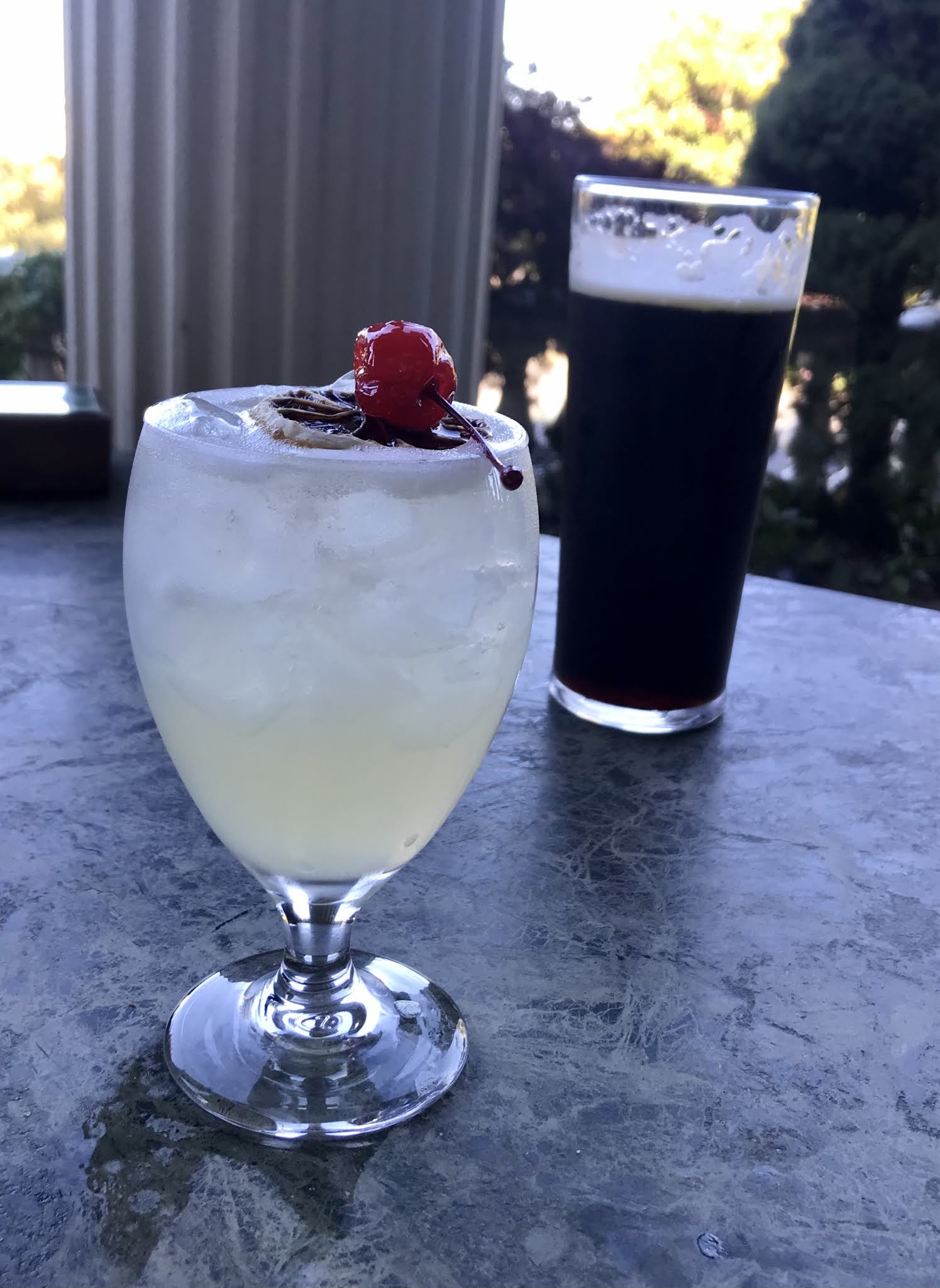

4. For dinner one evening we walked to Arjuna, an Indian restaurant on the outskirts of Katoomba. It doesn't look too salubrious from the exterior - although the adjacent water tower is painted with a rather attractive shark motif. 


It was Easter weekend and very busy; diners were booked into two sittings to keep the chef from getting two overwhelmed. We attended the earlier sitting, which means we caught the most amazing sunset views from the verandah. 


We weren't aware that the venue wasn't licensed so we hadn't brought a drink with us, although we spotted almost very other group arriving clutching bottles of wine - that's a top tip to remember for next time. The food was fabulous, though so I didn't feel as though we were lacking in anything. I had a Chicken Xacuti (Goan style chicken cooked with roasted coconut), which was melt in the mouth chunks of chicken in a rich and creamy sauce, while Him Outdoors went for Balti Gosht, which was served in one of those Balti buckets of spicy tomato and onion sauce. It was delicious, and we needed the walk of several kilometres back to our lodgings to work off some of the calories!


5. We were struggling to get a booking for dinner, because we had not been organised and had left everything too late, but we managed to book in to Avalon for Sunday lunch, and what a wonderful spot that was. The blurb on the website reads, 'set in the dress circle od the historic Savoy picture theatre, Avalon Restaurant and cocktail Bar at Katoomba combines playful art-deco charm with hearty food, friendly service and specular Blue Mountains views'. All of this is true.

The entrance leads us through the foyer of the 1930s cinema, past the ticket booth and up the stairs. It's all leadlight glass, geometric influences, upside down lampshades, kooky prints and vibrant colours. We began with cocktails, as it seemed wrong not to - he had a rhubarb and ginger martini and I had an 'Avalon', which was similar to the drink I had the other night featuring gin, elderflower liqueur, limoncello, Aperol, cranberry, peach bitters and mint. These were fabulous and a great start to the meal. 


For starters I had paprika prawns and tumeric scallops, served on pineapple and peach salsa, with caviar dip. The shellfish were melting with fishy goodness, and the salsa was popping with colour and flavour. I also inveigled a bite of the starter that Him Outdoors chose which was as delicious as it looked. He had grilled figs stuffed with blue cheese topped with a walnut and parmesan crust and wrapped in crispy prosciutto. This was rich and fruity with a bite from the blue cheese and savoury hints from the prosciutto - it was a perfect blend of texture as well. 


The quality of the starters set us up with high expectations for our mains, which were expertly met. Him Outdoors had the seared duck breast with carrot and ginger puree and orange liqueur reduction, served with rosemary potatoes and seasonal vegetables. I think he chose it partly because he loves duck - it's his go-to dish at a restaurant - but mainly because the description didn't mention 'jus' (a word he just despises for some reason; "why can't they just call it gravy?").  The waitress told him that it would be served pink and was he okay with this? He was, but I also like the way they explain this, not as an option, but as a directive - you don't have to have it if you don't like it!


It's Easter Sunday so I couldn't go past the lamb, and I do feel as though I have may have slightly won in the plate envy stakes. I had slow-roasted lamb wrapped in bacon, garlic, thyme, with a red wine and lime glaze, served with creamy mash and seasonal vegetables. The lamb was so tender and juicy; it practically fell apart and the comfort of the fat in the meat was well-matched with the crispness of the mangetout peas and the zing of the glaze. 


We accompanied the meal with a bottle of Robert Stein Shiraz Viognier (from Mudgee), which we lingered over at the end of the meal, unable to fit in any dessert. I was trying to think of an elegant word to tell the waitress I had had sufficient to eat, she supplied 'stonkered', which made me laugh as it is indeed a great word, but not particularly sophisticated. She also told us that the restaurant has been going for thirty years, and that last night (Easter Saturday) was their busiest night ever - people are obviously desperate to go on holiday and, as they can't currently go overseas, they are flocking to their own back yard. 

I also note that their menu says, 'along with our daily specials of new dishes to try, our main menu is well established, and so loved by our guests that we've hardly changed it in thirty years... we wouldn't dare!' It's good to know it should still be there serving fine fayre when we return.

Saturday, 16 March 2019

Rolling Sculpture: The Shape of Speed


I'm not particularly a fan of vintage or classic cars, or any cars come to that - they're a fine mode of transport, but if it's not an E-type Jag; it's just a car. The exhibition at the Portland Art Museum, however, intrigued me. It was called The Shape of Speed and it featured nineteen rare streamlined vehicles. These models are shiny and glorious with many Art Deco features and precision details but, as with anything new, they took a while to catch on with the public at a time when people wanted something that looked like everything else. 

The concept of streamlining has fascinated people for generations. The years between 1930 and the outbreak of World War II saw rapid advances in the design of aircraft, trains and highways. These changes, along with global events like the 1939 World Fair in New York spurred automotive designers and engineers to create streamlined cars that were aerodynamic, fast, and increasingly fuel-efficient.

The 1934 Chrysler Imperial Model CV Airflow Coupe was miles ahead in safety and strength, and its 'dramatically different shape' was influenced by the fastest railroad locomotives of its time. Unfortunately, however, people purchasing cars wanted something more conservative, and 'its unconventional design was also miles ahead of public acceptance'. Sales figures were 'disappointing'. A less radical and simplified style was brought out the following year, which proved to be 'more marketable to the car-buying public'.

1934 Chrysler Imperial Model CV Airflow Coupe
The cars on display, presented as kinetic art, are indeed rolling sculpture, yet they are eminently capable of dynamic function. As guest curator, Ken Gross, former executive director of the Petersen Automotive Museum in Los Angeles notes,
"The seventeen cars and two motorcycles in this exhibition were designed without the myriad safety and crash-absorbing constraints that affect the look and form of the modern automobile. The operative charge was that they be sleek and streamlined. We will not see their like again."
The Spirit of Motion, more popularly known as the 'Sharknose Graham' appears to be moving while at rest. Its massive headlights are Art Deco-inspired with elaborately scribed lenses and a squarish-shape that must have encouraged considerable comment in the day. The styling was a complete flop in sales.

Graham Spirit of Motion
The 1937 Lincoln-Zephyr Coupe is considered to be 'the first successful streamline car in America'. It sold more than 180,000 units (finally ending production in 1942), saved the faltering Lincoln brand from oblivion, and helped pave the way for more aerodynamic successors. I like the back of it; it looks like there's speed and power in those curves.
1937 Lincoln-Zephyr Coupe
These automobile designs were organic, with many of them emulating the teardrop shape then considered to be perfect for cheating the wind. The results were brought to life in cars whose startling shapes seemed to invite them to be embraced and caressed. Even if they weren't noticeably faster than their predecessors, they looked fast.

American Paul M. Lewis planned an affordable, lightweight, aerodynamic and distinctive-looking car of the future. The museum catalogue informs me that, 'The Airmobile's independent front suspension was composed of tubular shock absorbers, coil springs and control arms. The odd car's single rear wheel, which was smaller than the two front wheel, was supported by a longitudinal, semi-elliptic leaf spring, a lone trailing arm, and a single hydraulic shock absorber.' No, I don't know what any of that means, but it looks like an inverse Reliant Robin from The Jetsons. And it's bright orange.


This shape of speed found prominence in countless other designs of the period, ranging from the architecture of Streamline Moderne to kitchen appliances, radios, and pencil sharpeners. The automobile, however, became the perfect metal canvas for streamlined design. 

The Cord 812 Supercharged is an impressive machine. It was the first American front-wheel-drive car with independent front suspension. New features included hidden door hinges, petrol cap, and headlights (obviously these were visible when they were turned on), rear-hinged bonnet (rather than the side-opening one more usual at the time), and variable speed windscreen wipers. 

The most famous feature was the 'coffin nose', a louvered wraparound grille, which came from designer Gordon Buehrig's desire not to have a conventional grille. The supercharged models were distinguished from the ordinarily-charged models by the brilliant chrome-plated external exhaust pipes mounted on each side of the bonnet and grille. 

As we've established, when it comes to cars, I'm more interested in the design than the details, and I think this looks pretty distinctive. I'm not alone; in 1996 American Heritage magazine proclaimed it, 'The Single Most Beautiful American Car'. In 2006, the 'Classic Cord' Hot Wheels toy car of the 1960s, a convertible coupe, was one of the most valuable and commanded up to US$800 if still in an unopened package. 

Cord 812 Supercharged

The 1938 Mercedes-Benz 540K Streamliner was specially built as a test vehicle for the German branch of the Dunlop tyre company. It was a unique vehicle, used by a US serviceman after the war and then returned to Mercedes-Benz in the 1950s, whereupon its bodywork was removed and most of its mechanical components were taken off and lost. Following the rediscovery of the chassis, restoration technicians at Mercedes-Benz elected to build a new body using traditional methods. Car enthusiasts were suitably enthused. 

Mercedes-Benz 540K Streamliner
Motorbikes are often romantic pieces of engineering design - unless they are those ones where the rider sits back like they're in an armchair: those may be comfortable, but they're ugly and don't really seem to be playing the game. This one is glorious - if probably impractical. The Henderson KJ Streamline Motorcycle from 1930 is a one-off, built by craftsman Orley Ray Courtney. The catalogue notes that it had a 'power hammer-formed steel body and a rear end that looked like it belonged on a speedboat.' Probably.

Henderson KJ Streamline Motorcycle
The catalogue notes, 'Chrysler confidently touted the 1941 concept car, the Thunderbolt, as 'The Car of the Future'. Sporting a smooth, aerodynamic body shell, hidden headlights, enclosed wheels, and a retractable, one-piece metal hardtop (an American first), the roadster was devoid of superfluous ornamentation, with the exception of a single, jagged lightning bolt on each door. It stood apart from everything else on the road, hinting that tomorrow's Chryslers would leave their angular, upright, and more prosaic rivals in the dust.'I think it looks like a liquorice torpedo.

Chrysler Thunderbolt

This 1938 Talbot-Lago T-150-C-SS has lots of numbers and letters in its name, so it must be highly qualified. Or something. Apparently it was the first one of three built with aluminium alloy coachwork and is unique in several ways, thanks to its lightweight body, fold-out front windscreen, and competition-style exhaust headers. It's also pretty and shiny with nice curves and a gorgeous glossy shine.
Talbot-Lago T-150-C-SS
The Bugatti Type 57 Aérolithe is one of my favourite models on the car-walk. Designed by Jean Bugatti, the Aérolithe (French for Meteorite) was a one-of-a-kind model that was built by Bugatti to star at the 1935 London and Paris Auto Salons. After the touring continental show circuit, the one-off Aérolithe disappeared. The one on display is an exact re-creation of the earliest known Type 57 chassis.

Bugatti Type 57 Aérolithe

It may be partially that mint green colour, but it is such a dramatic example of Art Deco styling. It may be reminiscent of luggage or a sofa, but those sloping lines and rivets are glorious. According to the catalogue, 'the avante-garde couple was sensually curvaceous, with a flowing sculptural body that was in marked contrast to the era's square-rigged competitors'. This is not something I would usually say, but just look at that rear end!


Joseph Figoni (French, born in Italy, 1894-1978) and Ovidio Falaschi (French, born Italy, unknown-1978), renowned Paris-based carrossiers (coachbuilders) were noted for their swoopy, elegant custom coachwork in the mid to late 1930s.

Richard Adatto,  resident of Seattle, author and expert on pre-World War II French aerodynamic cars wrote, "Joseph Figoni took modern streamlining to the next level by allowing the optimal aerodynamic shape to dictate the styling. Instead of two pontoon fenders that protruded from the car's body, Figoni found a way to incorporate them into the body, heightening the impression of a singular, flowing form."

1938 Delahaye 135M Roadster

"These sensuous curves are considered the quintessential expression of 1930s luxury European automobiles. Often described as 'rolling sculptures' or 'Paris gowns on wheels', Figoni and Falschi's voluptuous creations were the epitome of Art Deco automobile elegance." It is believed that only eleven of these roadsters were built.