Friday, 29 May 2026

Friday Five: Inhabiting Change

At the Belconnen Art Gallery, I came across an exhibition, Inhabiting Change by Fiona Heard. Change Management is one of the things we hear about often at work. In corporate spaces, the theory of how to adapt and manage changes to our routine and processes is much touted. I thought I'd take a look at how that is represented in art and nature. 

According to the brochure, Fiona Heard is a multidisciplinary artist based in Lake Macqaurie who, inspired by the Australian landscape, uses mark making to explore the relationship between nature and time. Mark making is described as a deeply personal 'visual signature' of an artist, crating different lines, dots, patterns, textures and shapes in an artwork. 

Fiona Heard writes, "Inhabiting Change explores the nature of impermanence, framing the present not as a static destination, but as a dynamic threshold between what was and what will be. The images in this body of work originate in the landscape of South Western NSW: a reflection of both childhood memory and my evolving relationship with the region as an adult. My process mirrors this continuous state of becoming. I begin with the unpredictability of hand printing, embracing chance marks and reduced control to form an initial visual language.

"The final worls emerge through physical reconfiguration. By tearing, combining, and sewing these printed elements, I mimic the way memory and land are constantly reshaped. The resulting pieces move beyond literal representation to evoke an abstracted familiarity, reflecting the reality that change is never a finished state, but an ongoing transformative process."

The Guarded Ruin
Dawn Arrives and Colour Returns
The Deserted Hearth
Birdsong and Bullrushes
The Scorched Earth
The Sun's Benediction

What strikes me most about these images is the fluctuating light and shadows; hues change constantly with the intensity of the day, with our eyes deceiving us after dark - forms around us seemigly move and change, prompting us to question what is real and what is imagined? In some images the landscape is stripped back to its red ochre earth; in others trees stand as sentinels or skeletons. The shifting nature belies a restless earth that envelops the vegetation in its path, subsuming ruins of buildings and infrastructure, echoing absences and acknowledging ghosts.

The vibrating earth will continue thrumming with life. Birdsong breaks into quietude and, "The sun's energy unites the earth and the sky, the life cycle continues and still waters witness a world out of time." Everything has a place and co-exists; we cannot have the present without the past that informed it. Just as the canvas is composed of many layers and palimpsets, so is the country on which we live, work and play.

Tuesday, 26 May 2026

Renaissance Ripper: City of Vengeance


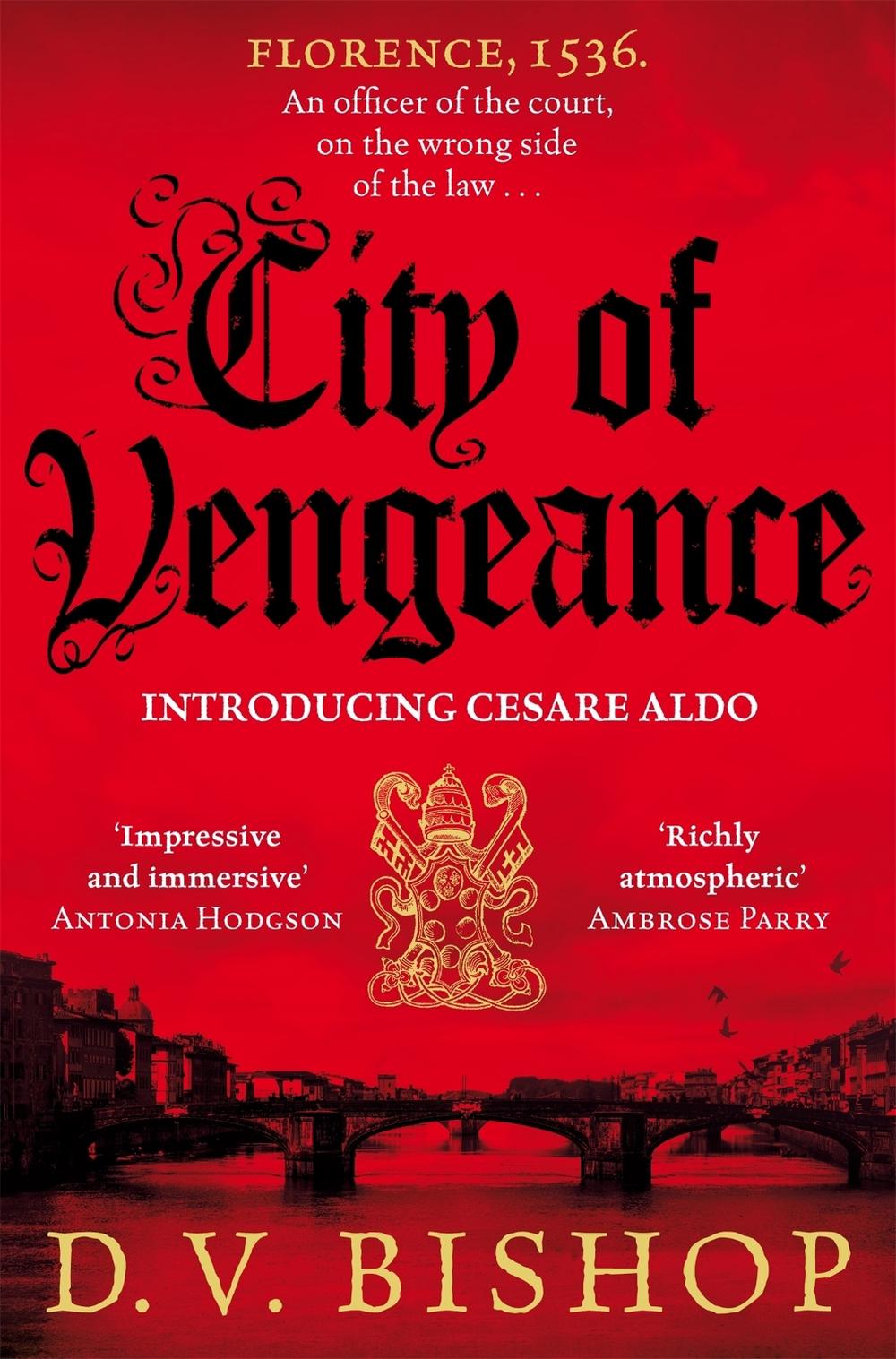
City of Vengeance by D. V. Bishop
Macmillan
Pp. 400

The city in question is Florence, and there are some good descriptions of the narrow streets and the crowded bridges. A map reveals the layout of the city in the sixteenth century, with many landmarks which still stand, such as the Duomo, the Ponte Vecchio and the Bargello, while others such as Le Stinche (the prison in the eastern quarter) have since been demolished.
“Florence: a jumble of grand palazzos and humble hovels, bustling marketplaces and quiet piazzas, churches and workshops, all elbowing one another for room. Above them loomed the Duomo, terracotta bricks divided into vertical segments by columns of pale stone, keeping a proud watch amid the plumes of smoke billowing from the city’s chimneys.”

This is a world where courtesans hustle for business among the wealthy men at court, secrets are round every corner, and the murder of a Jewish moneylender (Levi) barely raises an eyebrow, until a ledger of unpaid debts is stolen, leading to the Duke to make the Wildean quip, “The murder of one moneylender is bad for business. The murder of two is bad for the whole city.” With practically his dying breath, Levi forbids his daughter, Rebecca, from marrying his apprentice, Joshua. Another body, found beaten to death, turns out to be a man dressed as a woman. Meanwhile there is courtly intrigue as this is the time of the Medicis, when Alessandro, Duke of Florence, murdered by his cousin, Lorenzino de’ Medici, was succeeded by Cosimo de’ Medici. “Killings in Florence were not infrequent and were usually personal, fuelled by family, love, hate or greed.” With multiple plots, subplots, and frequent switches between character and locations, the story is almost deliciously Shakespearean.    


Cesare Aldo is our unlikely hero, a former soldier, with a war-injured knee, now a member of the Otto di Guardia (the eight), the city’s most feared criminal court. While ruthless when required – “Cesare Aldo took no pleasure from killing, but sometimes it was necessary” – he has a (poorly kept) secret of his own. He is homosexual, a ‘crime’ punishable by death. Although historically, this sentence was rarely executed, it makes a sufficient plot point for his blackmailer to warn that if discovered, “you’ll be hung from the gates, your body set on fire, and your ashes hurled into the Arno. That’s what the likes of you deserve.” Several set pieces and action scenes bring the novel to life. Florence is “a labyrinth for those who didn’t know it well, The Duomo and the Arno were helpful landmarks, but often hidden from view among the narrow streets and close buildings.” The opening chapter contains a thrilling ambush, and the chase sequences are full of evocative detail.

“The approach to the bridge [Ponte Vecchio] was choked with sellers hawking poultry, fish and produce to potential buyers, all of them arguing about prices. The aroma of fresh bread filled Aldo’s nostrils as he passed a baker. In the next doorway three youths were playing dice, pushing and shoving at each other, shouting to be heard above the babble of voices. Ahead the bandit had to swerve around a trader holding live chickens high in the air, one in each fist, proclaiming their price a bargain. The birds clucked and protested, flapping their wings, feathers fluttering down.”

Other locations are also described according to their geographical and historical features. The little village of Le Casette owes its existence to its position beside an easy place to ford the river Po. “The tallest building was the church with its bell tower, while the coach house and stables stood across the dirt road from it. Salvation and God on one side, drink and the potential for devilment on the other – it was often the way.”


The explanations of the legal machinations incorporate daily reports being made, denunciations being filed, and the quality of justice being questioned. “Explaining a dead body to the Office of Decency was always a nightmare. The court’s officials turned a blind eye to most things, if their vision was clouded with enough coin. But a corpse was too much, even for the greediest of them.” One of the wealthy merchants, Landini, has a very modern right-wing viewpoint:

“For every moment of triumph, there was always an official ready to interfere. Florence had dozens of different courts overseeing every aspect of city life. Didn’t the guilds do enough to bring prosperity to the people? Well, not all the people, but certainly to those who deserved it. Anyone who couldn’t – or, more likely, wouldn’t – work could always go to church for alms. It was the way of things, and some things never changed.”

Morally and politically, there is a balance between acceptance of the status quo and the potential for change. “At times Florence stumbled beneath the influence of those who did not have its best interests at heart. Mad monks that held sway over the people and their fearful souls. Wilful men clouding minds with talk of a republic where all might be equal. Guilds and merchants battling for financial supremacy. Armies fighting for territory. Kings and cardinals grappling for control.” 

Aldo concedes, “The people could have all the will they wanted, but the future of Florence would always remain in the hands of the few.” The struggle for influence and power, is only achievable by certain strata of society. Maria, Cosimo’s mother bemoans, “To be a woman in this world was hard enough; to be a mother and a widow was worse still. All the responsibility and none of the power.” Women, Jews, homosexuals, illegitimate children, in fact anyone but the sanctioned elite, must get by as best they can. “We do what those like us have always done. We live, we drink, we love, we fight, and we endure. The fools in charge do their worst, and we try to survive. Tomorrow will come, whether we welcome it or not.”


On the other hand, choices are important and no fate is inevitable. Doctor and love interest, Orvieto, tells his patient, Aldo, “Doesn’t matter how often I tell you to rest; what happens next depends on you. It’s the same with this conspiracy. You can warn those in danger, but they must decide how to respond.” Aldo has his own views on jeopardy. “There was no prudence in avoiding danger, because danger always came. Better to calculate the risk and act decisively.” 


The author cannot disguise his political or religious views, literally repeating himself. Early in the novel Aldo remarks, “Changing the minds of those with faith was almost always a lost cause.” Later, as he questions whether so many churches are necessary in Bologna when the coin could be better spent helping the needy, the constable, Strocchi, is uncomfortable with this reasoning. “Aldo chided himself for breaking his own rule: never argue with men of true faith, as changing their minds was almost always a lost cause.” Fearing Aldo is on a revenge mission, Strocchi warns, “You might be able to kill a man in his bed, I can’t. It is for God to take a life.”


Bishop animates this time and place with fictional features based on fact. Aldo explains to Cosimo, “Myths are stories told many times. The truth is usually still inside them.” This is the first in a series featuring Cesare Aldo and the city of Florence, and I would be happy to read more about both.


Friday, 22 May 2026

Friday Five: The shows keep on coming

  1. The Dear Departed: Live Radio Play - Lexi Sekuless Productions and ArtSound, The Mill Theatre: A fun hour or so spent in the presence of some fine actors going through their paces and clearly enjoying themselves. The play itself is a fairly innocuous drama from 1908 by Stanley Houghton which Bart Meehan has adapted into something more immediately palatable. A couple of sisters, Amelia and Elizabeth (Andrea Close and Helen McFarlane) and their extended family of husbands and child (Richard Manning, Sarah Hartley and Timmy Sekuless), squabble over the last will and testament of their dear deaprted father, until they realise that he (Graeme Rhodes) is not dead a at all. Although they do their own foley and commit to the characterisation, I question whether performing a rehearsed reading is a little self-indulgent. Don't get me wrong, all these people are charming actors and delightful company, but I can't help questioning whether it is more entertaining for the actors than the audience.
  2. No Exit - Mockingbird Too, The Studio, Belconnen Arts Centre: The famous quote, "Hell is other people" is the premise of this play, except it was written by Jean-Paul Sartre, so it is actually, "L'enfer, c'est les autres". The originial title is Huis clos, which is the French equivalent of the legal term, in camera, itself Latin for 'in a chamber' or a private discussion behind closed doors. These levels of translation and interpretation are relevant to this existentialist drama first produced in 1944, in which three people, Garcin (Eli Narev), Inez (Victoria Tyrell Dixon) and Estelle (Phoebe Chua) are trapped together in the afterlife. They imagine they will face torture or flames of damnation but the Valet (played with goblin-like glee by Peter Fock) who guides them to their room, assures them that while there is none of that, they can never close their eyes. While physically this does indeed sound like torment, metaphorically they are forced to see everything, including themselves through others' eyes and without filters. Initially they attempt not to speak to each other, but they then decide to explain why and how they died, before falling back upon the realisation that they don't like each other and perhaps silence might be the best policy. Being as we know that hell is eternal, there is no dramtic intrigue in the expectation of a denoument which compromises the pacing of the play. The actors try their best to enliven the situation and Victoria Tyrell Dixon in particular displays her range, from anger to seduction and back through desparation and ennui, as well as she can. The other two are less successful and once the premise is set, the action doesn't really take us anywhere - perhaps that is the true meaning of hell.    
  3. Thom Pain (based on nothing) by Will Eno - Lexi Sekuless Production and Joey Minogue, The Mill Theatre: Do you like those stream of consciousness comedians (usually American - usually New York) who seem to fall apart in front of your eyes when performing in a club? Or do they make you cringe as you have no option but to sit and endure their manic inner monologue, wondering if there are actually any jokes in this set at all? If the former, this is the play for you, as Joey Minogue as Thom Pain performs an hour of deep introspection, musing on seemingly random subjects including the death of his childhood dog, which informs his adolescent trauma, while being constantly distracted by his environment. It's a rambling monolgue delivered as therapy, without inviting the audience to do anything but witness a private meditation. The performace is solid, but the show is unengaging.
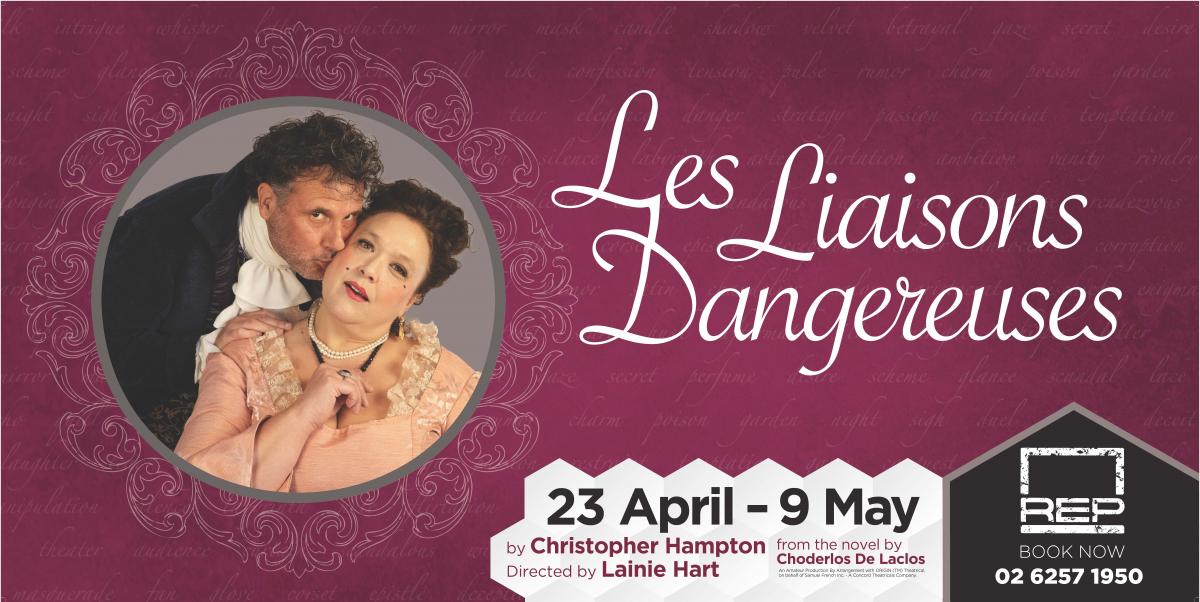
  4. Les Liaisons Dangereuses - Canberra Repertory, Theatre 3: This is a strong production of a highly-regarded play. Excellent performances from the three leads carry the drama and wit well; the casting of married leads (Jordan Best as Merteuil and Jim Adamik as Valmont) allows the sexual flirtation to flourish, and Yanina Clifton as Tourvel displays a haughty demeanour which is broken as she abandons herself to a torturous love. Director Lainie Hart keeps the action tight, with staging in quadrants and sharp character-driven scene changes, the fight scene is well executed, and the understanding of the game-turned-bad nature comes across well through card games and levels of both actors and set. The innovative approach to multiple scenes and locations keeps the pace from dragging too much, as the scene changes are fluid and morph into each other, although a touch more of the letters on which the play/novel is based would have been welcome. The set, sound and costume and are all cohesive; the scarlet woman taffeta of Merteuil and matching waistcoat of Valmont are suitably sumptous, and all the bodices, bustles, ruffles and cuffs look absolutely comme il faut. A commendation must go the intimacy consultant (Jill Young) as this play contains a rape scene which is vey sensitively handled. 
  5. Vanya and Sonia and Masha and Spike - Mockingbird, The Studio, Belco Arts Centre: Brother and sister (by adoption; not birth, which accounts for some almost incestous contemplations), Vanya (Chris Bladock) and Sonia (Tracey Noble) live alone together in a Pennsylvanian farmhouse  contemplating the blue heron in the garden and their daily grind. Their lives stretch before them in an endless future of ennui, until the third sibling, Masha (Helen McFarlane) returns from her rapidly-drying-up screen career with a toyboy lover, Spike (Darcy Worthy), in tow and news that she is going to sell the family home (which she owns and allows her siblings to live in rent-free). There is also a fancy-dress party next door to which she has invited them, bringing costumes that show her in a good light. A young woman, Nina (Lily Welling), suggests a threat to Masha's hold over Spike while providing a catalyst for Vanya to stage his play based on the avant-garde work of Konstantin in The Seagull. And hovering on the edges is Cassandra, the housekeeper who spits out random portentious warnings and dabbles in a little voodoo on the side. Mockingbird Theatre often mixes veteran actors with newcomers, and the effect can make for an uneven production. Chris Baldock is commanding as Vanya, particularly shining in his closing tirade lamenting the decline of manners in the modern world, Tracey Noble fully embodies the petulance of a woman afraid she has missed out on life and trying to blame someone else for her failings, and Helen McFarlane is utterly beliveable as the one trying to cling to her outward presentation to the world, secretly knowing that it isn't their true self. Darcy Worthy keeps taking his clothes off as the script demands and he is certainly nice to look at, although his acting is laboured and gestures repetitive, Lily Welling's freshness and innocence are delightful but the pitch is a little too high, and India Kazakoff feels too young and inexperienced to carry the weight of the Cassandra character (described as '30-60' in the script). Steph Evans directs with a relatively light touch - the best moments are the natural sibling bickerings - in this consummate satire of Chekovian drama in which nothing appears to happen, but everything actually does. 

Friday, 15 May 2026

Friday Five: Books Read in April

  1. City of Vengeance by D. V. Bishop (Macmillan)This is the first in a planned series featuring Cesare Aldo and the city of Florence, and I would be happy to read more about both. This is the time of the Medicis, when Alessandro, Duke of Florence, murdered by his cousin, Lorenzino de’ Medici, was succeeded by Cosimo de’ Medici. There are murders, family feuds, personal grievances, religious disputes and secrets around every corner.With multiple plots, subplots, and frequent switches between character and locations, the story is almost deliciously Shakespearean. Cesare Aldo is our unlikely hero, a former soldier, with a war-injured knee, now a member of the Otto di Guardia (the eight), the city’s most feared criminal court. While ruthless when required, he has a (poorly kept) secret of his own. He is homosexual, a ‘crime’ punishable by death. Ambushes, chase sequences and vivid descriptions of the Renaissance city keep the pages turning rapidly, while digressions about the nature of power and control give the novel a contemporary aspect.
  2. Madame Burova by Ruth Hogan (Two Roads) - Nice cover; shame about the cloying middle-class morality and condescending judgement. Madame Burova is a tarot reader who takes over from her mother Shunty Mae to run their sea front booth in Brighton and also works at the local holiday park, meeting lots of 'interesting characters'. Meanwhile, Billie, a young woman in London whose entire individuality seems to rely on the fact that she wears a jaunty bowler hat, finds out that she is adopted and travels to Brighton to uncover the truth of her origin story. The author makes her point so often that the characters have no personality of their own, and there are pages of exposition and creaky prose littered with unncessary adjectives. The period setting of 1973 to which we frequently flash back is practicably indistinguishable from the contemporary sections; what world does this author live in? We are firmly in the 'what could ever make a woman give up her precious baby' territory and authorial attitudes I thought had been left behind last century. 
  3. Witches: What Women Do Together by Sam George-Allen (Penguin Random House Audio Publishing Group) - I listened to this one as it is read by the author and they kept me company on car rides and bus trips. The premise is the fear that patriarchy has of women, especially when they get together, leads to their need to silence, censure, denigrate and ridicule us. From sport to music, to communication and activism, women's activities are seen as lesser by society. The greatest success of the patriarchy is pitting women against each other - women are easier to control (and sell things to) and compress into one of the very few ways to 'acceptably' be a woman if they are isolated. Conversely, they are often forced into the 'community and caring' roles, which are naturally underappreciated and underpaid, because they are 'women's work'. The allure of a network of connected women is what lies behind the pull of Wonder Woman and the fear of The Handmaid's Tale. This is admittedly a western-centric view of society - because that is the one in which the author and I live - which celebrates the power and pleasure of being among women. 
  4. Wild Dark Shore by Charlotte McConaghy (Penguin Random House Australia) - The world setting of this novel makes a mark right from the start. A man and his three children live on a remote island halfway between Australia and Antarctica (it's called Shearwater and clearly based on Macquarie), which is rich in marine wildlife and home to the world's largest seed bank. A woman is washed ashore while looking for her husband who was working there and left increasingly mysterious messages. As the family nurse her back to health, she realises that the island hides secrets and as the sea levels rise, all the inhabitants are threatened. Part mystery; part eco-drama; part psychological treatsie on isolation, preservation and growth, this book is patchy in places but memorable as a whole.

Friday, 8 May 2026

Friday Five: Cross-stitch Scandi Love

This collection from Spruce Cross Stitch was called 'Scandi-love', so I thought it approrpriate to post them as we head into Eurovision. I gave the first one of them to a friend for her birthday - it sits framed on her desk at work.


Wednesday, 29 April 2026

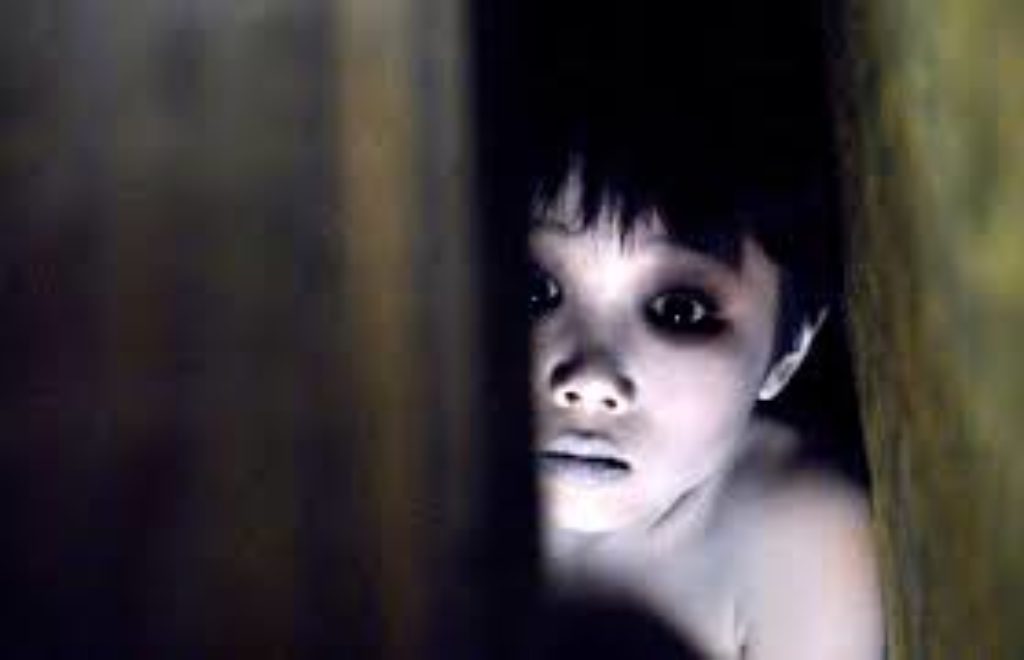
Horror in Another Dimension: Strange Houses


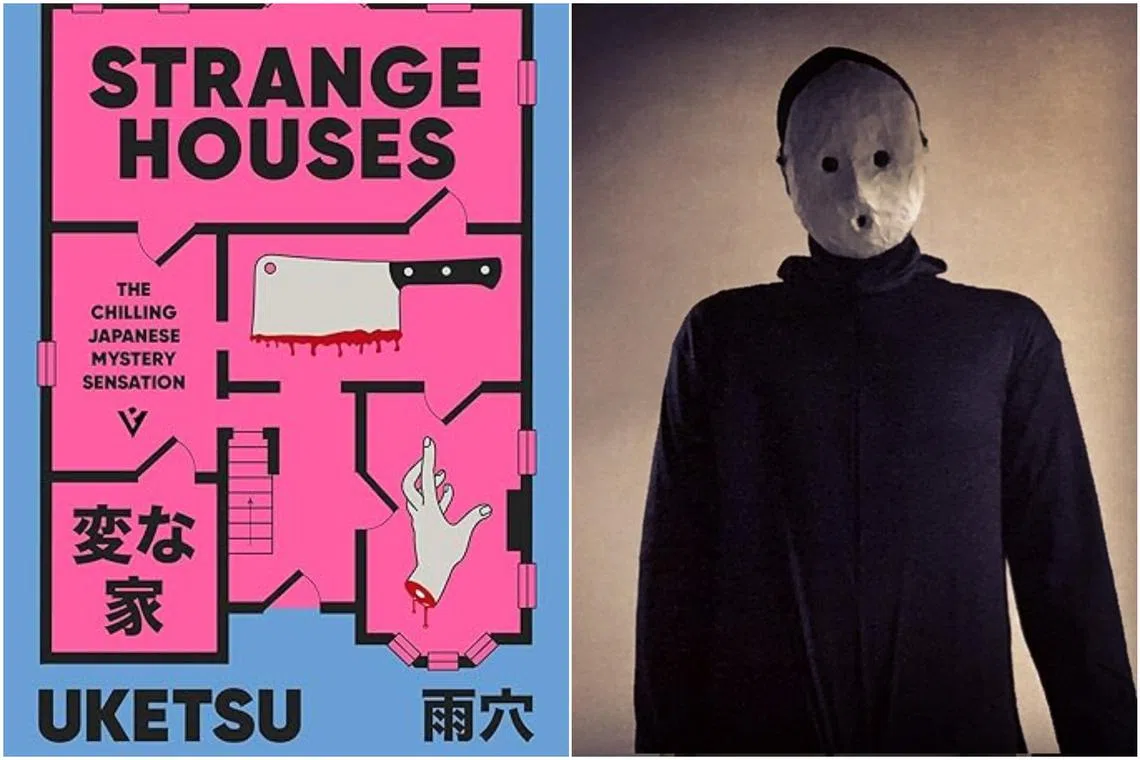
Strange Houses by Uketsu
Pushkin Vertigo
Pp.197
 

This is the first of three (so far) short novels by Uketsu, translated to English from the original Japanese by Jim Rion. According to the publisher’s blurb, the author, Uketsu, is “an enigmatic YouTuber and author, specializing in horror and mystery, who has exploded onto the literary scene in Japan, where his books have sold millions of copies. He only ever appears online, wearing a mask and speaking through a voice changer. His true identity is unknown.” A sort of viral Banksy if you will.


The story begins with the narrator explaining, “I’m a freelance writer, my speciality being stories of the macabre. Given this line of work, lots of people approach me with their personal experiences of the eerie and the unpleasant.” He goes on to tell a story with a blanket level of detail, in which floor plans and family trees take up half the book – refreshingly, there is no need to flick back to the beginning pictures to follow along. The floor plans reveal hidden passages and secret rooms for nefarious business. Most of the text is written as play dialogue, which contains all the exposition so there is very little description. There is an element of Edgar Allen Poe’s short stories; thrilling creepy tales that can be read in a day or two.


In keeping with detective fiction rules that all clues must be mentioned, there are plenty of apparent irrelevancies, but also deliberate omissions. Despite exhuming some standard tropes, the Japanese horror story is certainly different. Sub-headings within chapters are almost like a child’s first reader: A Message from a Friend; An Unexpected Email; The Mysterious Space; Daydream; Two Bathrooms; The Article; A Grisly Discovery; Differences; The Letter; The Hidden Room; The Sign. The tale deals with dismembered bodies, curses, murderous children, blackmail, and the importance of succession and illegitimacy. One character fairly remarks, “I can see how it all fits together, but… isn’t it all a little far-fetched? It’s so convoluted.” Japanese horror is built on this sort of thing, and there is already a film - released in Japan in 2024.


The murders themselves seem quite matter of fact. “The Katabuchi family has been murdering people for generations. I don’t know why, but it has become a tradition.” When a character suspects her father is involved, the narrator notes, “It was not the kind of truth that most people could have accepted so calmly, but she seemed surprisingly untroubled.” He, himself, hardly seems more disturbed, as he ponders where a child was killed, but not why they were killed at all. He casually discusses horrific customs, such as, “Mabiki. ‘Thinning the garden’. In Japan, there was once a tradition of aborting babies or even killing children to keep down the number of mouths to feed. The practice lasted into the late nineteenth or even early twentieth century in some communities.” When the ending appears to be inconclusive, and his colleague “flashed a broad grin”, he allows himself to feel “a twinge of irritation at his total lack of concern.”


Training children in macabre cults and brainwashing them into murder adds a particularly chilling element. “He had an unhealthy pallor, and his expression was as blank as if it had never known emotion… He never took any action of his own volition and never expressed any of his own feelings or desires.” The whole scenario is highly implausible, but this is the breeding ground for horror. “It sounds wild, but we already know the Katabuchi family is not a normal one.” Investigating murder by looking into floor plans brings a new angle – in many dimensions – to a standard genre. They may be compact crimes, but they are far from cosy.


Friday, 24 April 2026

Fiday Five: Latest Cat Memes

Simply because these things make me happy, and anyone who shares feline company can relate.

Friday, 17 April 2026

Friday Five: Books Read in March

  1. Prisoners of Geography by Tim Marshall (Elliott and Thompson Ltd) - To see how nations and cultures behave they way we do, we often look to history. In this fascinating work, Tim Marshall posits that past actions may have more to do with geography; natural rivers and mountains as boundaries (France was a successful nation because it has the most kilometres of navigable rivers of any country in the world, thus facilitating movement of goods and ease of trade), and artificial partitions (the arbitrary division of East and West Pakistan has caused unrest and volatility in the subcontinent for the past eighty years). For example, the USA and Russia had communication and unification issues purely due to their physical magnitude; Egypt didn't become a colonialist power because it had no trees with which to build ships; and China seeks expansion to secure warm water seaports. Control of ports, seas, exclaves, canals and straits are of crucial geopolitical importance. Marshall wrote this book in 2015, and this is a revised version published in 2025. With recent global conflicts, including the war to control the Strait of Hormuz, he has plenty to include in his next update. 
  2. Cunning Women by Elizabeth Lee (Windmill Books) - Of course I was going to read this book set in 1620 Lanacshire, at the height of the persecution of women condemened as wiches. In a small hamlet abandoned since the plague, the only people who live there are the Haworth family: Sarah, her little sister Annie (who is practically feral), her brother John and their mother, who is losing her wits (increasingly conversing with her familiar, Dew Springer) potentially due to lack of contact with the local community. It's sort of a love story as Daniel falls for Sarah but cannot explain why, so naturally others say it's because she has bewitched him, particularly the pretty May Queen who wants him for herself. It is also an exposé of hypocrisy as the villagers like the family and use their knowledge when it suits them, but blame and condemn them when that is more convenient.
  3. The Dark Side of Camelot by Seymour Hersch (Harper Collins) - There is a romantic view of JFK, enhanced in part by his assassination. If that's the way you'd like to preserve your idealisation, I would recommend steering clear of this book. From his serial womanising (he had people to procure him prostitutes and warn him when Jackie was returning to the White House so he could get them out of the pool), to his evident connections with the Mafia and organised crime, via his complete and callous incompetency over the Bay of Pigs incident and the Cuban Missile Crisis, there was something very rotten in the state of D.C. As part of his personal feud with Fidel Castro, Kennedy authorised to the CIA to lace Castro's cigars with toxins, poison his milkshakes, prepare contaminated diving suits and rig brightly-coloured explosive seashells in the areas where he commonly went skin diving, not to mention bringing the world to the brink of nuclear war. He made deals with Russian politicians, which have only come to light since the declassification of documents and personal correspondence in the late 1990s, escalated the Vietnam War and approved the use of chemical weapons. He was also on multiple drugs (including opioids, anaesthetics, steroids, tranquilizers and stimulants) to manage his back pain - naturally this toxic cocktail would have affected his judgement as much as the corset he wore to straighten his posture prevented him from slouching in the seat on that fatal day in Dallas. The tone of the book is very serious and wordy, so don't expect light relief, but then again, you might consider that the hagiography of an arrogant, misguided misogynist to be no laughing matter.
  4. The Shortest History of Australia by Mark McKenna (Black Inc.) - The 'Shortest History of' series began with Europe in 2012. It has since expanded to include titles on Japan, Greece, Ancient Rome, India, Democracy, The Crown, War, Economics and Innovation. The premise is that they offer 'clear and concise accounts of broad-ranging topics from the world's leading subject matter experts [that] can be read in an afternoon and will transform your perspective for a lifetime.' At over 250 pages and packed with facts and information, I dispute the idea that this could be read in an afternoon, but I do agree that it is fascinating and illuminating. Perhaps the main theory behind this treatsie is that the history of Australia is neither linear nor consequential but that many strands can co-exist consecutively. Indigenous Australia, the penal colony, the gold rush, Federation, WWI and the formation of the Anzac legend (Australia being "the only modern nation-state to create an origin myth not located on its own soil"), WWII, the Cold War, and waves of non-British migration are all necessary to the shaping of the country, and all are essential to understand Australia as it is now.  
  5. Strange Houses by Uketsu (Pushkin Vertigo) - In this Japanese horror/ mystery, housing floor plans and family trees take up half the book. Much of the text is written as play dialogue, which contains all the exposition, so there is very little description. The tale deals with dismembered bodies, family curses, murderous children, blackmail, and the importance of succession. Despite being pretty far-fetched and exhuming some standard tropes, the creepy thriller is certainly different in style. There is an element of Edgar Allen Poe's short stories, which can be read in a day or two, but leaves a lasting impression.

Friday, 10 April 2026

Friday Five: Boycotting Eurovision


Due to the presence of Israel in the Eurovision Song Contest, despite their 'participation in the conflict in Gaza', five countries have boycotted the event - not sending a contestant or televising the spectacle - complaining about the hypocrisy of banning Russia while allowing Israel to compete. So, here's the who's who of who's not.

There's no danger of getting the wrong outfit for Daði Freyr & Gagnamagnið
  1. Iceland - Iceland have been represented at the Eurovision Song Contest 37 times since its debut in 1986. Since the introduction of the semi-final round (in 2004), Iceland has failed to qualify for the final nine times, including four years consecutively (2015-2018). To date, Iceland is the only Nordic country not to have won the contest. They have quite an odd record, actually, having achieved second place twice (in 1999 and 2009), losing out to Sweden and Norway respectively, but also having finished in last place four times, including 1989 when they received the dreaded nul points. Most recently they are best known for the banger of a single, Think about Things by Daði Freyr og Gagnamagnið, which was all set to represent Iceland in 2020 until the contest got cancelled due to COVID. It might have been their best attempt at the top spot as the song was a viral sensation and the band were adored for their catchy electropop, standout dance moves, awkward adolescent vibe and quirky personalised sweatshirts.
  2. Ireland - It should be no surprise that Ireland have boycotted the contest this year, as they have form at protesting over this issue - down with this sort of thing. In 2024 Bambie Thug (who was one of my favourites) came sixth overall and was only allowed to perform after they removed make-up from their body which spelled out 'Ceasefire' in a Medieval Celtic script. The national broadcaster, RTE, which would normally televise the competition, has announced it will screen the satirical Father Ted Eurovision episode of 1996 instead. They are quite a big omission as along with Sweden, they have won the competition the most times (seven), although not since 1996. To be honest, I'm still traumatised by Johnny Logan's What's Another Year? from 1980. 
  3. The Netherlands - Along with France, Luxembourg and the United Kingdom, the Netherlands have won this contest five times previously, most recently in 2019 when, incidentally, the contest was hosted by Israel in Tel Aviv. In 2024 Joost Klein qualified for the final with the relentlessly poppy Europapa, which came second in its semifinal and was hotly tipped to win the competition. However, following a backstage incident between Klein and a production staff member shortly after the semifinal performance, the Netherlands was disqualified from the final. The investigation into the incident was closed on 12 August due to a lack of evidence. This is the only time that an entrant has been disqualified during the contest.
  4. Duncan Laurence wins Eurovision for the Netherlands in 2019 despite seemingly hand-syncing his keyboard playing
  5. Slovenia - Slovenia debuted at the Eurovision Song Contest in 1993, and since the introduction of the semi-finals in 2004, they have qualified for the final eight times. They have not made it into the top ten since coming seventh in 2001. In 2025 they stated they would reconsider participation in the contest if the European Broadcasting Union did not respond adequately to concerns surrounding the 'transparency of the vote', referring to Israel's televote win n 2025. Obviously, no such assurance was received, and the general director of Slovenia's national broadcaster stated that their questions were ignored and, "we clearly won't be going to the Eurovision Song Contest'. With all due respect, I'm not sure anyone will particularly notice their absence.
  6. Spain - Now, Spain, on the other hand... They are one of the Big Five (along with France, Germany, Italy and the United Kingdom), so now it is a Big Four. The aforementioned countries are the ones who contribute the most money to the European broadcasting Union and it is arguable that without these contributions, the contest would be financially unable to proceed. In return for this, they receive automatic entry into the final. This can actually work against their entry, with other countries feeling sour about giving them votes, or it might just be that their songs aren't all that good. (The UK entries for 2024 and 2025 both received no points from the public vote, although the juries brought them out of last place). Spain are no strangers to Eurovision controversy - they have two of only three non-winning entries who have been allowed to perform a second time. In 1990 the orchestra and backing track began the song out of synch, causing the singers to miss their cue, and in 2010 their performance was interrupted by a chap named Jimmy Jump known for pitch invasions and disruption of other entertainment events in order to show Catalan support. 
One of these people was not part of the act, although it made no more or less sense of the song.

Thursday, 2 April 2026

Eurovision 2026 - Just the Songs


I know we all know that Eurovision is all about the staging and the politics and the personalities and the drinking games, but let's imagine just for a moment that it is actually a song competition and purely about the songs themselves. In that vein, I listened to them all without pictures (moving or otherwise), or without knowing which country they were representing, and this is my honest commentary on what I heard (in the order in which they appear on the official Eurovision Song Contest 2026 playlist).

Viva Moldova!
  1. Dara - Bangaranga: I don't think they're referring to sexual relations with ginger-haired folk; it's got house beats, changes in tempo and a female-Prodigy energy. 
  2. Felicia - My System: Kylie Minogue meets The Pet Shop Boys in this disco rave beats banger. Sample lyric: "You're in my head, my heart, my body parts; I can't get you out of my system."
  3. Soren Torpegaard Lund - For Vi Gar Hjem: The pretty, boring ballad with the obvious chord progression, which will probably live rent free in the head.
  4. Linda Lampenius, Pete Parkkonen - Leikinheitin: It's way too busy, but I like the violins.
  5. Antigone - Jalla: More dancing and exhortation to hear the beat of the drum, shake your hips, dance on the table and get lost in the rhythm (or something like that). There's a smattering of ethnic styling and I imagine up-tempo belly dancing.
  6. Sarah Engels - Fire: Is this Cyprus trying to be Destiny's Child complete with the earthy growl/ grunt ting and lyrics such as 'Boy, I'm out of your league.' There will doubtless be accompanying hair flicking and gratuitous crotch flashing.
  7. Alexandra Capitanescu - Choke Me: Are you f*^king kidding me? It's probably supposed to be empowering and dark emo and all that, with a touch of Shakespeare's Sister-lite odd trills and screams, but the sub-dom lyrics are deeply unpleasant. 'All I need is your love. I want you to choke me.'
  8. Satoshi - Viva, Moldova!: They clearly don't want to win the competition with this song - they haven't even got the budget for lyrics or tune. With ethnic instruments and unmelodic chanting, this had better have fun staging.
  9. Akylas - Ferto: I'd dance to this down the clerb. Did he mention rally cars? It's got limited lyrics, but it feels pretty inclusive. I hope they have a gimmicky dance.
  10. Jonas Lovv - Ya Ya Ya: It's got guts, broken bones (lyrically speaking) and an Arctic Monkeys/ White Stripes vibe, so I really like it but it won't get to the final. I'm also terrible at predicting these things so it may go on and win this thing. Or neither.
  11. Sal da Vinci - Per sempre si: Sounds like a 1980s-style holiday music; there's probably one of those awful choreographed YMCA-type dances associated with it.
  12. Monroe - Regarde!: This is outstandingly Fench hitting soaring operatic vocal highs and completing the gamut down to the spoken word. One could say Le chanson va partous. 
  13. Veronica Fusaro - Alice: I really like this Amy Winehouse-style offering.
  14. Eclipse by Delta Goodrem
  15. Delta Goodrem - Eclipse: Obviously I know this is the Australian entry because I live here, and not under a rock. It's a strong commercial Euro-pop ballad with simple chords, mentions of astronomical love and those shouty vocals they seem to favour, plus she has an international profile since her Neighbours days, so it is perhaps in with a chance, although I question the lyric, 'We've only just begun'. I would say, it's been 11 years, Australia; you've had your fun; time to give it a rest now.
  16. Cosmo - Tanzschein: This fills the dull dance number slot. 
  17. Noam Bettan - Michelle: Ma Belle it is not, although the heartfelt sincerity is almost unbearable. Apparently this is Israel's representative so the crowd will hate it but it will mysteriously get lots of votes.
  18. Lelek - Andromeda: Great vocal harmonies create a wall of sound combining traditional ethno and modern pop.
  19. Essyla - Dancing on the Ice: Has Justin Trousersnake got a sister, because that's what this sounds like. 
  20. Eva Marija - Mother Nature: I could have sworn that was Regina Spektor. It's quite clever with an appealing arrangement including some violin string plucking. They sing in English and sound pretty cute, so I'm guessing this is Luxembourg.
  21. Bzikebi - On Replay: Typical bland boring Euro fare.
  22. Tamara Zivkovic - Nova Zora: Military opera with a Euro beat and a voice changer. My printer was making weird noises, or was it the song?
  23. Alis - Nan: A touch military and builds with good backing vocals but a fairly pedestrian lead and arrangement.
  24. Vanilla Ninja - Too Epic to Be True: This is quite charming with an innocent Kim Wilde feel (I know a few folk who'd like that...); a disco/pop number with a fun spoken word section.
  25. Look Mum, No Computer
  26. Look Mum No Computer - Eins, Zwei, Drei: If I didn't already know this was the U.K., the piss-taking posturing nihilism and novelty-song elements with the post-modern refrain, "I'm s bored with it; what's the point of it?" No one will appreciate this disrespectful take on the contest.
  27. Aidan - Bella: The highlight is the soaring James Bond-esque opening, and then there are some powerful strings but it descends into weak plinky plonky nonsense.
  28. Simon - Palmoa Rumba: This is the hardcore club sound that leads to a great light show and no votes.
  29. Senhit - Superstar: Not bad but not distinctive; a general disco dance tune.
  30. Daniel Zizka - Crossroad: A bloke just shouting and wailing isn't music. I blame The Voice.
  31. Alicja - Pray: An interesting mix of genres with some gospel energy and then some hip-hop rap.
  32. Lavina - Kraj mene: The gloomy death metal number with dark sounds and screams. I like it, whihc I believe is the kiss of death.
  33. Leleka - Ridnym: This is the sort of breathy tune I would expect from musical theatre, so it's fine if you like that sort of thing. I don't. A note on the high pitch squealing: just because you can, doesn't mean you should.
  34. Lion Ceccah - Solo Quiero Mas: This one is the Euro filler; time to put the kettle on. 
  35. Atvara - Ena: This means something to someone; it seems incredibly earnest with sudden spikes and heaps of emotion. I like the piano and the backing vocals. 
  36. Bandidos do Cante - Rosa: It's quite bad when it strats out a cappella, and then the ethnic strings join in and it gets even worse. This might have done quite well in 1976. I think we've moved on. I hope we have, anyway. 
  37. Jiva - Just Go: Imagine I Will Survive at half tempo. You're strong, well done, we get it, get off.
Alicja 

Friday, 27 March 2026

Friday Five: Theatre and Comedy

The cast in Never Closer: from left, Breanna Kelly, Natasha Lyall, Pippin Carroll, Joel Hrbek and Emily O'Mahoney
  1. Never Closer - Off the Ledge Theatre, The Courtyard Studio: This is a solid play set in Northern Ireland during the Troubles when a friendship group is on the brink of exploring a wider world, and again ten years later when they reconnect for Christmas Eve as they always used to do, except this time one of them brings along their fiancé, and he's English. Director Lachlan Houen has assembled a great ensemble of actors with whom he clearly works well. He is bold in his directing choices, although this occasionally misses the mark, and there are some issues of pace where actors hit one note and stay there. Emily O'Mahoney as Deirdre is the only one with a credible Northen Ireland accent, although she wrings every ounce of bitterness out of her position as the one left behind who feels she has to martyr herself with folded arms and closed off physicality. Joel Hrbek is cute in the role of Jimmy - reassuring in his presence and warmth - whereas Nick Bisa plays the polar opposite, Conor, with monochromatic rage. Although Niamh, has arguably made the biggest change (in going to England and embracing the life and culture across the Irish Sea) she is possibly the least developed character of the play and consequently Natasha Lyall plays her with even delivery that is perhaps a little too measured. Breanna Kelly brings energy and sincerity to the role of Mary, in exactly the same way that she did to her character in You Tell My Mum I'm Dead, the previous production in which I saw her here, and I'd like to see something else. Pippin Carrol is sublime in the role of Harry, the odd one out, and for every English person who has ever been blamed for their government's choices, I feel your pain! The set design (Lachlan Houen, Sophie Hope-White, Liah Naidoo, Anna Lorenz) is appropriately busy, signifying the hoarding elements of an ancestral home without being cluttered, and while the ambient sound (Marlene Radice) enhances the production, the blast of the bomb needs to be a lot louder. Sight-lines are compromised whenever a character sits on the floor, and the costumes are not era-appropriate. The play makes me question who gets to tell whose story? This is an Australian playwright writing about an extremely sensitive Irish/ British experience produced by an Australian team in Canberra, and it just feels slightly off.
  2. The Taming of the Shrew - Lakespeare, Belconnen Arts Centre: Director Karen Vickery has created the staging for outdoor performances but I saw it indoors (because I get annoyed by distractions), and it worked very well there too with the lakeland backdrop. The world created is big, bold, comic and colourful with grand gestures and gags, while costumes (Helen Wotja) and millinery (Rachel Henson) are extravagant and coordinated to households to help identity - the hats are a particular delight. Voices are generally loud and clear without shouting or straining, and all the action is through words and deeds rather than props (with the admirable exception of hobby horses) or set. There are four entrances on the diagonal, allowing cast to appear from multiple angles, and the only concession to set is a table for height (or hiding beneath). The gender switching works well, removing the violence, misogyny and general 'ick' often found in this play, replaced with a more playful rough and tumble. Ylaria Rogers is excellent and expressive as Petruchia, and when she catches Michael Cooper's arm as he goes to hit her in his role of  Christopher/ Kit and states calmly and firmly, 'do not strike me', it feels powerful and statesman-like. Cooper, meanwhile, is sulky and petulant as Kit rather than aggressive and spiteful, and he elicits sympathy instead of censure for his behaviour. When pretending to be someone else, the characters drop nods and winks as they add a skirt or a sash, with Anneke van der Velde Trania ('disguised' as Lucentia) being particularly good at this deception, engaging with the audience where others have some fear of eye contact. Always a joy to watch, Yanina Clifton takes both fun and weariness in being Grumia, the clown, who is very much the bridge between the actors' world of wealth and privilege and us, the normal folk.
  3. Shakespeare in Love - Mockingbird Theatre, The Rehearsal Room: The play by Lee Hall is adapted from the film by Marc Norman and Tom Stoppard which we all loved thirty (yes, thirty) years ago. If you're thinking sumptuous costumes, swooning chemistry and delectable staging, think again. Director Chris Baldock has taken on an ambitious project to fit all the actors on stage - there are 23 of them in all - and the result is messy (and I've seen the dressing room, which must have been even more crowded). There is a greatly varied standard of acting from experienced senior actors to students from Mockingbird acting classes. Tom Cullen displays a range of emotion as Shakespeare and is adept at dialogue and supporting his scene partners. Unfortunately, although Asha Forno looks the part of Viola de Lesseps, she hasn't got the necessary gravitas and presence; similarly James Phillips as Christopher (Kit) Marlowe lacks the swagger and charisma demanded of the role. Liz St Clair Long revels in the regality and narcissism of Queen Elizabeth, whereas Bruce Hardie as Lord Wessex is underused and looks uncomfortable being there, as if he has tried his best but given up with some the more self-indulgent cast members. Sian Harrington stands out as the Nurse, Sachin Nayak as Lord Edmund Tilney gives a strong and grounding performance, and Rob Karlen enjoys dressing up and playing the foolish pretend nurse. Many of the witty one-liners and Shakespearean allusions are discarded without due consideration. It's hard to do comedy well, and this production merely highlights just how hard that can be. It may be a brave attempt but it falls short of the high standards set by Mockingbird and ultimately disappoints.
  4. Emma Holland: The Dog Dies at the Start - The Street Presents Canberra Comedy Festival, Street One: Don't say you weren't warned; the trigger warning is in the title. This is almost a one-act play rather than a comedy routine, and Emma Holland rearranges the sparse set to make it larger and smaller as one feels when mourning the death of a pet. Using visual aids such as a screen and a clicker, she builds a world of her domestic circumstances, frquently having a laugh at her long-suffering mother's expense. The show explores the nature of grief in both a humorous and heartfelt way. Holland has a charming rapport with the audience, and she rambles and weaves the narrative on an extremely circuitous and deceptive route before concluding with a satisfactory ending like a true shaggy dog story should.
  5. Lloyd Langford: Okay, I Believe You - Canberra Comedy Festival, The Playhouse: Lloyd's laconic style is belied by his mischievous eyes, wicked grin and the sense that he never takes himself too seriously. It may seem effortless to string a series of unrelated anecdotes and observations together, but he handles them with precision timing, apart from one instance when he is disturbed by a random snort (potentially laughter) from the audience. Some young drunken types found his accent pants-wettingly hilarious, which manifested in inane shrieks and performative outbursts at innocuous words like Hobart or dragon. Yep, he's Welsh, get over it. That aside, it's a joy to listen to a man at the top of his game riff on subjects as varied as Katy Perry, picking fights in playgrounds and cafes, and his mistrust of the cloud (he envisages it as the sickly-scented fumes left behind by an adolescent vaper, so that's unsurprising). His wife and daughter feature as topics in his show, not in any mawkish manner but in an entirely natural, they're-just-a-big-part-of-my-life sort of way. And there are lots of amusing moments in life, if we only stop to look for them. 
  6. Melanie Bracewell: Dilly Dallying - Canberra Comedy Festival, Canberra Theatre Centre: Another comedy show without a theme is almost a theme in itself, especially when it is so well orchestrated. Melanie Bracewell is not so much a raconteur as that entertaining friend down the pub who fills their stories with colourful detail. Over the course of a meandering hour or so, she tells us about her recent engagement, by way of her previous boyfriends (the Four Fuckboys of the Apocalypse) and her fight with the neighbours over who has the best bin. She lets us know that this is the first stop on the tour, and she makes no aplogies for having her notes on stage. In fact, we seem to be taken into her confidence and feel like we may play some part in shaping the show, although by the end when the threads are all as neatly tied as a pair of shoelaces (you'll have to see the performance to see why that analogy works), it is clear that she was pulling the strings all along.

Wednesday, 25 March 2026

How well can you really ever know anyone? The Wife and The Widow


The Wife and the Widow by Christian White
Affirm Press
Pp. 326

In this novel Kate is the widow (husband; John) and Abby is the wife (husband; Ray), and, although this occasionally gets confusing, it is well-written and with enough suspense and intrigue to keep the reader engaged. It has a contemporary feel in that the characters frequently refer to true crime podcasts or “suburban procedural TV shows”, indicating that we have all become familiar with these, and that there is a communal enjoyment. It also explores a common theme of these novels in how secret lives are discovered after the death of a loved one (and sometimes even when they are alive), causing one character to reflect, “We all have things that ought to stay buried, things a person should keep to themselves. Things that, if they were ever dragged into the light, would change the way people saw us. I suppose my point is, how well can you really ever know anyone?”


With a wry aside to the power of fiction on susceptible minds, Kate first learns something may be amiss when she discovers her husband was skipping work and “reading horror novels by this mad American – Lovecroft? Something like that.” White examines the consequences of hiding feelings and burying emotions, suggesting that suppressed memory will never remain that way, even when counselled, “Put it someplace out of the way, in a room behind a locked door. Then all you have to do is not go in that room.” Kate remembers that John told their daughter they had to confront their fears; after all, “If they didn’t talk about the monsters in this world, then they wouldn’t be ready for them when they jumped out from under the bed.”


When Abby asks her husband why he hadn’t previously spoken to her of his fears, and dreams, he replies, “Come on Abby, I’m not one of your girlfriends. Men aren’t like that.” Later he relates his reading matter, “I started reading Tolstoy but couldn’t get into it. Vonnegut and Salinger were both pretty good. Didn’t mind Jane Austen either – bet you’re surprised to hear that one?” It’s difficult to tell whether this gender-reductive viewpoint is that of the character or the author, or both.


While appealing to the common denominator – we all consult Dr Google, right? “Her left foot ached with what the internet had diagnosed as either gout, a corn, or foot cancer.” – there are some aspects of the novel which are unoriginal or overexplained. We all know what TMI is and don’t need it spelled out. Similarly, the story of Orpheus and Eurydice is used to indicate the consequences of broken trust and looking back. This must be one of the most overworked myths in recent literature, and the fact that it needs to be explained suggests a level of disrespect for the reader.


On the other hand, the author deals well with the subject of grief. “Since John’s disappearance, such simple things had become near impossible. Preparing meals, for example, now seemed like a bizarre foreign custom, needlessly complicated.” Kate cannot easily see a way forward. “She baulked at people who said things like life’s too short and time passes in a blur and Jee-zus, is it Christmas already? Life was long, time moved too slow, and anyway fuck Christmas.” Her friend advises her how to cope with the aftermath. “You keep moving. You eat, you take a bath, you shave your legs and you keep looking forward. Guilt, fear, grief, they’re all like moss. If you slow down long enough, it’ll start to grow and it won’t stop until you’re covered.” Apart from the bit about shaving your legs – another male writing about women trope – this is an interesting metaphor.


At other times, the similes are so original as to almost be jarring. “She was quiet, like a duck slipping through a pond.” A false person speaks “words like a backdrop in a Hollywood studio, held together by balsawood and coated in cheap paint.” While waiting for news, a character smokes with attitude. “He sucked on the cigarette hard and fast, as if he was hoping to develop lung cancer before dinnertime.” The colloquial is ever-present as the ferry doors opened and “spat the Lexus out like a dislodged chunk of meat” or fact is sifted from fiction. “Around here, rumours are like holey buckets. They don’t hold water.”


The characters and setting are distinctly Australian. Abby practices taxidermy on roadkill her friends bring her, and the tools of her trade, pelts and glassy eyes are all fabulously macabre. It is set on a fictional Victorian (Australian) island out of season where, “The island represented a cold exclamation mark at the end of a sentence.” The atmosphere is frigid and grim, or as Abby puts it, “It’s colder than a fairy penguin’s pocket.”


Overall, this is an intense and compelling thriller which is hugely readable and atmospheric. It is only White’s second novel and already he is being described by The Age as a master of the art of misdirection.