Showing posts with label D.V. Bishop. Show all posts

Tuesday, 26 May 2026

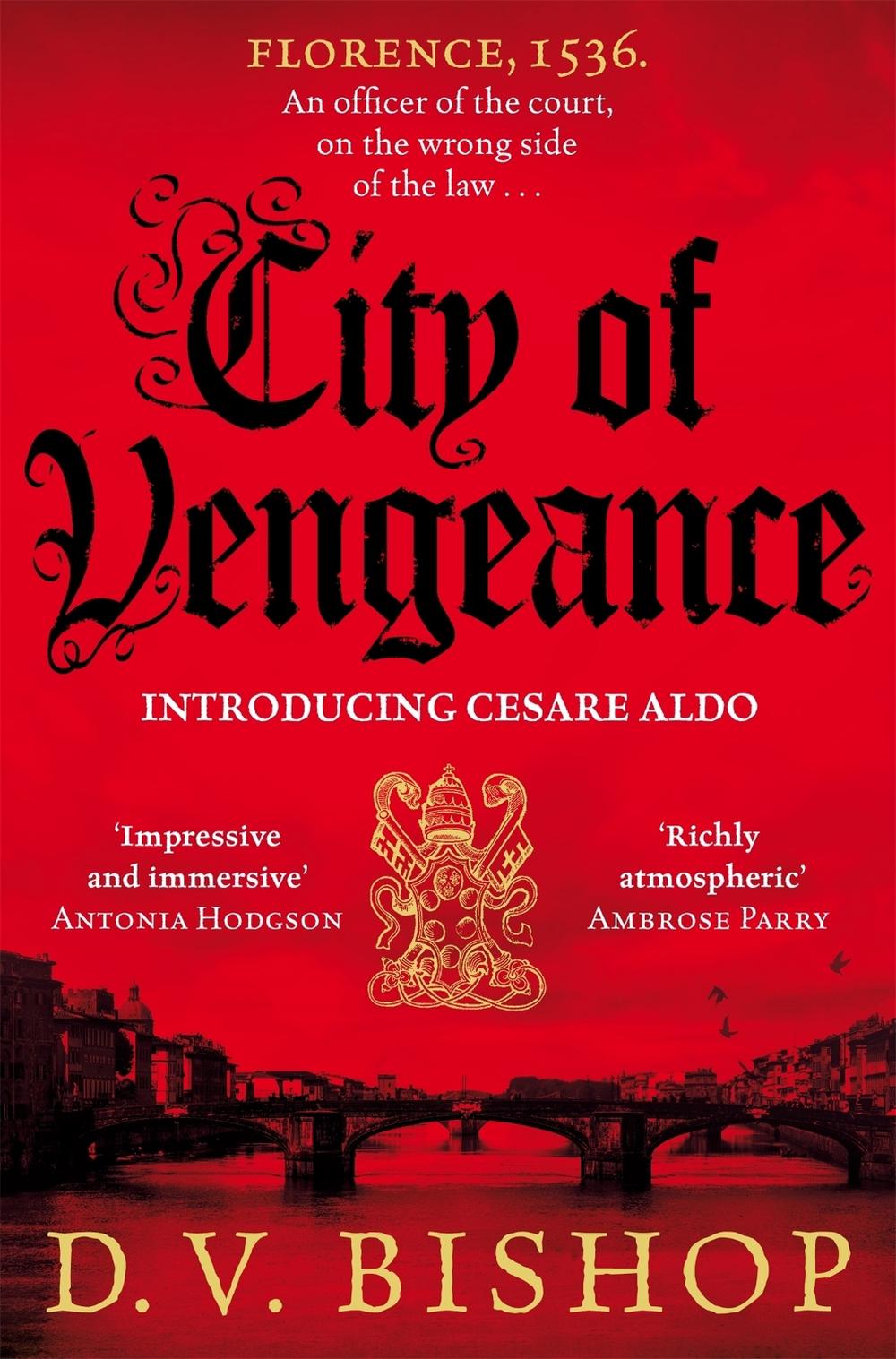
Renaissance Ripper: City of Vengeance


City of Vengeance by D. V. Bishop
Macmillan
Pp. 400

The city in question is Florence, and there are some good descriptions of the narrow streets and the crowded bridges. A map reveals the layout of the city in the sixteenth century, with many landmarks which still stand, such as the Duomo, the Ponte Vecchio and the Bargello, while others such as Le Stinche (the prison in the eastern quarter) have since been demolished.
“Florence: a jumble of grand palazzos and humble hovels, bustling marketplaces and quiet piazzas, churches and workshops, all elbowing one another for room. Above them loomed the Duomo, terracotta bricks divided into vertical segments by columns of pale stone, keeping a proud watch amid the plumes of smoke billowing from the city’s chimneys.”

This is a world where courtesans hustle for business among the wealthy men at court, secrets are round every corner, and the murder of a Jewish moneylender (Levi) barely raises an eyebrow, until a ledger of unpaid debts is stolen, leading to the Duke to make the Wildean quip, “The murder of one moneylender is bad for business. The murder of two is bad for the whole city.” With practically his dying breath, Levi forbids his daughter, Rebecca, from marrying his apprentice, Joshua. Another body, found beaten to death, turns out to be a man dressed as a woman. Meanwhile there is courtly intrigue as this is the time of the Medicis, when Alessandro, Duke of Florence, murdered by his cousin, Lorenzino de’ Medici, was succeeded by Cosimo de’ Medici. “Killings in Florence were not infrequent and were usually personal, fuelled by family, love, hate or greed.” With multiple plots, subplots, and frequent switches between character and locations, the story is almost deliciously Shakespearean.    


Cesare Aldo is our unlikely hero, a former soldier, with a war-injured knee, now a member of the Otto di Guardia (the eight), the city’s most feared criminal court. While ruthless when required – “Cesare Aldo took no pleasure from killing, but sometimes it was necessary” – he has a (poorly kept) secret of his own. He is homosexual, a ‘crime’ punishable by death. Although historically, this sentence was rarely executed, it makes a sufficient plot point for his blackmailer to warn that if discovered, “you’ll be hung from the gates, your body set on fire, and your ashes hurled into the Arno. That’s what the likes of you deserve.” Several set pieces and action scenes bring the novel to life. Florence is “a labyrinth for those who didn’t know it well, The Duomo and the Arno were helpful landmarks, but often hidden from view among the narrow streets and close buildings.” The opening chapter contains a thrilling ambush, and the chase sequences are full of evocative detail.

“The approach to the bridge [Ponte Vecchio] was choked with sellers hawking poultry, fish and produce to potential buyers, all of them arguing about prices. The aroma of fresh bread filled Aldo’s nostrils as he passed a baker. In the next doorway three youths were playing dice, pushing and shoving at each other, shouting to be heard above the babble of voices. Ahead the bandit had to swerve around a trader holding live chickens high in the air, one in each fist, proclaiming their price a bargain. The birds clucked and protested, flapping their wings, feathers fluttering down.”

Other locations are also described according to their geographical and historical features. The little village of Le Casette owes its existence to its position beside an easy place to ford the river Po. “The tallest building was the church with its bell tower, while the coach house and stables stood across the dirt road from it. Salvation and God on one side, drink and the potential for devilment on the other – it was often the way.”


The explanations of the legal machinations incorporate daily reports being made, denunciations being filed, and the quality of justice being questioned. “Explaining a dead body to the Office of Decency was always a nightmare. The court’s officials turned a blind eye to most things, if their vision was clouded with enough coin. But a corpse was too much, even for the greediest of them.” One of the wealthy merchants, Landini, has a very modern right-wing viewpoint:

“For every moment of triumph, there was always an official ready to interfere. Florence had dozens of different courts overseeing every aspect of city life. Didn’t the guilds do enough to bring prosperity to the people? Well, not all the people, but certainly to those who deserved it. Anyone who couldn’t – or, more likely, wouldn’t – work could always go to church for alms. It was the way of things, and some things never changed.”

Morally and politically, there is a balance between acceptance of the status quo and the potential for change. “At times Florence stumbled beneath the influence of those who did not have its best interests at heart. Mad monks that held sway over the people and their fearful souls. Wilful men clouding minds with talk of a republic where all might be equal. Guilds and merchants battling for financial supremacy. Armies fighting for territory. Kings and cardinals grappling for control.” 

Aldo concedes, “The people could have all the will they wanted, but the future of Florence would always remain in the hands of the few.” The struggle for influence and power, is only achievable by certain strata of society. Maria, Cosimo’s mother bemoans, “To be a woman in this world was hard enough; to be a mother and a widow was worse still. All the responsibility and none of the power.” Women, Jews, homosexuals, illegitimate children, in fact anyone but the sanctioned elite, must get by as best they can. “We do what those like us have always done. We live, we drink, we love, we fight, and we endure. The fools in charge do their worst, and we try to survive. Tomorrow will come, whether we welcome it or not.”


On the other hand, choices are important and no fate is inevitable. Doctor and love interest, Orvieto, tells his patient, Aldo, “Doesn’t matter how often I tell you to rest; what happens next depends on you. It’s the same with this conspiracy. You can warn those in danger, but they must decide how to respond.” Aldo has his own views on jeopardy. “There was no prudence in avoiding danger, because danger always came. Better to calculate the risk and act decisively.” 


The author cannot disguise his political or religious views, literally repeating himself. Early in the novel Aldo remarks, “Changing the minds of those with faith was almost always a lost cause.” Later, as he questions whether so many churches are necessary in Bologna when the coin could be better spent helping the needy, the constable, Strocchi, is uncomfortable with this reasoning. “Aldo chided himself for breaking his own rule: never argue with men of true faith, as changing their minds was almost always a lost cause.” Fearing Aldo is on a revenge mission, Strocchi warns, “You might be able to kill a man in his bed, I can’t. It is for God to take a life.”


Bishop animates this time and place with fictional features based on fact. Aldo explains to Cosimo, “Myths are stories told many times. The truth is usually still inside them.” This is the first in a series featuring Cesare Aldo and the city of Florence, and I would be happy to read more about both.


Friday, 15 May 2026

Friday Five: Books Read in April

  1. City of Vengeance by D. V. Bishop (Macmillan)This is the first in a planned series featuring Cesare Aldo and the city of Florence, and I would be happy to read more about both. This is the time of the Medicis, when Alessandro, Duke of Florence, murdered by his cousin, Lorenzino de’ Medici, was succeeded by Cosimo de’ Medici. There are murders, family feuds, personal grievances, religious disputes and secrets around every corner.With multiple plots, subplots, and frequent switches between character and locations, the story is almost deliciously Shakespearean. Cesare Aldo is our unlikely hero, a former soldier, with a war-injured knee, now a member of the Otto di Guardia (the eight), the city’s most feared criminal court. While ruthless when required, he has a (poorly kept) secret of his own. He is homosexual, a ‘crime’ punishable by death. Ambushes, chase sequences and vivid descriptions of the Renaissance city keep the pages turning rapidly, while digressions about the nature of power and control give the novel a contemporary aspect.
  2. Madame Burova by Ruth Hogan (Two Roads) - Nice cover; shame about the cloying middle-class morality and condescending judgement. Madame Burova is a tarot reader who takes over from her mother Shunty Mae to run their sea front booth in Brighton and also works at the local holiday park, meeting lots of 'interesting characters'. Meanwhile, Billie, a young woman in London whose entire individuality seems to rely on the fact that she wears a jaunty bowler hat, finds out that she is adopted and travels to Brighton to uncover the truth of her origin story. The author makes her point so often that the characters have no personality of their own, and there are pages of exposition and creaky prose littered with unnecessary adjectives. The period setting of 1973 to which we frequently flash back is practicably indistinguishable from the contemporary sections; what world does this author live in? We are firmly in the 'what could ever make a woman give up her precious baby' territory and authorial attitudes I thought had been left behind last century. 
  3. Witches: What Women Do Together by Sam George-Allen (Penguin Random House Audio Publishing Group) - I listened to this one as it is read by the author and they kept me company on car rides and bus trips. The premise is the fear that patriarchy has of women, especially when they get together, leads to their need to silence, censure, denigrate and ridicule us. From sport to music, to communication and activism, women's activities are seen as lesser by society. The greatest success of the patriarchy is pitting women against each other - women are easier to control (and sell things to) and compress into one of the very few ways to 'acceptably' be a woman if they are isolated. Conversely, they are often forced into the 'community and caring' roles, which are naturally underappreciated and underpaid, because they are 'women's work'. The allure of a network of connected women is what lies behind the pull of Wonder Woman and the fear of The Handmaid's Tale. This is admittedly a western-centric view of society - because that is the one in which the author and I live - which celebrates the power and pleasure of being among women. 
  4. Wild Dark Shore by Charlotte McConaghy (Penguin Random House Australia) - The world setting of this novel makes a mark right from the start. A man and his three children live on a remote island halfway between Australia and Antarctica (it's called Shearwater and clearly based on Macquarie), which is rich in marine wildlife and home to the world's largest seed bank. A woman is washed ashore while looking for her husband who was working there and left increasingly mysterious messages. As the family nurse her back to health, she realises that the island hides secrets and as the sea levels rise, all the inhabitants are threatened. Part mystery; part eco-drama; part psychological treatise on isolation, preservation and growth, this book is patchy in places but memorable as a whole.